Lichens (original) (raw)
Last Updated : 8 Jun, 2026
Lichens are unique composite organisms formed through a symbiotic association between a fungus and a photosynthetic partner, usually an alga or a cyanobacterium. In this mutualistic relationship, the fungal component provides shelter, water, and mineral nutrients, while the algal or cyanobacterial partner synthesises food through photosynthesis.
Lichens are widely distributed and can grow in diverse habitats ranging from rocky surfaces and tree trunks to deserts and polar regions.
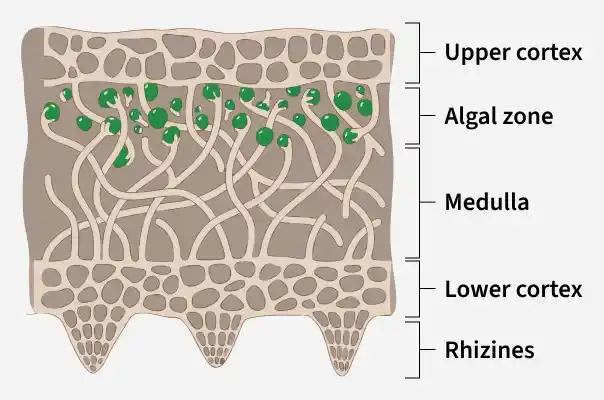
Structure of Lichens
The overall structure of a lichen can be described by looking at its associated partners.
Fungal Component (Mycobiont)
- The fungal partner, or mycobiont, forms the structural framework of the lichen.
- The lichen fungus body comprises filamentous cells called hyphae that form the thalli.
- The fungal portions also produce fruiting bodies. These reproductive structures produce spores, which can germinate to form new lichen thalli under suitable environmental conditions.
- The fungal partner produces root-like structures called rhizines that help anchor the lichen to the substrate.
Photosynthetic Component (Photobiont)
- The photosynthetic partner, or photobiont, provides the lichen with the ability to produce energy through photosynthesis.
- Algae photobionts are typically green algae, while cyanobacterial photobionts are blue-green bacteria capable of nitrogen fixation.
- The photobiont cells are usually arranged in a distinct algal layer within the thallus, although some lichens may possess specialised structures called cephalodia.
Thallus
- The thallus refers to the main body or structure of the lichen, composed of intertwined fungal hyphae and photobionts.
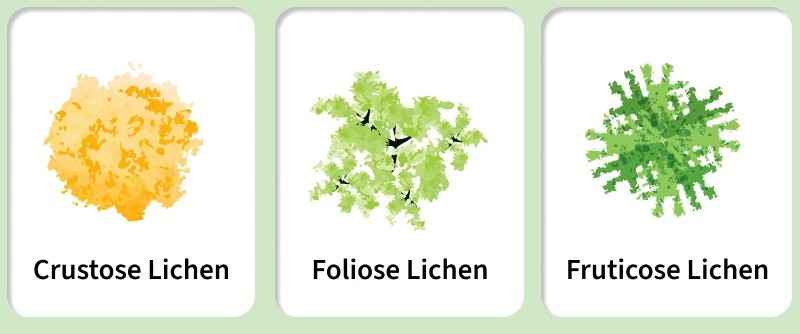
- The thallus can exhibit various forms, including crustose (crusty), foliose (leafy), and fruticose (shrubby), depending on the type of lichen.
Characteristics of Lichens
- Lichens are symbiotic organisms formed by a fungus and a photosynthetic partner (algae or cyanobacteria).
- The body of the lichen does not have a distinct or identifiable root, shoot, or leaf. Hence termed the **thallus.
- Lichens exhibit various forms, including crustose, foliose, and fruticose.
- Lichens can tolerate extreme environmental conditions and are found in diverse habitats.
- Lichens reproduce vegetatively through soredia and isidia, while sexual reproduction involves fungal spores produced by the fungal partner.
- Some lichen species are bioindicators, reflecting environmental conditions.
Types of Lichens
Lichens can be classified into different types based on their physical appearance and attachment to their substrate.
**1. Lichens Crustose appear as crust-like structures that tightly adhere to their substrate. These usually grow on new habitats like rocks and hard substrate.
**Examples: Caloplaca, Rhizocarpon, and Lecanora.
**2. Lichens Foliose have a leafy or lobed appearance, with thalli more loosely attached to the substrate than crustose lichens. These are mainly found on tree branches and moist substrates.
**Examples: Parmelia, Physcia, and Lobaria.
**3. Lichens Fruticose have a three-dimensional, branching, or shrubby growth form, often resembling miniature trees or bushes.
**Examples: Usnea, Cladonia, and Ramalina.
Significance of Lichens
Lichens play a crucial role in ecosystems, providing numerous environmental and human benefits. These include:
- **Indicator of Environmental Health: Lichens are highly sensitive to environmental changes. Lichens are good indicators of air pollution, making them valuable for ecological monitoring.
- **Soil Formation and Stability: Lichens contribute to soil formation by breaking down rocks and other substrates through physical and chemical weathering processes. Their ability to colonise barren habitats helps initiate soil development and stabilise surfaces, paving the way for the establishment of other plant species.
- **Pioneer Organisms: Lichens are often good pioneer organisms in bare habitats and play an important role in ecological succession.
- **Food Source: Lichens are food for various wildlife species, including insects, birds, and small mammals like reindeer. Humans can also eat some species.
- **Medicinal Uses: Certain lichen species contain bioactive compounds with potential pharmaceutical applications.
- **Industrial Use: Some lichens are also used to extract dyes.