Sense Organs and Their Functions (original) (raw)
Last Updated : 25 May, 2026
The human body constantly interacts with the surrounding environment. In order to survive and function properly, the body must be able to detect changes occurring both inside and outside the body. This important function is carried out by specialised structures known as sense organs. Sense organs help humans receive information from the environment in the form of stimuli such as light, sound, smell, taste, touch, pressure, heat, and pain.
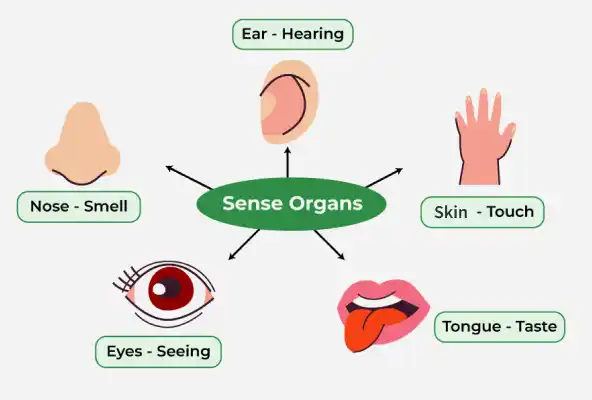
Sense organs play a major role in helping humans understand their surroundings, communicate with others, maintain balance, protect the body from harmful conditions, and perform everyday activities. The five major sense organs in humans are the eyes, ears, nose, tongue, and skin. Each organ is specialised to detect a particular type of stimulus and perform specific functions.
The Eye – Organ of Vision
The eyes are the organs of vision and help humans see the surrounding world. Vision allows humans to observe colours, shapes, sizes, movements, and distances of objects. The eyes are among the most delicate and complex sense organs of the body. The human eyes are located in protective bony sockets called orbits in the skull. Each eye is approximately spherical in shape and is protected by eyelids, eyelashes, and tears. Tears help keep the eye moist, remove dust particles, and prevent infection.
Structure of the Eye
The eye consists of several important parts that work together to produce vision.
- **Cornea: The cornea is the transparent front part of the eye. It allows light rays to enter the eye and helps in bending and focusing the light.
- **Sclera: The sclera is the white outer covering of the eye. It protects the internal parts of the eye and maintains the shape of the eyeball.
- **Choroid: The choroid is a pigmented layer located between the sclera and retina. It contains blood vessels that nourish the eye tissues and prevent internal reflection of light.
- **Iris: The iris is the coloured portion of the eye. It contains muscles that regulate the size of the pupil according to the intensity of light.
- **Pupil: The pupil is a small opening present in the centre of the iris. It controls the amount of light entering the eye. In bright light, the pupil becomes smaller, while in dim light, it enlarges to allow more light to enter.
- **Lens: The eye lens is a transparent, elastic, biconvex structure located behind the pupil. It focuses light rays onto the retina.
- **Ciliary Muscles: The ciliary muscles are attached to the lens and help change its curvature during accommodation.
- **Retina: The retina is the innermost layer of the eye and contains light-sensitive cells called photoreceptors. The retina contains two types of photoreceptor cells: Rods ( sensitive to dim light and help in night vision) and Cones (sensitive to bright light and help in colour vision)
- **Yellow Spot: The yellow spot, also called the fovea, is the region of the retina where vision is the sharpest because it contains a large number of cone cells.
- **Blind Spot: The blind spot is the point where the optic nerve leaves the retina. No vision occurs at this spot because photoreceptors are absent there.
- **Optic Nerve: The optic nerve carries visual impulses from the retina to the brain for interpretation.

Functions of Eye
- **Vision: The eye helps us see objects around us.
- **Focusing Light: The cornea and lens focus light onto the retina.
- **Light Regulation: The iris controls the amount of light entering the eye.
- **Colour Vision: Cone cells help detect and distinguish colours.
- **Night Vision: Rod cells help us see in dim light
The Ear – Organ of Hearing and Balance
The ears are the organs responsible for hearing and maintaining balance. They help humans detect sounds from the environment and maintain body posture and equilibrium. The ear is divided into three main parts:
1. Outer Ear
The outer ear consists of the pinna and the external auditory canal.
- **Pinna: The pinna is the visible part of the ear. It collects sound waves and directs them into the auditory canal.
- **External Auditory Canal: This canal carries sound waves towards the tympanic membrane.
2. Middle Ear
The middle ear is an air-filled chamber that contains three tiny bones called ear ossicles.
- **Tympanic Membrane: The tympanic membrane, or eardrum, vibrates when sound waves strike it.
- **Ear Ossicles: The three ossicles are the malleus, incus, and stapes. These bones amplify and transmit sound vibrations to the inner ear.
3. Inner Ear
The inner ear contains the cochlea and semicircular canals.
- **Cochlea: The cochlea is a coiled structure filled with fluid. It contains sensory cells that detect sound vibrations.
- **Organ of Corti: The Organ of Corti contains hearing receptors that convert vibrations into nerve impulses.
- **Semicircular Canals: The semicircular canals contain receptors that help maintain body balance and posture.

Functions of the Ear
The ears perform the following functions:
- Hearing sounds
- Maintaining body balance
- Helping with body coordination and posture
The Nose – Organ of Smell
The nose is the organ responsible for smell. It also plays an important role in respiration. The inner lining of the nasal cavity contains olfactory receptors that detect odour molecules present in the air.
Structure of the Nose
- The nose contains two nostrils that open into the nasal cavity.
- The nasal cavity is lined with mucus and tiny hair-like structures called cilia.
- The mucus traps dust particles and microorganisms, while cilia help remove them.
- The upper part of the nasal cavity contains the olfactory epithelium, which possesses olfactory receptors.

Functions of the Nose
The nose performs several important functions. It helps in:
- Detecting smell
- Breathing
- Filtering dust particles
- Moistening and warming inhaled air
- Protecting the respiratory tract from harmful particles
The Tongue – Organ of Taste
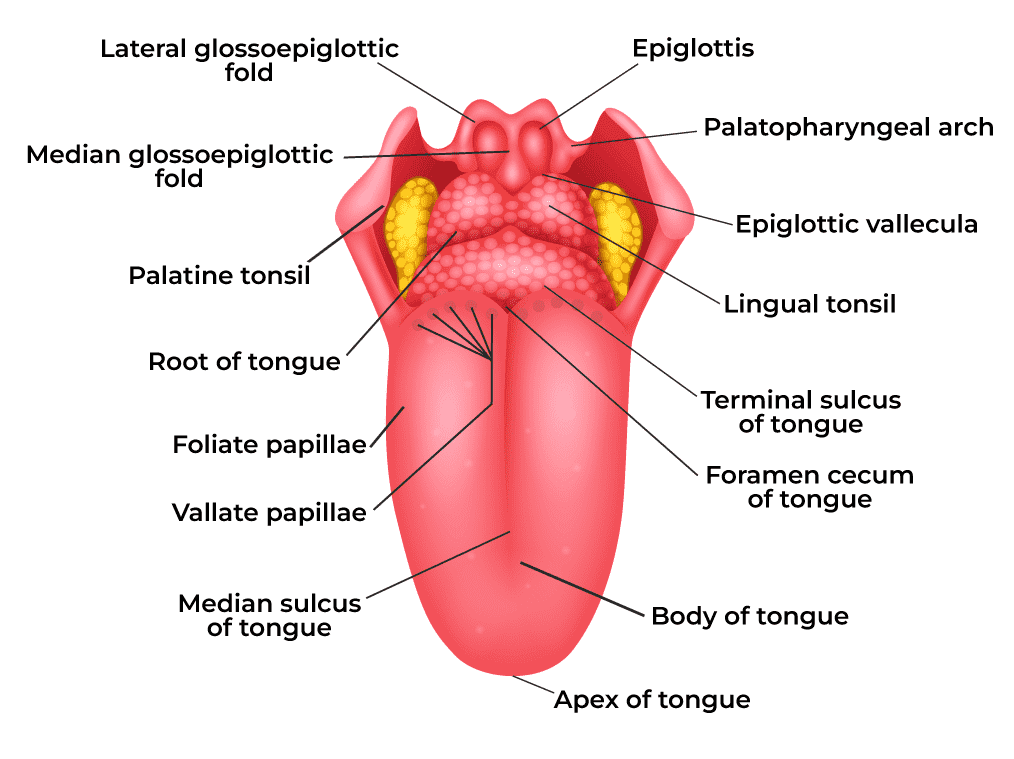
The tongue is a muscular organ located in the mouth. It helps in tasting food, chewing, swallowing, and speaking. The upper surface of the tongue contains tiny projections called papillae, which contain taste buds.
Taste Buds
Taste buds contain gustatory receptors that detect dissolved chemicals in food. Humans can identify five basic taste sensations: sweet, sour, salty, bitter and umami.
Functions of the Tongue
The tongue performs many functions. It helps in:
- Detecting taste
- Chewing food
- Swallowing food
- Mixing food with saliva
- Speech and pronunciation
The Skin – Organ of Touch
The skin is the largest organ of the human body and acts as the organ of touch. It covers the entire body and contains various sensory receptors that detect touch, pressure, heat, cold, and pain.
Structure of the Skin
The skin consists of three layers:
- **Epidermis: The epidermis is the outer protective layer.
- **Dermis: The dermis contains sensory receptors, blood vessels, sweat glands, and hair follicles.
- **Hypodermis: The hypodermis contains fat tissues that provide insulation and cushioning.

Receptors Present in the Skin
The skin contains different types of receptors.
- **Touch Receptors: These receptors detect light touch.
- **Pressure Receptors: These receptors detect deep pressure.
- **Thermoreceptors: These receptors detect heat and cold.
- **Pain Receptors: These receptors detect injury and tissue damage.
Functions of the Skin
The skin performs numerous important functions. It helps in:
- Detecting touch, pressure, heat, cold, and pain
- Protecting the body from injury and infection
- Preventing water loss
- Regulating body temperature
- Excreting sweat
Importance of Sense Organs
Sense organs are extremely important for survival and the proper functioning of the body. They help humans:
- Understand the environment
- Detect danger
- Maintain balance and posture
- Communicate effectively
- Perform daily activities
- Learn and interact with surroundings