Reflex Action (original) (raw)
Last Updated : 25 May, 2026
Reflex action is an automatic, rapid, and involuntary response to a stimulus that occurs without conscious control. E.g. Blinking of eyes, touching a flame, and then withdrawing the hand. In general, reflex action provides a protective pathway to prevent any injury, which helps avoid pain.
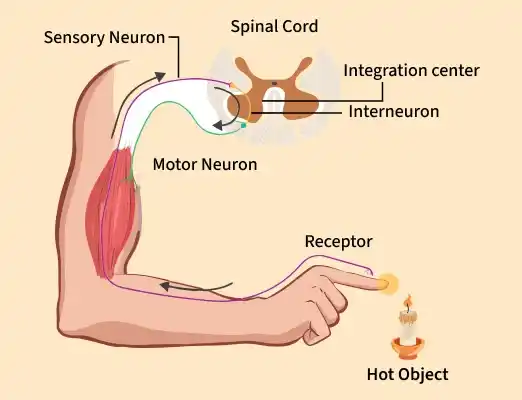
When you touch a hot plate, a reflex action occurs in which the sensory receptor in the body responds to the stimulus, which in this case is heat. Then the signal is transmitted via a sensory neuron to the spinal cord. Interneurons present in the spinal cord process the signal and activate the motor neuron, which then sends the response signal back to the muscles to produce a reflexive response. The person will automatically remove his/her hand from the plate.
Types of Reflex Action
The following are the different types of reflex actions:
- **Monosynaptic Reflex: This type of reflex involves a single synapse, and the knee-jerk reaction is an example of it.
- **Polysynaptic Reflex: An example of this type of reflex is the withdrawal reflex that involves multiple synapses and interneurons.
- **Conditioned Reflex: Conditioned reflex is a learned or acquired reflex developed through experience or training.
Example: Salivation in Pavlov’s experiment. - **Abdominal Reflex: Abdominal reflex is a superficial reflex in which abdominal muscles contract when the skin of the abdomen is stimulated.
- **Blink Reflex: The eyes blink automatically without the brain knowing about it.
- **Sucking Reflex: This is seen in newborns where they automatically learn how to suckle on their mother's nipples.
Example of Reflex Action
Some common examples of reflex action are:
- Salivation on seeing or smelling food.
- Body parts moving in response to touching a flame, touching a needle, or touching a cold object
- Change in pupil size in response to bright light.
- Sudden withdrawal of the leg when pricked by a pin
- Coughing or sneezing because of irritation in the nasal passages, etc.
**Reflex Arc
The neural pathway involved in a reflex action is called a reflex arc. Reflex arcs allow rapid responses to stimuli without involving conscious brain activity. Reflex arcs are formed in the spinal cord, and the input information in the form of signals goes to the brain.
**Reflex Action Pathway
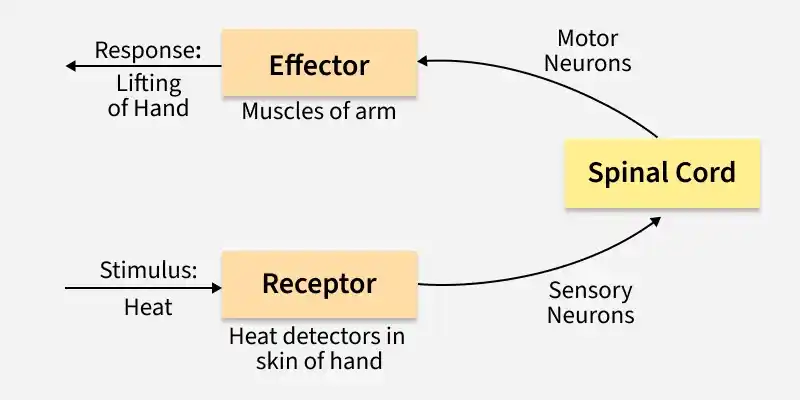
A reflex arc is a neural pathway that mediates a reflex action. It is the basic functional unit of the nervous system responsible for generating reflex responses. The reflex arc involves the following components:
- **Receptor: The sensory nerve endings or specialised cells that detect a stimulus. Receptors are often located in the skin, muscles, tendons, or internal organs.
- **Sensory Neuron: Nerve fibres that transmit the sensory input from the receptor to the central nervous system.
- **Integration Centre: The spinal cord or brain region where the sensory input is processed. In some cases, interneurons within the spinal cord play a role in processing the information.
- **Motor Neuron: Nerve fibres that transmit signals from the CNS to the effector organ to produce a response.
- **Effector: The muscle or gland that carries out the response to the stimulus. If the reflex is motor, the effector is usually a muscle; if it is autonomic, the effector is typically a gland.
**Action of Neuron
In reflex action, two main types of neurons are involved: afferent (sensory) neurons and efferent (motor) neurons. Both nerves work together to make any reflex action. Reflex action occurs in a series of events, which are mentioned below:
- Any reflex action starts when the afferent nerve receives a signal due to any sudden change in the surroundings. The stimulus is detected by receptors present in sensory organs or tissues.
- Afferent nerves become active and pass the information to the relay nerves after getting the stimulus.
- Interneurons (relay neurons) transmit the impulse to motor neurons.
- Motor neurons send the signal or activate the efferent nerves.
- The effector organ (muscle or gland) responds accordingly.
Afferent nerves become active after receiving signals from the sensory organ, which transfers the information via signals to the Central Nervous System. Efferent nerves transmit signals to the muscles that react according to the signal. In most reflex actions, the spinal cord coordinates the response without the direct involvement of the brain, allowing a faster reaction.