Root System in Plants Types and Functions of Root (original) (raw)
Last Updated : 7 May, 2026
The Root System in Plants is an intricate network of structures that allows the transport of nutrients and water. A root is a piece of a vascular plant typically present under the ground. Its essential functions include the ingestion of water and dissolved minerals, the conduction of these to the stem, and the capacity to hold various food types. The root differs from the stem in that it lacks leaf scars and buds, has a root cap, and has branches that originate from the inner tissue rather than buds.

The Root is a very important part of all vascular plants. Roots help the plant to interact with the soil and enable the plant to get the essential nutrients, water, and vitamins from the soil. Roots help to get water from the soil, which is very important for proper growth and photosynthesis.
Structure of Root
A root is made of three regions- the Meristematic region, the Region of Elongation and the Region of Maturation.
The details are given below:
- **Root Cap: The root is covered at the tip by a thimble-like design. This is known as the root cap. The root cap protects the delicate root tips when it clears its path through the dirt.
- **Region of Meristematic Activity: This area is also known as the region ofcell division. This area lies a couple of millimetres over the root cap. This is the area of meristematic action. The cells in this district are tiny and have thick cellular material. Since this is the meristematic area, the cells divide quickly.
- **Region of Elongation: This area lies above the region of the meristematic movement. The cells close to this region undergo quick extension and growth. These cells help in the growth of roots.
- **Region of Maturation: This area lies above the region of Elongation. The root hairs are found in this region. Root hairs are essential for the root epidermis
Characteristics of Root
The following are a few of the characteristics of roots:
- Chlorophyll is absent in roots, and because of that, they are not green in colour.
- They don't have nodes and internodes.
- Root hair is present on the roots, which helps in the absorption of nutrients.
- Roots show different types of movements: Positive Geotropism(Growth of roots towards gravity), Positive Hydrotropism(Growth towards the water), and Negative Phototropism(Movement of roots away from sunlight).
- Roots are protected via **root caps at the tips of the roots.
The actual tip of the root is covered by a thimble-shaped root cap, which protects the developing tip as it clears its path through the dirt. The apical meristem is present directly under the root cap.
**Types of Root System
There are two major types of root systems:
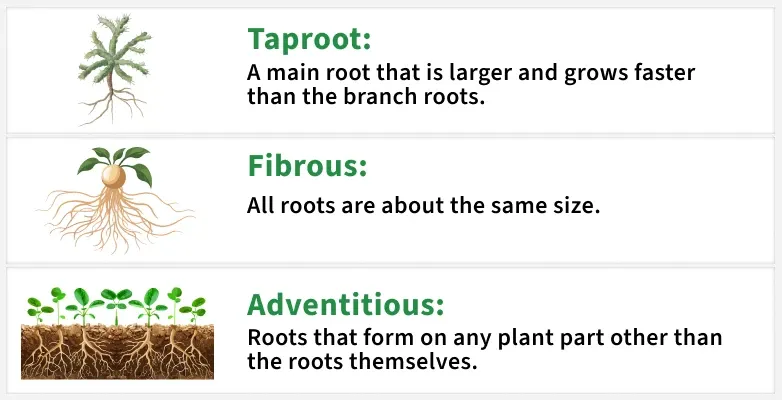
- **Taproot System: The primary roots grow directly from the radicle. The tap root system consists of a single primary root to which small lateral roots, called the root hair are attached. E.g Beetroot, carrot and other dicots all have a taproot.
- **Fibrous Root System: These are tiny, bushy roots that are large in number. They do not go very deep. E.g Monocots such as Rice, Maize and Banana.
- **Adventitious Root System: An adventitious root system consists of roots that arise from any part of the plant other than the radicle. These roots may develop from stems, leaves, or even other roots, and they serve functions such as support, anchorage, and nutrient uptake. Adventitious roots are common in plants like ivy, mangroves, and maize.
Various other particular roots exist among vascular plants. Pneumatophores, generally found in Mangroves, are horizontal roots that develop vertically out of the mud and water to work as the site of oxygen absorption. Parasitic plants have penetrating roots called haustoria, which insert themselves into the host plant to absorb nutrients.
Modifications of Root
Plant roots display modifications that enable them to carry out purposes beyond water absorption and anchoring. These modifications occur in the form of adaptations to the environment. For food storage purposes, the roots are modified in the case of carrots and sweet potatoes. In plants that are present in swamps, many roots come out upward from the ground. These are empty roots, called pneumatophores****.** Their function involves the exchange of gases in the roots.
Tap Root Modification
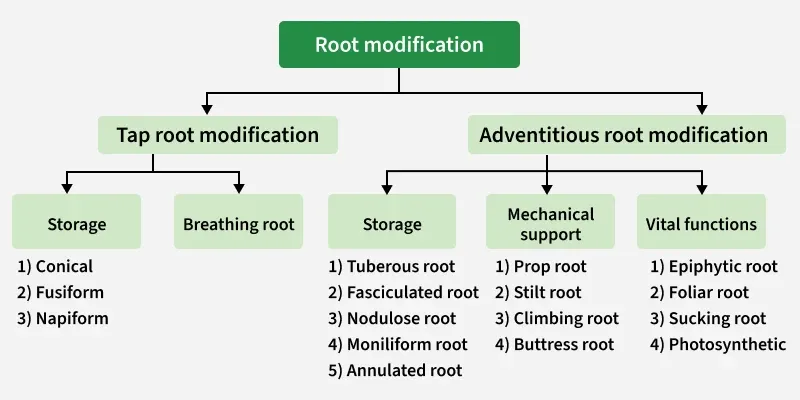
- **Conical roots: This type of taproot assumes the shape of a cone and grows vertically downward. For example, Carrots
- **Fusiform Roots: This type of taproot becomes swollen or spindle-shaped. For example, Radish
- **Napiform Roots: This taproot type is spherical at its base and tapers at both ends. For example, Turnip.
- **Breathing Roots: These roots are specialised aerial roots that grow upward from the soil to help plants take in oxygen in waterlogged conditions. For example: Rhizophora.
Adventitious Root Modification
- **Tuberous Roots: This type does not assume any shape and develops swellings along its length. For example, Sweet Potato.
- **Fasciculated Roots: These roots are clusters of swollen adventitious roots arising from the base of the stem for food storage, as seen in Dahlia and Asparagus.
- **Nodulose Roots: Adventitious roots that are swollen only at the tip, forming a nodule-like structure, as seen in Curcuma.
- **Moniliform Roots: Adventitious roots that show bead-like swellings at regular intervals, as found in Momordica.
- **Annulated Roots: Adventitious roots that appear ringed due to a series of swollen and constricted regions, as seen in Cephaelis.
- **Prop Roots: These roots grow downwards after emerging from the existing branches of the tree, and anchor into the ground upon reaching the soil. For example, a banyan tree.
- **Stilt Roots: Various small trees and shrubs grow in places where the anchorage is not strong, like on the edges of tanks. In these cases, small roots grow diagonally downwards from the base of the stem, providing additional support like stilts. For example, the sugarcane plant
- **Climbing Roots: Arising from the nodes, these roots attach themselves to a support and climb up using it, therefore providing support to the plant. For example, Money plant
- **Buttress Roots: These develop at the base of a stem and are spread in different directions in the soil. These roots look like planks and prevent the tree from falling. For example, Bombax.
- **Epiphytic Roots: This type of roots with a spongy tissue (velamen) that absorbs moisture from the air, found in Vanda and Dendrobium.
- **Foliar Roots: These roots have a spongy tissue (velamen) that absorbs moisture from the air, found in Vanda and Dendrobium.
- **Sucking Roots: Specialised roots that penetrate the host plant to absorb water and nutrients, found in Cuscuta.
- **Photosynthetic Roots: This type of roots that perform photosynthesis, as seen in Tinospora and Trapa.
Functions of the Root
Roots perform different roles that are essential for the survival of the plants. Some of them are listed below:
- **Anchoring: Roots help the plants stay connected to the ground. They support the plant body, guaranteeing that it stands erect.
- **Absorption: The primary function of the roots is to assimilate water and break down minerals from the dirt. This is urgent as it helps during the time spent in Photosynthesis.
- **Storage: Plants produce food through Photosynthesis and save it as starch in the leaves, shoots, and roots.
- **Reproduction: Even though roots are not the regenerative parts of plants, they are vegetative parts. In certain plants, the roots are a method of proliferation. For example, new plants emerge from crawling-level stems called sprinters (stolons) in jasmine, grass, and so forth. This kind of multiplication is called the vegetative spread.
- **Ecological Function: Their roots keep an eye on soil disintegration, and give food and territory to different organic entities.