Transportation in Plants (original) (raw)
Last Updated : 1 May, 2026
Transportation in plants is the process by which water, minerals, and food move from one part of the plant to another. Just like humans have a circulatory system, plants have their own transport system.
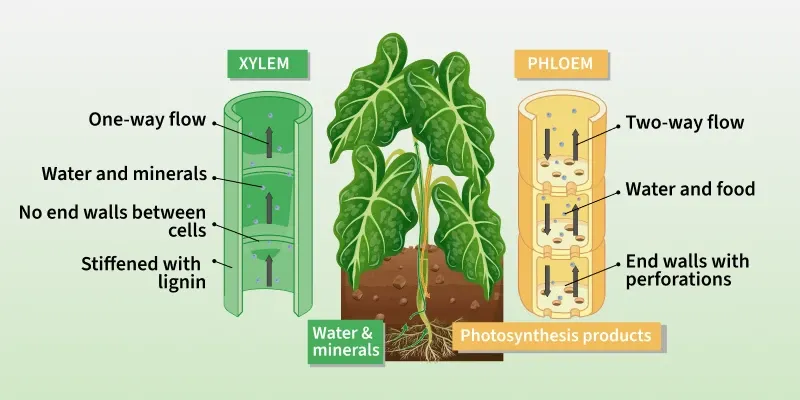
Roots absorb water and minerals from the soil. These move up through the stem to the leaves through a tissue called xylem. The leaves make food during photosynthesis. This food is then carried to all parts of the plant through another tissue called phloem. So, transportation in plants helps the plant get what it needs to grow, stay alive, and make food.
Two Main Transport Systems in Plants
The two main transport systems involved in transportation in plants are:
1. Xylem – Transports Water & Minerals (Upward Only)
- Xylem is responsible for conducting water from the roots to the stems and leaves.
- It is made up of four elements- tracheids, vessels, Xylem fibres and Xylem Parenchyma.
- Water moves through xylem mainly due to transpiration pull, cohesion and adhesion, and root pressure.
- A plant has one continuous xylem tissue system.
- It forms a continuous network of tissues that transports water from the roots to all parts of the plant.
2. Phloem – Transports Food (Up & Down)
- Food is synthesised in the leaves and transported throughout the plant body through the phloem.
- Phloem is further divided into Sieve tube elements, Companion cells, Phloem parenchyma and Phloem fibres.
- The carbohydrates and sugars manufactured are sent across the plant from the leaves.
- The direction of translocation is basically unidirectional in the case of water(from root to stem, leaves, flowers, and fruits).
- Food is transported multidirectionally through phloem, whereas water and minerals move unidirectionally upward through xylem.
Water Absorption in Plants
Absorption in plants occurs via two pathways:
- Apoplast Pathway: This pathway uses the gradient to transport water through the intercellular spaces and walls of the cells. No movement of water occurs across the cell membrane. The water moves through cell walls and intercellular spaces driven by a pressure gradient without crossing cell membranes. This is also called as passive absorption.
- Symplast Pathway: This pathway uses Plasmodesmata to move water across neighbouring cells. The movement of water is slower in the Symplast pathway. It is also aided by cytoplasmic streaming.
**Means of Transport
Transport in plants occurs via two methods: active and passive transport. Passive transport includes Simple diffusion and facilitated diffusion.

Diffusion
Features of Diffusion are listed below:
- Movement by diffusion is passive and slow, and it occurs along the concentration gradient.
- In diffusion, molecules move randomly, the net result being substances moving from regions of higher concentration to regions of lower concentration.
- Diffusion does not require any energy.
- Diffusion acts as the primary method for gaseous exchange within the plant organism.
- The rate of diffusion is influenced by several factors, including the concentration gradient, the permeability of the intervening membrane, temperature, and pressure.
Facilitated Diffusion
Features of Facilitated Diffusion are given below:
- The cell membrane is made up of lipids. Particles that are lipid soluble can easily pass directly through the cell membrane, as it is almost entirely made of it. The hydrophilic solutes find it difficult to pass through the membrane. Their movement has to be facilitated. The membrane proteins help in transporting these molecules, hence the term 'Facilitated Diffusion'.
- Aquaporins are membrane proteins that specifically facilitate the passive transport of water across cell membranes
- Porins form large pores in the outer membrane of cell organelles like plastids and mitochondria. This diffusion is very specific as it allows cells to select substances for uptake. It is sensitive to inhibitors and shows a saturation effect.
- Two major types of transport proteins are known, viz., Carrier Proteins (also called carriers, transporters) and Channel Proteins.
- Carrier proteins bind the particular solute to be transported and deliver the same to the other side of the membrane.
- Channel proteins are usually gated, i.e., they may be open or closed. When the 'gate' is open, the solute of an appropriate size may diffuse.
Active Transport
Features of Active Transport are given below:
- Pumps are proteins that use energy to carry substances across the cell membrane.
- These pumps can transport substances from low concentration to high concentration ('uphill' transport).
- The transport rate reaches a maximum when all the protein transporters are being used or are saturated. Like enzymes, the carrier protein is very specific in what it carries across the membrane.
- These proteins are sensitive to impediments that inhibit protein side chains.
- Active transport is faster than passive transport.
- Some carrier proteins allow transport only if two types of molecules move together. This is called Cotransport.
- It is of two types, In the symport system of cotransport, both molecules cross the membrane in the same direction at the same time. In the antiport system of cotransport, both molecules move in opposite directions.
- When a molecule moves across a membrane independent of another molecule, the process is called uniport.

Forces Responsible for Transportation in Plants
Transportation in plants occurs as a result of the following forces:
Root pressure
This is responsible for moving or bumping water through very short distances. It allows the formation of a continuous water column, which sometimes breaks due to the tension created by transpiration.
**Transpiration Pull
Cohesion-tension-transpiration pull model of water transport is applicable in the case of long trees and plants. Water is usually lost from the leaves through the stomata. This process is called Transpiration.
- Transpiration results in driving the xylem sap upwards towards the highest points of a tall tree.
- When water evaporates due to transpiration, a suction pull is created, which creates a continuous column of water. A few properties of water allow this process to happen, like Cohesion, Adhesion and Surface Tension.
- **Cohesion: This is the property by which water molecules stick to each other.
- **Adhesion: This is the property by which water molecules attach to the wall of the polar surfaces.
- **Surface Tension: This property makes sure that the water molecules are attracted to each other in the liquid phase more than to water in the gas phase.
- All these properties allow the water to rise in the form of small tubes, which is known as capillary action. The small diameter of tracheids and vessels aids in capillarity.