Light Dependent Reaction (original) (raw)
Last Updated : 11 May, 2026
The light-dependent reaction is a stage of photosynthesis in which light energy is absorbed by chlorophyll molecules present in the thylakoid membranes of chloroplasts. During this process, light energy is converted into chemical energy in the form of ATP and NADPH. The involvement of photosystems (PSI and PSII) ensures efficient absorption of light and transfer of energy. This process demonstrates how plants effectively harness solar energy to carry out essential biological activities.
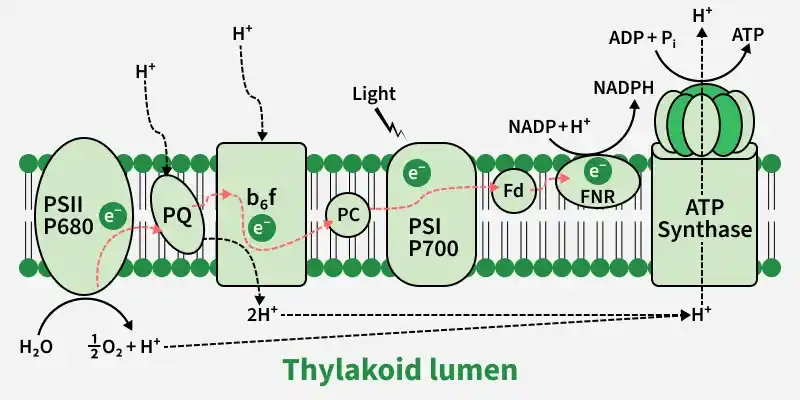
The light-dependent reaction, also known as the light reaction, is the first stage of photosynthesis. It's where plants, algae, and some bacteria capture the energy from sunlight and convert it into a usable form to fuel the next stage. In summary, the light-dependent reaction uses light energy to create chemical energy for the plant's growth and development.
Process of Light-Dependent Reaction
In this reaction, chlorophyll and other pigments capture light energy. This energy splits water molecules into oxygen, protons, and electrons, releasing oxygen as a result. Meanwhile, the energised electrons move through a series of carriers, producing ATP and NADPH, which are vital energy molecules. These products are then used in the Calvin cycle to make carbohydrates from carbon dioxide.
- **Light Absorption: Chlorophyll and other pigments in the thylakoid membranes absorb light energy.
- **Activation of Photosystem II (PSII): Light energy excites electrons in PSII (P680), raising them to a higher energy level.
- **Photolysis of Water: Water molecules split into oxygen (O₂), protons (H⁺), and electrons (e⁻), and oxygen is released as a byproduct, and electrons replace those lost by PSII
- **Electron Transport Chain (ETC): Excited electrons move through a series of carriers (including cytochrome complex), releasing energy.
- **ATP Synthesis: The energy released is used to pump protons and create a gradient, which drives ATP formation through chemiosmosis (photophosphorylation).
- **Activation of Photosystem I (PSI): Electrons reach PSI (P700) and are re-energised by light.
- **NADPH Formation: High-energy electrons reduce NADP⁺ to NADPH.
The overall function of light dependent reaction is that they convert light energy into chemical energy in the form of ATP and NADPH, which are used in the Calvin cycle to synthesise carbohydrates.
Location of Light-Dependent Reaction
- The light-dependent reaction occurs within the thylakoid membranes of chloroplasts, which are tiny structures found in plant cells.
- These membranes contain specialised molecules called chlorophyll and other pigments, which absorb light energy from the sun.
- This absorbed energy initiates a series of chemical reactions that split water molecules into oxygen, protons, and electrons.
- As a result, oxygen is released as a byproduct. The energised electrons then move through a chain of carriers, generating ATP and NADPH, which are essential energy molecules used in the later stages of photosynthesis.
Role of Photosystems in Light-Dependent Reaction
There are two types of photosystems in the thylakoid membrane.
1. Photosystem II (PS2)
- Photosystem 2 (PS2) functions first (the number reflects the order of discovery) and is best at absorbing a wavelength of 680 nm.
- The reaction centre chlorophyll of PS2 is called P680. Photosystem 1 (PS1) absorbs a wavelength of 700 nm. The reaction centre chlorophyll of PS1 is called P700.
2. Photosystem I (PSI)
- Photosystem 1 (PS1) absorbs a wavelength of 700 nm.
- The reaction centre chlorophyll of PS1 is called P700.
Products of Light-Dependent Reaction
The products of the light-dependent reaction are:
- **ATP (Adenosine Triphosphate****):** Generated through photophosphorylation during the electron transport chain in the thylakoid membranes. ATP serves as a primary energy currency in cells.
- **NADPH (Nicotinamide Adenine Dinucleotide Phosphate): Formed through the reduction of NADP+ by electrons from Photosystem I (PSI). NADPH acts as a reducing agent in biochemical reactions, transferring high-energy electrons to drive the synthesis of organic molecules.
- **Oxygen (O2): Released as a byproduct of the photolysis of water molecules during the light-dependent reaction. Oxygen is essential for cellular respiration in plants and other organisms.
**Light Reaction VS Dark Reaction
The difference between the light reaction and the dark reaction is given below:
| **Light Reaction | **Dark Reaction (Calvin Cycle) |
|---|---|
| Takes place only in the presence of light | Does not directly require light (can occur in light or dark) |
| It is a photochemical phase | It is a biochemical phase |
| Occurs in the grana (thylakoid membranes) of the chloroplast | Occurs in the stroma of the chloroplast |
| Photolysis of water occurs (in PSII) | Photolysis does not occur |
| Water splits into H⁺, electrons, and O₂ | CO₂ is used to synthesise glucose |
| Produces ATP and NADPH | Uses ATP and NADPH to form glucose |
| Involves Photosystem I and II | Does not involve photosystems |
| Oxygen is released as a byproduct | No oxygen is released |