Chloroplasts (original) (raw)
Last Updated : 12 Mar, 2026
A chloroplastis a cell organelle that consists of the photosynthetic pigment chlorophyll, which absorbs sunlight and transforms it into usable energy, then releases oxygen from water.
- Chloroplasts are found in mesophyll cells, which are the green tissue of leaves.
- They are also present in other green parts of the plant, for example, stems and unripe fruits.
- The chloroplasts in these cells are responsible for conducting photosynthesis.
- It is not found in animal cells; it is a unique feature of plant cells and some types of algae.
- They are the food producers of plants.
- They consist of a high concentration of chlorophyll that traps sunlight.
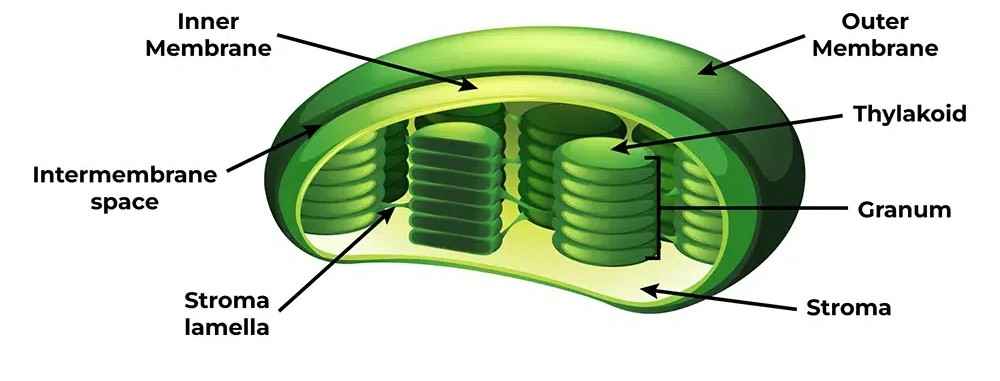
Structure of Chloroplast
The structure of the chloroplast is explained as follows:
**Double Membrane Envelope
- The chloroplast is enclosed by a double membrane envelope.
- The outer membrane acts as a barrier between the chloroplast and the cell.
- Protein channels present in the outer membrane, known as envelope pores, regulate the passage of molecules, such as ions and metabolites, into and out of the chloroplast.
- The inner membrane regulates the passage of molecules in and out of the chloroplast.
- The space between them is referred to as the periplastidial space (intermembrane space).
- A matrix is present inside these membranes. Carbohydrates are formed in this part; that is, the dark reaction of photosynthesis occurs.
**Thylakoid Membranes (Lamellae)
- The system is suspended in the stroma.
- There are a large number of flattened, sac-like structures called thylakoids.
- These contain pigments, like chlorophyll, which capture sunlight energy during the light-dependent reactions of photosynthesis.
- The thylakoids are arranged in stacks referred to as grana, and each granum consists of approximately 10-20 thylakoids.
**Grana
- Thylakoid membranes are structured into stacks called grana.
- It increases the surface area for light absorption and has the component necessary for the light-dependent reactions.
- The number of grana in a chloroplast can be up to 40-60.
- The particles present in it are referred to as quantasomes. Each quantasome is made up of 200 green molecules.
- The width of the grana lamellae found in the grana is less than that of the stroma lamellae.
**Stroma
- The stroma is an aqueous, protein-rich, colorless fluid that encloses the thylakoids.
- It contains enzymes and substances necessary for the light-independent reactions of photosynthesis.
- Stroma also consists of various enzymes, DNA, ribosomes, and other substances.
- Stroma lamellae function by connecting the stacks of thylakoid sacs, or grana.
**Chlorophyll
- Chlorophyll molecules are present in the thylakoid membranes.
- They are responsible for capturing light energy and come in different types (chlorophyll a and chlorophyll b), which are essential for photosynthesis.
**DNA and Ribosomes
- Chloroplasts contain their own DNA and ribosomes.
- It encodes proteins required for chloroplast function.
- The ribosomes present are involved in chloroplast protein synthesis.
**Lipid and Starch Granules
- Chloroplasts store lipids and starch granules.
- Lipids act as an energy reserve
- Starch is a storage form of glucose that is produced during photosynthesis.
Characteristics of Chloroplast
The word "chloroplast" originated from the Greek words "chloros," meaning "green," and "plast," meaning “form” or "entity."
- In higher plants, almost all chloroplasts are uniformly round, oval, flattened, or elliptical.
- Their length can be 2-5 µ or up to 100 µ, while the width remains 3-4. µ.
- According to the personnel, their number should be up to 20-40 cans. Usually, their presence is close to the nucleus or cell wall.
- Chloroplasts have their own extranuclear DNA and, therefore, are semiautonomous, like mitochondria.
- They also produce the lipids and proteins needed to make the chloroplast membrane.
**Functions of Chloroplast
- Chloroplasts are the primary sites of photosynthesis in plant cells. They capture light energy and use it to convert carbon dioxide and water into glucose and oxygen.
- Chlorophyll pigments within chloroplasts absorb light energy, which is essential for the photosynthesis process.
- During photosynthesis, chloroplasts synthesize glucose and other organic compounds, which serve as an energy source for the plant and can be stored as starch.
- Oxygen is released as a byproduct of photosynthesis, which is vital for the respiration of both plants and animals.
- Chloroplasts can store energy in the form of lipids and starch granules, which can be used when needed by the plant.
The table given below shows the structure and function of each part of the chloroplast:
| Structure | Function |
|---|---|
| Double Membrane Envelope | Acts as a barrier, regulating the passage. |
| Thylakoid Membranes | Contain pigments for capturing light energy during photosynthesis. |
| Grana | Stacks of thylakoids optimise light absorption efficiency. |
| Stroma | Protein-rich fluid housing enzymes for photosynthesis reactions. |
| Chlorophyll | Pigment responsible for capturing light energy for photosynthesis. |
| DNA and Ribosomes | Synthesize proteins required for chloroplast function. |
| Lipid and Starch Granules | Store energy reserves in the form of lipids and starch, respectively. |
| Envelope Pores | Regulate the passage of molecules, such as ions and metabolites, in and out of the chloroplast. |