Committee Organisation (original) (raw)
Last Updated : 10 Jan, 2026
Committee Organisation is a form of organisational structure in which decisions are made not by a single manager or leader, but by a group of people working together as a committee. These committees may be permanent or temporary and are usually created to discuss issues, give recommendations, or make decisions related to specific tasks or areas of work.
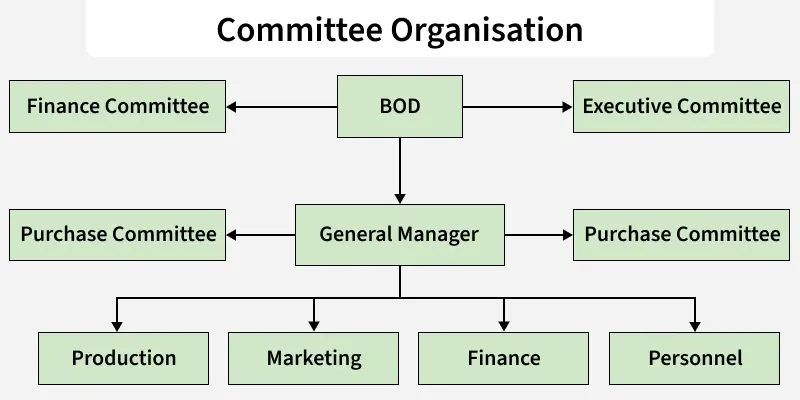
Features of Committee Organisation
The committee organisation is characterised by several distinctive features, some of which are mentioned below:
**Task-Oriented Focus: Committees are created with a specific purpose or task. Each committee works on clearly defined issues, allowing the organisation to handle specialised matters efficiently and achieve targeted results.
**Expertise and Diversity: Members are selected based on their knowledge, skills, and relevance to the issue. Their diverse backgrounds help bring multiple viewpoints together, leading to well-informed and comprehensive decisions.
**Collaboration and Collective Decision-Making: Committees work on the principle of teamwork. Members discuss problems, share ideas, and make decisions collectively. This approach ensures balanced opinions and decisions based on collective judgment.
**Workload Distribution: Committee structures help divide responsibilities among members. Each person contributes according to their expertise, reducing individual burden and improving efficiency in handling tasks.
**Decision Implementation and Monitoring: Apart from making decisions, committees also ensure their implementation. They monitor progress, review actions, and make sure decisions are aligned with organisational goals.
**Reporting and Communication: Committees maintain communication with management by submitting regular updates, reports, and recommendations. This structured flow of information supports transparency and smooth coordination.
**Flexibility and Adaptability: Committees can be formed, reorganised, or dissolved depending on the situation. This flexibility helps organisations respond quickly to new challenges or changing needs.
Suitability of Committee Organisation
The suitability of a committee organisation depends on a range of factors and specific circumstances. Some of the key considerations to be kept in mind while assessing the suitability of committee organisations are as follows:
- Suitable when an organisation needs to handle complex and multi-faceted tasks requiring diverse expertise.
- Useful when collaboration, discussion, and collective decision-making are important.
- Ideal when different stakeholders or departments must be represented in decisions.
- Great for situations where workload needs to be shared and responsibilities delegated effectively.
- Works well when the organisation needs flexibility through temporary or ad-hoc committees.
- Effective when transparency, documentation, and accountability are required in decision-making.
Advantages of Committee Organisation
The committee organisation brings forth numerous advantages in the management of an organisation. Some of them are as follows:
**Diverse Expertise
Committees assemble individuals with varied backgrounds, skills, and knowledge. This diversity of expertise enables committees to approach complex issues from different angles and make well-informed decisions. The range of perspectives fosters comprehensive problem-solving and encourages innovative ideas.
**Shared Responsibility
Committee organisations ensure the equitable distribution of workload and responsibilities among committee members. This prevents individuals from becoming overwhelmed and promotes a balanced allocation of tasks. Shared responsibility nurtures a spirit of collaboration and teamwork, as committee members work together towards common objectives.
**Efficient Decision-making
Committees facilitate efficient decision-making processes. By harnessing the collective knowledge and expertise of committee members, decisions can be reached promptly and effectively. Committees provide a platform for in-depth discussions, thorough analysis of options, and consideration of various viewpoints, resulting in well-considered and balanced decisions.
**Enhanced Accountability
Committee organisations foster accountability among members. Each member has a defined role and responsibility within the committee, and their contributions and actions are visible to others. This promotes a sense of ownership and ensures that decisions and tasks are carried out effectively.
**Stakeholder Representation
Committees often include representatives from diverse stakeholder groups within an organisation. This ensures that multiple perspectives and interests are considered during the decision-making process. Stakeholder representation enhances transparency, builds trust, and increases the likelihood of decisions that align with the organisation's overall objectives.
**Effective Communication
Committee organisations establish structured communication channels among members and with other parts of the organisation. Regular meetings and interactions facilitate the exchange of information, updates, and progress reports. Effective communication ensures that everyone remains well-informed, aligned, and able to contribute effectively to the committee's work.
**Flexibility and Adaptability
Committee organisations exhibit flexibility and adaptability to changing circumstances or emerging needs. New committees can be formed or existing ones can be adjusted to address specific issues or initiatives. This flexibility enables organisations to respond promptly to evolving challenges and seize opportunities as they arise.
Disadvantages of Committee Organisation
While committee organisations have their advantages, they also come with certain disadvantages. some of them are as follows:
**Time-consuming Decision-making: Committees often involve multiple members, which can lead to lengthy decision-making processes. The need for discussions, debates, and consensus-building among committee members can extend the time required to reach a decision. This can result in delays, especially in situations where prompt decision-making is crucial.
**Potential for Biases in Decision-making
Committee organisations are not immune to decision-making biases. Groupthink, where members prioritise conformity over critical thinking, can hinder the exploration of alternative viewpoints or innovative ideas. Additionally, the presence of dominant personalities or power dynamics within the committee can influence decision outcomes.
**Diffusion of Individual Accountability
With shared responsibilities, individual accountability may become diluted. Committee members may feel less individually accountable for decision outcomes or implementation, leading to potential gaps in accountability. This diffusion of responsibility can hinder effective execution and follow-through on decisions.
**Possibility of Conflicts and Disagreements
Committees consist of individuals with diverse perspectives and interests, which can sometimes lead to conflicts and disagreements. Disagreements may result in prolonged discussions or even impede decision-making if consensus cannot be reached. Managing conflicts and maintaining constructive dialogue becomes crucial in committee organisations.
**Overlapping Responsibilities and Duplication of Efforts
In some cases, committee organisations can lead to duplication of efforts or overlapping responsibilities. This can occur when committees have similar mandates or when there is inadequate coordination between them. The lack of clear boundaries and communication can create inefficiencies and confusion within the organisation.
**Administrative Burden
Establishing and managing committee organisations require administrative efforts. This includes organising meetings, managing documentation, and ensuring effective communication channels. The administrative workload can sometimes be demanding, particularly if there are numerous committees within the organisation.
**Potential Limitations in Representation
While committees aim to include diverse perspectives, they may not always fully represent all stakeholders or affected parties. Some voices may be underrepresented, resulting in decisions that do not adequately consider all relevant viewpoints. It is important to ensure inclusivity and comprehensive stakeholder engagement to mitigate this limitation.