Line and Staff Organisation (original) (raw)
Last Updated : 9 Jan, 2026
Line and Staff Organisation is a type of organisational structure where there are two kinds of authorities:
- **Line authority – gives direct orders and instructions (e.g., Production, Sales)
- **Staff authority – provides advice and support to help line managers (e.g., HR, Finance, Legal)
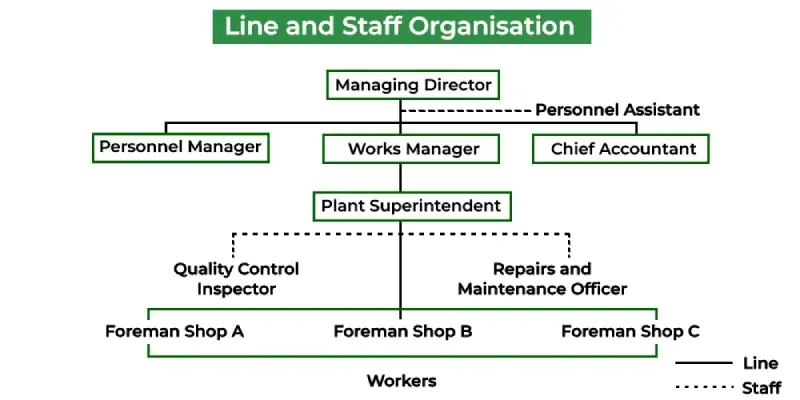
**Example
- **Line: Production Manager → supervises workers and controls operations
- **Staff: HR Manager → gives advice on hiring and training, but doesn’t command workers directly
Features of Line and Staff Organisation
A Line and Staff Organisation has some unique parts that make it stand out:
**Mix of Doers and Advisors: This setup combines the doers, who are the line managers, and the advisors, who are in the staff positions. It's a team where everyone has a specific role.
**Clarity on Who's in Charge: In this setup, the line managers are in charge. They're the ones responsible for getting the company's main goals done.
**Expert Help: Staff positions provide expert help in specific areas like money matters, hiring people, legal stuff, and technical work. This means that the line managers can get expert advice when needed.
**Flexible Setup: This kind of organisation is flexible because you can add or remove staff roles based on what the company needs.
**Better Decision-Making: When the line managers' practical know-how is combined with the staff's expert knowledge, one can get the best of both worlds. This can lead to better decisions.
**Chance of Conflicts: here can be some clashes between line and staff roles because of the two types of authority. This is especially true if it's not clear who's supposed to do what or if communication isn't good.
**Reliance on Staff Advice: The line managers often need to rely on the advice of the staff. This means that the staff roles are really important for the company to work well.
Suitability of Line and Staff Organisation
The suitability of a line and staff organisation depends on various factors and needs to be carefully considered. While it offers advantages, it may not be the best fit for every organisation.
- Best suited for large organisations with complex operations.
- Useful when the organisation needs specialised expertise in areas like finance, HR, or marketing.
- Works well when the roles of line managers and staff experts are clearly distinguished.
- Effective if the organisation encourages strong communication and collaboration.
- Fits organisations whose culture values teamwork and expert advice.
- Suitable for organisations that must stay flexible and adapt to changing situations.
- Appropriate when staff expertise supports the organisation’s goals and strategic objectives.
Advantages of Line and Staff Organisation
The Line and Staff Organisation structure carries several advantages, such as:
**Clear Chain of Command: It has a clear and direct chain of command. This helps in decision-making, task delegation, and accountability.
**Specialised Expertise: It includes specialised staff members with expertise in areas like finance, HR, marketing, or law. They offer valuable advice and support to managers, helping them make better decisions.
**Efficiency and Productivity: With specialised staff, the organisation becomes more efficient and productive. Staff members handle research, analysis, planning, and coordination, allowing managers to focus on their main responsibilities.
**Better Decision-Making: Staff experts contribute to better decision-making. They provide insights, alternative perspectives, and expert advice, leading to improved evaluation, risk management, and identification of opportunities.
**Flexibility and Adaptability: The line and staff organisation is flexible and adaptable to changing circumstances. Staff members can be added or removed based on the organisation's needs, adjusting expertise and resources quickly.
**Career Development: Staff positions offer career growth opportunities. Staff members can specialise, acquire knowledge and skills, and progress without transitioning into management roles.
**Focus on Core Competencies: Employees can focus on their strengths. Managers oversee operations and goals, while staff members provide specialised support and services.
**Improved Organisational Control: It enhances control and coordination. Managers make decisions, and staff members assist in executing policies, procedures, and strategies effectively.
**Enhanced Communication: It promotes effective communication within the organisation. Managers and staff collaborate, exchange information, and share knowledge for better coordination, problem-solving, and innovation.
Disadvantages of Line and Staff Organisation
While a Line and Staff Organisation structure has its benefits, it also comes with certain disadvantages:
**Communication Challenges
The line and staff structure can create communication problems. Line managers and staff members may struggle to share information effectively, leading to misunderstandings and delays in decision-making.
**Potential Conflict
Differences in perspectives, authority, and priorities can cause conflicts between line managers and staff members. Line managers may feel undermined, while staff members may feel ignored. This conflict can hinder collaboration and overall organisational effectiveness.
**Power Struggles
The presence of staff specialists can sometimes lead to power struggles. Line managers may resist taking advice from staff members, creating an imbalance in decision-making authority and resistance to change.
**Over-emphasis on Staff Roles
Organisations may place too much focus on staff roles, which can lead to inefficient allocation of resources. Staff members may become too involved in day-to-day operations instead of focusing on their specialised areas.
**Lack of Accountability
The inclusion of staff positions can create confusion regarding accountability. It may be difficult to determine who is ultimately responsible for decisions and their outcomes.
**Complexity and Bureaucracy
The line and staff organisation can introduce complexity and bureaucracy. Decision-making processes may become slower, and the organisation may become less agile if multiple layers of approval or coordination are required.
**Potential Resistance to Change
Implementing a line and staff structure may face resistance from line managers and employees who perceive it as a threat to their authority or job roles. Resistance to change can hinder the successful adoption of the new structure.
**Difficulty in Staff Integration
Integrating staff members into the organisation's culture and promoting collaboration between line and staff functions can be challenging. It requires effective communication, respect, and a supportive work environment.