Functional Organisation (original) (raw)
Last Updated : 9 Jan, 2026
A functional organisation groups people based on similar tasks or skills into departments like marketing, finance, or operations. Each department is led by a specialist and focuses on its own work to improve efficiency.
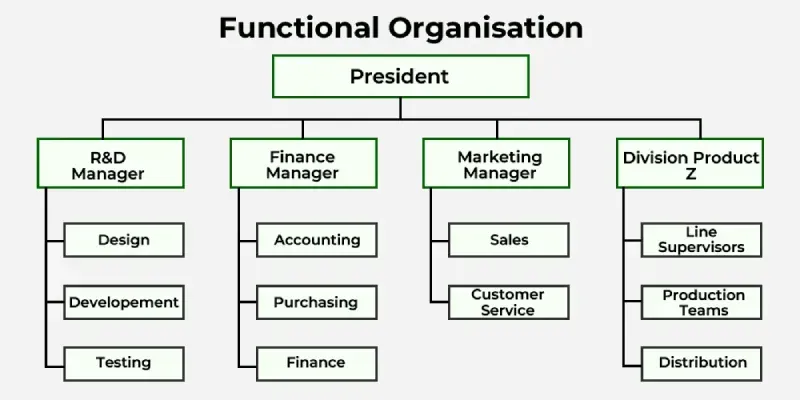
**Example
- Marketing department → handles promotion and sales
- Finance department → manages money
- Production department → oversees manufacturing
Features of Functional Organisation
Functional organisations have some key features that make them unique. Some of them are discussed below;
**Departments: Functional organisations divide people into different departments based on their skills and expertise. Each department focuses on a specific area like marketing, finance, or operations.
**Specialisation: In these departments, employees become experts in their particular field. They learn specialised skills and knowledge that help them work efficiently.
**Clear Reporting: In a functional organisation, there are clear lines of reporting. Employees have a direct supervisor or manager to whom they report, and those supervisors report to higher-level executives.
**Collaboration: Within each department, employees work closely together. They share their expertise, knowledge, and resources to achieve common goals. This teamwork improves efficiency and effectiveness.
**Efficiency and Expertise: By grouping people with similar skills together, functional organisations aim to be efficient and make the best use of expertise. Employees can focus on their specific tasks and use their specialised knowledge to perform well.
**Function-Focused: Functional organisations prioritise the effective execution of specific functions. Each department works towards optimising its area while aligning with the organisation's overall goals.
**Challenges: Although functional organisations have benefits, they can also face challenges. Communication and coordination between departments can be difficult, leading to conflicts or isolated thinking. Decision-making may also take longer because multiple functions need to be involved.
Suitability of Functional Organisation
A functional organisation structure is suitable in certain situations and can bring advantages to specific businesses. Some scenarios where a functional structure works well are:
- Useful when a business needs specialised skills and employees can focus on specific functions.
- Suitable for organisations with clearly defined roles and responsibilities in each department.
- Helps optimise resources by grouping similar functions and avoiding duplication.
- Ideal for industries where focused specialisation in each function is important.
- Supports clear career growth within each functional area.
- Works well when different functions need autonomy and independent decision-making.
- Effective when departmental coordination can achieve organisational goals smoothly.
Advantages of Functional Organisation
Functional organisations have several advantages that make them beneficial for businesses. Some of the key advantages are as follows:
**Specialisation and Expertise
Functional organisations allow employees to focus on specific areas or tasks. This specialisation helps them become experts in their field, which leads to better work quality and efficiency.
**Efficient Resource Allocation
By organising employees based on their functions, functional organisations can allocate resources effectively. Each department can concentrate on its responsibilities, making the best use of personnel, equipment, and technology. This efficient allocation improves productivity and reduces waste.
**Clear Career Paths and Development
Functional organisations provide clear paths for career growth within each department. Employees can advance within their specialised area, taking on more senior roles. This clear progression motivates employees and encourages them to enhance their skills and expertise.
**Collaboration and Coordination
Functional organisations promote collaboration and coordination within each department. Employees work together closely, sharing knowledge and ideas. This collaborative environment improves problem-solving and decision-making.
**Cost Saving
Functional organisations can achieve cost savings through economies of scale. By consolidating similar functions, the organisation can streamline processes, eliminate duplication, and reduce costs. This centralised approach increases efficiency and profitability.
**Targeted Training and Development
Functional organisations provide specific training and development opportunities within each department. Employees receive training tailored to their functional area, which enhances their skills. This focused approach ensures employees have the necessary tools to excel in their roles.
**Accountability and Performance Evaluation
Functional organisations establish clear accountability through defined departments and reporting lines. Each department has specific goals, making it easier to evaluate performance. This accountability helps identify areas for improvement and supports performance management.