ThreeTier Client Server Architecture in Distributed System (original) (raw)
Last Updated : 23 Jul, 2025
The Three-Tier Client-Server Architecture divides systems into presentation, application, and data layers, increasing scalability, maintainability, and efficiency. By separating the concerns, this model optimizes resource management and allows for independent scaling and updates, making it a popular choice for complex distributed systems.

Three-Tier Client Server Architecture in Distributed System
Table of Content
- What are Distributed Systems?
- What is Three-Tier Client Server Architecture in Distributed Systems?
- Importance of Three-Tier Client Server Architecture in Distributed Systems
- Components of Three-Tier Client Server Architecture in Distributed Systems
- Benefits of Three-Tier Client-Server Architecture
- Disadvantages of Three-Tier Client Server Architecture
What are Distributed Systems?
Networks of separate computers that cooperate to accomplish a shared goal are known as distributed systems. As if they were one interconnected system, they communicate and share resources to deliver services or carry out activities. Social media networks, online banking platforms, and cloud computing platforms are a few examples of distributed systems.
What is Three-Tier Client Server Architecture in Distributed Systems?
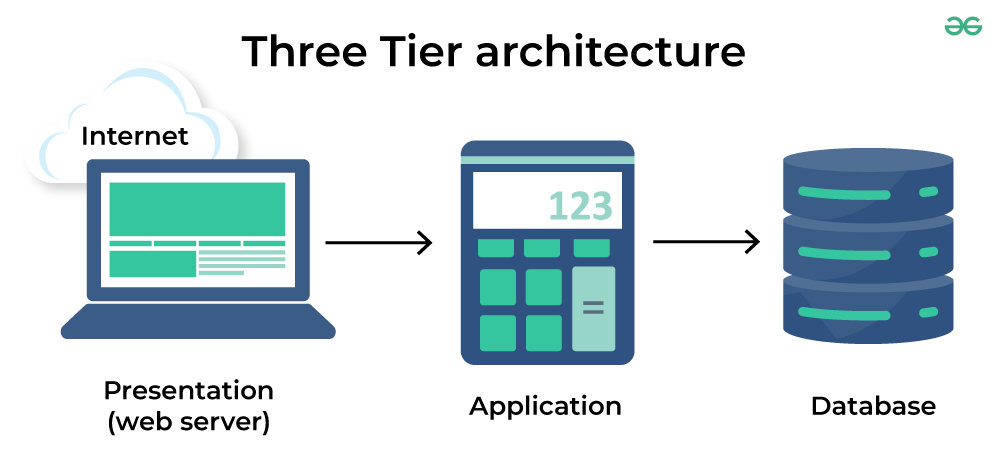
In distributed systems, applications are divided into three distinct tiers using the Three-Tier Client-Server Architecture design model:
- **Presentation Tier: The user interface layer, where interactions occur. It handles data display and user input.
- **Application Tier: The business logic layer, which processes user requests, performs computations, and makes decisions. It acts as a mediator between the presentation and data tiers.
- **Data Tier: The storage layer, is responsible for managing and storing data. It handles database operations and data retrieval.
This separation helps improve scalability, manageability, and flexibility by isolating each layer’s responsibilities.
Importance of Three-Tier Client Server Architecture in Distributed Systems
The Three-Tier Client-Server Architecture is crucial in distributed systems for several reasons:
- **Scalability: Each tier can be scaled independently. For example, the application tier can be scaled to handle increased business logic load without affecting the presentation or data tiers.
- **Maintainability: Developers can update or change one layer without affecting others when there is a clear separation of responsibilities, which makes maintenance easier and lowers the possibility of system-wide problems.
- **Flexibility: Upgrading the user interface, for example, can be done without affecting the data management or business logic below, making upgrades and modifications simpler.
- **Performance: Distributing tasks across different tiers can optimize resource use and performance. For instance, caching strategies can be implemented at the application tier to enhance response times.
- **Security: Each tier can have distinct security measures. For example, sensitive data can be securely managed at the data tier, while the presentation tier focuses on user interaction.
Components of Three-Tier Client Server Architecture in Distributed Systems
The Three-Tier Client-Server Architecture is a layered approach to building distributed systems, with each tier serving distinct roles. Below is a detailed explanation of each component:
1. **Presentation Tier (Client Tier)
The user interface and user interaction are under the control of the Presentation Tier. It functions as the application's front end, where users enter information and see the outcomes.
- **Components:
- **User Interface (UI): Includes web browsers, mobile apps, or desktop applications that users interact with. It displays data and collects user inputs.
- **User Interaction Logic: Handles how user inputs are processed and communicated to the Application Tier. This can involve form validation, data formatting, and sending requests to the server.
- **Responsibilities:
- Display data from the Application Tier to the user.
- Collect user inputs and forward them to the Application Tier.
- Provide a user-friendly interface and manage user interactions.
2. **Application Tier (Business Logic Tier)
The Application Tier is where the core business logic resides. It processes user requests, performs calculations, enforces business rules, and interacts with the Data Tier to retrieve or store data.
- **Components:
- **Business Logic: Implements the rules and processes specific to the application, such as order processing, authentication, or data validation.
- **Application Server: Manages communication between the Presentation and Data Tiers and hosts the business logic. Web servers and application servers such as Apache Tomcat, Microsoft IIS, or JBoss are examples.
- **Responsibilities:
- Process and interpret data received from the Presentation Tier.
- Execute business logic and apply rules.
- Communicate with the Data Tier to retrieve or store information.
- Send processed data back to the Presentation Tier for user display.
3. **Data Tier (Database Tier)
The Data Tier is responsible for data management and storage. It handles all database operations, including data retrieval, updates, and management.
- **Components:
- **Database Management System (DBMS): Software like MySQL, Oracle, or Microsoft SQL Server that manages data storage and retrieval.
- **Database: The actual repository where data is stored, organized in tables or other structures.
- **Responsibilities:
- Store and manage data securely and efficiently.
- Handle queries and transactions initiated by the Application Tier.
- Ensure data integrity, consistency, and availability.
- Provide backup and recovery mechanisms to protect data.
**Interactions Among Tiers
- **Client Request: The user interacts with the Presentation Tier, which sends a request to the Application Tier.
- **Business Processing: The Application Tier processes the request using its business logic and may interact with the Data Tier to retrieve or update data.
- **Data Retrieval/Update: The Data Tier handles data operations and sends the results back to the Application Tier.
- **Response to Client: The Application Tier processes the results and sends the response back to the Presentation Tier for display to the user.
This tiered approach helps manage complexity by separating responsibilities, allowing for easier maintenance, scalability, and flexibility in distributed systems
**Benefits of Three-Tier Client-Server Architecture
Below are the benefits of three-tier client-server architecture in distributed systems:
- **Vertical Scaling: Each tier can be scaled independently. For instance, you can add more application servers or database servers to handle increased load without affecting the presentation tier.
- **Horizontal Scaling: By dividing the load over several servers at every tier, you can improve the system's capacity to manage high request volumes.
- **Modular Design: The separation of concerns allows developers to make changes or updates to one tier without affecting others. For example, updating the user interface or business logic can be done independently.
- **Easier Debugging: Isolating issues becomes easier as each tier has its own distinct responsibilities.
- **Technology Independence: Different technologies and platforms can be used for each tier. For example, the presentation layer might use a web framework, while the application layer could use a different programming language or framework.
- **Load Balancing****:** Distributing workload across multiple servers at each tier can enhance overall system performance and responsiveness.
**Disadvantages of Three-Tier Client Server Architecture
Below are the challenges of three-tier client-server architecture in distributed systems:
- **System Design****:** Designing and implementing a three-tier architecture can be complex due to the need to manage interactions and data flow between tiers.
- **Integration Issues: Ensuring seamless integration between tiers may require additional development and testing effort.
- **Network Latency****:** Communication between tiers, especially when they are distributed across different servers or locations, can introduce latency and affect performance.
- **Increased Resource Usage: Multiple layers may increase resource consumption, such as network bandwidth and server processing power.
- **Configuration Management: Managing configurations and deployments for multiple tiers can be challenging, particularly in distributed environments.
- **Version Compatibility: Ensuring compatibility between different versions of each tier (e.g., updated business logic or database schema) requires careful coordination.
- **Infrastructure Costs: Operating and maintaining separate servers or services for each tier can increase infrastructure and operational costs.