Image Segmentation: Techniques and Applications (original) (raw)
Last Updated : 6 Nov, 2025
Image Segmentation is a computer vision technique used to divide an image into multiple segments or regions, making it easier to analyze and understand specific parts of the image. It helps identify objects, boundaries and relevant features within an image for further processing.
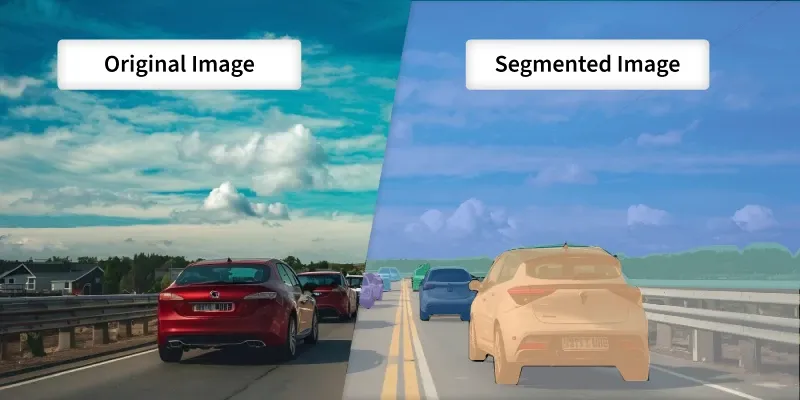
Image Segmentation
This technique is widely used in applications such as medical imaging, object detection, autonomous driving and image editing. By classifying each pixel into meaningful categories, image segmentation forms the foundation for many visual understanding tasks in AI and machine learning.
Types of Image Segmentation
Various types of image segmentation techniques are:
1. Semantic Segmentation
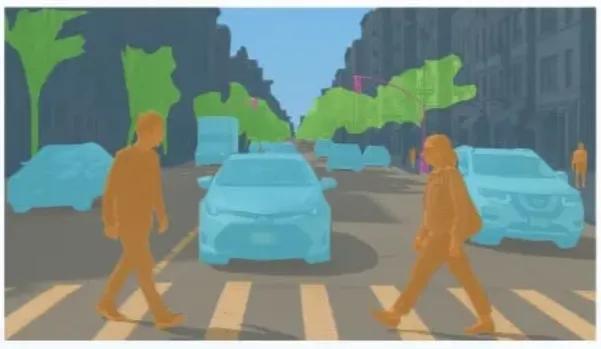
Semantic Segmentation
- Semantic Segmentation involves assigning a class label to every pixel in an image based on shared characteristics such as colour, texture and shape.
- This method treats all pixels belonging to the same class as identical without distinguishing between individual objects.
- **For example: In an image with multiple trees all pixels corresponding to any tree would be labelled as "tree" regardless of how many trees appear in the image.
**2. Instance segmentation
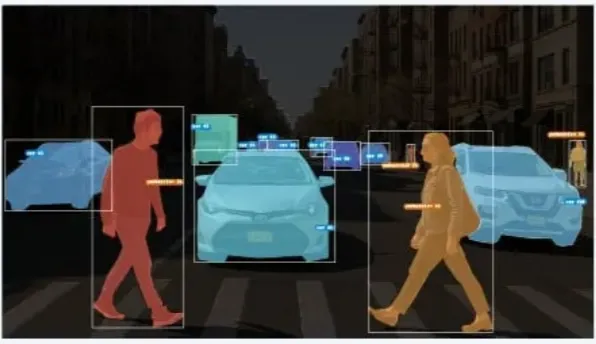
Instance Segmentation
- Instance Segmentation extends semantic segmentation by not only labelling colour of each pixel but also distinguishing between individual objects of the same class.
- This approach identifies each object of the same class as a unique instance.
- **For example: If there are multiple cats in an image it will differentiate each cat and treat them as separate entities despite them all being labelled as "cats."
**3. Panoptic Segmentation
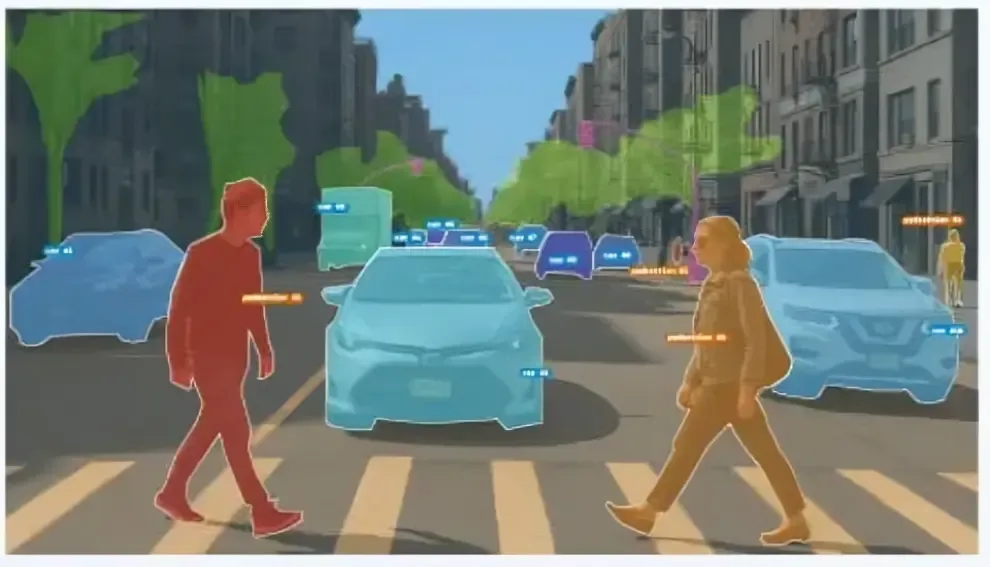
Panoptic Segmentation
- Panoptic segmentation combines both semantic and instance segmentation techniques providing a complete image analysis.
- It assigns a class label to every pixel and also detects individual objects. This combines both broad categories and detailed object boundaries simultaneously.
- **For example: In a traffic scene it would label all pedestrians and cars which is semantic segmentation while also outlining the location of each individual person and car which is instance segmentation.
Common Techniques
Let's see various techniques used in image segmentation:
- **Thresholding: Thresholding based image segementation selects a threshold value and classifies image pixels between foreground and background based on intensity values.
- **Edge Detection: Abrupt change in intensity or discontinuation in the image can be identified using Edge Detection. It uses algorithms like Sobel or Laplacian edge detectors.
- **Region Based Segmentation: Region Based Segmentation method segments the image into smaller regions and iteratively merges them based on predefined attributes to handle noise in the image.
- **Clustering Algorithm: Clustering algorithms like K-means or Gaussian models to group object pixels in an image into clusters based on similar features.
- **Watershed Segmentation: Images are treated using Watershed Algorithm where the watershed lines are identified based on pixel intensity and connectivity.
Deep Learning Based Segmentation Models
Some of the deep learning based segmentation models are:
- **U-Net: U-shaped architecture of U-Net is ideal for medical imaging combines context capture with fine detail retention through skip connections.
- **FCN (Fully Convolutional Network): Dense layers are replaced with convolutional ones for pixel-wise segmentation on images of any size using FCN.
- **SegNet: Uses an encoder-decoder structure for accurate scene understanding and object localization.
- **Mask R-CNN: Faster R-CNN is extended by adding a mask prediction branch for instance-level segmentation using Mask R-CNN.
- **Vision Transformer (ViT): Image patches are captured using ViT to capture global context for complex segmentation tasks.
- **ResNet: Used as a backbone in models like DeepLab and Mask R-CNN, ResNet's residual connections enable deeper, more accurate feature extraction.
Evaluation Metrics
Image segmentation performance is measured using metrics that compare predicted segments to ground truth labels. Common ones are:
- **Intersection over Union (IoU): Measures the overlap between predicted and actual regions.
- **Dice Coefficient: Evaluates similarity between two samples, emphasizing accuracy in overlapping areas.
- **Pixel Accuracy: Calculates the percentage of correctly classified pixels.
- **Precision and Recall: Assess how well the model identifies true positives versus false detections.
Difference between Computer Vision Techniques
Comparison table of different Computer Vison Techniques:
| Aspect | Image Classification | Object Detection | Image Segmentation |
|---|---|---|---|
| Purpose | Assign a label or category to the whole image | Identifies and locates multiple objects | Divide the image into meaningful regions |
| Output | Single label or category | Bounding boxes around detected objects | Pixel wise segmentation masks |
| Focus | High level classification of the entire image | Detection of objects with localization | Detailed segmentation of objects and background |
| Complexity | Simpler and faster | Moderate complexity | More complex and computationally intensive |
| Examples | "Cat" for a picture of a cat | Cars and pedestrians in a traffic scene | Separating tumor from healthy tissue in an X-ray |
Applications
Some of the applications of Image Segmentation are:
- **Autonomous Vehicles: Image segmentation helps autonomous vehicles in identifying and segmenting objects like real time road lane detections, vehicles or traffic signs for safe navigation.
- **Medical Imaging Analysis: It is used for segmenting organs, tumors and other anatomical structures from medical images like X-Rays and CT Scans helps in diagnosis and treatment planning.
- **Satellite Image Analysis: It is used in analyzing satellite images for landcover classification, urban planning and environmental changes.
- **Object Detection and Tracking: In security systems, it helps with tasks like person detection, anomaly detection and tracking activities in video footage.
Challenges
Some of the challenges of Image Segmentation are:
- **Complex backgrounds: Segmentation can struggle when the background is complex or there’s little contrast between objects and the surroundings.
- **Variety in object appearance: Objects might look different in various lighting conditions making it harder to segment consistently.
- **Computational cost: Advanced methods like deep learning can require significant computational power and time.
- **Overlapping Objects: When objects overlap or are partially occluded, distinguishing between them can be difficult leading to poor segmentation accuracy.