What is Image Recognition? (original) (raw)
Last Updated : 19 Aug, 2025
Image recognition is an important application of machine learning which help systems to understand and interpret visual information from images or videos. Just as we easily distinguish between a cat and a dog, image recognition helps computers "see" and identify objects, people, places or actions within an image. This ability is achieved through the use of machine learning and deep learning techniques with Convolutional Neural Networks (CNNs) being one of the most popular methods for recognizing patterns in images.
Understanding an Image
- An image is made up of pixels, the smallest units of color that, when arranged form the complete picture.
- Images are stored as a 2-D array of pixels, with their arrangement containing all visual information.
- Understanding pixel patterns is important for image recognition, helping machines identify objects and interpret content similar to human vision.
- Each pixel carries specific color and intensity information and the arrangement of these pixels help machines to analyze and understand the visual structure of objects within the image.
How Does Image Recognition Work?
Image recognition help computers to identify and classify objects in images by analyzing pixel patterns. Let's see a simple process below:
- **Image Input: The system first receives the image which consists of pixels each carrying color information.
- **Pattern Detection: The system looks for patterns in these pixels. These patterns help the system understand the structure of objects, people or scenes.
- **Machine Learning: Image recognition relies on machine learning where the system is trained to recognize these patterns. Initially, the system learns from labeled data, images that have already been tagged with the correct object or category.
- **Convolutional Neural Networks (CNNs): One of the most effective techniques in image recognition is the use of Convolutional Neural Networks (CNNs). These networks are designed to detect hierarchical patterns in images by identifying features like edges, shapes and textures.
- **Feature Extraction: CNNs automatically extract essential features from images such as lines, corners and textures which help in identifying and classifying objects.
- **Training and Testing: The model is trained on a large set of images and then tested on new ones to check how accurately it can recognize objects. Through continuous learning, the model refines its ability to identify patterns and improve accuracy.
Role of AI in Image Recognition
- **Training Machines with Data: AI teaches machines to analyze and understand visual data by training them on large datasets of labeled images.
- **Learning Patterns: Machine learning help AI systems to recognize patterns in images and make predictions on new data.
- **Computer Vision: A key technique in image recognition, it uses AI and machine learning algorithms to interpret and process visual data, mimicking human vision. It help machines to "see" and understand images.
- **Real-World Applications: AI and computer vision work together to perform tasks like object detection, face recognition and scene interpretation. These technologies are important in areas such as security (e.g surveillance), healthcare (e.g medical imaging), automotive (e.g self-driving cars) and retail (e.g visual search).
- **Automatic Recognition: It allows for automatic recognition and classification of images in real-time, reducing the need for human intervention while improving accuracy and speed.
Key Techniques in Image Recognition
Image recognition has improved through various core techniques, with each contributing to specific applications across industries. Let's see some of the main techniques:
1. Traditional Image recognition
Traditional image recognition methods rely on manual feature extraction and rule-based algorithms. These methods were used before the rise of deep learning and still have their place in specific applications when data is limited. Some common models include:
- **Haar Cascades****:** It is a classical method for object detection, used in face detection. It trains a classifier using positive and negative image samples to detect objects in new images.
- **Histogram of Oriented Gradients (HOG)****:** It is a feature descriptor for detecting objects, particularly humans. It calculates the gradient of pixel intensity in small image cells and forms a histogram of gradient directions, used with classifiers like SVM.
- **Scale-Invariant Feature Transform (SIFT)****:** It detects key points in an image that remain invariant to scale and rotation. It’s useful for object matching and tasks like image stitching and 3D reconstruction.
**2. Machine Learning Methods
Machine learning methods in image recognition require manually extracting features from images before using them for classification. While not as flexible as deep learning, they can still be highly effective in simpler tasks or smaller datasets. Some common models include:
- **Support Vector Machines (SVM)****:** It is used for classification tasks, as it finds the optimal hyperplane to separate classes in feature space, effective for smaller datasets and clear class boundaries.
- **K-Nearest Neighbors (K-NN)****:** It classifies images by comparing an unknown image to the ‘K’ nearest labeled images. It’s computationally expensive for large datasets but works well for smaller applications.
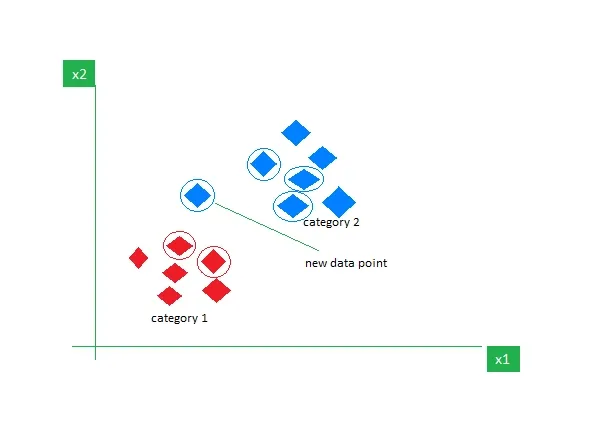
KNN
- **Random Forests****:** They are an ensemble learning method that uses multiple decision trees to classify images which offers high accuracy and robustness, especially with variable data.
3. Deep Learning Methods
Deep learning methods have revolutionized image recognition due to their ability to learn and extract features automatically from large datasets. These methods primarily use Convolutional Neural Networks (CNNs) and other advanced models that can handle complex image patterns and structures. Some common models include:
- **YOLO (You Only Look Once)****:** It is a fast and efficient deep learning-based object detection model. It divides the image into a grid and predicts object locations and categories in a single pass, making it highly suitable for real-time applications like autonomous driving and security surveillance.
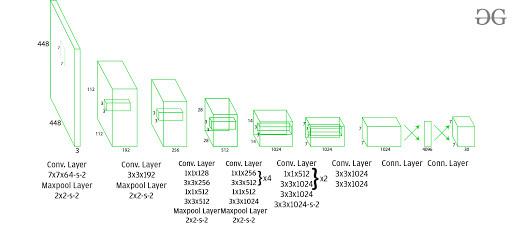
YOLO Architecture l
- **Single Shot MultiBox Detector****(SSD):** It is a real-time object detection model similar to YOLO. It also performs predictions in a single pass but is optimized for detecting objects at various scales, making it effective for applications involving videos, surveillance and real-time analytics.
- **Faster R-CNN****:** It improves on earlier CNN-based models by integrating a Region Proposal Network (RPN) to generate object proposals faster and more accurately. It is highly effective for detecting objects in complex scenes and is used in autonomous vehicles and surveillance systems.
- **Vision Transformers (ViT)****:** It treat images as sequences of patches and process them using transformer architectures, traditionally used in natural language processing. It has been proven effective for large-scale image classification tasks and are gaining traction for object detection and segmentation.
Application of Image Recognition
Image recognition is used across various sectors, improving functionality and efficiency:
- **Fraud Detection: Image recognition helps identify fraudulent activities like fake profiles on social media by detecting reused or stolen images, helping in preventing identity theft and scams.
- **Facial Recognition: This technology is used in security systems, smartphones and retail. It allows for identity verification and personalized experiences by recognizing and analyzing facial features.
- **Reverse Image Search: It allows users to search for images by uploading them, helping find the original source or visually similar content. It’s useful for content discovery, copyright protection and social media monitoring.
- **Law Enforcement: In law enforcement, it assists in identifying suspects, tracking criminals and solving crimes by analyzing photos and videos from surveillance systems or social media.
- **E-commerce: Visual search helps shoppers find products based on images, improving the online shopping experience by enabling item discovery without relying on textual descriptions.
Limitations of Image Recognition
Despite its benefits, image recognition faces some challenges:
- **Background Clutter: Complex or busy backgrounds can confuse algorithms, making it difficult to focus on the object of interest and leading to potential misidentifications.
- **Occlusion: When objects are partially hidden, image recognition systems struggle to accurately detect them which is a common issue in dynamic environments.
- **Lighting Conditions: Poor or inconsistent lighting can alter how objects appear, causing recognition failures, especially in dim or overly bright conditions.
- **Dataset Bias: If the training data is biased, the model can produce inaccurate results, for underrepresented groups.
Future Trends in Image Recognition
- **Augmented Reality (AR) and Virtual Reality (VR): Real-time image recognition will enhance AR and VR experiences, making interactions more immersive and realistic by recognizing objects and environments in real time.
- **Healthcare: Image recognition will transform healthcare by improving diagnostic accuracy, especially with medical images like X-rays and MRIs, enabling faster and more precise treatments.
- **Real-Time Detection: Real-time image recognition will continue to improve, especially in autonomous vehicles and surveillance, providing quicker and more reliable responses for dynamic situations.
- **Retail: In retail, it will enhance online shopping by offering virtual try-ons and improving product search. It will also optimize inventory management and optimize customer experiences.