The sum of opposite angles of a cyclic quadrilateral is 180° | Class 9 Maths Theorem (original) (raw)
Last Updated : 23 Jul, 2025
In Euclidean geometry, a cyclic quadrilateral or inscribed quadrilateral is a quadrilateral whose vertices all lie on a single circle. This circle is called the circumcircle or circumscribed circle, and the vertices are said to be concyclic.
The center of the circle and its radius are called the circumcenter and the circumradius respectively. Other names for these quadrilaterals are concyclic quadrilateral and chordal quadrilateral, the latter since the sides of the quadrilateral are chords of the circumcircle.
Table of Content
- Theorem Statement
- Proof of Theorem on the Sum of Opposite Angles of Cyclic Quadrilateral
- Sample Problems on the Given Theorem
- The Converse of Cyclic Quadrilateral
- Limitation of the Theorem on the Sum of Opposite Angles of a Cyclic Quadrilateral
- Application of the Theorem on the Sum of Opposite
- Class 9 Math Theorems
**Theorem Statement
**The sum of the opposite angles of a cyclic quadrilateral is 180°.
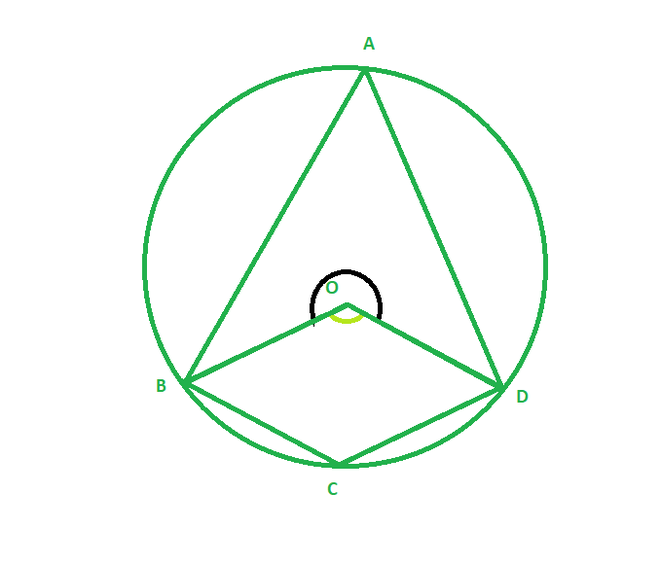
So according to the theorem statement, in the below figure, we have to prove that
**∠BAD + ∠BCD = 180 o
**∠ABC + ∠ADC = 180 o
**Proof of Theorem on the Sum of Opposite Angles of Cyclic Quadrilateral
**Given:
A cyclic quadrilateral ABCD where O is the centre of a circle.
**Construction:
Join the line segment OB and OD
Since, The angle subtended by an arc at the centre is double the angle on the circle.
Therefore,
∠BAD = 1/2 (∠BOD) - equation 1
Similarly,
∠BCD = 1/2 (reflex of ∠BOD) - equation 2
By adding equation 1 and 2, we get
∠BAD + ∠BCD = 1/2 (∠BOD + reflex of ∠BOD)
∠BAD + ∠BCD = 1/2 ( 360o) {Since , ∠BOD + reflex of ∠BOD form complete angle i.e 360 degree}
**∠BAD + ∠BCD = 180 o
Similarly,
**∠ABC + ∠ADC = 180 o
**Hence proved, that the sum of opposite angles of a cyclic quadrilateral is 180°
**Sample Problems on the Given Theorem
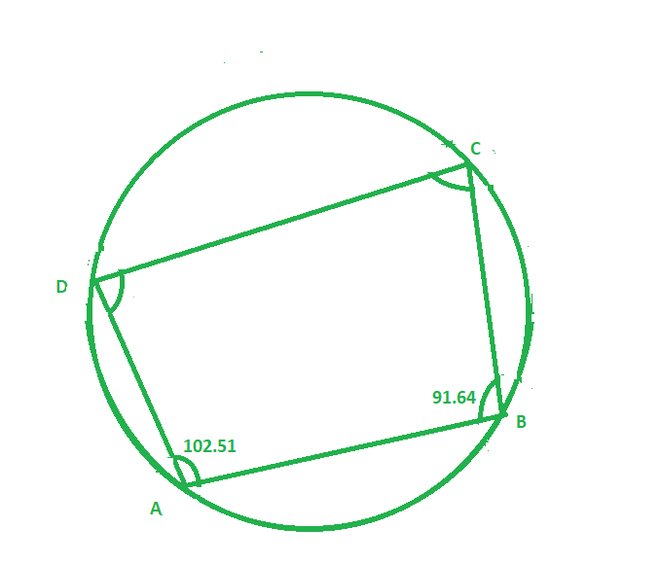
**Question 1: In the figure given below, ABCD is a cyclic quadrilateral in which ∠CBA = 91.64° and ∠DAB = 102.51° find ∠ADC and ∠DCB?
**Solution:
By applying theorem,
The sum of opposite angles of a cyclic quadrilateral is 180°
We get,
∠ADC + ∠ABC = 180o
∠ADC + 91.64o =180o
∠ADC =180o - 91.64o = 88.36 degree
And,
∠DCB + ∠BAD =180o
∠DCB + 102.51o = 180o
∠DCB = 180o - 102.51o
∠DCB = 77.49o
**Hence ∠ADC = 88.36 o and ∠DCB = 77.49 o
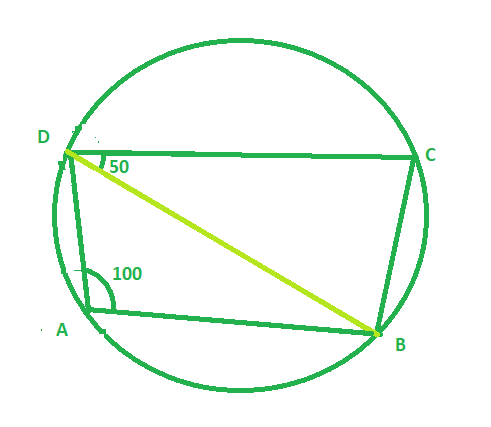
**Question 2: In the figure given below, ABCD is a cyclic quadrilateral in which ∠BAD = 100° and ∠BDC = 50° find ∠DBC?
**Solution:
**Given :
∠BAD = 100° and ∠CDB = 50o
∠BAD + ∠BCD = 180o (Since opposite angle of cyclic quadrilateral)
∠BCD = 180o - 100o = 800
In ∆BCD ,
∠BCD + ∠CDB + ∠DBC = 180o
80o + 50o + ∠DBC = 180o
∠DBC = 180o - 130o
∠DBC = 50o
**Therefore ∠DBC = 50 o
The Converse of Cyclic Quadrilateral
- If in a quadrilateral, the sum of one pair of opposite angles equals 180 degrees,
- Then the quadrilateral can be inscribed in a circle.
- This condition indicates that the quadrilateral is cyclic.
- The theorem simplifies geometric proofs and constructions involving quadrilaterals.
- It's a useful tool for identifying cyclic quadrilaterals based on angle measurements.
Limitation of the Theorem on the Sum of Opposite Angles of a Cyclic Quadrilateral
- Dependence on Cyclic Property
- No Information on Side Lengths
- Doesn't Guarantee Unique Circumcircle
- Not Applicable to Non-convex Quadrilaterals
- Limited in Higher Dimensions
Application of the Theorem on the Sum of Opposite
**Angle Chasing: The theorem is frequently used in geometric proofs and constructions involving cyclic quadrilaterals.
**Cyclic Quadrilateral Identification: Given a quadrilateral, if one can prove that the sum of opposite angles is 180 degrees, it confirms that the quadrilateral is cyclic.
**Geometric Constructions: The theorem aids in constructing cyclic quadrilaterals.
**Solving Problems Involving Circles: The theorem is essential in solving problems related to circles, such as inscribed angles, tangents, and secants.
**Trigonometric Applications: In trigonometry, the theorem can be used to derive and prove trigonometric identities involving angles in cyclic quadrilaterals.
**Advanced Geometry Proofs: The theorem serves as a foundational principle in more advanced geometric proofs involving cyclic polygons and other geometric figures. It provides a basis for understanding the relationships between angles and arcs in cyclic quadrilaterals and their extensions to higher-order polygons.