Important Formulas in Statistics for Economics | Class 11 (original) (raw)
Last Updated : 8 Aug, 2025
Statistics for Economics is a field that helps in the study, collection, analysis, interpretation, and organization of data for different ultimate objectives. Statistics help a user in gathering and analyzing huge numerical data easily and efficiently. For this, it provides various statistical tools and formulas that can be used to collect, interpret, and analyse the given set of data. Following are some of the important formulas (chapter-wise) used in Class 11th Statistics for Economics.
Table of Content
- 1. Width of Class Interval
- 2. Mid-Point or Mid-Value
- 3. Conversion of percentage into degrees in Pie Diagram
- 4. Adjustment Factor for any Class (Histogram)
- 5. Arithmetic Mean
- 6. Charlier's Accuracy Check
- 7. Formula to calculate Missing Value in Individual, Discrete, and Continuous Series
- 8. Combined Mean
- 9. Corrected Mean
- 10. Weighted Arithmetic Mean
- 11. Median
- 12. Quartiles
- 13. Deciles
- 14. Percentiles
- 15. Mode
- 16. Relationship between Mean, Median, and Mode
- 17. Range
- 18. Coefficient of Range
- 19. Quartile Deviation
- 20. Coefficient of Quartile Deviation
- 21. Mean Deviation
- 22. Coefficient of Mean Deviation
- 23. Standard Deviation
- 24. Coefficient of Standard Deviation
- 25. Combined Standard Deviation
- 26. Variance
- 27. Coefficient of Variation
- 28. Degree of Correlation
- 29. Karl Pearson's Coefficient of Correlation
- 30. Karl Pearson's Coefficient of Correlation and Covariance
- 31. Spearman's Rank Correlation Coefficient
- 32. Unweighted or Simple Index Numbers
- 33. Weighted Index Numbers
- 34. Methods of Constructing Consumer Price Index
- 35. Purchasing Power
- 36. Real Wages
**1. **Width of Class Interval
Widht~of~Class~Interval=\frac{Largest~Observation-Smallest~Observation}{Number~of~Classes~Desired}
Where,
Largest Observation is the largest value of the given data set
Smallest Observation is the smallest value of thegiven data set
Number of Classes Desired is the number of class intervals required
**2. **Mid-Point or Mid-Value
Mid-Point/Mid-Value=\frac{Lower~Class~Limit+Upper~Class~Limit}{2}
Where,
Lower Class Limit is the lower limit of a class interval of the given frequency distribution
Upper Class Limit is the upper limit of the same class interval of the given frequency distribution
3. Conversion of percentage into degrees in Pie Diagram
1\%=\frac{360\degree}{100}=3.6\degree
4. Adjustment Factor for any Class (Histogram)
Adjustment~Factor~for~any~Class=\frac{Class~Interval~of~the~Concerned~Class}{Lowest~Class~Interval}
OR
Adjustment~Factor~for~any~Class=\frac{Width~of~the~Class}{Width~of~the~Lowest~Class}
5. Arithmetic Mean
i) Individual Series:
- **Direct Method
\bar{X}=\frac{\sum{X}}{N}
Where,
\bar{X}=Arithmetic~Mean
\sum{X}=Sum~of~all~the~values~of~items
N = Total Number of Items
- **Short-cut Method
\bar{X}=A+\frac{\sum{d}}{N}
Where,
\bar{X}=Arithmetic~Mean
A = Assumed Mean
d = X - A (deviations of variables from assumed mean)
∑d = ∑(X - A) (sum of deviations of variables from assumed mean)
N = Total Number of Items
- **Step Deviation Method
\bar{X}=A+\frac{\sum{d^\prime}}{N}\times{C}
Where,
\bar{X}=Arithmetic~Mean
A = Assumed Mean
d = X - A (deviations of variables from assumed mean)
d^\prime=\frac{X - A}{C} (Step Deviations; i.e., deviations divided by common factor)
\sum{d^\prime}=Sum~of~Step~Deviations
C = Common Factor
N = Total Number of Items
ii) Discrete Series:
- **Direct Method
\bar{X}=\frac{\sum{fX}}{\sum{f}}
Where,
\bar{X}=Arithmetic~Mean
∑fX = Sum of the product of variables with the respective frequencies
∑f = Total Number of Items
- **Short-cut Method
\bar{X}=A+\frac{\sum{fd}}{\sum{f}}
Where,
\bar{X}=Arithmetic~Mean
A = Assumed Mean
d = X - A (deviations of variables from assumed mean)
∑fd = Sum of the product of deviations (d) with the respective frequencies
∑f = Total Number of Items
- **Step Deviation Method
\bar{X}=A+\frac{\sum{fd^\prime}}{\sum{f}}\times{C}
Where,
\bar{X}=Arithmetic~Mean
A = Assumed Mean
d = X - A (deviations of variables from assumed mean)
d^\prime=\frac{X - A}{C} (Step Deviations; i.e., deviations divided by common factor)
\sum{fd^\prime}=Sum~of~product~of~Step~Deviations~with~the~respective~frequencies
C = Common Factor
∑f = Total Number of Items
iii) Continuous Series:
- **Direct Method
\bar{X}=\frac{\sum{fm}}{\sum{f}}
Where,
\bar{X}=Arithmetic~Mean
∑fm = Sum of the product of mid-points with the respective frequencies
∑f = Total Number of Items
- **Short-cut Method
\bar{X}=A+\frac{\sum{fd}}{\sum{f}}
Where,
\bar{X}=Arithmetic~Mean
A = Assumed Mean
d = m - A (deviations of mid-points from assumed mean)
∑fd = Sum of the product of deviations (d) with the respective frequencies
∑f = Total Number of Items
- **Step Deviation Method
\bar{X}=A+\frac{\sum{fd^\prime}}{\sum{f}}\times{C}
Where,
\bar{X}=Arithmetic~Mean
A = Assumed Mean
d = m - A (deviations of mid-points from assumed mean)
d^\prime=\frac{m - A}{C} (Step Deviations; i.e., deviations divided by common factor)
\sum{fd^\prime}=Sum~of~product~of~Step~Deviations~with~the~respective~frequencies
C = Common Factor
∑f = Total Number of Items
6. Charlier's Accuracy Check
- **For Short-cut Method
∑f(d + 1) = ∑fd + ∑f
Where,
f = Number of Observations
d = m - A (deviations of mid-points from assumed mean)
∑fd = Sum of the product of deviations (d) with the respective frequencies
∑f = Total Number of Items
- **For Step Deviation Method
\sum{f(d^\prime+1)}=\sum{fd^\prime}+\sum{f}
Where,
f = Number of Observations
d^\prime=\frac{m - A}{C} (Step Deviations; i.e., deviations divided by common factor)
\sum{fd^\prime}=Sum~of~product~of~Step~Deviations~with~the~respective~frequencies
C = Common Factor
A = Assumed Mean
∑f = Total Number of Items
7. Formula to calculate Missing Value in Individual, Discrete, and Continuous Series
i) Individual Series:
\bar{X}=\frac{X_1+X_2+.....................+X_{n-1}+X_n}{N}
Where,
X1, X2, ..................... Xn-1 = Given Values
Xn = Missing Value
ii) Discrete Series:
\bar{X}=\frac{\sum{fX}}{\sum{f}}
Where,
\bar{X}=Arithmetic~Mean
∑fX = Sum of the product of variables with the respective frequencies
∑f = Total Number of Items
iii) Continuous Series:
\bar{X}=\frac{\sum{fm}}{\sum{f}}
Where,
\bar{X}=Arithmetic~Mean
∑fm = Sum of the product of mid-points with the respective frequencies
∑f = Total Number of Items
8. Combined Mean
\bar{X}_{1,2}=\frac{N_1\bar{X}_1+N_2\bar{X}_2}{N_1+N_2}
Where,
\bar{X}_{1,2}=Combined~Mean
\bar{X}_1=Arithmetic~mean~of~first~distribution
\bar{X}_2=Arithmetic~mean~of~second~distribution
N1 = Number of Items of first distribution
N2 = Number of Items of second distribution
9. Corrected Mean
Correct~\bar{X}=\frac{\sum{X}(Wrong)+Correct~Value-Incorrect~Value}{N}
10. Weighted Arithmetic Mean
\bar{X_w}=\frac{\sum{XW}}{\sum{W}}
Where,
\bar{X_w} =Weighted~Mean
∑WX = Sum of product of items and respective weights
∑W = Sum of the weights
i) Individual Series:
Median(M)=Size~of~[\frac{N+1}{2}]^{th}~item
Where,
N = Number of Items
- **If the Number of Items is Even
Median(M)=\frac{Size~of~[\frac{N}{2}]^{th}~item+Size~of~[\frac{N}{2}+1]^{th}~item}{2}
Where,
N = Number of Items
ii) Discrete Series:
Median(M)=Size~of~[\frac{N+1}{2}]^{th}~item
Where,
N = Total of Frequency
Find out the value of [\frac{N+1}{2}]^{th}~item Locate the cumulative frequency which is equal to higher than [\frac{N+1}{2}]^{th}~item and then find the value corresponding to this cf. This value will be the Median value of the series.
iii) Continuous Series:
Median=l_1+\frac{\frac{N}{2}-c.f.}{f}\times{i}
Where,
l1 = lower limit of the median class
c.f. = cumulative frequency of the class preceding the median class
f = simple frequency of the median class
i = class size of the median group or class
12. Quartiles
i) Individual Series:
Lower~Quartile(Q_1)=Size~of~[\frac{N+1}{4}]^{th}~item
Upper~Quartile(Q_3)=Size~of~3[\frac{N+1}{4}]^{th}~item
Where,
N = Number of Items
ii) Discrete Series:
Lower~Quartile(Q_1)=Size~of~[\frac{N+1}{4}]^{th}~item
Upper~Quartile(Q_3)=Size~of~3[\frac{N+1}{4}]^{th}~item
Where,
N = Cumulative Frequency
iii) Continuous Series:
Lower~Quartile(Q_1)=l_1+\frac{\frac{N}{4}-c.f.}{f}\times{i}
Upper~Quartile(Q_3)=l_1+\frac{\frac{3N}{4}-c.f.}{f}\times{i}
13. Deciles
i) Individual Series:
D_{1}=[\frac{N+1}{10}]^{th}~item
D_{2}=[\frac{2(N+1)}{10}]^{th}~item
..........D_{9}=[\frac{9(N+1)}{10}]^{th}~item
Where,
n is the total number of observations, D1 is First Decile, D2 is Second Decile,..........D9 is Ninth Decile.
ii) Discrete Series:
D_{1}=[\frac{N+1}{10}]^{th}~item
D_{2}=[\frac{2(N+1)}{10}]^{th}~item
..........D_{9}=[\frac{9(N+1)}{10}]^{th}~item
Where,
n is the total number of observations (∑f), D1 is First Decile, D2 is Second Decile,..........D9 is Ninth Decile.
iii) Continuous Series:
D_{1}=[\frac{N}{10}]^{th}~item
D_{2}=[\frac{2N}{10}]^{th}~item
..........D_{9}=[\frac{9N}{10}]^{th}~item
Where,
n is the total number of observations (∑f), D1 is First Decile, D2 is Second Decile,..........D9 is Ninth Decile.
14. Percentiles
i) Individual Series:
P_{1}=[\frac{N+1}{100}]^{th}~item
P_{2}=[\frac{2(N+1)}{100}]^{th}~item
P_{3}=[\frac{3(N+1)}{100}]^{th}~item
..........P_{99}=[\frac{99(N+1)}{100}]^{th}~item
Where,
n is the total number of observations (∑f), P1 is First Percentile, P2 is Second Percentile, P3 is Third Percentile, ..........P99 is Ninety Ninth Percentile.
ii) Discrete Series:
P_{1}=[\frac{N+1}{100}]^{th}~item
P_{2}=[\frac{2(N+1)}{100}]^{th}~item
P_{3}=[\frac{3(N+1)}{100}]^{th}~item
..........P_{99}=[\frac{99(N+1)}{100}]^{th}~item
Where,
n is the total number of observations (∑f), P1 is First Percentile, P2 is Second Percentile, P3 is Third Percentile, ..........P99 is Ninety Ninth Percentile.
iii) Continuous Series:
P_{1}=[\frac{N}{100}]^{th}~item
P_{2}=[\frac{2N}{100}]^{th}~item
P_{3}=[\frac{3N}{100}]^{th}~item
..........P_{99}=[\frac{99N}{100}]^{th}~item
Where,
n is the total number of observations (∑f), P1 is First Percentile, P2 is Second Percentile, P3 is Third Percentile, ..........P99 is Ninety Ninth Percentile.
15. Mode
i) Individual Series:
Mode is the value that occurs the largest number of times.
ii) Discrete Series:
In the case of regular and homogeneous frequencies, and single maximum frequency, Mode is the value corresponding to the highest frequency. Otherwise, the grouping method is used.
iii) Continuous Series:
Z=l_1+\frac{f_1-f_0}{2f_1-f_0-f_2}\times{i}
Where,
Z = Value of Mode
l1 = lower limit of the modal class
f1 = frequency of modal class
f0 = frequency of pre-modal class
f2 = frequency of the next higher class or post-modal class
i = size of the modal group
Mode = 3 Median - 2 Mean
17. Range
Range(R) = Largest Item(L) - Smallest Item(S)
18. Coefficient of Range
Coefficient~of~Range=\frac{Largest~Item(L)-Smallest~Item(S)}{Largest~Item(L)+Smallest~Item(S)}
In **Individual Series, the largest and smallest item is taken from the given observations.
In **Discrete Series, the largest and smallest item is taken from the given frequencies.
In **Continuous Series, the first method to calculate coefficient of range is to take the difference between the upper and lower limit of the highest and lowest class interval respectively. The second method is to take the difference between the mid-points of the highest class limit and lowest class limit.
19. Quartile Deviation
Quartile~Deviation=\frac{Q_3-Q_1}{2}
Where,
Q3 = Upper Quartile (Size of 3[\frac{N+1}{4}]^{th} item)
Q1 = Lower Quartile (Size of [\frac{N+1}{4}]^{th} item)
20. Coefficient of Quartile Deviation
Coefficient~of~Quartile~Deviation=\frac{Q_3-Q_1}{Q_3+Q_1}
Where,
Q3 = Upper Quartile (Size of 3[\frac{N+1}{4}]^{th} item)
Q1 = Lower Quartile (Size of [\frac{N+1}{4}]^{th} item)
21. Mean Deviation
i) Individual Series:
- **Mean Deviation from Mean
Mean~Deviation~from~Mean(MD_{\bar{X}})=\frac{\sum{|X-\bar{X}|}}{N}=\frac{\sum{|D|}}{N}
- **Mean Deviation from Median
Mean~Deviation~from~Median(MD_M)=\frac{\sum{|X-M|}}{N}=\frac{\sum{|D|}}{N}
- **Alternate Method
Mean~Deviation~from~Assumed~Mean=\frac{\sum|D|+(\bar{X}-A)(\sum{f_B}-\sum{f_A})}{N}
Where,
∑|D| = Sum of absolute deviations from Assumed Mean
\bar{X}=Actual~Mean
A = Assumed Mean
∑fB = Number of Values from actual mean
∑fA = Number of values below actual mean including actual mean
N = Number of Observations
ii) Discrete Series:
- **Mean Deviation from Mean
Mean~Deviation~from~Mean(MD_{\bar{X}})=\frac{\sum{f|X-\bar{X}|}}{N}=\frac{\sum{f|D|}}{N}
- **Mean Deviation from Median
Mean~Deviation~from~Median(MD_M)=\frac{\sum{f|X-M|}}{N}=\frac{\sum{f|D|}}{N}
Where,
∑f|D| = Sum of product of frequency and absolute deviations from Assumed Mean
\bar{X}=Actual~Mean
M = Median
N = Number of Observations
iii) Continuous Series:
- **Mean Deviation from Mean
Mean~Deviation~from~Mean(MD_{\bar{X}})=\frac{\sum{f|m-\bar{X}|}}{N}=\frac{\sum{f|D|}}{N}
- **Mean Deviation from Median
Mean~Deviation~from~Median(MD_M)=\frac{\sum{f|m-M|}}{N}=\frac{\sum{f|D|}}{N}
Where,
∑f|D| = Sum of product of frequency and absolute deviations from Assumed Mean
\bar{X}=Actual~Mean
m = Mid-value
M = Median
N = Number of Observations
22. Coefficient of Mean Deviation
- **Coefficient of Mean Deviation from Mean
Coefficient~of~Mean~Deviation~from~Mean(\bar{X})=\frac{MD_{\bar{X}}}{\bar{X}}
Where,
MD_{\bar{X}} = Mean Deviation from Mean
\bar{X}=Actual~Mean
- **Coefficient of Mean Deviation from Median
Coefficient~of~Mean~Deviation~from~Median(M)=\frac{MD_{M}}{M}
Where,
MDM = Mean Deviation from Median
M = Median
23. Standard Deviation
i) Individual Series:
\sigma=\sqrt{\frac{\sum{x^2}}{N}}
Where,
σ = Standard Deviation
∑x2 = Sum total of the squares of deviations from the actual mean
N = Number of pairs of observations
\sigma=\sqrt{\frac{\sum{X^2}}{N}-(\bar{X})^2}
Or
=\sqrt{\frac{\sum{X^2}}{N}-(\frac{\sum{X}}{N})^2}
Where,
σ = Standard Deviation
∑X2 = Sum total of the squares of observations
\bar{X} = Actual Mean
N = Number of Observations
\sigma=\sqrt{\frac{\sum{d^2}}{N}-(\frac{\sum{d}}{N})^2}
Where,
σ = Standard Deviation
∑d = Sum total of deviations from assumed mean
∑d2 = Sum total of squares of deviations
N = Number of pairs of observations
ii) Discrete Series:
\sigma=\sqrt{\frac{\sum{fx^2}}{N}}
Where,
σ = Standard Deviation
∑fx2 = Sum total of the squared deviations multiplied by frequency
N = Number of pairs of observations
\sigma=\sqrt{\frac{\sum{fX^2}}{N}-(\bar{X})^2}
Or
=\sqrt{\frac{\sum{fX^2}}{N}-(\frac{\sum{fX}}{N})^2}
Where,
σ = Standard Deviation
∑fx2 = Sum total of the squared deviations multiplied by frequency
\bar{X} = Actual Mean
N = Number of Observations
\sigma=\sqrt{\frac{\sum{fd^2}}{N}-(\frac{\sum{fd}}{N})^2}
Or
=\sqrt{\frac{\sum{fd^2}}{N}-(\frac{\sum{fd}}{N})^2}
Where,
σ = Standard Deviation
∑fd = Sum total of deviations multiplied by frequencies
∑d2 = Sum total of the squared deviations multiplied by frequencies
N = Number of pairs of observations
\sigma=\sqrt{\frac{\sum{fd^\prime{^2}}}{N}-(\frac{\sum{fd^\prime}}{N})^2}\times{C}
Where,
σ = Standard Deviation
\sum{fd^\prime{^2}} = Sum total of the squared step deviations multiplied by frequencies
\sum{fd^\prime} = Sum total of step deviations multiplied by frequencies
N = Number of pairs of observations
iii) Continuous Series:
σ = \sqrt{\frac{\sum{\\fx^{2}}}{N}}
OR
\sqrt{\frac{\sum f(X - \bar{X})^{2}}{N}}
Where,
σ = Standard Deviation
\bar{X} = Actual Mean
∑fx2 = Sum total of the deviations of every mid-value of the class intervals multiplied by frequency
N = Number of pair of observations
σ = \sqrt{{\frac{\sum{\\fd^{2}}}{N}}-({\frac{\sum{fd}}{N}})^2}
Where,
σ = Standard Deviation
∑fd2 = Sum total of the squared deviations multiplied by frequency
∑fd = Sum total of deviations multiplied by frequency
N = Number of pair of observations
σ=\sqrt{{\frac{\sum{\\fd'^{2}}}{N}}-({\frac{\sum{fd'}}{N}})^2}\times{C}
Where,
σ = Standard Deviation
\sum{fd^\prime}^2 = Sum total of the squared step deviations multiplied by frequency
\sum{fd^\prime} = Sum total of step deviations multiplied by frequency
C = Common Factor
N = Number of pair of observations
24. Coefficient of Standard Deviation
Coefficient~of~Standard~Deviation=\frac{\sigma}{\bar{X}}
Where,
σ = Standard Deviation
\bar{X} = Arithmetic Mean
25. Combined Standard Deviation
\sigma_{1,2}=\sqrt{\frac{N_1\sigma_1^2+N_2\sigma_2^2+N_1d_1^2+N_2d_2^2}{N_1+N_2}}
Where,
\sigma_{1,2} = Combined Standard Deviation of two groups
\sigma_{1} =Standard Deviation of first group
\sigma_{2} = Standard Deviation of second group
d_1^2=(\bar{X_1}-\bar{X}_{1,2})^2
d_2^2=(\bar{X_2}-\bar{X}_{1,2})^2
\bar{X}_{1,2} = Combined Arithmetic Mean of two groups
\bar{X}_1 = Arithmetic Mean of first group
\bar{X}_2 = Arithmetic Mean of second group
N_1 = Number of Observations in the first group
N_2 = Number of Observations in the second group
26. Variance
Variance = σ2
Where,
σ = Standard Deviation
27. Coefficient of Variation
Coefficient~of~Variation(C.V.)=\frac{\sigma}{\bar{X}}\times{100}
Where,
C.V. = Coefficient of Variation
σ = Standard Deviation
\bar{X} = Arithmetic Mean
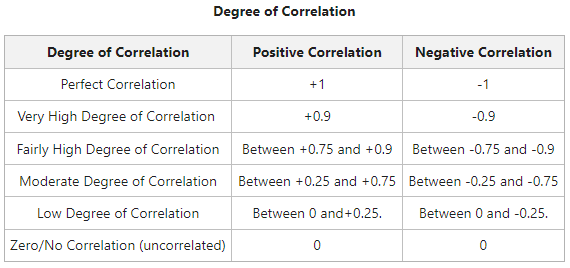
28. Degree of Correlation
29. Karl Pearson's Coefficient of Correlation
Karl~Pearson's~Coefficient~of~Correlation(r)=\frac{Sum~of~Products~of~Deviations~from~their~respective~means}{Number~of~Pairs\times{Standard~Deviations~of~both~Series}}
Or, r=\frac{\sum{xy}}{N\times{\sigma_x}\times{\sigma_y}}
Or, r=\frac{\sum{xy}}{N}\times{\frac{1}{\sigma_x}}\times{\frac{1}{\sigma_y}}
Or, r=\frac{\sum{xy}}{N\times{\sqrt{\frac{\sum{x^2}}{N}}}\times{\sqrt{\frac{\sum{y^2}}{N}}}}
Or, r=\frac{\sum{xy}}{\sqrt{\sum{x^2}\times{\sum{y^2}}}}
Where,
N = Number of Pair of Observations
x = Deviation of X series from Mean (X-\bar{X})
y = Deviation of Y series from Mean (Y-\bar{Y})
\sigma_x = Standard Deviation of X series
\sigma_y = Standard Deviation of Y series
r = Coefficient of Correlation
r=\frac{\sum{xy}}{\sqrt{\sum{x^2}\times{\sum{y^2}}}}
Where,
∑xy = Sum of Product of Deviation of X series and Y series from their respective Means
∑x2 = Sum of squares of Deviation of X Series
∑y2 = Sum of squares of Deviation of Y Series
r = Coefficient of Correlation
N = Number of Pair of Observations
r=\frac{N\sum{XY}-\sum{X}.\sum{Y}}{\sqrt{N\sum{X^2}-(\sum{X})^2}{\sqrt{N\sum{Y^2}-(\sum{Y})^2}}}
Where,
∑XY = Sum of Product of X Series and Y Series
∑X = Sum of Series X
∑Y = Sum of Series Y
∑X2 = Sum of squares of Series X
∑Y2 = Sum of squares of Series Y
r = Coefficient of Correlation
N = Number of Pair of Observations
r=\frac{N\sum{dxdy}-\sum{dx}.\sum{dy}}{\sqrt{N\sum{dx^2}-(\sum{dx})^2}{\sqrt{N\sum{dy^2}-(\sum{dy})^2}}}
Where,
N = Number of pair of observations
∑dx = Sum of deviations of X values from assumed mean
∑dy = Sum of deviations of Y values from assumed mean
∑dx2 = Sum of squared deviations of X values from assumed mean
∑dy2 = Sum of squared deviations of Y values from assumed mean
∑dxdy = Sum of the products of deviations dx and dy
r=\frac{N\sum{dx^\prime{dy^\prime}}-\sum{dx^\prime}.\sum{dy^\prime}}{\sqrt{N\sum{dx^\prime{^2}}-(\sum{dx^\prime})^2}{\sqrt{N\sum{dy^\prime{^2}}-(\sum{dy^\prime})^2}}}
Where,
N = Number of pair of observations
\sum{dx^\prime} = Sum of deviations of X values from assumed mean
\sum{dy^\prime} = Sum of deviations of Y values from assumed mean
\sum{dx^\prime{^2}} = Sum of squared deviations of X values from assumed mean
\sum{dy^\prime{^2}} = Sum of squared deviations of Y values from assumed mean
\sum{dx^\prime{dy^\prime}} = Sum of the products of deviations (dx^\prime) and (dy^\prime)
30. Karl Pearson's Coefficient of Correlation and Covariance
COV(X,~Y)=\frac{\sum{(X-\bar{X})(Y-\bar{Y})}}{N}=\frac{\sum{xy}}{N}
Where,
COV(X,Y) = Covariance of X and Y
∑xy = Sum of Product of Deviation of X series and Y series from their respective Means
N = Number of pair of observations
\bar{X} = Arithmetic Mean of Series X
\bar{Y} = Arithmetic Mean of Series Y
31. Spearman's Rank Correlation Coefficient
- **When ranks are not equal
r_k=1-\frac{6\sum{D^2}}{N^3-N}
Where,
rk = Coefficient of rank correlation
D = Rank differences
N = Number of variables
- **When ranks are equal
r_k=1-\frac{6[\sum D^2+\frac{1}{12}(m_1^3-m_1)+\frac{1}{12}(m_2^3-m_2)+...]}{N^3-N}
Here,
m1, m2, ....... are the number of times a value has repeated in the given X, Y, ........ series respectively.
32. Unweighted or Simple Index Numbers
P_{01}=\frac{\sum{p_1}}{\sum{p_0}}\times100
Where,
P01 = Index Number of the Current Year
∑p1 = Total of the current year's price of all commodities
∑p0 = Total of the base year's price of all commodities
P_{01}=\frac{\sum{(\frac{p_1}{p_0}\times100)}}{N}
33. Weighted Index Numbers
i) Weighted Aggregative Method
Laspeyre's~Price~Index~(P_{01})=\frac{\sum{p_1q_0}}{\sum{p_0q_0}}\times{100}
Here,
P01 = Price Index of the current year
p0 = Price of goods at base year
q0 = Quantity of goods at base year
p1 = Price of goods at the current year
Pasche's~Index~Number~(P_{01})=\frac{\sum{p_1q_1}}{\sum{p_0q_1}}\times{100}
Here,
P01 = Price Index of the current year
p0 = Price of goods in the base year
q1 = Quantity of goods in the base year
p1 = Price of goods in the current year
Fisher's~Price~Index~(P_{01})=\sqrt{\frac{\sum{p_1q_0}}{\sum{p_0q_0}}\times{\frac{\sum{p_1q_1}}{\sum{p_0q_1}}}}\times{100}
Here,
P01 = Price Index of the current year
p0 = Price of goods in the base year
q1 = Quantity of goods in the base year
p1 = Price of goods in the current year
Fisher's Method is considered the Ideal Method for Constructing Index Numbers.
ii) Weighted Average of Price Relatives Method
P_{01}=\frac{\sum{RW}}{\sum{W}}
Where,
∑RW = Sum of product of Price Relatives (R) and Value Weights (W)
∑W = Sum of Value Weights
34. Methods of Constructing Consumer Price Index
- **Aggregate Expenditure Method
Consumer~Price~Index=\frac{\sum{p_1q_0}}{\sum{p_0q_0}}\times100
Where,
p1 = Price of goods in the current year
p0 = Price of goods in the base year
q0 = Quantity of goods at base year
- **Family Budget Method
Consumer~Price~Index=\frac{\sum{RW}}{\sum{W}}
Where,
∑RW = Sum of product of Price Relatives (R) and Value Weights (W)
∑W = Sum of Value Weights
35. Purchasing Power
Purchasing~Power=\frac{1}{Consumer~Price~Index}\times100
36. Real Wages
Real~Wages=\frac{Money~Wages}{Consumer~Price~Index}\times100