Difference between Series and Sequence (original) (raw)
Last Updated : 4 Dec, 2025
**Sequences and Series are the most important topics in math, though many people get confused between them; they can easily be differentiated. A sequence refers to an arrangement in a particular order in which the related terms follow each other. When a sequence follows a particular pattern, it is called a progression. It is not the same as a series, which is defined as the summation of the sequence's elements.
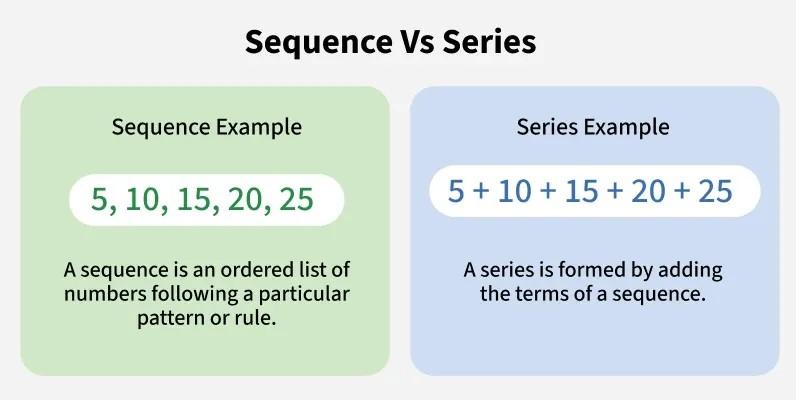
Basic difference between Sequence and Series
**Sequence
A **sequence is an ordered list of numbers arranged according to a certain rule or pattern. Each number in a sequence is called a **term.
The terms of a sequence are usually denoted as:
a1, a2, a3, …, an, …
The subscript indicates the **position of each term within the sequence:
- First term = a1
- Second term = a2
- Third term = a3
The nth term is the number at the nth position of the sequence and is denoted by an. This term is also called the general term of the sequence.
**For example, the sequence is 2, 4, 6, 8, 10, 12, . . .
- Here, 2 is the first term, 4 is the second term,6 is the third term, and so on.
- The dots at the end (. . .) indicate that the sequence continues indefinitely.
- This sequence has a constant difference (common difference) of 2, as each term is obtained by adding 2 to the previous term.
**The sequence can be classified into different types:
- **Arithmetic Sequence - An arithmetic sequence is defined as a sequence of numbers in which the difference between one term and the next term remains constant.
- **Geometric Sequence - A geometric sequence is a sequence of numbers where each term after the first is found by multiplying the previous term by a fixed, non-zero number called the common ratio.
- **Harmonic Sequence - Harmonic Sequence is defined as a sequence of real numbers obtained by taking the reciprocals of an Arithmetic Progression that excludes 0.
- **Fibonacci Sequence - The Fibonacci Sequence is a series of numbers starting with 0 and 1, where each succeeding number is the sum of the two preceding numbers.
**Series
A **series is defined as the sum of terms of a sequence, where the order of the terms typically matters. Series can be classified into **finite and **infinite, depending on whether the underlying sequence has a finite or infinite number of terms.
- A **finite series has a definite number of terms and thus an end.
- An **infinite series continues indefinitely without ending.
**Example:
- Finite series: 1 + 3 + 5 + 7 + 9
- Infinite series: 1 + 3 + 5 + 7 + …
**Different types of series include:
- **Geometric Series- In a Geometric Series, every next term is the multiplication of its Previous term by a certain constant, and depending upon the value of the constant, the Series may increase or decrease.
- **Harmonic Series - Harmonic series is the inverse of an arithmetic progression. In general, the terms in a harmonic progression can be denoted as 1/a, 1/(a + d), 1/(a + 2d), 1/(a + 3d) …. 1/(a + nd).
- **Power Series- Power series is a type of infinite mathematical series that involves terms with a variable raised to increase powers anto infinite level.
- **Alternating Series - The Alternating Series is a mathematical series where the sign of each term alternates between the positive and negative terms.
- **Exponent Series- An exponential series is an infinite series representation of the exponential function, often used to express the function in a form that is easier to manipulate mathematically.
Sequence vs Series
This table comprises differences between sequence and series :
| Sequence | Series |
|---|---|
| Sequence elements are placed in a particular order following a particular set of rules. | In series, the order of the elements is not necessary. |
| It is just a collection of elements in a particular pattern. | It is a sum of elements that follows a pattern. |
| Represented as a1, a2, a3...... | Represented as Sn = a1 + a2 + a3 + a4.... |
| The order of appearance of the number is important. | Finite series sums are order-independent (due to commutativity).Infinite series can change sums based on term order. |
| Finite Sequence: 1, 2, 3, 4, 5 | Finite Series: 1 + 2 + 3 + 4 + 5 |
| Infinite Sequence: 1, 2, 3, 4....... | Infinite Series: 1 + 2 + 3 + 4 + 5..... |
| A sequence is just a list of numbers. | A series is the **summation of a sequence’s terms. |
| Used in computer science, physics, and patterns. | Used in calculus, economics, and physics for application. |
**Related Articles:
Practice Questions on Difference between Series and Sequence
**Question 1: Identify the sequence type: 3, 6, 12, 24, 48, …
**Answer:
**Geometric Sequence (Common ratio = 2).
**Question 2: Determine if the sequence is arithmetic, geometric, or harmonic: 5, 9, 13, 17, 21, …
**Answer:
**Arithmetic Sequence (Common difference = 4).
**Question 3: Classify the sequence: 1, 1/2, 1/3, 1/4, 1/5, …
**Answer:
**Harmonic Sequence (Reciprocals form an arithmetic sequence: 1, 2, 3, 4, 5, …).
**Question 4: Identify the pattern: 0, 1, 1, 2, 3, 5, 8, …
**Answer:
**Fibonacci Sequence (Each term is the sum of the two preceding terms).