What are Terms in an Expression? (original) (raw)
Last Updated : 23 Jul, 2025
Let us learn about what an algebraic expression is before learning about the terms of an algebraic expression. An algebraic expression is a concept of expressing numbers by using letters such as a, b, m, n, x, y, z, etc. without specifying their actual values.
An algebraic expression is a mathematical statement where variables have been combined using basic arithmetic operations such as addition, subtraction, multiplication, or division. The variables are the unknown values such as a, b, x, y, z, etc. A coefficient is a value that is placed before and multiplied by a variable, while a constant is a fixed numerical value.
Terms in Algebraic Expressions
Variables, coefficients, constants, and terms are different components of an algebraic expression. For example, mx + c is an algebraic expression, where "m" is the coefficient, "x" is the variable, and "c" is a constant. "mx" and "c" are terms of the given algebraic expression.

Algebraic Expressions
- **Variable: A variable is a symbol in an algebraic expression that doesn't have a fixed value. In the above-given figure, x is the variable that can take any value. In mathematics, some examples of variables are a, b, p, q, x, y, z, etc.
- **Constant: Contrarily, a constant is a symbol with a fixed numerical value. Every number is a constant, and some examples of constants are 6, -1, (2/3), -(4/5), √7, etc. × ÷
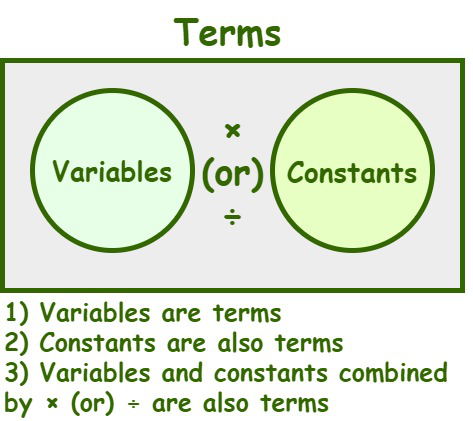
- **Term: A term might be a variable alone or a constant alone (or) both variables and constants which are combined by multiplication or division. Some examples of terms are -3a, 6xy, (x/2), √(8x), etc. Here, -3, -9, 1/5, and 2/3 are coefficients.
- **Coefficient: A coefficient is a value that is placed before and multiplied by a variable. If -3a, 6xy, (x/2), √(8x), etc are some terms, then -3, -9, 1/5, and 2/3 are coefficients.
Like and Unlike Terms
- **Like Terms: Like terms are those that have the same variables, and each variable has the same exponent power on them. **For example, 7x 2 and -5x 2 are like terms. Both of them have the same variable x and also their exponents are the same, i.e., 2.
- **Unlike Terms: Unlike terms are those that don't have the same variable and cannot be raised to the same power. **For example, 4ab and 9b 2 are unlike terms.
**Example: Determine the like terms in the given algebraic expression: 4x 2 − 12x − 3x 3 + 8x + 10.
**Solution:
Given expression: 4x2 − 12x − 3x3 + 8x + 10
= 4x2 + (−12x) + (−3x3) + 8x + 10
We know that like terms are those that have the same variables.
Here, (−12x) and 8x are like terms, while 4x2, (−3x3) and 10 are unlike terms.
Types of Algebraic Expressions
There are various kinds of algebraic expressions depending upon the number of terms, and the highest degree of terms.
**Types of algebraic expressions depending upon the number of terms
| Type of Algebraic Expression | Definition | Examples |
|---|---|---|
| Monomial | An algebraic expression with one term is a monomial. | 12ab, 3x2, 2p/7, etc. |
| Binomial | An algebraic expression with two monomials is a binomial. | 3x+6y, 8p2+5q, etc |
| Trinomial | An algebraic expression with three monomials is a trinomial. | 2x+4y+9z, etc |
| Polynomial | An algebraic expression having two or more terms with non-negative exponents is a polynomial. | ax2+bx+c, 5x3+2y+4xz+8, etc. |
**Types of Algebraic Expressions depending upon the Highest Degree of Terms
When the polynomial is represented in its standard form, the degree is the highest integral power of the variables of its terms. If the term has more than one variable, then the degree is equal to the sum of the exponents of the variables.
- **First Degree: A first-degree polynomial is an algebraic expression whose highest degree is "1". 4a, (-3x + 5y), m, etc are examples of first-degree polynomials.
- **Second Degree: A second-degree polynomial is an algebraic expression whose highest degree is "2". (ax2+bx+c), (7ab - 2), etc are examples of second-degree polynomials.
- **Third Degree: A third-degree polynomial is an algebraic expression whose highest degree is "3". (7y3+2x2y+5xy-6), (4mn - m3 + 9), etc examples of third-degree polynomials.
and so on.
Algebraic Formulae
The general algebraic formulas we use for solving the expressions or equations are:
- (x + a) (x + b) = x2 + x(a + b) + ab
- (a + b)2 = a2 + 2ab + b2
- (a – b)2 = a2 – 2ab + b2
- (a + b)2 + (a – b)2 = 2 (a2 + b2)
- (a + b)2 – (a – b)2 = 4ab
- a2 – b2 = (a – b)(a + b)
- (a + b + c)2 = a2 + b2 + c2 + 2ab + 2bc + 2ca
- (a + b)3 = a3 + b3 + 3ab(a + b)
- (a – b)3 = a3 – b3 – 3ab(a – b)
- a3 – b3 = (a – b)(a2 + ab + b2)
- a3 + b3 = (a + b)(a2 – ab + b2)
- a3 + b3 + c3 – 3abc = (a + b + c)(a2 + b2 + c2 – ab – bc – ca))
Coefficient in Algebric Expression
A coefficient is a number multiplied by a variable. Coefficient is a numerical factor that accompanies a variable or is multiplied by the variable in a term. It signifies the number by which the variable is scaled.
For instance, in the term 7x,7 is the coefficient. If a variable appears without an explicit numerical factor, it has an implied coefficient of 1, such as in the term z where the coefficient is 1. Similarly, in the expression, Similarly, in the expression 3??, 3 is the coefficient.
7 is the coefficient of the term –7ab2.
When there is no numerical factor in a term, its coefficient is taken as +1. For example, in the term x2y3, the coefficient is +1.
In the term –x, the coefficient is -1.
Similar Reads
| What is an Expression and What are the types of Expressions? |
|---|
| Expression Evaluation |
| Arithmetic Expression Evaluation |
| Regular Expressions, Regular Grammar and Regular Languages |
Solved Examples based on Algebraic Expressions
**Example 1: Determine the variable, coefficient, constant, and terms of the algebraic expression 31mn – 16m + 4n + 19.
**Solution:
Given expression: 31mn – 16m + 4n + 19
= 31mn + (–16m) + 4n + 19
Variables: mn, m, and n.
Terms: 31mn, (–16m), 4n, and 19.
Constant: 19
Coefficients: 31 is the coefficient of mn,
–16 is the coefficient of m, and
4 is the coefficient of n.
**Example 2: Identify the terms, like terms, coefficients, and constants in the expressions given below.
**a) 8xy − 13x 2 + 14x + 5y − 21
**b) x 2 + 5x + 7 − 15x
**Solution:
**a) Given expression: 8xy − 13x2 + 14x + 5y − 21
= 8xy + (−13x2) + 14x + 5y + (−21)
The terms of the given expression are 8xy, (−13x2), 14x, 5y, and (−21).
We know that like terms are those that have the same variables.
The given expression doesn't have any like terms.
Constant: (−21).
8 is the coefficient of xy, (−13) is the coefficient of x2, 14 is the coefficient of x, and 5 is the coefficient of y.
Hence, the coefficients are 8, (−13), 14, and 5.
**b) Given expression: x2 + 5x + 7 − 15x
= x2 + 5x + 7 + (−15x)
The terms of the given expression are x2, 5x, 7, and (−15x).
We know that like terms are those that have the same variables.
Here the like terms are 5x and (−15x).
Constant: 7.
1 is the coefficient of x2, 5 is the coefficient of x, and (−15) is the coefficient of x.
Hence, the coefficients are 1, 5, (−15).
**Example 3: **Determine the value of y in the equation 5y − 13 = 2y + 17.
**Solution:
Given,
5y − 13 = 2y + 17
⇒5y − 2y = 17 + 13
⇒ 3y = 30
⇒ y = 30/3
⇒ y = 10.
Therefore the value of y in the equation 5y − 13 = 2y + 17 is 10.
**Example 4: Identify the terms, like terms, coefficients, and constants of the algebraic expression 10x 3 + 71x 2 + 91x − 20x 2 + 61.
**Solution:
Given expression: 10x3 + 71x2 + 91x − 20x2 + 61
= 10x3 + 71x2 + 91x + (−20x2) + 61.
Terms: 10x3, 71x2, 91x , (−20x2), and 61.
Constant: 61
Coefficients: 10 is the coefficient of x3, 71 is the coefficient of x2, 91 is the coefficient of x, and (−20) is the coefficient of x2.
Like terms: 71x2 and (−20x2).