Projectile Motion for Vertical Displacement (original) (raw)
Last Updated : 23 Jul, 2025
A projectile is any object launched into space with only gravity acting on it. Gravity is the primary force that influences a projectile's motion. This doesn't mean that other forces don't act on the projectile, but their impact is minimal compared to gravity. The trajectory of a projectile is the path it follows. Some examples of a projectile in real life are a bullet fired from a gun, a javelin thrown by an athlete, or an arrow released from a bow.
What is Projectile Motion?
- When an object is launched into the air, it travels along a curved path under constant acceleration that is directed toward the center of the Earth. The object launched or thrown into the air is called a projectile. Some initial force must be imparted upon an object to become a projectile, and the motion of a projectile is referred to as **projectile motion.
- When an object is first launched into the air, it goes at a certain speed, known as the initial speed or velocity. The angle of projection describes the angle with respect to the horizontal when the object is launched.
- The maximum height, range, and time of flight of a projectile are determined by the initial speed and angle of projection of the projectile. The force of gravity is the only force acting on an object after it has been launched into the air, as the other forces have a negligible impact compared to gravity.
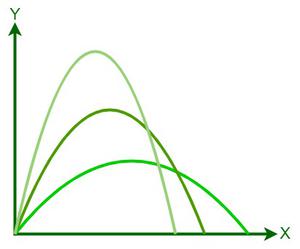
Trajectories of projectiles under various initial conditions
- The maximum height and range of the projectile will change if there is an increase or decrease in the initial velocity or angle of projection. The height and range will increase with an increase in the initial velocity, while the impact of the change in angle of projection is different on the maximum height and range.
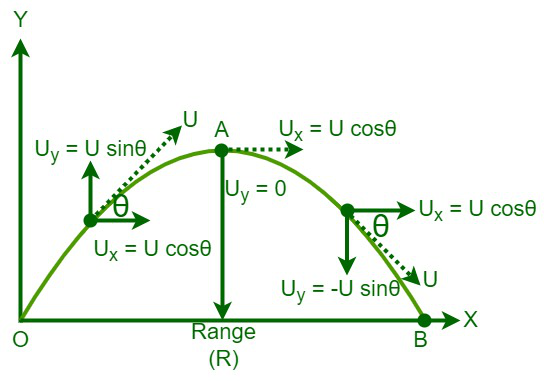
- The figure depicts the projectile motion of an object that was propelled at an angle of θ with an initial velocity of '****U '**and 'O' is the point of projection. The object will ascend along a parabolic path while being decelerated by gravity until it reaches its maximum height.
- The vertical component of the velocity diminishes as the object travels up and becomes zero when it reaches the maximum height. Following that, the object will drop till it touches the ground while being pulled downward by gravity.
- The horizontal range, or range ****(OB),** is the horizontal distance between the point of projection and the landing location. ****"Time of flight"** is the total time taken by the object from reaching **O to B.
**An important concept in projectile motion is that there are two simultaneous independent rectilinear motions:
- **Along the x-axis (or) Horizontal motion: The initial velocity and angle of projection are the sole factors that affect the horizontal motion of an object.
- **Along the y-axis (or) Vertical motion: The initial conditions (initial velocity and angle of projection) and the acceleration due to gravity are the factors that affect the vertical motion of an object.
Equations of Motion for a Projectile
We can make use of various equations of motion to find different parameters related to projectile motion:
**If the initial velocity, acceleration, and time of flight are known, the final velocity can be determined using the formula below:
**v = u + at
Where '**u' is the initial velocity, '**a' is the acceleration, and 't' is the time of flight.
**We can also determine the displacement of a projectile using the initial velocity, acceleration, and time of flight, according to the formula below:
**s = u t+ ½ at 2
**If the time of flight is not given, and the displacement of the projectile is given, then the final velocity can be calculated using the formula below:
**v 2 = u 2 + 2as
**The initial velocity and angle of projection can be used to calculate the horizontal component of the initial velocity:
**U x = U cos θ
**The velocity in the horizontal direction will not change as the projectile will not experience acceleration in this direction since the acceleration due to gravity acts vertically down. Hence,
**V x = U x
**Furthermore, the range or horizontal displacement of a projectile is dependent on the horizontal component of the initial velocity and time of flight. The equation for the range or horizontal displacement of a projectile is given as:
**x = U x t
**x = U cosθ t
**Just like the horizontal component, the vertical component of the initial velocity also depends only on the initial velocity and angle of projection. It can be determined using the formula below:
**U y =U sin θ
**The velocity in the vertical direction will change as the projectile experiences acceleration due to gravity which acts vertically down. Hence,
**V y = U sinθ − gt
Vertical displacement of a projectile Motion
**The maximum height, or vertical displacement, of a projectile, depends on the initial velocity, acceleration due to gravity, and time of flight. The equation for the vertical displacement or maximum height of a projectile is given as:
**y = U y t − ½ gt 2
**y = U sinθ t − ½ gt 2
Where 'y' is the vertical displacement of a projectile
**U = initial velocity of the particle,
**t = time of flight,
**θ = angle of projection, and
**g = acceleration of gravity
How to find Vertical Displacement of Projectile Motion?
**To calculate the vertical displacement of a particle in projectile motion using a calculator, follow these steps:
**Step 1: Enter the initial velocity and time of flight into the corresponding input fields.
**Step 2: Input ****'x**' in the 'Vertical Displacement at Time' field.
**Step 3: Click the "Calculate the Unknown" button to get the result.
**Step 4: The vertical displacement value will be displayed in the output field.
Practice Problems
**1. A ball is launched at a velocity of 35 m/s in a direction, making an angle of 60° with the horizontal. Determine the vertical projectile displacement of the ball if the time interval is 4 seconds. (g = 9.8 m/s 2 )
**Given data,
**Velocity (u) = 35 m/s
**Time interval = 4 sec
**Angle (θ) = 60°
**Acceleration due to gravity = 9.8m/s2
**We have,
**Vertical displacement in the projectile motion of a particle is given by:
**y = u sinθ t – ½ g t2
**y = 35 × sin 60° × 4 - ½ × 9.8 × (4)2
= 121.243 - 78.4 ****{sin 60° = √3/2}**
**= 42.84 m
**Hence, the vertical projectile displacement of the particle is 42.84 m.
**2. Determine the vertical projectile displacement of a body launched at 50 m/s in a direction that forms a 45° angle with the horizontal and the time interval is 2.5 sec. (g = 9.8 m/s 2 )
**Given data,
**Velocity (u) = 50 m/s
**Time interval = 2.5 sec
**Angle (θ) = 45°
**Acceleration due to gravity = 9.8m/s2
**We have,
**Vertical displacement in the projectile motion of a particle is given by:
**y = u sinθ t – ½ g t 2
**y = 50 × sin 45° × 2.5 - ½ × 9.8 × (2.5)2
= 88.388 - 30.625 {sin 45° = 1/√2}
= 57.763 m
**Hence, the vertical projectile displacement of the particle is 57.763 m.
**3. Find the velocity at which an object is launched, making an angle of 30° with the horizontal, and the vertical projectile displacement of the ball, and the time interval are 35m and 5 seconds. (g = 10 m/s 2 )
**Given data,
**The vertical projectile displacement (y) = 35 m
**Time interval = 5 sec
**Angle (θ) = 30°
**Acceleration due to gravity = 10 m/s2
**We have,
**Vertical displacement in the projectile motion of a particle is given by:
**y = u sinθ t – ½ g t 2
⇒ 35 = u × sin 30° × 5 - ½ × 10 × (5)2
⇒ 35 = 2.5 u - 125 {sin 30° = ½}
⇒ 2.5u = 160 ⇒ u = 64 m/s
**Hence, the velocity at which an object is launched is 64 m/s
**4. A ball is launched at a velocity of 40 m/s and the vertical projectile displacement of the ball and the time interval are 45m and 3.5 seconds. Now, determine the angle that the ball forms with the horizontal. (g = 10 m/s 2 )
**Given data,
**The vertical projectile displacement (y) = 45 m
**Time interval = 3.5 sec
**Velocity (u) = 40 m/s
**Acceleration due to gravity = 10 m/s2
**We have,
**Vertical displacement in the projectile motion of a particle is given by:
**y = u sinθ t – ½ g t 2
⇒ 45 = 40 × sin θ × 3.5 – ½ × 10 × (3.5)2
⇒ 45 = 140 sin θ – 61.25
⇒ 140 sin θ = 45 + 61.25 = 106.25
⇒ sin θ = 106.25/140 = 0.7589
⇒ θ = sin-1(0.7589) = 49.37°
Conclusion
In projectile motion, gravity influences the vertical displacement, creating a parabolic path. The vertical motion operates independently of the horizontal motion, and the vertical displacement can be determined using kinematic equations, taking into account the initial vertical velocity, time, and acceleration due to gravity.
**Related Reads,