Software Development Life Cycle (SDLC) Models (original) (raw)
Last Updated : 23 Jul, 2025
**Software development models are various processes or methods that are chosen for project development depending on the objectives and goals of the project. Many development life cycle models have been developed to achieve various essential objectives. Models specify the various steps of the process and the order in which they are executed.
What is Software Modeling?
**Software modeling is the process of creating abstract representations of a software system. These models serve as blueprints that guide developers, designers, and stakeholders through the system’s structure, behavior, and functionality.
By using diagrams and various modeling languages, software modeling helps in visualizing and understanding the complex aspects of the software, making it easier to plan, develop, and manage the system.
**Top 8 Software Development Models
Choosing the right model is very important for the **Development of a Software Product or application. Development and testing processes are carried out based on the model.
Different companies, depending on the software application or product, choose the type of development model whichever is appropriate for their application. But these days '**Agile Methodology' is the most popular in the market.
Let's look at the every model in brief one by one:-

Popular-Software-Development-Models
1. Agile Model
**Agile Development Model is a combination of iterative and incremental models, that is, it is made up of iterative and incremental models.
- In Agile model, focus is given to process adaptability and customer satisfaction.
- In earlier times, iterative waterfall model was used to create software. But in today's time developers have to face many problems. The biggest problem is that in the middle of software development, the customer asks to make changes in the software. It takes a lot of time and money to make these changes. So to overcome all these shortcomings, the agile model was proposed in the 1990s.
The Agile Model was created mainly to make changes in the middle of **software development so that the software project can be completed quickly.
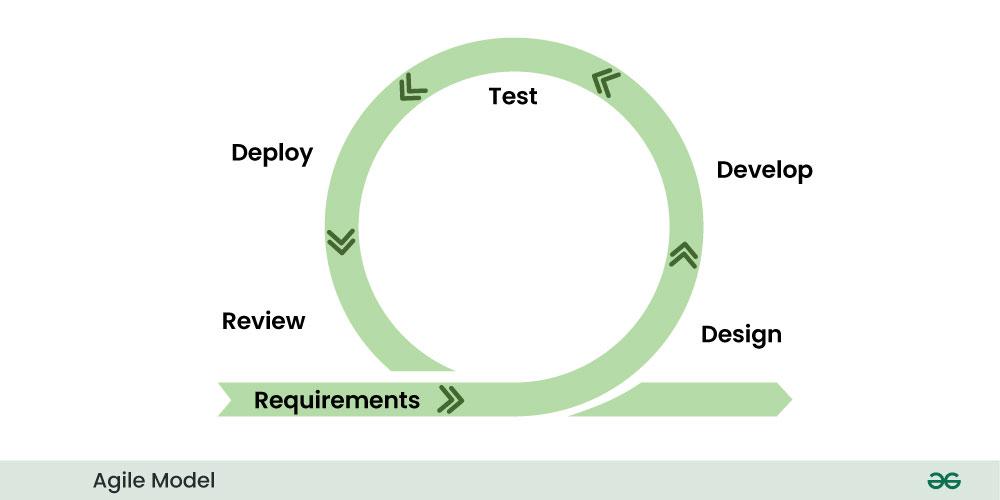
Agile Model
- In the agile model, the software product is divided into small incremental parts. In this, the smallest part is developed first and then the larger one.
- And each incremental part is developed over iteration.
- Each iteration is kept small so that it can be easily managed. And it can be completed in two-three weeks. Only one iteration is planned, developed and deployed at a time.
2. Waterfall Model
**Waterfall Model is a famous and good version of **SDLC(System Development Life Cycle) for software engineering. The waterfall model is a linear and sequential model, which means that a development phase cannot begin until the previous phase is completed. We cannot overlap phases in waterfall model.
Phases of Waterfall model

Waterfall Model
Similarly waterfall model also works, once one phase of development is completed then we move to the next phase but cannot go back to the previous phase. In the waterfall model, the output of one phase serves as the input for the other phase.
3. V-Model
**V-Model is an SDLC model, it is also called Verification and Validation Model. V-Model is widely used in the **Software Development Process, and it is considered a disciplined model. In V-Model, the execution of each process is sequential, that is, the new phase starts only after the previous phase ends.
Phases of V-model

V-Model
- It is based on the association of testing phase with each development phase that is in V-Model with each development phase, its testing phase is also associated in a V-shape in other words both **Software Developmentand testing activities take place at the same time.
- So in this model, Verification Phase will be on one side, Validation Phase will be on the other side that is both the activities run simultaneously and both of them are connected to each other in V-Shape through Coding Phase, hence it is called V-Model.
- V-Design: In V-Design the left side represents the development activity, the right side represents the testing activity.
4. Incremental Model
In **Incremental Model, the **Software Development Process is divided into several increments and the same phases are followed in each increment. In simple language, under this model a complex project is developed in many modules or builds.

Incremental Model
- For example, we collect the customer's requirements, now instead of making the entire software at once, we first take some requirements and based on them create a module or function of the software and deliver it to the customer. Then we take some more requirements and based on them add another module to that software.
- Similarly, modules are added to the software in each increment until the complete system is created. However, the requirements for making a complex project in multiple iterations/parts should be clear.
- If we understand the entire principle of Incremental methodology, then it starts by developing an initial implementation, then user feedback is taken on it, and it is developed through several versions until an accepted system is developed. Important functionalities of the software are developed in the initial iterations.
Each subsequent release of a software module adds functions to the previous release. This process continues until the final software is obtained.
5. RAD Model
**RAD Model stands for rapid application development model. The methodology of RAD model is similar to that of incremental or waterfall model. It is used for small projects.
The main objective of RAD model is to reuse code, components, tools, processes in project development.

RAD Model
- If the project is large then it is divided into many small projects and these small projects are planned one by one and completed. In this way, by completing small projects, the large project gets ready quickly.
- In RAD model, the project is completed within the given time and all the requirements are collected before starting the project. It is very fast and there are very less errors in it.
6. Iterative Model
In **Iterative Model we start developing the software with some requirements and when it is developed, it is reviewed. If there are requirements for changes in it, then we develop a new version of the software based on those requirements. This process repeats itself many times until we get our final product.
Through this diagram you can understand the Interactive model.

Iterative Model
- So, in Iterative model a software is developed by following several iterations. Iteration means that we are repeating the Development Process again and again. For example, we develop the first version of the software following the SDLC process with some software requirements.
- After the first version is developed, if there is a need to change the software , then a new version is developed with the second iteration. Now again we will see if the new version is enough, if not then we will make changes in it with the third iteration. The iteration will be repeated until the complete software is ready.
- The basic concept of Iterative model is that the software should be developed through repeated cycles or what we also call iteration and only a small part of it should be developed at a time. This model was developed to overcome the drawbacks of the classical waterfall model.
7. Spiral Model
**Spiral Model is a software development process model. This model has characteristics of both iterative and waterfall models. This model is used in projects which are large and complex. This model was named spiral because if we look at its figure, it looks like a spiral, in which a long curved line starts from the center point and makes many loops around it. The number of loops in the spiral is not decided in advance but it depends on the size of the project and the changing requirements of the user. We also call each loop of the spiral a phase of the software development process.
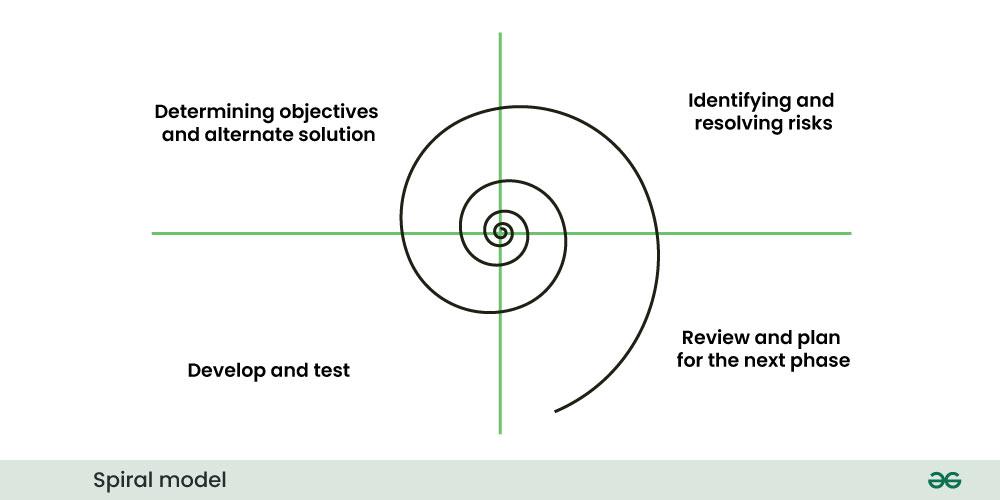
Spiral Model
In Spiral Model the entire process of software development is described in four phases which are repeated until the project is completed.
A software project goes through these loops again and again in iterations. After each iteration a more and more complete version of the software is developed. The most special thing about this model is that risks are identified in each phase and they are resolved through prototyping. This feature is also called Risk Handling.
Since it also includes the approaches of other SDLC models, it is also called Meta Model. It was first developed by Barry Boehm in 1986.
8. Prototype model
**Prototype Model is an activity in which prototypes of software applications are created. First a prototype is created and then the final product is manufactured based on that prototype.
One problem in this model is that if the end users are not satisfied with the prototype model, then a new prototype model is created again, due to which this model consumes a lot of money and time.

Prototype Model
- The prototype model was developed to overcome the shortcomings of the waterfall model.
- This model is created when we do not know the requirements well.
- The specialty of this model is that this model can be used with other models as well as alone.
Why companies are shifting toward agile Software Development models?
In earlier times, iterative waterfall model was used to create software. But in today's time developers have to face many problems. The biggest problem is that in the middle of software development, the customer asks to make changes in the software. It takes a lot of time and money to make these changes. The agile model was created mainly to make changes in the middle of Software Development so that the software project can be completed quickly.
Agile focuses on customer-centric approach that constantly take feedback from customer and make changes in the middle of software developer according to their needs and expectation. Agile Methodologies like scrum adopt iterative and incremental approach this accelerate the time-to-market for new features and product.
Conclusion
Choosing the right software development model is important for the **Success of a Project. Each model offers unique advantages and is suitable for **Different Types of Projects. Agile Methodologies, due to their flexibility and customer-centric approach, are increasingly popular in the industry. By adopting Agile, companies can accelerate time-to-market and better adapt to changing requirements, leading to higher customer satisfaction and **Successful Project Outcomes.