Polling in System Design (original) (raw)
Last Updated : 23 Jul, 2025
Polling in system design is an important method for gathering data or monitoring device status at regular intervals. This article provides an overview of polling, its importance, applications, strategies, and challenges also.
Important Topics for Polling in System Design
- What is Polling?
- Importance of Polling in System Design
- Polling Mechanisms in System Design
- Use Cases of Polling
- Polling Strategies
- Benefits of Polling
- Challenges of Polling
- Alternatives to Polling
- Examples of Polling
What is Polling?
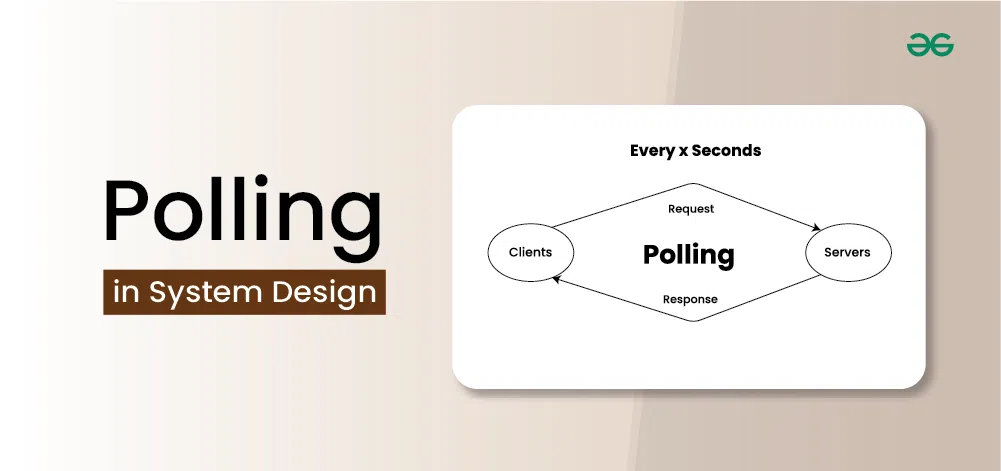
Polling is a method used in system design to check the status or gather data from multiple sources periodically. It involves continuously querying or checking devices, or other components at predetermined intervals to see if there's any new information or if certain conditions have been met.
- In the context of system designing, polling typically involves a central system (like a server) regularly sending requests to multiple client devices or nodes to gather information or to determine their status.
- This can include checking for updates, retrieving data, or verifying if certain tasks have been completed.
Importance of Polling in System Design
Polling plays a significant role in system design across various domains. Here's why it's important:
- **Resource Management: Polling allows system designers to manage resources efficiently. By scheduling polling intervals, they can balance the need for timely data updates with the resources available in the system.
- **Compatibility: Polling can work with a wide range of devices and systems, making it a versatile choice for system design. It doesn't require specialized hardware or software support beyond basic communication protocols, making it accessible in many contexts.
- **Fault Detection and Handling: Polling can help detect faults or failures in devices or processes. If a source fails to respond to polling requests within a reasonable time frame, it can trigger an alert or initiate a recovery process, enhancing system reliability.
- **Scalability****:** Polling can scale to accommodate a large number of sources. By managing polling intervals and priorities, system designers can ensure that critical data sources are queried more frequently while less critical ones are queried less often, maintaining system performance and responsiveness.
- **Integration: Polling can be seamlessly integrated into existing systems and architectures. Whether it's a standalone application or part of a larger distributed system, polling can be adapted to suit the specific requirements and constraints of the system design.
Polling Mechanisms in System Design
Polling mechanisms come in various forms, each tailored to different requirements and system architectures. Below are some common polling mechanisms:
- **Regular Polling: This is the simplest form of polling, where the controlling entity queries the source at regular intervals. The interval can be fixed or dynamically adjusted based on factors such as system load or the urgency of data updates.
- **Adaptive Polling: In adaptive polling, the polling interval is dynamically adjusted based on factors such as the rate of change of data, the responsiveness of the source, or the current system load. This helps optimize resource usage and responsiveness.
- **Priority-Based Polling: In systems where multiple sources need to be polled, priority-based polling ensures that more critical sources are queried more frequently than less critical ones. This prioritization helps ensure that resources are allocated efficiently based on the importance of the data.
- **Grouped Polling: Grouped polling involves grouping similar sources together and polling them collectively rather than individually. This reduces overhead by minimizing the number of polling requests sent and responses received, especially useful when dealing with a large number of sources.
- **Event-Driven Polling: In event-driven polling, the controlling entity triggers a polling request in response to specific events or conditions, rather than at regular intervals. This approach helps reduce unnecessary polling and can improve responsiveness in systems where data updates are sporadic.
- **Asynchronous Polling: In asynchronous polling, the controlling entity initiates polling requests asynchronously, allowing it to continue executing other tasks while waiting for responses. This approach improves overall system throughput and responsiveness, especially in systems with high concurrency.
Use Cases of Polling
Polling mechanisms find applications in various fields and systems due to their versatility and effectiveness in gathering data from multiple sources. Here are some common use cases and applications:
- **Network Monitoring:
- Polling is extensively used in network monitoring systems to collect data about network performance, traffic, and device status.
- Network monitoring tools regularly poll network devices such as routers, switches, and servers to gather information about bandwidth usage, packet loss, latency, and error rates.
- **Server Monitoring:
- Polling is employed in server monitoring systems to collect metrics related to server health, resource usage, and performance.
- Monitoring agents installed on servers regularly poll system metrics such as CPU usage, memory utilization, disk I/O, and network traffic to detect issues, optimize resource allocation, and ensure system reliability.
- **IoT Device Management:
- Polling is utilized in IoT (Internet of Things) systems to manage and monitor connected devices.
- IoT platforms use polling mechanisms to collect data from sensors, actuators, and IoT devices deployed in various environments, enabling real-time monitoring, analysis, and control of IoT infrastructure.
- **Database Monitoring:
- Polling is employed in database monitoring systems to collect performance metrics, query execution statistics, and database health information.
- Monitoring tools regularly poll database servers to gather data about database connections, transactions, query throughput, and resource utilization, helping database administrators optimize database performance and troubleshoot issues.
- **Application Performance Monitoring (APM):
- Polling is employed in APM solutions to collect data about application performance, response times, and user experience.
- Monitoring agents deployed on servers, containers, or virtual machines regularly poll application metrics such as response times, error rates, and resource utilization, enabling developers and IT operations teams to identify performance bottlenecks, troubleshoot issues, and optimize application performance.
Polling Strategies
Polling strategies refer to the various approaches and techniques used to optimize the polling process for efficiency, responsiveness, and resource utilization. Here are some common polling strategies:
- **Fixed Interval Polling:
- In this strategy, the controlling entity polls the data source at regular fixed intervals.
- This approach is simple to implement but may lead to inefficient resource usage if the polling interval is too short or unnecessary if it's too long.
- **Event-Driven Polling:
- Event-driven polling triggers the polling process in response to specific events or conditions rather than at regular intervals.
- This approach reduces unnecessary polling and improves responsiveness, especially in systems where data updates are sporadic or unpredictable.
- **Exponential Backoff:
- Exponential backoff is a technique used to handle situations where the data source is temporarily unavailable or overloaded.
- Instead of continuously retrying failed polling requests, the polling interval is exponentially increased with each consecutive failure, allowing the source time to recover before retrying.
- **Threshold-Based Polling:
- Threshold-based polling triggers the polling process when certain conditions or thresholds are met.
- For example, polling may be initiated when a certain level of data accumulation occurs or when a specific event or condition is detected, ensuring that data is collected when it's most relevant.
- **Asynchronous Polling:
- Asynchronous polling initiates polling requests asynchronously, allowing the controlling entity to continue executing other tasks while waiting for responses.
- This improves overall system throughput and responsiveness, particularly in systems with high concurrency.
- **Grouped Polling:
- Grouped polling involves grouping similar data sources together and polling them collectively rather than individually.
- This reduces overhead by minimizing the number of polling requests sent and responses received, especially useful when dealing with a large number of sources.
Benefits of Polling
Below are the benefits of Polling:
- **Predictability: Polling allows for predictable data collection intervals, which can be beneficial for planning and resource allocation in systems where timing is crucial.
- **Control: Polling provides control over when data is collected, allowing system designers to manage resources effectively and prioritize data sources based on their importance.
- **Compatibility: Polling can work with a wide range of devices and systems, making it a versatile choice for system design. It doesn't require specialized hardware or software support beyond basic communication protocols.
- **Fault Tolerance****:** Polling can help detect faults or failures in devices or processes. If a source doesn't respond to polling requests within a reasonable time frame, it can trigger an alert or initiate a recovery process, enhancing system reliability.
- **Simplicity: Polling is often simpler to implement than other methods like interrupts or event-driven programming, especially in systems where hardware or software support for those features is lacking.
Challenges of Polling
Below are the challenges of Polling:
- **Resource Overhead: Constantly polling devices or processes can consume significant system resources, especially in large-scale systems with many sources. This can lead to inefficiency and increased operating costs.
- **Latency****:** Polling introduces latency because data is only collected at set intervals, rather than being available immediately when it's produced. In systems where real-time data is critical, latency introduced by polling can be a significant drawback.
- **Synchronization Issues: Polling multiple sources introduces synchronization challenges, especially if sources have different update rates or response times. Maintaining consistency and coordination between polled sources can be complex, particularly in distributed systems.
- **Scalability: As the number of sources to be polled increases, scalability becomes a challenge. Managing polling intervals, priorities, and resource allocation becomes more complex, and system performance may degrade if not handled properly.
- **Concurrency: In systems with high concurrency, coordinating multiple polling processes can be challenging. Ensuring that polling requests are processed efficiently and responses are handled in a timely manner requires careful design and implementation.
Alternatives to Polling
Several alternatives to polling exist, offering different approaches to data retrieval and system design. Here are some common alternatives:
- **Event-Driven Programming****:** In event-driven programming, systems respond to events triggered by external sources, such as user interactions or data updates. Event-driven systems are more responsive and efficient than polling-based systems since they only process data when events occur, reducing idle time and resource usage.
- **Push Notifications: Push notification systems send data from sources to recipients without the need for continuous polling. When new data becomes available, the source pushes the data to the recipient, eliminating the need for the recipient to poll for updates.
- **Message Queues****:** Message queue systems decouple producers of data from consumers, allowing data to be asynchronously processed without continuous polling. Producers push messages to a queue, and consumers retrieve messages from the queue as they become available.
- **Pub/Sub (Publish/Subscribe) Systems****:** Pub/Sub systems enable systems to subscribe to specific topics or channels and receive notifications when new data is published to those topics. This decouples data producers from consumers and allows for efficient distribution of data without continuous polling.
- **Remote Procedure Calls (RPC)****:** RPC systems allow systems to invoke procedures or functions on remote hosts and retrieve results without continuous polling. This enables efficient communication between distributed systems without the need for constant querying.
- **Caching****:** Caching systems store frequently accessed data locally, reducing the need for continuous polling of remote sources. By caching data, systems can improve performance and reduce latency, especially for read-heavy workloads.
Examples of Polling
Below are some examples of how polling can be used in system design:
- **Database Polling: In a system with a database backend, polling can be used to regularly query the database for new records or changes to existing records. For example, an e-commerce platform might poll the database every few seconds to check for new orders or updates to inventory levels.
- **API Polling: Many systems integrate with external APIs to exchange data. Polling can be used to periodically request data from these APIs. For instance, a weather application might poll a weather API every hour to get updated forecasts.
- **Monitoring Systems: In systems monitoring, polling is used to continuously check the health and performance of various components. This could involve polling CPU and memory usage, network latency, disk space, etc., on servers or other devices.
- **Notification Systems: Polling can be used to check for new notifications or messages. For example, a messaging app might poll the server every few seconds to check for new messages for the user.
- **File System Polling: In file processing systems, polling can be used to monitor directories for new files. For instance, a file upload service might periodically check a directory for new files to process.