Sympathetic Vibratory Physics | Color (original) (raw)
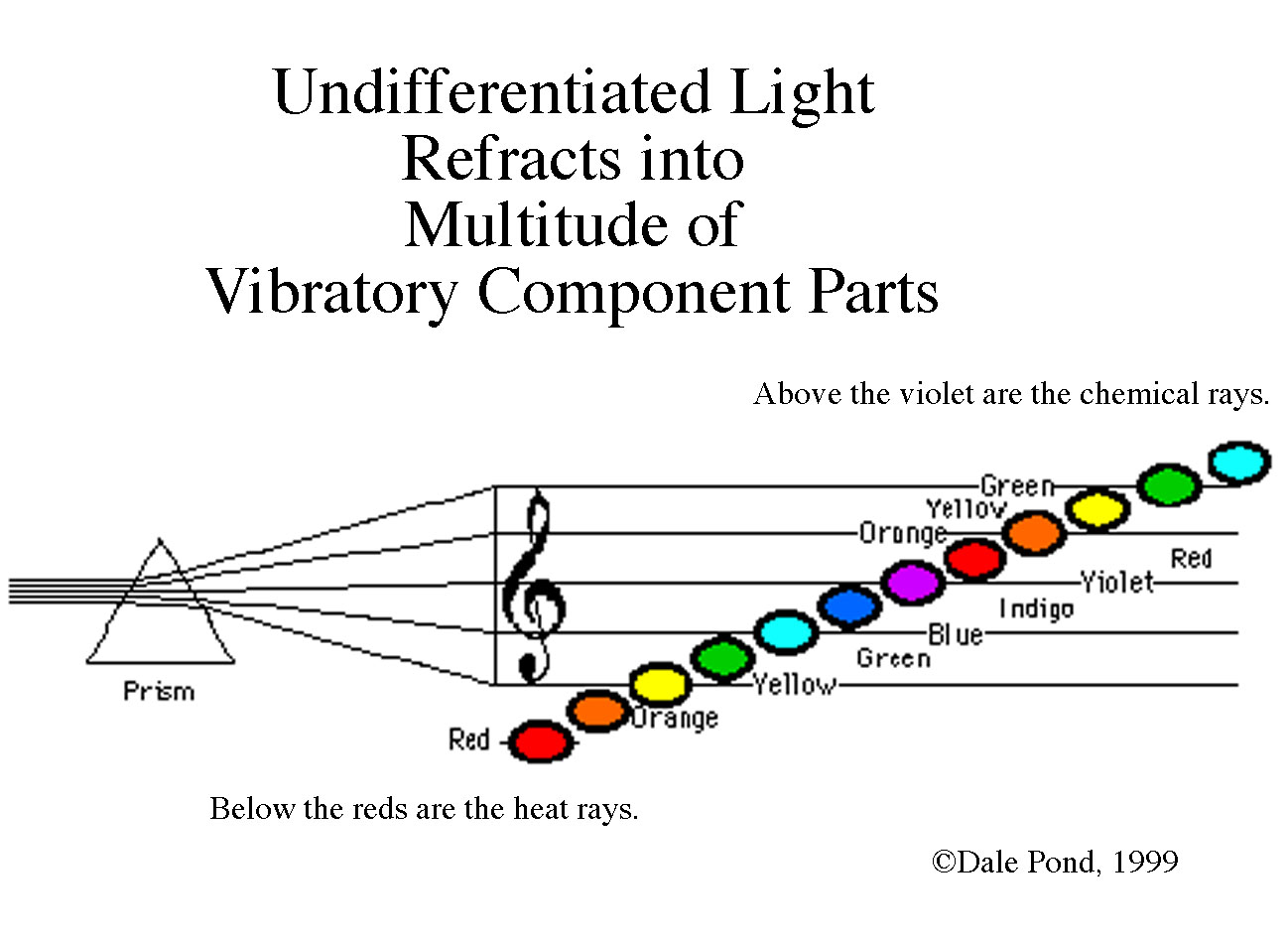
Likewise a fundamental music tone refracts or differentiates into the notes of its scale.
Colour. A term variously employed in mideval treatises on music to represent: a repetition of a sound in part music; purity of tone; a movement of the voice from the part; an alteration of rhythm by different voices; a purposely introduced for the sake of variety. [Stainer, John; Barrett, W.A.; A Dictionary of Musical Terms; Novello, Ewer and Co., London, pre-1900]
Biology
"That the different colors of the spectrum have an influence on vegetation has long been known. Plants grown under green glass soon die; under red glass they live a long time, but become pale and slender. Mr. Yung, of the University of Geneva, has placed the eggs of frogs and fishes in similar conditions, and found that violet light quickens their development; and blue, yellow, and light also, but in a lesser degree. Tadpoles, on the contrary, die sooner in colored light than in white light. As regards frogs, Mr. Yung has ascertained that their development is not stopped by , as some observers have supposed, but that the process is much slower than in the light."[Eclectic Magazine, 1880, pp 510]
"He [] has invented instruments which demonstrate in many variations the colours of sound, registering the of necessary vibrations to produce each . The transmissive sympathetic chord of B flat, third octave, when passing into inaudibility, would induce billions of billions of vibrations, represented by sound colour on a screen illuminated from a solar ray." [Bloomfield-Moore] [3rd octave]
"Colors, to be sure, will often affect the ." (299-1)
"Colors affect the , even as pollen does many another." (5511-1)
"Colors will also find an influence ... especially those not too severe, but the violet, ultra-violet, shades of green, of mode (mauve?) and . Though the others may make for a rigor oft in the entity, the delicate shades - or those which may be termed the - will influence the entity. When illness were to come about, soft music and the lighter shades or tones will quiet, where medicine would fail ... (may have stage or politics for vocation). In these fields the entity will gain the most; but the developing will come for the soul, for the portion, through music ... awakenings through color and song, and especially dirge..." (773-1)
"By color certain activities are also symbolized, - for instance, black indicates the whole combination of all. For, to material interpretation, white is the absence of color, black is the combination of them all. The dark blue indicates awakening; , healing; white, purity; gold, attaining. All of these and their varied shades indicate the activity; this applying to the stars as well as the sun or . The sun indicates strength and life, while the indicates change - and in one direction indicating the singleness of that activity through an individual experience, - the variations being indicated by the variations in color. Star, - the white, purity; the five-pointed, the whole senses of man indicated as attained to activity - the colors showing the variation; the forms of six, seven or eight pointed indicating the attainments, - as do the seven stars in a figure indicate the attaining to the seven particular centers in the body." (5746-1)
"We will find that colors influence the entity a great deal more, even, than musical forces in their tone, or the color in music. Drab colors and certain greens have an effect upon the entity that is almost such as to bring illness in the physical body; while purples or violets or shades of tan bring an exultant influence - tending to bring building influences to the entity." (482-124?)
"In those things that pertain to correlation of the or soul forces of the entity with its activities in colors, and inharmonious relationships: the tonal numbers are in F and C, while the colors should be - which denote the royalty of the associations and make for an influence in the vibrations about the entity. And this, with violet, should be about the when there is any disorder in the vibrations in the ; for the effect these have upon the relationships between the physical, mental and soul-developing forces ...would give strength to the activities in relationship with the ." (324-1)
"Each , each activity, each soul-entity vibrates better to this, that or other color... Colors are naturally the spiritualization of tone or sound..." (288-38)
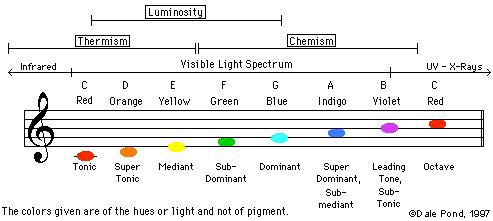
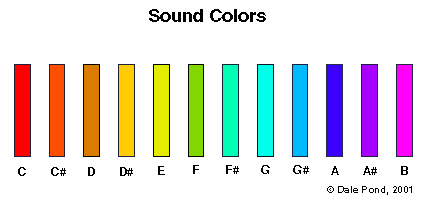
() There is a correspondence between color and music notes. For purposes the correspondences below are used. (Subject to change at any time for any reason.)
| Color | Note | |
|---|---|---|
| Dark Red | ||
| C | ||
| D | 1 | |
| E | 2 | |
| F | 3 | |
| G | 4 | |
| A | ||
| B | ||
| Bb |
See Table 12.02.01 - Wavelengths and Frequencies
Table 11.03 - Roots Powers of Two and Indig Numbers
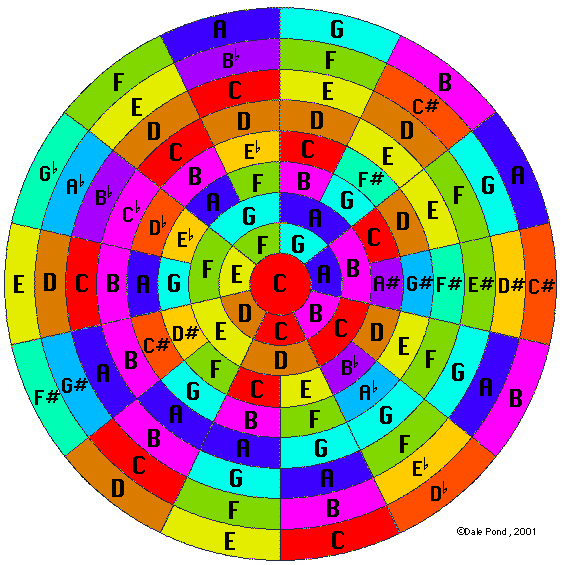
"The master-tone of each octave is the inheritance of the original of the thinking process of . These master-tones are the "inert gases" which are classified in the zero group of the Mendeleef table.
The state of of these inert gases is that of motion-in-inertia."
" is that state of which lies between any two masses.
"The inertial line, or is that dividing line, or , toward which all masses discharge their potential.
"It is the line, or , of lowest potential of two opposing areas of potential, where opposing pressures neutralize. This is the of minimum of two opposing areas.
"The master-tones which represent a state of motion-in-inertia and are the inert gases, bear the same relationship to the elements that white bears to the colors. They are a registration of them all. is not included in the spectrum, it has no place there. The inert gases should not be included in the elements. They have no place there. Of this more shall be written later in its proper place." [, The Universal One]
This of is characterised by the fact that the ratio between oxygen and its carbone is 4% : 96%, because all the remaining oxygen has been transformed into fertilising substances and then . Therefore the new of has the highest negative valency and is of . Certain factors relating to these processes should be noted: In the scientific synthesising process heat has a shrivelling effect on the decisive formative substance in its nascent state, while physical pressure ruptures its outer envelope. In the case of by means of cold flows the increasing on the developmental path acts to the potential. However, since the in the potential of the true formative substance is of a purely energetic nature, it would be unable to break through the outer envelope had this not been mechanically abraded through the and inner rotation (about itself and its own axis) caused by the increasing frictional pressure arising from the doubly increased of the whole . These differences demand the closest and . The of obtained by means of cold flows, binds itself into its own waste product (juvenile water). Therefore apart from a new, fresh and more highly cultured energy, an associated of the highest order is also created at the of the gradually transforming (internally reconstituted) stocks of old . This two-fold transformation represents the and the qualitative improvement of what has been quantitatively increased (the of ). The finished is a crystal-clear that has neither , nor , nor colour, because in this of all kinds of things are on the loose or have been loosed (emancipated), i.e. they have been raised to the [The Energy Evolution - Harnessing Free Energy from Nature, The Liquefaction of Coal by Means of Cold Flows]
On colours developing by the same laws as musical harmonies
—The physical properties of light and briefly considered
—If the laws are correctly gained, of tones and of colours will agree
—Quotation from a lecture by Professor W. F. Barrett on the order of sonorous and luminous wave-lengths
—Fountain of musical , E root of B; in colours yellow and ultra-violet, being tints and shades of white and black
—All of sound and colour condense into a primo springing from the
— of tones and colours
—<Wünsch>'s views nearly one hundred years ago
—Clerk Maxwell's, Lord Rayleigh's, and [Harmonies of Tones and Colours, Table of Contents1 - Harmonies]
Helmholtz's experiments on developing colours shown to agree with the scheme
—The sounds of the Falls of Niagara are in triplets or trinities
—The Arabian system divides tones into
—Two trinities springing from apparently the of never-ending developments in tones and colours
—Inequality of the equinoctial points; is the want of the motive power of the entire universe?
—The double tones of keyed instruments, the meetings by fifths, the major and minor keys, so agree with the development of colours, that a correct would detect errors in a piece of coloured music
—Numbers not entered upon, but develope by the same laws
—Bass notes omitted in order to simplify the scheme, 18 [Harmonies of Tones and Colours, Table of Contents2 - Harmonies]
The chords
—The fourteen roots of the chords of the twelve major keys
—A threefold major chord examined, fourfold with its octave
—The of each key seen to have two chords and its scale one chord, thirty-six in all, forty-eight with octaves
—The chords of the twelve keys as they follow in order are written in musical
—Colours seen to agree, . . . 27 [Harmonies of Tones and Colours, Table of Contents2 - Harmonies]
The following scheme endeavours to show that the development of the musical gamut and the colours of the are regulated by the same laws. I wish it to be clearly understood that I have gained the evolutions from the mysterious type of —a golden thread running throughout the Scriptures, from the first chapter of to the last of ;—life developing around us and within us from the Almighty, who is its Eternal Fountain. My youthful impressions included the that the views of Dr. Darwin, my great-uncle, contradicted the teaching of the Scriptures, and I therefore avoided them altogether. Having endeavoured for years to gain correctly the laws which develope Evolution, I suddenly discovered that I was working from Scripture on the same foundation which he had found in ; and as and proceed from the same Author, I knew that they could not contradict each other. It is considered by many that my cousin, Charles Darwin, gained his first ideas of Evolution from his grandfather's works; but I know from himself that he was ignorant of them, and that his theory of Evolution was arrived at by his close experiments and observations of the laws of creation alone. Only a few months since, after reading his work on "the Movements of Plants," published in 1881, and wishing to be certain that I had not an incorrect , I asked the following question—"Did you gain your views on Evolution by your wonderfully acute observations, ignorant of your grandfather's ideas?" The reply was, that he had done so entirely from his own observations. [Harmonies of Tones and Colours, Introduction1 - Harmonies, page 9]
I had for a long time studied the development of the of colour, and believed that I had gained them correctly; but I saw no way of proving this. The thought occurred—Why not test the laws in musical harmonies? I wrote down the development of the seven major keys of the white notes in keyed instruments. I was perplexed by the as of "to and fro," but the development of numbers explained this point, and I found that the method of development in colours, tones, and numbers agreed. I remembered the keys with sharps, but had forgotten that B? belonged to the key of F, and here I thought that the laws failed. But I found by reference that all were correct, the eighth being the first of a higher , the laws having enabled me to distinguish between flats and sharps, [Harmonies of Tones and Colours, General Remarks on Harmonies of Tones and Colours, page 12]
ON COLOURS AS DEVELOPED BY THE SAME LAWS AS MUSICAL HARMONIES.
"And said, Let there be light, and there was light."—GEN. i.3.
[Harmonies of Tones and Colours, On Colours as Developed by the same Laws as Musical Harmonies1, page 18]
WE know not for how many ages colours have been developing. "In the , was upon the face of the deep." The physical properties of light are probably the deepest and most interesting studies in physical science. I only touch upon light as the acting energy or life, causing, in its struggles with , not only the varieties of colour around us, but the colour even of light itself, as colours arise from of light exercising different influences. [Harmonies of Tones and Colours, On Colours as Developed by the same Laws as Musical Harmonies1, page 18]
The primitive laws of any should be capable of succinct statement, but in with others they become more and delicate, and is proved if in the developments they do not each other. If, therefore, musical are correctly gained, the same laws will develope of colour, and will agree with the colour of the , the circle of which is divided by the horizon. All who are interested in the laws which regulate these two sciences will doubtless know the interesting lectures delivered by W. F. Barrett (Professor of Experimental Physics in the Royal College of Science, Dublin), and the article written by him and published in the Quarterly Journal of Science, January, 1870, entitled "Light and Sound; an examination of their reputed , showing the oneness of colour and music as a physical basis." I will quote shortly from the latter for the benefit of those who may not have met with it. "The question arises, Has all this æsthetic oneness of colour and music any physical , over and above the general we have so far traced between light and sound? We believe the following considerations will show, not only that it has some , but that the is far more wonderful than has hitherto been [Harmonies of Tones and Colours, On Colours as Developed by the same Laws as Musical Harmonies1, page 18]
suspected. Let us take as our standard of colours the given by the of white light, the so-called spectrum: as our standard of musical notes, let us take the natural or diatonic scale. We may justly compare the two, for the former embraces all possible gradations of simple colours, and the latter a similar of notes of varying pitch. Further, the of colours in the spectrum is perfectly to the . Their invariable is— red, orange, yellow, green, blue, indigo, and violet; any other arrangement of the colours is less enjoyable. Likewise, the of notes in the scale is the most agreeable that can be found. The is—C, D, E, F, G, A, B; any attempt to ascend or descend the entire scale by another is disagreeable. The of colours given in the spectrum is exactly the of luminous wave-lengths, decreasing from red to violet. The of notes in the scale is also exactly the of sonorous wave-lengths, decreasing from C to B." [Harmonies of Tones and Colours, On Colours as Developed by the same Laws as Musical Harmonies2, page 19]
"Now comes the important question—Are the intermediate colours of the spectrum produced by vibrations that bear a definite ratio to the vibrations giving rise to the intermediate notes of the scale? According to our knowledge up to this time, apparently not." [Harmonies of Tones and Colours, On Colours as Developed by the same Laws as Musical Harmonies2, page 19]
"Comparing wave-lengths of light with wave-lengths of sound—not, of course, their actual lengths, but the ratio of one to the other—the following remarkable correspondence at once comes out:—Assuming the note C to correspond to the colour red, then we find that D exactly corresponds to orange, E to yellow, and F to green. and indigo, being difficult to localise, or even distinguish in the spectrum, they are put together; their mean exactly corresponds to the note G: violet would then correspond to the ratio given by the note A. The colours having now ceased, the ideal position of B and the upper C are calculated from the musical ratio." [Harmonies of Tones and Colours, On Colours as Developed by the same Laws as Musical Harmonies2, page 19]
This on vibrations will be seen to agree with the laws which I have gained. The fact that six of the notes of keyed instruments are obliged to act two parts, must prevent the intermediate notes bearing a definite ratio of vibrations with the intermediate colours of the spectrum. I name the note A as violet, and B ultra-violet, as it seemed to me clearer not to mention the seventh as a colour. [Harmonies of Tones and Colours, On Colours as Developed by the same Laws as Musical Harmonies2, page 19]
The or life of musical and colours is E, or yellow; the B, or ultra-violet: these being, in fact, tints and shades of white and black. Ascending, they partake more of white; descending, of black: the former drawing tones and colours higher, the latter lower. [Harmonies of Tones and Colours, On Colours as Developed by the same Laws as Musical Harmonies2, page 19]
densed into a ; as an example, we trace the notes and colours in the fundamental scale of C. [Harmonies of Tones and Colours, On Colours as Developed by the same Laws as Musical Harmonies3, page 20]
| C rises from the , and contains all tones within itself. | also rises from the , and contains all colours, with white and black. |
|---|---|
| D=the notes C and E mingled. | , red and yellow mingled. |
| E=the root of the fountain. | , containing all colours, is white in its extreme. |
| F=the notes E and G mingled. | __=yellow and blue mingled. |
| G contains all tones. | , with more or less of black and white. |
| A=G and B mingled. | __=blue, and all colours, inclining to black. |
| B, the key-note of the fountain. | _Ultra-violet_=violet mingled with more black: a deeper shade of all colours—in its extreme, black. , red and yellow mingled. |
[Harmonies of Tones and Colours, On Colours as Developed by the same Laws as Musical Harmonies3, page 20]
Notes and colours are thus condensed into a springing from the , and mingling with each other in an endless variety. Although yellow as a colour is explained away as white, it is, nevertheless, the colour yellow in endless tints and shades throughout nature, and proves to us that the three great apparent primaries correspond to the tonic chord of the scale of C—i.e., C, E, G = red, yellow, blue; or more correctly, C and G correspond to red and blue with the central fountain of E, white and black mingled, from which all tones and colours arise. [Harmonies of Tones and Colours, On Colours as Developed by the same Laws as Musical Harmonies3, page 20]
"Their music is of a style very difficult for foreigners to acquire or imitate, but the children very easily and early attain it. I low much the Arabs profited by the works of ancient Greek writers is well known."† As knowledge increases, may not the of every physical science be traced first as a springing from a trinity in unity, followed by a second partaking of the nature of the first, so as to unite with it in complementary pairs as here described in tones and colours, trinity in unity being the of never-ending developments? [Harmonies of Tones and Colours, The Arabian System of Music, page 21]
The of the equinoctial points is a well-known fact. It will be seen how apparent this is in the developments of . From the moment that trinities depart from , the balance is unequal, and the repeated endeavours after closer cause a perpetual restlessness. May not this want of be the life or motive power of the entire , with its continuous struggle after , even to oneness? "Closer and closer is the soul of perfect harmony." In tracing harmonies of tones and colours, the double tones of keyed instruments will be seen to correspond with the intermediate tints and shades of colours. The twelve notes, scales, and chords in the and , the meetings by fifths, &c., all agree so exactly in their mode of development, that if a piece of music is written correctly in colours with the intermediate tints and shades, the experienced musician can, as a rule, detect errors more quickly and surely with the than the , and the correct , even of a non-musical person, may detect technical errors. Although the arithmetical relation has been most useful in gaining the laws, it is not here entered upon; but numbers equally meet all the intricacies both of tones and colours. The bass notes have been omitted, in order to simplify the scheme. [Harmonies of Tones and Colours, The Arabian System of Music, page 21]
The which develope twelve major harmonies are written thus
the other six which are incapabable of developing thus

without regard to musical time. The seven colours are shown to answer to the seven white notes, the other five being intermediate tones and colours. A marked to a note indicates that it is nearer to the tone or colour below; a means that it is nearer to the tone or colour above. The notes and chasms are not written according to accurately measured degrees. [Harmonies of Tones and Colours, Diagram I - The Eighteen Tones of Keyed Instruments, page 22a]
The keys of C and G meeting are coloured, and show the beautiful results of colours arising from gradual when meeting by fifths. Each key-note and its trinities have been traced as complete in itself, and all knit into each other, the of each rising a tone and developing seven times through seven octaves, the keys mingled. The twelve scales have been traced, developing seven times through seven octaves, all knit into each other and into the key-notes and their trinities. The chords have also been traced, each complete in itself, and all knit into each other and into the key-notes, trinities, and scales. And lastly, one of the twelve keys, no longer mingled, but modulating into each other, have been traced, closely linked into each other by fifths through seven octaves, three keys always meeting. Mark the of notes thus linked together, and endeavour to imagine this of tones meeting from the various notes. [Harmonies of Tones and Colours, The Twelve Scales Meeting by Fifths, page 31a]
Ascending, begin with C in the innermost circle, F being its root. The Key-note C becomes the root of G, G becomes the root of D, and so on. In descending, begin with the octave Key-note C in the outermost circle. F, the root of C, becomes the lower Key-note. F is the next Key-note, and becomes the root of B?, &c. The 12 Keys in their are written in musical below. Lastly, the Keys of C and G, on a keyed instrument, are written in music as descending; therefore, to shew correctly notes and colours meeting, it is necessary to them, and write C below G. All are seen to be complementary pairs in tones and colours. [Harmonies of Tones and Colours, Diagram VII Continued2, page 31e]
In the musical the and seventh notes from A, the fundamental minor key-note, are repeated, in order to show the use of the poles D#-C?, and that the colours agree. The use of the two poles, both in the major and minor series, is strikingly evident. [Harmonies of Tones and Colours, Diagram X - Minor Keynotes Developing by Sevens, page 35a]
ALTHOUGH only twelve notes of a keyed instrument develope perfect minor harmonics, there are fifteen different chords, the double tones D#-E?, E#-F?, A#-B? all sounding as roots. The fifteen roots are written in musical . A major and a minor fifth embrace the same number of key-notes, but the division into threefold chords is different. In counting the , a major fifth has four below the third note of its harmony, and three above it; a minor fifth has three below the third note of its harmony, and four above it. A major seventh includes twelve key-notes, a minor seventh only eleven. As an example of the minor chords in the different keys, we may first examine those in the key of A, written in musical . The seven of its harmony have two threefold chords, and two of its ascending scale. If we include the octave note, the highest chord of the descending scale is a repetition (sounding an octave higher) of the lowest chord of the seven in its harmony, and the second chord of the descending scale is a repetition of the first chord of its ascending scale. These two repetition chords are only written to the key of A: the chords of the other eleven keys will all be found exactly to agree with those of A in their mode of development. We may again remark on the beautiful effect which would result if the colours of the minor chords could be seen, with the tones, as they develope. [Harmonies of Tones and Colours, Diagram XII - The Chords of the Twelve Minor Keys, page 37a]
If we examine the line last quoted by the laws of life which regulate the foregoing scheme, we may compare it with the fundamental threefold chord of the scale of C and its relative colours,
from the fountain key-note which contains in itself all tones. "Him first," the Son of God proceeding from the Almighty, and yet in Himself the Trinity in Unity. E, yellow or light. E is the root of B, ultra indigo, or black. "Him midst," the Almighty Father, the Fountain of life, light gradually rising and dispelling . G, blue, "Him last," the Holy Spirit, proceeding from the and the , Trinity in Unity. The Son of God and the Holy Spirit are the complemental working pair throughout the universe; each containing "the seven spirits of life." and blue contain all colours in each. C and G are a complemental pair, C rising from the fountain key-note which contains in itself all tones, and C and G combine all tones in each. In Chapter III. it is explained that all varieties of tones and colours may be condensed into this , rising from and falling again into the . [Harmonies of Tones and Colours, Reflections on the Scheme2, page 44]
If the foregoing harmonies of sound and of colour have been rightly developed from the Scriptures, I trust they will be considered as steps gained towards the that Evolution is the law of the Almighty for the continuance of activity throughout the universe, and towards an increasing study of and as mutually explaining each other. According to my , the Scriptures must be based on the principle which is explained of keyed instruments at the conclusion of Chapter II. In the development of musical the and the ending are unfathomable. It is the same in the Scriptures. No musical note or colour can be separated from those below and above it. Neither can any portion of the be separated: every part embraces the past, [Harmonies of Tones and Colours, Reflections on the Scheme4, page 46]
1867.—"Your plan of eliciting facts from Scripture (altogether new) interests me exceedingly." "To make out the scheme of harmonical parallel proper for the elucidation of your system, it will, if possible, run all true with the harmony of colour, and this has never yet been done, except in a way which has been met with serious objections. When I commenced the examination of your theory, I spent five days at the British Museum, and collated about forty volumes." "I am very glad to hear you have a probability of harmonising numbers by the same laws as light and sound." "What you call , I call the appearance and disappearance of a harmonical cycle." "Your series of fifths is quite correct." [Harmonies of Tones and Colours, Extracts from Dr. Gauntlett's Letters1, page 48]
1871.—"There has been much written lately respecting colour and tone, but nothing bearing on your own view." "The new theories in music seem inclined to go back to the ancient faith of , everything being used up with the modern notions of . Perhaps we may find a great change at hand; the present system, limiting, as it does, that which is illimitable, cannot be right." [Harmonies of Tones and Colours, Extracts from Dr. Gauntlett's Letters1, page 48]
1874.—"I have been intending to write to you with a full scheme, your scheme so differs from any put forth in these modern days. Like all theories—for there is no exception—my plan does not come up to clear demonstration. It is like the colour theory. No doubt simplicity [Harmonies of Tones and Colours, Extracts from Dr. Gauntlett's Letters1, page 48]
IN preparing for a Supplement to "Tones and Colours," several musicians have carefully investigated the work. I transcribe a copy of Dr. Chalmers Masters' opinion, as he had previously studied colours:— [Harmonies of Tones and Colours, Supplementary Remarks and Diagrams, page 53]
"I esteem myself fortunate in being introduced to you, and becoming acquainted with your beautiful work on 'Tones and Colours.' I have, to the best of my ability, worked out your idea, by writing down in music the various discords in use amongst musicians, and resolving them according to the laws of Harmony, and I find in all cases the perfect triad agrees with what you term the trinities in colours. The way in which you find the whole circle of Major and Minor keys by pairs in colours is deeply interesting, and must be true. The only point of divergence between your system and that recognised by all musicians is the Minor Scale. No musically trained can tolerate the seventh note being a whole tone from the eighth. The Minor second in the lower octave descending is very beautiful, and it is strange how all composers feel a desire to use it. To mention one case out of hundreds, I may cite 's well-known air, 'La Danza.'
"Yours faithfully,
"W. CHALMERS MASTERS." [Harmonies of Tones and Colours, Supplementary Remarks and Diagrams, page 53]
"But what accordance is there between the material and that which antedates all Matter?
On what principle does the architect, when he finds the house standing before him correspondent with his inner ideal of a house, pronounce it beautiful? Is it not that the house before him, the stones apart, is the inner idea stamped upon the mass of exterior matter, the indivisible exhibited in diversity?
So with the perceptive faculty: discerning in certain objects the Ideal-Form which has bound and controlled shapeless matter, opposed in nature to Idea, seeing further stamped upon the common shapes some shape excellent above the common, it gathers into unity what still remains fragmentary, catches it up and carries it within, no longer a thing of parts, and presents it to the Ideal-Principle as something concordant and congenial, a natural friend: the joy here is like that of a good man who discerns in a youth the early signs of a virtue consonant with the achieved perfection within his own soul.
The beauty of colour is also the outcome of a unification: it derives from shape, from the conquest of the darkness inherent in Matter by the pouring-in of light, the unembodied, which is a Rational-Principle and an Ideal-Form.
Hence it is that Fire itself is splendid beyond all material bodies, holding the rank of Ideal-Principle to the other elements, making ever upwards, the subtlest and sprightliest of all bodies, as very near to the unembodied; itself alone admitting no other, all the others penetrated by it: for they take warmth but this is never cold; it has colour primally; they receive the Form of colour from it: hence the splendour of its light, the splendour that belongs to the Idea. And all that has resisted and is but uncertainly held by its light remains outside of beauty, as not having absorbed the plenitude of the Form of colour.
And harmonies unheard in sound create the harmonies we hear, and wake the soul to the consciousness of beauty, showing it the one essence in another kind: for the measures of our sensible music are not arbitrary but are determined by the Principle whose labour is to dominate Matter and bring pattern into being.
Thus far of the beauties of the realm of sense, images and shadow-pictures, fugitives that have entered into Matter- to adorn, and to ravish, where they are seen." [The Enneads by ]
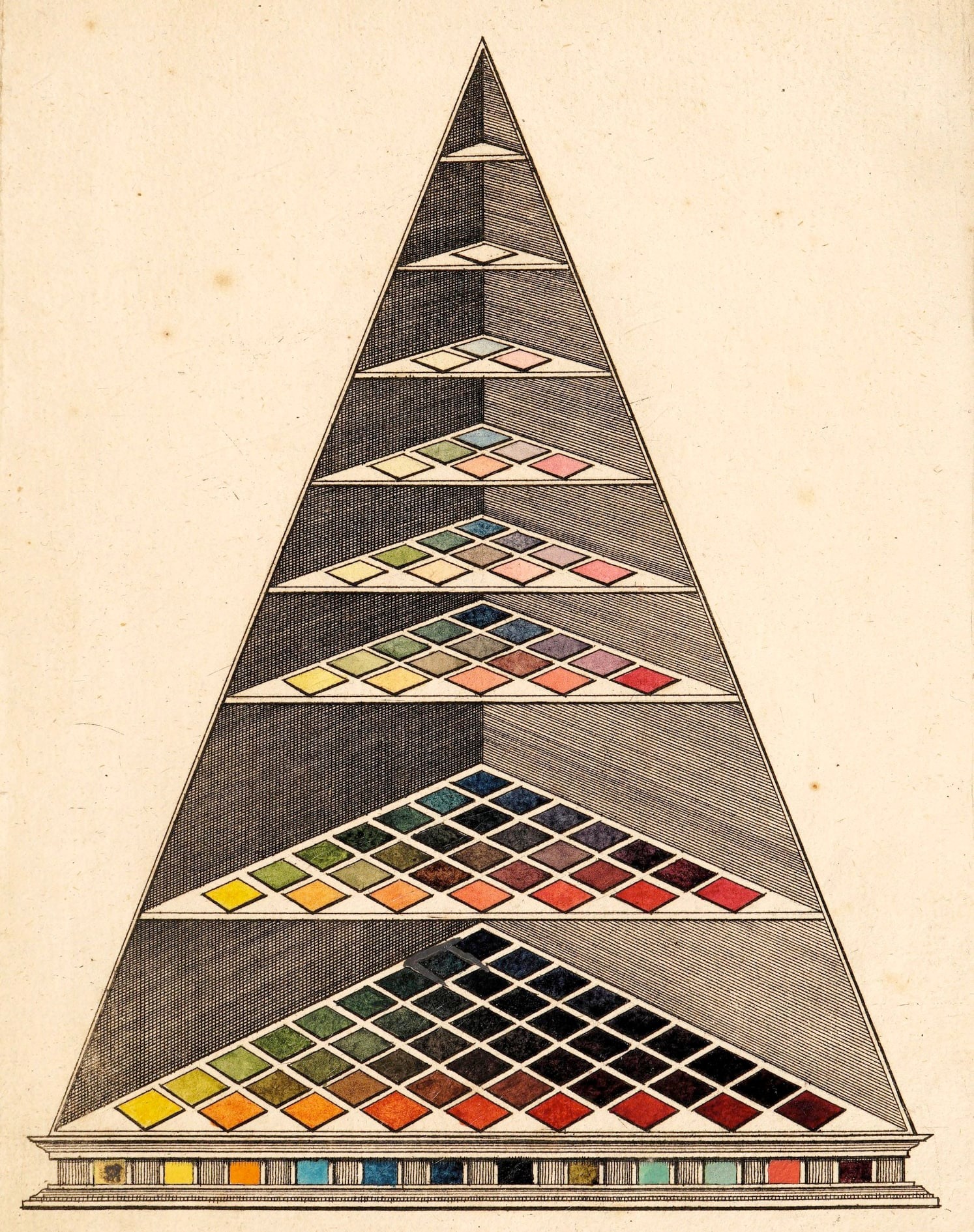
Illustration: by Lambert, Johann Heinrich, 1728-1777
See Also
Figure 12.03 - Scale Showing Relations of Light Color and Tones
Figure 4.16 - Break-out of Colors Tones and Attributes
Figure 4.17 - Musical Relationships of Colors Tones and Attributes
Figure 7B.01 - Colors Represent Relative Frequencies
Figure 7B.02 - Colors and Tones
Frequency Wavelength Light Energy
Harmonic Vibrations and Vibration Figures
Harmonies of Tones and Colours - Developed by Evolution
intermediate tints
music note or sound colors
orange
red
Table 12.02.01 - Wavelengths and Frequencies
Table 11.03 - Roots Powers of Two and Indig Numbers
The Physics of Love 2.0 - The Ultimate Universal Laws
The Scientific Basis and Build of Music
The Secret of Light
The Universal One
Visible Sound
white
12.40 - Color