Sympathetic Vibratory Physics | D sharp (original) (raw)
Ramsay
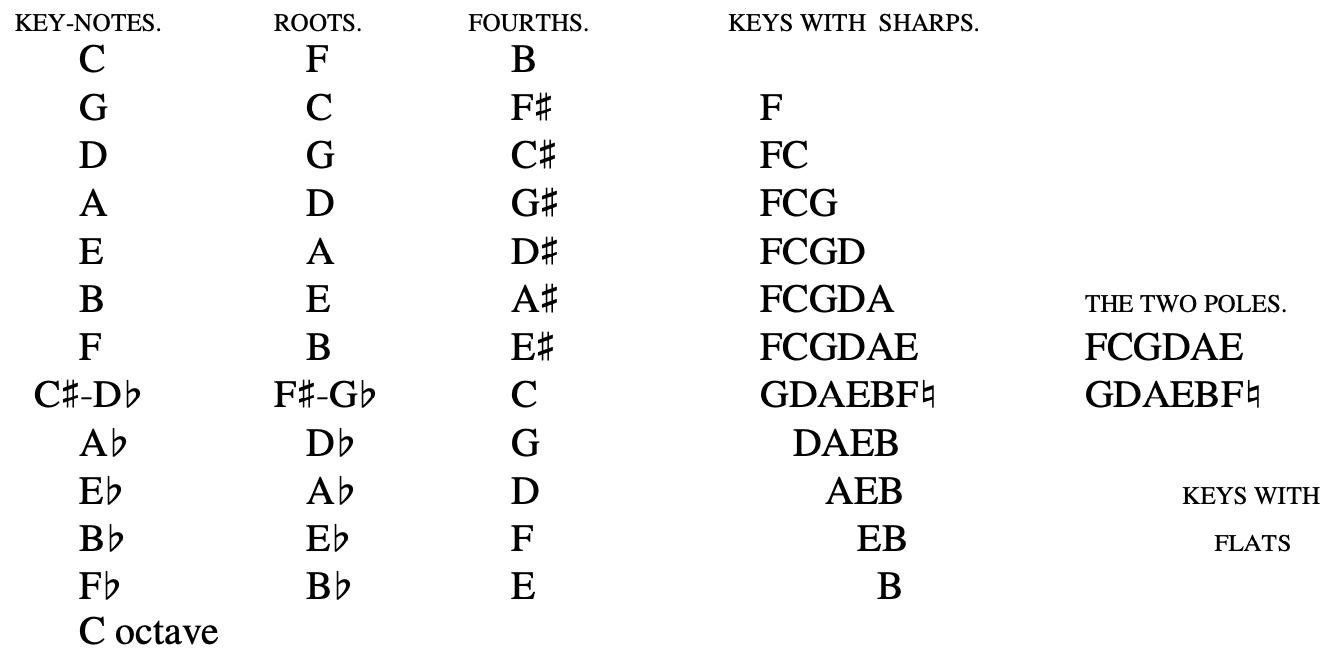
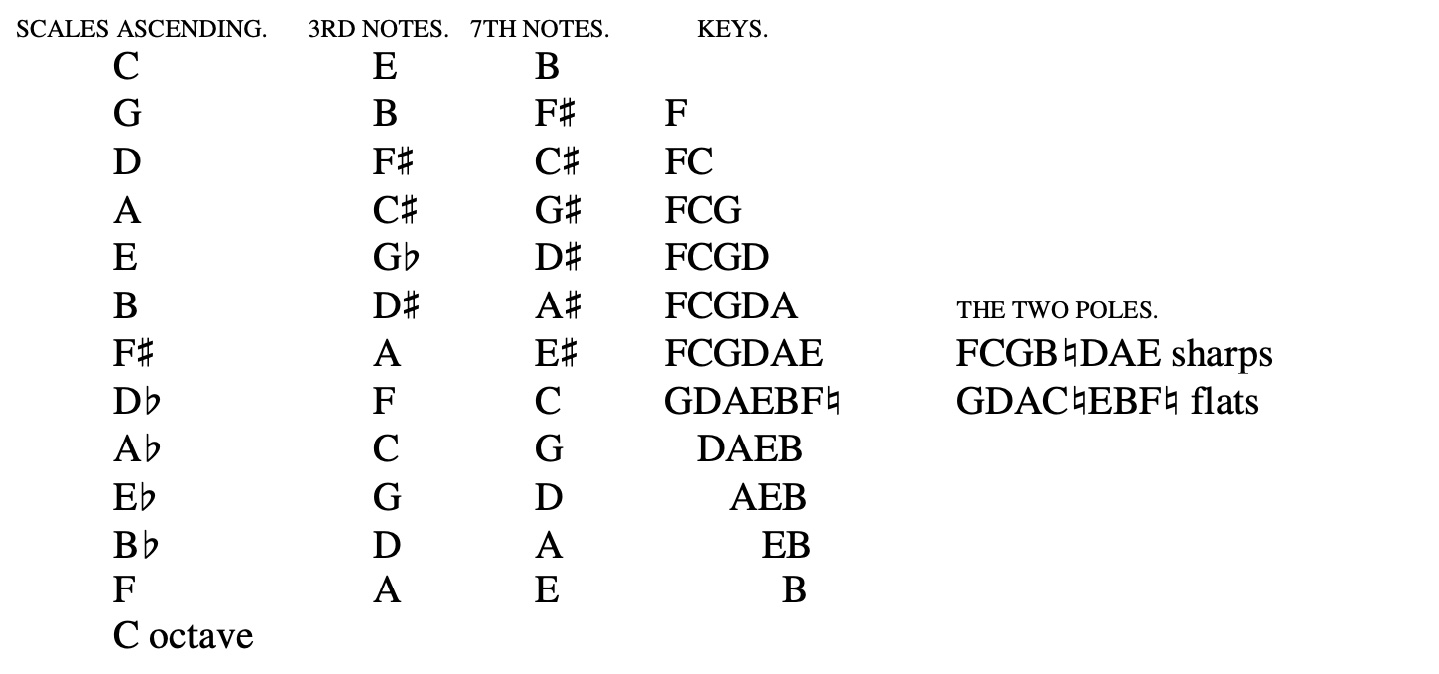
The reason why there are 13 mathematical scales is that G? and F# are written separately as two scales, although the one is only a comma and the apotome minor higher than the other, while in the regular succession of scales the one is always 5 notes higher than the other; so this G? is an anomaly among scales, unless viewed as the first of a second cycle of keys, which it really is; and all the notes of all the scales of this second cycle are equally a comma and the higher than the notes of the first cycle; and when followed out we find that a third cycle is raised just as much higher than the second as the second is higher than the first; and what is true of these majors may be simply repeated as to the D# and E? of the minors, and the new so begun, and all successive cycles. Twelve and not is the natural number for the mathematical scales, which go on in a spiral line, as truly as for the tempered scales, which close as a circle at this point. [Scientific Basis and Build of Music, page 89]
The two notes required for the scale of
E minor are the F# of G, and the D of C major;
for B minor, the C# of D, and the A of G major;
for F# minor, the G# of A, and the E of D major;
for C# minor, the D# of E, and the B of A major;
for G# minor, the A# of B, and the F# of E major;
for D# minor, the E# of F#, and the C# of B major. [Scientific Basis and Build of Music, page 90]
One purpose of this plate is to show that times the interval of a divides the octave into semitones; and each of these notes is the first note of a major and a minor scale. When the same note has two names, the one has sharps and the other has flats. The of sharps and flats taken together is always . In this plate will also be observed an exhibition of the omnipresence of the chromatic chords among the twice twelve scales. The in the center of the plate is also used as to show the whole 24 scales. Going from the end, the winding line, advancing by fifths, goes through all the keys notes; but in order to keep all within the , a double expedient is resorted to. Instead of starting from C0, the line starts from the subdominant F0, that is, one key lower, and then following the line we have C1, G2, etc., B6 proceeds to G? instead of F#, but the continues still to indicate as if the keys went on in sharps up to F12, where the winding line ends. Going from the end, the line starts from E0 instead of A0 - that is, it starts from the dominant of A0, or one key in advance. Then following the line we have B1, F#2, etc. When we come to D#5, we proceed to B? instead of A#6, but the continues as if still in sharps up [Scientific Basis and Build of Music, page 114]
The middle portion with the and lines are the chromatic chords, as it were 'd. They are shown 5-fold, and have their form from the right side, and their form from the left. In the column on the right they are seen in resolution, in their primary and fullest manner, with the 12 minors. The reason why there are 13 scales, though called the 12, is that F# is one scale and G? another on the side; and D# and E? separated the same way on the side. Twelve, however, is the natural for the mathematical scales as well as the tempered ones. But as the mathematical scales roll on in cycles, F# is mathematically the first of a new , and all the notes of the scale of F# are a comma and the apotome minor higher than G?. And so also it is on the side, D# is a comma and the higher than E?. These two thirteenth keys are therefore simply a repetition of the two first; a fourteenth would be a repetition of the second; and so on all through till a second of would be completed; and the to it would be just the first of a third a comma and the apotome minor higher than the second, and so on ad infinitum. In the tempered scales F# and G? on the side are made one; and D# and E? on the side the same; and the circle of the twelve is closed. This is the explanation of the in any of the plates being called . The lines join identical notes with diverse names. The lines thread the rising which constitute the chromatic chords under diverse names, and these chords are then seen in , or the and sides opposites. The system of the Secondary and Tertiary manner of resolution might be shown in the same way, thus exhibiting 72 resolutions into Tonic chords. But the Chromatic chord can also be used to to the Subdominant and Dominant chords of each of these 24 keys, which will exhibit 48 more chromatic resolutions; and resolving into the 48 chords in the primary, secondary, and tertiary manners, will make 144 resolutions, which with 72 above make 216 resolutions. These have been worked out by our author in the Common Notation, in a variety of positions and inversions, and may be published, perhaps, in a second edition of this work, or in a practical work by themselves. [Scientific Basis and Build of Music, page 115]
These two plates show the chromatic chord resolving into the major and minor tonic chords of the twenty-four scales. There seems to be twenty-five, but that arises from making G? and F# in the major two scales, whereas they are really only one; and the same in the series, E? and D# are really one scale. C in the and A in the , which occur in the of the series, when both sharps and flats are employed in the signatures, are placed below and outside of the circular to give them prominence as the types of the scale; and the first chromatic chord is seen with them in its and form, and its typical manner of resolving - the form rising to the , and falling to the and ; the form falling to the , and rising to the and . The signatures of the keys are given under the . [Scientific Basis and Build of Music, page 116]
advance by semitones, the keys with ?s and #s alternate in both modes. The between G# and A? in the , and between D# and E? in the , is in each mode, and the scale made one. The dotted lines across the plate lead from to relative minor; and the solid spiral line starting from C, and winding left and right, touches the consecutive keys as they advance normally, because genetically, by fifths. The relative major and are in one at C and A; and in the right opposite this the relative to F# is D#, and that of G? and E?, all in the same , and by one set of notes, but read, of course, both ways. [Scientific Basis and Build of Music, page 117]
The inner contains the chromatic scale of twelve notes as played on keyed instruments. The flat and sharp phase of the intermediate notes are both given to indicate their relation to each other; the sharpened note being always the higher one, although seemingly on the the lower one. The two notes are the apotome minor apart overlapping each other by so much; ?D is the lower than C#; ?E the lower than D#; F# the higher than ?G; G# the higher than ?A; and A# the higher than ?B. The figures for the chromatic scale are only given for the notes and their sharps; but in the mathematical series of notes the numbers are all given. [Scientific Basis and Build of Music, page 120]
The in the development of a major and a minor harmony
—The twelve developing keys mingled
—D? shown to be an imperfect minor harmony
—E? taking B? as C? to be the same as D#
—The intermediate tones of the white notes are coloured, showing gradual modulation
—As in the diagram of the majors, the are written in musical below the , each minor primary sounding the of the third harmony below, but in a different , and one tone rising higher, . . . . . 34 [Harmonies of Tones and Colours, Table of Contents3 - Harmonies]
Minor key-notes developing by sevens, veering round and in musical below
—The use of the two poles **D#**-E? is seen, . . . . . . . . . . 35 [Harmonies of Tones and Colours, Table of Contents3 - Harmonies]
I had forgotten all the minor keys, except that A is the relative minor of C major; but although I had only faint hopes of success, I determined to try, and I gained the twelve keys correctly, with the thirteenth octave. I found also that E? was usually printed as a minor key-note, 's laws having shown that it must be D#. [Harmonies of Tones and Colours, Dr. Gauntletts Remarks1, page 13]
In the diagrams the circles are not drawn as interlacing into each other, from the difficulty of representing them accurately as rising spirally in geometric progression. If we endeavour to realise the development of , both in geometric order, and at the same time advancing and retiring, as in musical , we must imagine a musician having the physical power of striking all the notes on a circular keyed instrument of seven octaves, linked to a lower of seven octaves, and a corresponding of seven higher. But in fact the depth of the lower , and the height of the higher, are alike unfathomable to our present powers. C, the first note of the seven octaves, sounds the four lowest tones, F, G, A, B of the lower ; and B, the last and highest note of the seven octaves, sounds in its harmony C? and D# of the higher of sevens. [Harmonies of Tones and Colours, The Method of Development or Creation of Harmonies3, page 17]
[Harmonies of Tones and Colours, Diagram VII - The Modulating Gamut of the Twelve Keys2, page 30]
[Harmonies of Tones and Colours, The Twelve Scales Meeting by Fifths, page 31a]
When the twelve minor harmonies are traced developing in , we notice how exactly they all agree in their method of development, also the use of the chasms and the double tones, the seven of each harmony rising a tone when , but reversing the in descending; keys with sharps and those with flats are mingled. The intermediate tones are here coloured, showing gradual modulation. D? is shown to be an imperfect minor harmony, and E?, by employing B as C?, is seen to be equivalent to D#. [Harmonies of Tones and Colours, Diagram IX - The Minor Keynote A and Its Six Notes, page 34a]
The diagram represents the Minor Key-note A and its 6 notes veering round in trinities; A and the other 11 developing their trinities in musical . Below each is the in which the pairs unite, avoiding consecutive fifths, Lastly, D? is shewn to be an imperfect minor harmony, and by employing B as C?, E? is seen to be the same harmony as D#. As before, it should be remembered that the and notes should, strictly, have intermediate tints. [Harmonies of Tones and Colours, The Diagram Represents the Minor Keynote, page 34c]
In the musical the and seventh notes from A, the fundamental minor key-note, are repeated, in order to show the use of the poles **D#**-C?, and that the colours agree. The use of the two poles, both in the major and minor series, is strikingly evident. [Harmonies of Tones and Colours, Diagram X - Minor Keynotes Developing by Sevens, page 35a]
Below, the D# and E? are repeated, to shew the use of the two poles. [Harmonies of Tones and Colours, First Circle are 7 Minor Keynotes, page 35c]
ALTHOUGH only twelve notes of a keyed instrument develope perfect minor harmonics, there are fifteen different chords, the double tones **D#**-E?, E#-F?, A#-B? all sounding as roots. The fifteen roots are written in musical . A major and a minor fifth embrace the same number of key-notes, but the division into threefold chords is different. In counting the , a major fifth has four below the third note of its harmony, and three above it; a minor fifth has three below the third note of its harmony, and four above it. A major seventh includes twelve key-notes, a minor seventh only eleven. As an example of the minor chords in the different keys, we may first examine those in the key of A, written in musical . The seven of its harmony have two threefold chords, and two of its ascending scale. If we include the octave note, the highest chord of the descending scale is a repetition (sounding an octave higher) of the lowest chord of the seven in its harmony, and the second chord of the descending scale is a repetition of the first chord of its ascending scale. These two repetition chords are only written to the key of A: the chords of the other eleven keys will all be found exactly to agree with those of A in their mode of development. We may again remark on the beautiful effect which would result if the colours of the minor chords could be seen, with the tones, as they develope. [Harmonies of Tones and Colours, Diagram XII - The Chords of the Twelve Minor Keys, page 37a]
See Also