Characterization of the Surfaces and Near-Surface Atmospheres of Ganymede, Europa and Callisto by JUICE (original) (raw)
Alessandra Migliorini ORCID: orcid.org/0000-0001-7386-92151,
Leonid I. Gurvits ORCID: orcid.org/0000-0002-0694-245911,25,
…
7821 Accesses
32 Citations
20 Altmetric
3 Mentions
Abstract
We present the state of the art on the study of surfaces and tenuous atmospheres of the icy Galilean satellites Ganymede, Europa and Callisto, from past and ongoing space exploration conducted with several spacecraft to recent telescopic observations, and we show how the ESA JUICE mission plans to explore these surfaces and atmospheres in detail with its scientific payload. The surface geology of the moons is the main evidence of their evolution and reflects the internal heating provided by tidal interactions. Surface composition is the result of endogenous and exogenous processes, with the former providing valuable information about the potential composition of shallow subsurface liquid pockets, possibly connected to deeper oceans. Finally, the icy Galilean moons have tenuous atmospheres that arise from charged particle sputtering affecting their surfaces. In the case of Europa, plumes of water vapour have also been reported, whose phenomenology at present is poorly understood and requires future close exploration. In the three main sections of the article, we discuss these topics, highlighting the key scientific objectives and investigations to be achieved by JUICE. Based on a recent predicted trajectory, we also show potential coverage maps and other examples of reference measurements. The scientific discussion and observation planning presented here are the outcome of the JUICE Working Group 2 (WG2): “_Surfaces and Near-surface Exospheres of the Satellites, dust and rings_”.
1 Introduction
Working Group 2 (WG2): “_Surfaces and Near-surface Exospheres of the Satellites, dust and rings_” is one of four groups established by the JUICE Project in 2015 to provide both scientific and operation support to the Science Working Team (SWT), and to work closely with the Science Operations Center (SOC) to produce the Long-Term Science Planning. The primary goals of WG2 are to: (i) consolidate and update the science goals and requirements of JUICE concerning the surface and tenuous atmospheres of the Galilean satellites, as well as the smaller moons and the dust ring system; (ii) prepare detailed observation strategies for planning purposes; (iii) assess the science return from the different JUICE mission phases; and (iv) understand opportunities for synergistic observations between instruments.
In this article, focusing on the surfaces and tenuous atmospheres of the three icy Galilean satellites, we summarise the scientific rationale deriving from the state of the art of the observations and modelling available up to now, and we clarify which key measurements will be addressed by JUICE in the light of this rationale and of the planning discussed within WG2, considering the expected instrument performances.
Section 2 of this article summarises the general geology of the three satellites with reference to the past and present geological processes found there. We show the coverage achievable by optical imaging and we emphasise the potential of combining optical and topographical data to derive morpho-stratigraphic maps of the surface. Section 3 focuses on the surface composition of the three moons with an emphasis on the different classes of compounds known or expected on the icy Galilean satellites, and clarifying what could be obtained by a multi-wavelength analysis of remotely sensed data. A specific subsection is dedicated to the connections between the surface and subsurface (geophysical processes are discussed in detail in Van Hoolst et al. [2024](/article/10.1007/s11214-024-01089-8#ref-CR312 " Van Hoolst T, Tobie G, Vallat C, Altobelli N, Bruzzone L, Cao H, Iess L, Kimura J, Khurana K, Dirkx D, Genova A, Hussmann H, Lucchetti A, Mitri G, Moore W, Saur J, Stark A, Vorburger A, Wieczorek M, Aboudan A, Bergman J, Bovolo F, Breuer D, Cappuccio P, Carrer L, Cecconi B, Choblet G, De Marchi F, Fayolle M, Fienga A, Futaana Y, Hauber E, Kofman W, Kumamoto A, Lainey V, Molyneux P, Mousis O, Plaut J, Puccio W, Retherford K, Roth L, Seignovert B, Steinbrügge G, Thakur S, Tortora P, Tosi F, Zannoni M, Barabash S, Dougherty M, Gladstone R, Gurvits LI, Hartogh P, Palumbo P, Poulet F, Wahlund J-F, Grasset O, Witasse O (2024) Geophysical characterization of the interiors of Ganymede, Callisto and Europa by ESA’s JUpiter ICy moons Explorer. Space Sci Rev 220:54. https://doi.org/10.1007/s11214-024-01085-y
"), this collection), which could highlight specific areas where fresh material has risen from the interior. Section [4](/article/10.1007/s11214-024-01089-8#Sec19) focuses on the tenuous atmospheres of the three satellites, clarifying both their chemical and physical properties known to date and placing emphasis on the connections with the surface and on the potential detection of plumes. Finally, an [Appendix](/article/10.1007/s11214-024-01089-8#Sec30) specifies the JUICE scientific objectives and investigations relevant to Ganymede, Europa and Callisto, as defined in the Science Requirements Matrix (SRM) found in the Science Requirements Document (SciRD). These objectives are referred to in the text by means of specific codes made up by a pair of capital letters followed by a number and a lowercase letter (e.g., EA.2d, EB.1b, EC.3c, GB.1b, GC.4b, GD.1a, CA.1a, CB.1c, CC.3c, where the first capital letter refers to Europa, Ganymede and Callisto, respectively).Given the breadth of topics covered by JUICE WG2, a separate article in this collection focuses on Io and Jupiter’s minor moons (Denk et al. 2024, this collection).
2 Surface Geology of the Icy Galilean Moons (Ganymede, Callisto, Europa)
2.1 Background
The surfaces of the icy Galilean satellites have been closely explored by six NASA-led spacecraft: Pioneer 10 and 11 (1973 and 1974, respectively), Voyager 1 and 2 (1979), Galileo (1995–2003), and Juno (2016–present). The data recorded by the remote sensing instruments revealed that the surfaces are shaped by different endogenic and exogenic geological processes such as tectonism, cryovolcanism, mass wasting, and impact cratering. Thus, their surfaces became accessible for analysis through geological methods and could be compared among themselves and with those of other bodies in our Solar System (e.g., Johnson [2005](/article/10.1007/s11214-024-01089-8#ref-CR137 " Johnson TV (2005) Geology of the icy satellites. Space Sci Rev 116:401–420. https://doi.org/10.1007/s11214-005-1963-1
            "); Prockter and Pappalardo [2014](/article/10.1007/s11214-024-01089-8#ref-CR236 "
                Prockter LM, Pappalardo RT (2014) Europa. In: Spohn T, Breuer D, Johnson TV (eds) Encyclopedia of the Solar System, 3rd edn. Elsevier, Amsterdam, pp 793–811.
              https://doi.org/10.1016/B978-0-12-415845-0.00036-0

            "); Collins and Johnson [2014](/article/10.1007/s11214-024-01089-8#ref-CR45 "
                Collins GC, Johnson TV (2014) Ganymede and Callisto. In: Spohn T, Breuer D, Johnson TV (eds) Encyclopedia of the Solar System, 3rd edn. Elsevier, Amsterdam, pp 813–829.
              https://doi.org/10.1016/B978-0-12-415845-0.00037-2

            ")). With increasing spatial resolution of the measurements (Fig. [1](/article/10.1007/s11214-024-01089-8#Fig1)), older ideas were abandoned and/or revised, and a better understanding of the geological evolution was gained – not only of the Galilean satellites themselves, but also of the Jovian system at large. The detection of global oceans below the surface (Khurana et al. [1998](/article/10.1007/s11214-024-01089-8#ref-CR149 "
                Khurana KK, Kivelson MG, Stevenson DJ, Schubert G, Russell CT, Walker RJ, Polanskey C (1998) Induced magnetic fields as evidence for subsurface oceans in Europa and Callisto. Nature 395(6704):777–780.
              https://doi.org/10.1038/27394

            "); Kivelson et al. [2000](/article/10.1007/s11214-024-01089-8#ref-CR154 "
                Kivelson M, Khurana K, Russell CT, Volwerk M, Walker RJ, Zimmer C (2000) Galileo magnetometer measurements: a stronger case for a subsurface ocean at Europa. Science 289(5483):1340–1343.
              https://doi.org/10.1126/science.289.5483.1340

            "); Zimmer et al. [2000](/article/10.1007/s11214-024-01089-8#ref-CR323 "
                Zimmer C, Khurana KK, Kivelson MG (2000) Subsurface oceans on Europa and Callisto: constraints from Galileo magnetometer observations. Icarus 147(2):329–347.
              https://doi.org/10.1006/icar.2000.6456

            "); Kivelson et al. [2002](/article/10.1007/s11214-024-01089-8#ref-CR155 "
                Kivelson M, Khurana K, Volwerk M (2002) The permanent and inductive magnetic moments of Ganymede. Icarus 157(2):507–522.
              https://doi.org/10.1006/icar.2002.6834

            "); Saur et al. [2015](/article/10.1007/s11214-024-01089-8#ref-CR255 "
                Saur J, Duling S, Roth L, Jia X, Strobel DF, Feldman PD, Christensen UR, Retherford KD, McGrath MA, Musacchio F, Wennmacher A, Neubauer FM, Simon S, Hartkorn O (2015) The search for a subsurface ocean in Ganymede with Hubble Space Telescope observations of its auroral ovals. J Geophys Res Space Phys 120(3):1715–1737.
              https://doi.org/10.1002/2014ja020778

            ")) and the implications for habitability (for an early discussion see Reynolds et al. [1983](/article/10.1007/s11214-024-01089-8#ref-CR243 "
                Reynolds RT, Squyres SW, Colburn DS, McKay CP (1983) On the habitability of Europa. Icarus 56(2):246–254.
              https://doi.org/10.1016/0019-1035(83)90037-4

            ")) increased the interest in the surfaces of the icy Galilean satellites even more, as their analysis can, e.g., reveal the mechanisms of tidal heating, constrain the thicknesses and mechanical properties of the icy shells, provide insights into possible exchange processes between the interior and space, and determine the chronology of events.
Fig. 1

The alternative text for this image may have been generated using AI.
Comparison of spatial resolutions in two images obtained during the Voyager (panel a) and Galileo (panel b) explorations of Ganymede. The left and right frames have a scale of ∼1.3 km px−1 and 74 m px−1, respectively. In the left frame (panel a), high-albedo (bright) and low-albedo (dark) bands can be seen but no details can be resolved. In the right frame (panel b), with a resolution improved by a factor of 17, each band turns out to be made of many smaller ridges. In both frames north is to the top, and the Sun illuminates the surface from the lower left. The area is centred at 10°N/167°W and is about 35 × 55 km in size (Image: NASA/JPL). The reports by Kersten et al. ([2021](/article/10.1007/s11214-024-01089-8#ref-CR148 " Kersten E, Zubarev AE, Roatsch T, Matz KD (2021) Controlled global Ganymede mosaic from Voyager and Galileo images. Planet Space Sci 206:105310. https://doi.org/10.1016/j.pss.2021.105310
            ")) and Hansen et al. ([2024](/article/10.1007/s11214-024-01089-8#ref-CR106 "
                Hansen CJ, Ravine MA, Schenk PM, Collins GC, Leonard EJ, Phillips CB, Caplinger MA, Tosi F, Bolton SJ, Jónsson B (2024) Juno’s JunoCam images of Europa. Planet Sci J 5(3):76.
              https://doi.org/10.3847/PSJ/ad24f4

            ")) provide information on the images of Ganymede and Europa acquired by the Voyager, Galileo, and Juno missions, respectively
2.2 Surface Characteristics of Ganymede, Callisto and Europa
Some geological surface characteristics are shared among Europa, Ganymede, and Callisto. At least two of these satellites are thought to feature an icy shell above a likely (salty) liquid ocean (Ganymede may even have a stack of layered oceans, Vance et al. [2014](/article/10.1007/s11214-024-01089-8#ref-CR313 " Vance S, Bouffard M, Choukroun M, Sotin C (2014) Ganymede’s internal structure including thermodynamics of magnesium sulfate oceans in contact with ice. Planet Space Sci 96:62–70. https://doi.org/10.1016/j.pss.2014.03.011
            ")), and all of them display evidence for bombardment by exogenic impactors (i.e., impact craters and basins). Despite their spatial proximity, however, each Galilean satellite is a world of its own. One reason for that is the amount of tidal heating that they experience. Europa, the innermost of the three, receives most tidal heating, which is reflected by the youthful appearance of its surface (less impact craters) due to ongoing resurfacing processes. Europa also has the most complex surface compared to Ganymede and Callisto in terms of tectonic deformation and possible cryovolcanic activity. Ganymede is situated between Europa and Callisto, and its surface is tectonically less complex with less and/or ambiguous evidence for cryovolcanism, while showing a higher density of impact craters pointing to an older age than Europa. Lastly, Callisto is the outermost Galilean satellite, and its surface shows the least signs of recent geological activity, it is covered by large parts of dark lag deposits and is most heavily cratered. In this regard, the surfaces of the icy Galilean satellites reflect important characteristics of their interior geodynamic activity and, in contrast to the old adage «Don’t judge a book by its cover», their sharply differing covers (i.e. surfaces) are indeed indicators of significant differences in the interiors (Fig. [2](/article/10.1007/s11214-024-01089-8#Fig2)). For a general review on the geology of the icy Galilean satellites see, e.g., Stephan et al. ([2013](/article/10.1007/s11214-024-01089-8#ref-CR290 "
                Stephan K, Jaumann R, Wagner R (2013) Geology of icy bodies. In: Gudipati MS, Castillo-Rogez J (eds) The science of Solar System ices. Springer, New York, pp 279–367.
              https://doi.org/10.1007/978-1-4614-3076-6_10

            ")).
Fig. 2
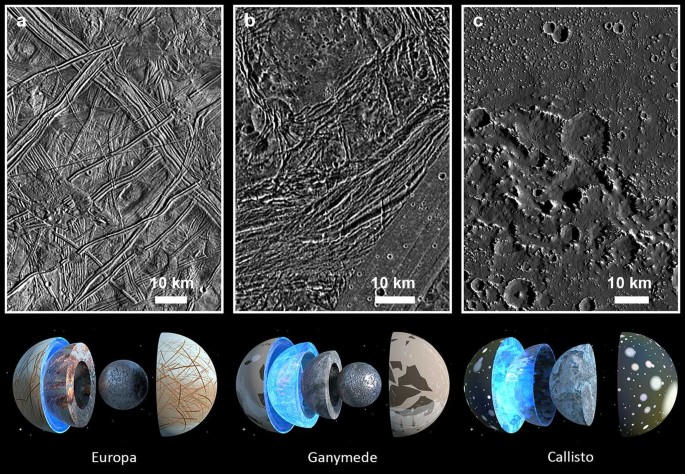
The alternative text for this image may have been generated using AI.
Above: Examples of typical surfaces of the icy Galilean satellites (panel a: Europa, near Conamara Chaos region at 8.1°N/90.9°E; panel b: Ganymede, Nicholson Regio at ∼14°S/12.7°E; panel c: Callisto, detail of Asgard impact basin at 14.7°N/218°E). All images are scaled to 150 m px−1. The crater density (a proxy of surface age) increases from Europa to Callisto, reflecting the geological history of surface processes. The surface of Europa displays the most complex inventory of landforms that were formed by endogenic processes, whereas Callisto’s surface is almost devoid of any evidence for tectonic and cryovolcanic activity (Image: NASA/DLR). Below: Models of the interiors of the icy Galilean satellites (Images: ESA/ATG Medialab). Details on their examination by JUICE are provided by Van Hoolst et al. ([2024](/article/10.1007/s11214-024-01089-8#ref-CR312 " Van Hoolst T, Tobie G, Vallat C, Altobelli N, Bruzzone L, Cao H, Iess L, Kimura J, Khurana K, Dirkx D, Genova A, Hussmann H, Lucchetti A, Mitri G, Moore W, Saur J, Stark A, Vorburger A, Wieczorek M, Aboudan A, Bergman J, Bovolo F, Breuer D, Cappuccio P, Carrer L, Cecconi B, Choblet G, De Marchi F, Fayolle M, Fienga A, Futaana Y, Hauber E, Kofman W, Kumamoto A, Lainey V, Molyneux P, Mousis O, Plaut J, Puccio W, Retherford K, Roth L, Seignovert B, Steinbrügge G, Thakur S, Tortora P, Tosi F, Zannoni M, Barabash S, Dougherty M, Gladstone R, Gurvits LI, Hartogh P, Palumbo P, Poulet F, Wahlund J-F, Grasset O, Witasse O (2024) Geophysical characterization of the interiors of Ganymede, Callisto and Europa by ESA’s JUpiter ICy moons Explorer. Space Sci Rev 220:54. https://doi.org/10.1007/s11214-024-01085-y
"), this collection)2.3 Major Past and Present Geological Surface Processes
A review of the investigation of specific landforms and their geological implications would be beyond the scope of this section. To this end, the reader is referred to individual review studies on specific features and processes. Most, if not all landforms on the surfaces of Europa, Ganymede and Callisto can be attributed to four classes of geological processes: (1) tectonism, (2) cryovolcanism, (3) mass wasting, and (4) impact cratering (Fig. 3). Tectonic deformation of the ice shells left a diverse record of stresses and associated strain, expressed as different classes of structural features (Collins et al. [2010](/article/10.1007/s11214-024-01089-8#ref-CR48 " Collins GC, McKinnon WB, Moore JM, Nimmo F, McGill GE, Pappalardo RT, Schultz RA, Watters TR (2010) Tectonics of the outer planet satellites. In: Watters TR, Schultz RA (eds) Planetary tectonics. Cambridge University Press, Cambridge, pp 264–350. https://doi.org/10.1017/CBO9780511691645.008
            ")). They are most pristine and complex on Europa, still abundant in the bright grooved terrains of Ganymede (Fig. [3](/article/10.1007/s11214-024-01089-8#Fig3)a, b), and least obvious on Callisto. The second class of endogenic landforms is represented by cryovolcanic features (Fig. [3](/article/10.1007/s11214-024-01089-8#Fig3)b), which are most diverse on Europa, less numerous and certain on Ganymede, and basically absent on Callisto, consistent with the notion that tidal heating and the consequent geological activity decreases from Io to Ganymede, and does not concern Callisto (Geissler [2015](/article/10.1007/s11214-024-01089-8#ref-CR84 "
                Geissler P (2015) Cryovolcanism in the outer Solar System. In: Sigurdsson H (ed) The encyclopedia of volcanoes, 2nd edn. Elsevier, Amsterdam, pp 763–776.
              https://doi.org/10.1016/B978-0-12-385938-9.00044-4

            "); Fagents et al. [2022](/article/10.1007/s11214-024-01089-8#ref-CR75 "
                Fagents SA, Lopes RMC, Quick LC, Gregg TKP (2022) Cryovolcanism. In: Gregg TKP, Lopes RMC, Fagents SA (eds) Planetary volcanism across the Solar System. Elsevier, Amsterdam, pp 161–234.
              https://doi.org/10.1016/B978-0-12-813987-5.00005-5

            ")). Mass wasting occurs everywhere on Solar System bodies with (partly) inclined surfaces, including volatile-rich terrain (Moore et al. [1996](/article/10.1007/s11214-024-01089-8#ref-CR199 "
                Moore JM, Mellon MT, Zent AP (1996) Mass wasting and ground collapse in terrains of volatile-rich deposits as a Solar System-wide geological process: the pre-Galileo view. Icarus 122(1):63–78.
              https://doi.org/10.1006/icar.1996.0109

            "); Melosh [2012](/article/10.1007/s11214-024-01089-8#ref-CR191 "
                Melosh HJ (2012) Planetary surface processes. Cambridge University Press, Cambridge.
              https://doi.org/10.1017/CBO9780511977848

            ")) (Fig. [3](/article/10.1007/s11214-024-01089-8#Fig3)c). Last, but not least, impact craters and basins are the most ubiquitous surface features (Fig. [3](/article/10.1007/s11214-024-01089-8#Fig3)d), and the investigation of their morphologies, specifically, reveal important properties of the icy shells of the Galilean satellites and their thermal structure and evolution (Senft and Stewart [2011](/article/10.1007/s11214-024-01089-8#ref-CR267 "
                Senft LE, Stewart ST (2011) Modeling the morphological diversity of impact craters on icy satellites. Icarus 214(1):67–81.
              https://doi.org/10.1016/j.icarus.2011.04.015

            "); Burchell [2013](/article/10.1007/s11214-024-01089-8#ref-CR27 "
                Burchell MJ (2013) Cratering on icy bodies. In: Gudipati MS, Castillo-Rogez J (eds) The science of Solar System ices. Springer, New York, pp 253–278.
              https://doi.org/10.1007/978-1-4614-3076-6_9

            ")). A comprehensive list of landforms that are relevant to meeting the science objectives of JUICE and a selection of suggested targets is presented by Stephan et al. ([2021a](/article/10.1007/s11214-024-01089-8#ref-CR293 "
                Stephan K, Roatsch T, Tosi F, Matz K-D, Kersten E, Wagner R, Molyneux P, Palumbo P, Poulet F, Hussmann H, Barabash S, Bruzzone L, Dougherty M, Gladstone R, Gurvits LI, Hartogh P, Iess L, Wahlund J-E, Wurz P, Witasse O, Grasset O, Altobelli N, Carter J, Cavalié T, D’Aversa E, Della Corte V, Filacchione G, Galli A, Galluzzi V, Gwinner K, Hauber E, Jaumann R, Krohn K, Langevin Y, Lucchetti A, Piccioni G, Solomonidou A, Stark A, Tobie G, Tubiana C, Vallat C, Van Hoolst T (the JUICE SWT Team) (2021a) Regions of interest on Ganymede’s and Callisto’s surfaces as potential targets for ESA’s JUICE mission. Planet Space Sci 208:105324.
              https://doi.org/10.1016/j.pss.2021.105324

            ")).
Fig. 3
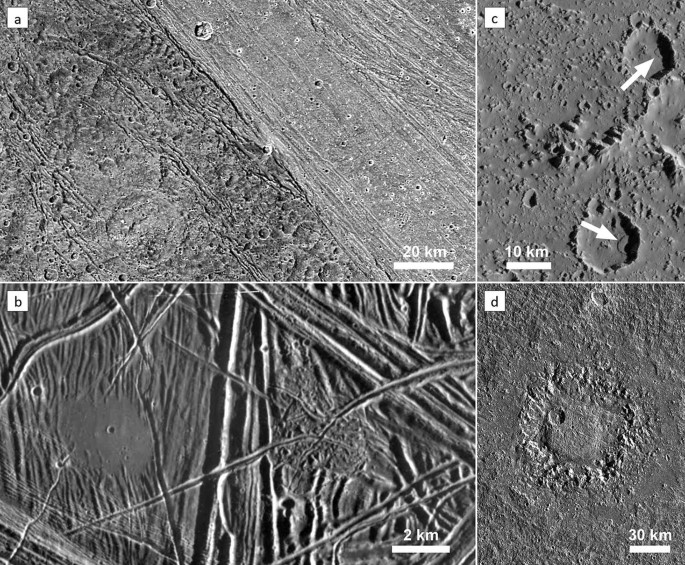
The alternative text for this image may have been generated using AI.
Examples of landforms created by the main four geological processes that shape the surfaces of the icy Galilean satellites. (a) Structural features in dark and bright terrains of Ganymede (Nicholson Regio and Harpagia Sulcus, respectively) are visible as linear zones of fractures. (image: NASA/JPL/DLR). (b) On Europa, a ∼3 km patch («puddle») of smooth, level terrain left of the image centre is interpreted as an area that has been flooded by an extruded liquid (water). Many tectonic fractures with different orientations and styles are crossing the entire scene (image: NASA/JPL/ASU). (c) Landslide deposits in craters on Callisto. The two landslides (arrows) are about 3 to 3.5 km long and are a result of mass wasting at the inner crater walls (image: NASA/JPL/ASU). (d) Dome crater Neith on Ganymede. The 45 km dome in the crater interior is surrounded by a concentric zone of rugged terrain, which represents a former central pit. The actual crater rim is barely visible and is located along the outer boundary of a relatively smooth, circular area. Neith is one example of a crater whose topography was strongly modified by post-impact relaxation or by the response of a weak substrate to a high-energy impact (image: NASA/JPL/DLR). North is up in all images
The analysis of all the respective surface features will benefit from a combination of data sets acquired by several remote instruments onboard JUICE, notably JANUS images (Palumbo et al. 2024, this collection) and GALA laser altimetry profiles (Hussmann et al. 2024, this collection). See Table 1 for a summary of the ground sampling of several JUICE remote sensing instruments for different sub-phases of the Ganymede orbital mission phase.
Table 1 Ground sampling / spot size of JANUS, MAJIS, UVS, GALA and SWI as a function of altitude above the surface for the three different sub-phases of the JUICE orbital mission at Ganymede, assuming nadir looking. GALA cannot operate in GCO5000. (*) The GCO200 sub-phase is not optimal for acquiring images and spectra in the ultraviolet to infrared range, due to smearing and long shadows in the observed scene, ultimately resulting in very low SNR. For JANUS, MAJIS and UVS, the salient sub-phases are GCO5000 and GCO500. SWI also does not plan to operate in GCO200, due to inability to calibrate the instrument with the spacecraft in a strict nadir-looking attitude at 200-km height
Images enable the recognition and morphologic investigation of landforms as well as the determination of model ages (Stephan et al. [2013](/article/10.1007/s11214-024-01089-8#ref-CR290 " Stephan K, Jaumann R, Wagner R (2013) Geology of icy bodies. In: Gudipati MS, Castillo-Rogez J (eds) The science of Solar System ices. Springer, New York, pp 279–367. https://doi.org/10.1007/978-1-4614-3076-6_10
            ")). Stereoscopic images allow the derivation of topographic information and the construction of Digital Elevation Models (DEM). Laser altimetry profiles provide along-track shot-to-shot topography and can be interpolated along-track and cross-track to construct DEM. In cross-track, the resolution of a GALA-based terrain model is driven by the separation of neighbouring profiles. These vary over the surface of Ganymede from a few hundred metres at polar regions to a few km at the equator. The spot size corresponds to about 7 × 7 JANUS pixels and roughly the expected spatial resolution of DTM determined from stereo-pairs. Topographic information from either stereoscopic images or laser altimetry is essential for quantifying processes in all four categories of landforms and surface processes (e.g., Melosh [2012](/article/10.1007/s11214-024-01089-8#ref-CR191 "
                Melosh HJ (2012) Planetary surface processes. Cambridge University Press, Cambridge.
              https://doi.org/10.1017/CBO9780511977848

            ")). Subsurface profiles of thermal, compositional, and structural horizons obtained through RIME (Bruzzone et al., this collection) will be very useful to combine surface and subsurface information. The analysis of the surface morphology of the icy Galilean satellites will enable addressing many of the JUICE scientific objectives (see the [Appendix](/article/10.1007/s11214-024-01089-8#Sec30)).
2.3.1 Tectonics
Different tectonic features exist on the surface of Europa, Ganymede and Callisto. In particular, Europa shows ubiquitous extensional deformation on its surface, such as isolated troughs, which are V-shaped depressions measuring 100-300 m wide and spanning several to hundreds of kilometres, whose formation remains uncertain. These troughs are part of a morphological progression that includes double ridges on Europa and wider ridge complexes, suggesting an evolutionary sequence. Such ridges, which are composed of raised rims to either side of a central fracture, likely formed in response to a combination of extensional, compressive, and shear-related processes. Then, dilatation bands, which are polygonal regions of smoother terrain with distinct boundaries, formed in response to both tidally driven extension and endogenic processes. For a complete review of tectonic features on the surfaces of Europa we refer to Kattenhorn and Hurford (2009).
On the other hand, Ganymede’s surface exhibits widespread brittle deformation, with furrows in low-albedo (dark) regions and grooves in high-albedo (bright) ones. Furrows, linear to curvilinear kilometre-scale troughs, offer insight into Ganymede’s early history and tectonics. Grooves, regional scale morphotectonic structures, represent brittle deformation in light terrains, indicative of fractures and faults. Proposed tectonic processes include extensional forces, like horst-and-graben normal faulting, and strike-slip kinematics. For a complete review of tectonic features on the surfaces of Ganymede we refer to Pappalardo et al. (2004). In contrast, Callisto lacks prominent tectonic features. Furrows similar to those found on Ganymede, as well ridges and scarps, are impact-related and were created in basin-forming events, such as Valhalla or Asgard (Moore et al. 2004).
The identification and characterization of structural elements is a critical component of all surface studies of the icy shells of the outer planets’ satellites. Deformation features (e.g., faults) bear a record of the strain that the ice shells experienced (e.g., Bland and McKinnon [2015](/article/10.1007/s11214-024-01089-8#ref-CR10 " Bland MT, McKinnon WB (2015) Forming Ganymede’s grooves at smaller strain: toward a self-consistent local and global strain history for Ganymede. Icarus 245:247–262. https://doi.org/10.1016/j.icarus.2014.09.008
            ")), and of exchange processes between the subsurface, the surface and, if present, the atmosphere (Tobie et al. [2010](/article/10.1007/s11214-024-01089-8#ref-CR301 "
                Tobie G, Giese B, Hurford TA, Lopes RM, Nimmo F, Postberg F, Retherford KD, Schmidt J, Spencer JR, Tokano T, Turtle EP (2010) Surface, subsurface and atmosphere exchanges on the satellites of the outer Solar System. Space Sci Rev 153:375–410.
              https://doi.org/10.1007/s11214-010-9641-3

            ")). Therefore, their investigation is pivotal to better understand of the stresses acting on the satellite (e.g., tides, non-synchronous rotation, internal forces such as convection), the properties of the icy “lithosphere”, the tectonic regime (e.g., Collins et al. [2022](/article/10.1007/s11214-024-01089-8#ref-CR50 "
                Collins GC, Patterson GW, Detelich CE, Prockter LM, Kattenhorn SA, Cooper CM, Rhoden AR, Cutler BB, Oldrid SR, Perkins RP, Rezza CA (2022) Episodic plate tectonics on Europa: evidence for widespread patches of mobile-lid behavior in the antijovian hemisphere. J Geophys Res, Planets 127(11):e2022JE007492.
              https://doi.org/10.1029/2022JE007492

            ")) and, indirectly, of the nature of an underlying ocean. Despite their overwhelming importance, however, many tectonic landforms on the icy Galilean satellites are still poorly understood (Collins et al. [2010](/article/10.1007/s11214-024-01089-8#ref-CR48 "
                Collins GC, McKinnon WB, Moore JM, Nimmo F, McGill GE, Pappalardo RT, Schultz RA, Watters TR (2010) Tectonics of the outer planet satellites. In: Watters TR, Schultz RA (eds) Planetary tectonics. Cambridge University Press, Cambridge, pp 264–350.
              https://doi.org/10.1017/CBO9780511691645.008

            ")). Several remote sensing instruments onboard JUICE will contribute to address many of the key science questions related to the structural evolution of Ganymede’s icy shell, especially JANUS, GALA, 3GM, and RIME (GB.1b, GB.2b, GD.1a, GD.1b, GD.2a). In the following paragraphs, we describe key observations of the structural geology of Ganymede and how they will be used to derive information about its tectonic history and the evolution of its lithosphere. Basically, the same considerations apply to Europa (EA.2d, EA.2e, EB.1b, EB.1c), although the limited coverage of Europa during flybys implies that tectonic studies cannot be global and structural geology will have to focus on specific targets. Callisto will be observed to a larger degree than Europa, but its tectonic inventory is sparse and may be limited to impact tectonics (Collins et al. [2010](/article/10.1007/s11214-024-01089-8#ref-CR48 "
                Collins GC, McKinnon WB, Moore JM, Nimmo F, McGill GE, Pappalardo RT, Schultz RA, Watters TR (2010) Tectonics of the outer planet satellites. In: Watters TR, Schultz RA (eds) Planetary tectonics. Cambridge University Press, Cambridge, pp 264–350.
              https://doi.org/10.1017/CBO9780511691645.008

            ")).
In the following, we report the different investigations JUICE will perform at various scales. Specifically, the global, regional and local scale analyses refer to both spatial resolution and geological analysis providing a comprehensive understanding of features and processes at different spatial scales across the planetary surface. The global scale involves features or processes that stand out across the entire planetary body or a large portion of it, and which can be studied through optical observations carried out by JANUS at a few 100s metres. At a regional scale, the focus narrows down to specific areas or regions where geological or geomorphological characteristics may exhibit some level of homogeneity or distinctiveness. This scale allows for a more detailed examination of features and processes that may be unique to certain geographic regions and require an intermediate resolution of about 100 m. Finally, the local scale zooms in even further to investigate specific sites or features within a region, providing a high-resolution view of geological formations or surface characteristics. Local-scale analysis enables the identification and characterization of individual landforms, structures, or surface textures, requiring high-resolution imaging from <10 metres to a few tens of metres).
Global-Scale Analyses
JUICE data will significantly improve the accuracy of structural mapping and gain an understanding of global stratigraphy. At Ganymede, global colour coverage (RGB filters) at 308 m/pixel and potentially down to 77 m/pixel with the panchromatic filter will ultimately enable complete mapping of basic categories of geological surface units (i.e., light terrain, dark terrain, impacts) (Patterson et al. [2010](/article/10.1007/s11214-024-01089-8#ref-CR222 " Patterson GW, Collins GC, Head JW, Pappalardo RT, Prockter LM, Lucchitta BK, Kay JP (2010) Global geological mapping of Ganymede. Icarus 207(2):845–867. https://doi.org/10.1016/j.icarus.2009.11.035
            ")). Global photogeological mapping at such spatial resolution will also include large-scale tectonically relevant surface units such as bright grooved terrain, chaos regions, and bands (GD.1a). Moreover, it will be possible to map linear structural elements such as furrows and (large) ridges. Although solar illumination evolves during the Ganymede orbital mission phase in such a way that the solar incidence angle increases over time for any given location observed nadir on the dayside, making the illumination increasingly grazing (for details about the JUICE mission profile, see Boutonnet et al. [2024](/article/10.1007/s11214-024-01089-8#ref-CR17 "
                Boutonnet A, Langevin Y, Erd C (2024) Designing the JUICE Trajectory. Space Sci Rev 220
            "), this collection), the dimensions of furrows (width ∼6 to 20 km, vertical relief up to 1 km; Giese et al. [1998](/article/10.1007/s11214-024-01089-8#ref-CR85 "
                Giese B, Oberst J, Roatsch T, Neukum G, Head JW, Pappalardo RT (1998) The local topography of Uruk Sulcus and Galileo Regio obtained from stereo images. Icarus 135(1):303–316.
              https://doi.org/10.1006/icar.1998.5967

            ")) and (double) ridges (width 200 m to >4 km, relief up to 100 m, even more for double ridges; Nimmo et al. [2003](/article/10.1007/s11214-024-01089-8#ref-CR208 "
                Nimmo F, Pappalardo RT, Giese B (2003) On the origins of band topography, Europa. Icarus 166(1):21–32.
              https://doi.org/10.1016/j.icarus.2003.08.002

            ")) are sufficiently large to be identified and mapped (e.g., lineament mapping). In addition, quantitative (e.g., strain) analyses can also be performed based on such data. The analysis of global topography as provided by GALA (e.g., through DEMs) will enable assessing large-scale elevation differences, identifying structurally coherent units, and putting constraints on displacements. However, 2D imaging data will also provide quantitative information on the deformation history, as the amount of strain associated with the opening of dilatation bands can be estimated if kinematic analysis techniques are utilised. Such analysis requires the identification of offset indicators (e.g., so-called “piercing-points”; Schultz et al. [2010a](/article/10.1007/s11214-024-01089-8#ref-CR265 "
                Schultz RA, Hauber E, Kattenhorn SA, Okubo CH, Watters T (2010a) Interpretation and analysis of planetary structures. J Struct Geol 32:855–875.
              https://doi.org/10.1016/j.jsg.2009.09.005

            ")) that can reliably be identified in images with moderate resolution acquired by JANUS. Another example is the determination of lateral offset along strike-slip faults, which are known to exist on both Europa and Ganymede (e.g., Tufts et al. [1999](/article/10.1007/s11214-024-01089-8#ref-CR310 "
                Tufts BR, Greenberg R, Hoppa GV, Geissler P (1999) Astypalaea Linea: a San Andreas-sized strike-slip fault on Europa. Icarus 141(1):53–64.
              https://doi.org/10.1006/icar.1999.6168

            "); Cameron et al. [2018](/article/10.1007/s11214-024-01089-8#ref-CR29 "
                Cameron ME, Smith-Konter BR, Burkhard L, Collins GC, Seifert F, Pappalardo RT (2018) Morphological mapping of Ganymede: investigating the role of strike-slip tectonics in the evolution of terrain types. Icarus 315:92–114.
              https://doi.org/10.1016/j.icarus.2018.06.024

            "), [2019](/article/10.1007/s11214-024-01089-8#ref-CR30 "
                Cameron ME, Smith-Konter BR, Collins GC, Patthoff DA, Pappalardo RT (2019) Tidal stress modeling of Ganymede: strike-slip tectonism and Coulomb failure. Icarus 319:99–120.
              https://doi.org/10.1016/j.icarus.2018.09.002

            ")). Lateral (horizontal) strain in the lithosphere will also be quantified by determination of the ellipticity of craters, which is thought to have originated from pure extension and/or simple shear (Pappalardo and Collins [2005](/article/10.1007/s11214-024-01089-8#ref-CR216 "
                Pappalardo RT, Collins GC (2005) Strained craters on Ganymede. J Struct Geol 27:827–838.
              https://doi.org/10.1016/j.jsg.2004.11.010

            ")). Indeed, on Ganymede, tectonically deformed craters can serve as markers to test the hypothesis that high-strain fault blocks can tectonically resurface pre-existing terrains (Pappalardo and Collins [2005](/article/10.1007/s11214-024-01089-8#ref-CR216 "
                Pappalardo RT, Collins GC (2005) Strained craters on Ganymede. J Struct Geol 27:827–838.
              https://doi.org/10.1016/j.jsg.2004.11.010

            ")).
Regional- and Local-Scale Analyses
The global-scale mapping and the kinematic analyses will be complemented by in-depth investigations of structural elements (GD.1a and GD.1b, GD.2a). The next logical step after global mapping and kinematic analyses (and building on their results) will be the close-up inspection of selected targets to reveal their genetic characteristics. Photogeological studies of sets of deformation features, such as furrows or ridge complexes, at higher resolution are required to determine their true mechanical nature (e.g., in analogy to deformation (shear) bands in terrestrial rocks as suggested by Aydin ([2006](/article/10.1007/s11214-024-01089-8#ref-CR3 " Aydin A (2006) Failure modes of the lineaments on Jupiter’s moon, Europa: implications for the evolution of its icy crust. J Struct Geol 28(12):2222–2236. https://doi.org/10.1016/j.jsg.2006.08.003
            ")). In this context, images with a scale of <100 m/px will enable studying their detailed morphology and developing models of their origin and evolution. Detailed lineament mapping over regional scales (tens to hundreds of km) will reveal cross-cutting relationships and therefore will be pivotal to acquire a robust stratigraphy (e.g., Rossi et al. [2018](/article/10.1007/s11214-024-01089-8#ref-CR244 "
                Rossi C, Cianfarra P, Salvini F, Mitri G, Massé M (2018) Evidence of transpressional tectonics on the Uruk Sulcus region, Ganymede. Tectonophysics 749:72–87.
              https://doi.org/10.1016/j.tecto.2018.10.026

            ")). Lineament analysis will also reveal characteristics of fault populations (e.g., length-frequency distributions, interaction, and linkage), which are required information for the further analysis of mechanical stratigraphy, strain partitioning, and fault growth in ice (see Schultz et al. ([2010b](/article/10.1007/s11214-024-01089-8#ref-CR266 "
                Schultz RA, Soliva R, Okubo CH, Mège D (2010b) Fault populations. In: Watters TR, Schultz RA (eds) Planetary tectonics. Cambridge University Press, Cambridge, pp 457–510.
              https://doi.org/10.1017/CBO9780511691645.011

            ")) for a review of the value of fault population analysis for the understanding of lithospheric properties and processes). Lineament mapping will also reveal the spacing between linear tectonic elements. For example, an applied horizontal stress can induce regularly spaced folds (buckling) with a wavelength that is a function of the thickness of the elastic lithosphere (Turcotte and Schubert [2002](/article/10.1007/s11214-024-01089-8#ref-CR311 "
                Turcotte DL, Schubert G (2002) Geodynamics, 2nd edn. Cambridge University Press, Cambridge.
              https://doi.org/10.1017/CBO9780511807442

            ")). Although the required stresses might be too large for Ganymede (Tobie et al. [2010](/article/10.1007/s11214-024-01089-8#ref-CR301 "
                Tobie G, Giese B, Hurford TA, Lopes RM, Nimmo F, Postberg F, Retherford KD, Schmidt J, Spencer JR, Tokano T, Turtle EP (2010) Surface, subsurface and atmosphere exchanges on the satellites of the outer Solar System. Space Sci Rev 153:375–410.
              https://doi.org/10.1007/s11214-010-9641-3

            ")), other periodic spacings such as observed in grooved terrain on Ganymede (typical wavelengths of ∼3–17 km) will be readily measurable in JANUS imagery and in GALA altimetric profiles. If the periodicity in grooved terrain is indeed caused by extensional necking instabilities, the results can be used to constrain the depth to the brittle-ductile transition and the implied thermal gradients (Dombard and McKinnon [2001](/article/10.1007/s11214-024-01089-8#ref-CR68 "
                Dombard AJ, McKinnon WB (2001) Formation of grooved terrain on Ganymede: extensional instability mediated by cold, superplastic creep. Icarus 154(2):321–336.
              https://doi.org/10.1006/icar.2001.6728

            ")). Images of JANUS, complemented by altimetric (GALA) and radar sounding (RIME) data, will also help to distinguish between different models of grooved terrain formation (e.g., tilt-block faulting).
The analysis of topographic laser profiles acquired by GALA will be extremely useful to characterise the geometry of structural features on the icy Galilean satellites. In particular, the combination of laser altimetry and imaging data is a powerful tool for the mechanical analysis of deformation features (e.g., Hauber et al. [2010](/article/10.1007/s11214-024-01089-8#ref-CR111 " Hauber E, Grott M, Kronberg P (2010) Martian rifts: structural geology and geophysics. Earth Planet Sci Lett 294(3–4):393–410. https://doi.org/10.1016/j.epsl.2009.11.005
            ")). Laser altimetry profiles will be co-registered with medium-resolution images to obtain topographic profiles with very high vertical accuracy that cross tectonic features (e.g., furrows) at high angles and are directly linked to spatially resolved information (necessary to interpret the morphology, which is difficult or even impossible if based on discrete laser shots alone). Topography as measured by a laser altimeter can then be used to quantify mechanical deformation and derived properties of the icy shell (e.g., flexural uplift of trough flanks; Nimmo and Pappalardo [2004](/article/10.1007/s11214-024-01089-8#ref-CR207 "
                Nimmo F, Pappalardo RT (2004) Furrow flexure and ancient heat flux on Ganymede. Geophys Res Lett 31(19):L19701.
              https://doi.org/10.1029/2004GL020763

            "); Giese et al. [2008](/article/10.1007/s11214-024-01089-8#ref-CR86 "
                Giese B, Wagner R, Hussmann H, Neukum G, Perry J, Helfenstein P, Thomas PC (2008) Enceladus: an estimate of heat flux and lithospheric thickness from flexurally supported topography. Geophys Res Lett 35(24):L24204.
              https://doi.org/10.1029/2008GL036149

            ")). Ideally, such information will be coupled with subsurface profiles of structural horizons and discontinuities acquired by RIME (e.g., the brittle-ductile interface in bright terrains; Heggy et al. [2017](/article/10.1007/s11214-024-01089-8#ref-CR113 "
                Heggy E, Scabbia G, Bruzzone L, Pappalardo RT (2017) Radar probing of Jovian icy moons: understanding subsurface water and structure detectability in the JUICE and Europa missions. Icarus 285:237–251.
              https://doi.org/10.1016/j.icarus.2016.11.039

            ")) (GB.1a, GB.2a).
High-Resolution and Stereo Imaging
Even more high-resolution images are needed to provide critical insight into some aspects of the small-scale architecture of folds and faults. Although the stereo coverage of JANUS will be limited due to operation aspects, it will be sufficient to determine key properties of selected individual faults or fault populations. One example is the determination of the displacement-length scaling of faults (Schultz et al. [2006](/article/10.1007/s11214-024-01089-8#ref-CR264 " Schultz RA, Okubo CH, Wilkins SJ (2006) Displacement-length scaling relations for faults on the terrestrial planets. J Struct Geol 28:2182–2193. https://doi.org/10.1016/j.jsg.2006.03.034
            ")), which has rarely been realised for icy satellites. At larger fault lengths (km to tens of km) this can be accomplished by a combination of a sufficiently dense grid of laser altimetry measurements by GALA and co-registered image data from JANUS, but for smaller fault lengths (hundreds of metres to kilometres) it can only be done with gridded DEM derived from JANUS stereo images. During the Ganymede orbital phase, the best dataset will be acquired on selected regions of interest at an average altitude of 490 km above the surface (see Table [1](/article/10.1007/s11214-024-01089-8#Tab1)). High-resolution optical imagery obtained in the 7-30 metres/pixel range will also enable a better understanding of how dark material is mobilised with respect to the topography of tectonic structures (Prockter et al. [2010](/article/10.1007/s11214-024-01089-8#ref-CR238 "
                Prockter LM, Lopes RMC, Giese B, Jaumann R, Lorenz RD, Pappalardo RT, Patterson GW, Thomas PC, Turtle EP, Wagner RJ (2010) Characteristics of icy surfaces. Space Sci Rev 153(1–4):63–111.
              https://doi.org/10.1007/s11214-010-9649-8

            "); Rossi et al. [2023](/article/10.1007/s11214-024-01089-8#ref-CR245 "
                Rossi C, Lucchetti A, Massironi M, Penasa L, Pozzobon R, Munaretto G, Pajola M (2023) Multi-phase activity on Ganymede’s dark terrain: tectonic evolution of Galileo regio. Icarus 390:115305.
              https://doi.org/10.1016/j.icarus.2022.115305

            ")), or how low-albedo (dark) terrain changes into high-albedo (bright) terrain (which has been suggested to be the result of motion along faults). Small-scale architectural elements of faults (e.g., relay ramps) can also be examined in detail only with very high-resolution images obtained by JANUS.
2.3.2 Cryovolcanism
Cryovolcanism is defined as the «Eruption of liquid or vapour phases (with or without entrained solids) of water or other volatiles that would be frozen solid at the normal temperature of an icy satellite’s surface» (Geissler [2015](/article/10.1007/s11214-024-01089-8#ref-CR84 " Geissler P (2015) Cryovolcanism in the outer Solar System. In: Sigurdsson H (ed) The encyclopedia of volcanoes, 2nd edn. Elsevier, Amsterdam, pp 763–776. https://doi.org/10.1016/B978-0-12-385938-9.00044-4
            ")). It is a widespread process in the outer Solar System and has been reported to occur in icy satellites (Europa, Ganymede, Enceladus, Titan, Triton), on Pluto and its largest satellite Charon, and possibly even on asteroids (Ceres). As cryovolcanic eruptions might deliver materials from the interior (e.g., from subsurface oceans) to the surface, they would represent direct evidence for interior-surface exchange processes and, therefore, would make potential records of habitable environments (e.g., Kargel et al. [2000](/article/10.1007/s11214-024-01089-8#ref-CR144 "
                Kargel JS, Kaye JZ, Head JW, Marion GM, Sassen R, Crowley JK, Ballesteros OP, Grant SA, Hogenboom DL (2000) Europa’s crust and ocean: origin, composition, and the prospects for life. Icarus 148(1):226–265.
              https://doi.org/10.1006/icar.2000.6471

            ")) accessible for remote sensing observations and possible future in situ analysis. Nevertheless, it should be noted that a direct ascent of ocean water to the surface of Europa is unlikely due to the very high pressures that would be required (Manga and Wang [2007](/article/10.1007/s11214-024-01089-8#ref-CR176 "
                Manga M, Wang C-Y (2007) Pressurized oceans and the eruption of liquid water on Europa and Enceladus. Geophys Res Lett 34(7):L07202.
              https://doi.org/10.1029/2007GL029297

            ")), and shallow subsurface sources may be more likely (Gaidos and Nimmo [2000](/article/10.1007/s11214-024-01089-8#ref-CR80 "
                Gaidos E, Nimmo F (2000) Tectonics and water on Europa. Nature 405(6787):637.
              https://doi.org/10.1038/35015170

            ")). Regardless of the exact location of melted subsurface reservoirs, the search for and analysis of potential subsurface intrusions is among the most important science objectives of JUICE related to Europa and Ganymede (e.g., Grasset et al. [2013](/article/10.1007/s11214-024-01089-8#ref-CR90 "
                Grasset O, Dougherty MK, Coustenis A, Bunce EJ, Erd C, Titov D, Blanc M, Coates A, Drossart P, Fletcher LN, Hussmann H, Jaumann R, Krupp N, Lebreton JP, Prieto-Ballesteros O, Tortora P, Tosi F, Van Hoolst T (2013) JUpiter ICy moons Explorer (JUICE): an ESA mission to orbit Ganymede and to characterise the Jupiter system. Planet Space Sci 78:1–21.
              https://doi.org/10.1016/j.pss.2012.12.002

            ")).
Evidence or indication for cryovolcanism comes from observations of active plumes on Triton (Soderblom et al. [1990](/article/10.1007/s11214-024-01089-8#ref-CR280 " Soderblom LA, Kieffer SW, Becker TL, Brown RH, Cook AF, Hansen CJ, Johnson TV, Kirk RL, Shoemaker EM (1990) Triton’s geyser-like plumes: discovery and basic characterization. Science 250(4979):410–415. https://doi.org/10.1126/science.250.4979.410
            ")), Enceladus (Porco et al. [2006](/article/10.1007/s11214-024-01089-8#ref-CR230 "
                Porco CC, Helfenstein P, Thomas PC, Ingersoll AP, Wisdom J, West R, Neukum G, Denk T, Wagner R, Roatsch T, Kieffer S, Turtle E, McEwen A, Johnson TV, Rathbun J, Veverka J, Wilson D, Perry J, Spitale J, Brahic A, Burns JA, Del Genio AD, Dones L, Murray CD, Squyres S (2006) Cassini observes the active south pole of Enceladus. Science 311(5766):1393–1401.
              https://doi.org/10.1126/science.11230

            "); Spitale and Porco [2007](/article/10.1007/s11214-024-01089-8#ref-CR289 "
                Spitale J, Porco C (2007) Association of the jets of Enceladus with the warmest regions on its south-polar fractures. Nature 449(7163):695–697.
              https://doi.org/10.1038/nature06217

            ")), Europa (Roth et al. [2014a](/article/10.1007/s11214-024-01089-8#ref-CR248 "
                Roth L, Saur J, Retherford KD, Strobel DF, Feldman PD, McGrath MA, Nimmo F (2014a) Transient water vapor at Europa’s south pole. Science 343(6167):171–174.
              https://doi.org/10.1126/science.1247051

            "); Jia et al. [2018](/article/10.1007/s11214-024-01089-8#ref-CR134 "
                Jia X, Kivelson MG, Khurana KK, Kurth WS (2018) Evidence of a plume on Europa from Galileo magnetic and plasma wave signatures. Nat Astron 2(6):459–464.
              https://doi.org/10.1038/s41550-018-0450-z

            ")), and possibly on Ceres (Küppers et al. [2014](/article/10.1007/s11214-024-01089-8#ref-CR161 "
                Küppers M, O’Rourke L, Bockelée-Morvan D, Zakharov V, Lee S, von Allmen P, Carry B, Teyssier D, Marston A, Müller T, Crovisier J, Barucci MA, Moreno R (2014) Localized sources of water vapour on the dwarf planet (1) Ceres. Nature 505(7484):525–527.
              https://doi.org/10.1038/nature12918

            ")). Optical imagery of the surfaces can indirectly support these findings, e.g., unusually smooth areas on Europa or “caldera-like” features on Ganymede (Schenk et al. [2001](/article/10.1007/s11214-024-01089-8#ref-CR260 "
                Schenk PM, McKinnon WB, Gwynn D, Moore JM (2001) Flooding of Ganymede’s bright terrains by low-viscosity water-ice lavas. Nature 410(6824):57–60.
              https://doi.org/10.1038/35065027

            ")). Europa is the JUICE target with the strongest evidence for cryovolcanism, and surface evidence consists of lobate “flow-like features”, certain elliptical to circular lenticulae, «chaos» terrain, and low-lying, smooth, low-albedo surfaces (Fagents [2003](/article/10.1007/s11214-024-01089-8#ref-CR73 "
                Fagents SA (2003) Considerations for effusive cryovolcanism on Europa: the post-Galileo perspective. J Geophys Res 108(E12):5139.
              https://doi.org/10.1029/2003JE002128

            ")). The analysis of JANUS optical images and MAJIS hyperspectral images (Poulet et al. [2024](/article/10.1007/s11214-024-01089-8#ref-CR235 "
                Poulet F, Piccioni G, Langevin Y, Dumesnil C, Tommasi L, Carlier V, Filacchione G, Amoroso M, Arondel A, D’Aversa E, Barbis A, Bini A, Bolsée D, Bousquet P, Caprini C, Carter J, Dubois J-P, Condamin M, Couturier S, Dassas K, Dexet M, Fletcher L, Grassi D, Guerri I, Haffoud P, Larigauderie C, Du Le M, Mugnuolo R, Pilato G, Rossi M, Stefani S, Tosi F, Vincendon M, Zambelli M, Arnold G, Bibring J-P, Biondi D, Boccaccini A, Brunetto R, Carapelle A, Cisneros González M, Hannou C, Karatekin O, Le Cle’h J-C, Leyrat C, Migliorini A, Nathues A, Rodriguez S, Saggin B, Sanchez-Lavega A, Schmitt B, Seignovert B, Sordini R, Stephan K, Tobie G, Zambon F, Adriani A, Altieri F, Bockelée-Morvan D, Capaccioni F, De Angelis S, De Sanctis M-C, Drossart P, Fouchet T, Gérard J-C, Grodent D, Ignatiev N, Irwin P, Ligier N, Manaud N, Mangold N, Mura A, Pilorget C, Quirico E, Renotte E, Strazzulla G, Turrini D, Vandaele A-C, Carli C, Ciarniello M, Guerlet S, Lellouch E, Mancarella F, Morbidelli A, Le Mouélic S, Raponi A, Sindoni G, Snels M (2024) Moons And Jupiter Imaging Spectrometer (MAJIS) on Jupiter Icy Moons Explorer (JUICE). Space Sci Rev 220(3):27.
              https://doi.org/10.1007/s11214-024-01057-2

            "), this collection) will provide complementary information on the morphology, microtexture and composition of potential cryovolcanic features and deposits (EA.2d). GALA will acquire two topographic profiles during the two flybys, and any segments of the laser tracks that show flat and smooth terrain (as revealed by relative shot-to-shot elevation differences as well as through the analysis of within-footprint roughness; Hussmann et al. [2024](/article/10.1007/s11214-024-01089-8#ref-CR127 "
                Hussmann H et al (2024) The Ganymede Laser Altimeter (GALA) on the Jupiter Icy Moons Explorer (JUICE) Mission: Scientific Objectives and Experiment Description. Space Sci Rev 220
            "), this collection) would be candidate examples of, specifically, the cryovolcanic flows (EA.2e). Ideally, RIME will acquire co-located profiles that may display supporting subsurface evidence of subsurface intrusions (e.g., basal interfaces).
Whereas early studies, based on the inspection of lower resolution images, have tentatively interpreted bright terrains on Ganymede as the consequence of cryovolcanic resurfacing (e.g., Parmentier et al. [1982](/article/10.1007/s11214-024-01089-8#ref-CR221 " Parmentier EM, Squyres SW, Head JW, Allison ML (1982) The tectonics of Ganymede. Nature 295(5847):290–293. https://doi.org/10.1038/295290a0
            "); Schenk et al. [2001](/article/10.1007/s11214-024-01089-8#ref-CR260 "
                Schenk PM, McKinnon WB, Gwynn D, Moore JM (2001) Flooding of Ganymede’s bright terrains by low-viscosity water-ice lavas. Nature 410(6824):57–60.
              https://doi.org/10.1038/35065027

            ")), later analysis of higher-resolution Galileo images has shown that possible cryovolcanic deposits on Ganymede are rare, at best (e.g., Geissler [2015](/article/10.1007/s11214-024-01089-8#ref-CR84 "
                Geissler P (2015) Cryovolcanism in the outer Solar System. In: Sigurdsson H (ed) The encyclopedia of volcanoes, 2nd edn. Elsevier, Amsterdam, pp 763–776.
              https://doi.org/10.1016/B978-0-12-385938-9.00044-4

            ")). According to our current knowledge, scarp-bounded depressions that appear to be the result of collapse and roughly resemble volcanic calderas on Earth (Lucchitta [1980](/article/10.1007/s11214-024-01089-8#ref-CR173 "
                Lucchitta BK (1980) Grooved terrain on Ganymede. Icarus 44(2):481–501.
              https://doi.org/10.1016/0019-1035(80)90039-1

            ")), are the best candidate sites to search for cryovolcanic deposits (Solomonidou et al. [2021](/article/10.1007/s11214-024-01089-8#ref-CR281 "
                Solomonidou A, Stephan K, Kalousova K, Soderlund K (2021) Candidate cryovolcanic regions on Ganymede: a target priority for JUICE. EPSC Abstracts 15:EPSC2021-81.
              https://doi.org/10.5194/epsc2021-81

            ")). They are described as «flat-floored depressions surrounded by inward-scalloped walls, breached on one side and typically associated with light subdued materials» by Collins et al. ([2013](/article/10.1007/s11214-024-01089-8#ref-CR49 "
                Collins GC, Patterson GW, Head JW, Pappalardo RT, Prockter LM, Lucchitta BK, Kay JP (2013) Global geological map of Ganymede: U.S. Geological Survey Scientific Investigations Map 3237, pamphlet 4 p., 1 sheet, scale 1:15,000,000.
              https://doi.org/10.3133/sim3237

            ")). Another type of potential cryovolcanic landforms are craters hosting central domes whose formation suggests a diapiric origin, whose rise began by post impact subsurface adjustments (e.g., Melkart crater, Lucchetti et al. [2023](/article/10.1007/s11214-024-01089-8#ref-CR172 "
                Lucchetti A, Dalle Ore C, Pajola M, Pozzobon R, Rossi C, Galluzzi V, Penasa L, Stephan K, Munaretto G, Cremonese G, Massironi M, Palumbo P (2023) Geological, compositional and crystallinity analysis of the Melkart impact crater, Ganymede. Icarus 401:115613.
              https://doi.org/10.1016/j.icarus.2023.115613

            ")). Only very limited topographic information is available for these landforms (Giese et al. [2017](/article/10.1007/s11214-024-01089-8#ref-CR87 "
                Giese B, Hauber E, Hussmann H (2017) On the formation of caldera-like features on Ganymede: implications from Galileo-G28 images. 48th Lunar and Planetary Science Conference, LPI Contribution No. 1964, #2474
            ")). The diameters of the caldera-like landforms range from several kilometres to tens of kilometres, hence a first identification together with establishing the geological context (GD.1a), once in orbit around Ganymede, will be possible through JANUS imaging carried out at an average altitude of 5100 km above the surface. These images will also be essential to search for potential surface changes that occurred since the last look given by the Galileo mission at the caldera-like features, but also at fractures. For a better characterization of the collapse mechanism, the associated tectonic deformation (e.g., through the detection of margin-parallel tension cracks), and the ages (GD.2a), however, higher-resolution images will be necessary (resolution of a few 10s m or better), which will require spacecraft pointing for selected features. A quantitative modelling of the physical mechanisms of cryomagma ascent and eruption together with the associated surface deformation will require topographic information. GALA measurements together with co-aligned monoscopic JANUS images will be very useful, but ideally JANUS stereo images (with respective pointing requirements) will provide spatially extended Digital Elevation Models (DEM) that allow topographic mapping and modelling of the caldera areas and surroundings (GB.2f). As for Europa, RIME profiles could reveal subsurface structures associated with cryovolcanic deposits that may have originated at these caldera-like collapse depressions (GB.2a, GD.1c).
Importantly, the compositional analysis of cryovolcanic deposits will be an important objective of JUICE. Colour information coming from JANUS in different filters (Palumbo et al. 2024, this collection) will provide constraints about the composition of such features on Ganymede (GE.1e), which will be coupled with MAJIS data at coarser spatial resolution (GE.1a; see Sect. 3).
2.3.3 Mass Wasting
The presence of various types of mass movement processes and associated features have modified the surfaces of Europa, Callisto and Ganymede at a regional scale (Moore et al. [1999](/article/10.1007/s11214-024-01089-8#ref-CR200 " Moore JM, Asphaug E, Morrison D, Spencer JR, Chapman CR, Bierhaus B, Sullivan RJ, Chuang FC, Klemaszewski JE, Greeley R, Bender KC, Geissler PE, Helfenstein P, Pilcher CB (1999) Mass movement and landform degradation on the icy Galilean satellites: results of the Galileo nominal mission. Icarus 140(2):294–312. https://doi.org/10.1006/icar.1999.6132
            "); Chuang and Greeley [2000](/article/10.1007/s11214-024-01089-8#ref-CR44 "
                Chuang FC, Greeley R (2000) Large mass movements on Callisto. J Geophys Res 105(E8):20227–20244.
              https://doi.org/10.1029/2000JE001249

            ")). Small-scale mass movements have been detected on Europa, primarily occurring on the steep slopes of ridges and bands, and occasionally on the rims of impact craters. These movements result in deposits accumulating at the base of the slope from where they detached, forming tongue-like bulges at the front of the deposit. On Ganymede, significant sliding movements are noted on the slopes of certain recently formed impact craters. The most prevalent mass movements observed on Callisto are lobate (flow-like) features, typically resulting in alcoves and fan-like structures due to lateral spreading. These flow-like movements often mix with impact ejecta, obscuring the original topography of neighbouring regions (Parekh et al. [2023](/article/10.1007/s11214-024-01089-8#ref-CR219 "
                Parekh R, Pappalardo RT, Scully JEC, Cameron ME (2023) Small-scale mass movements on Europa, Callisto and Ganymede. 54th Lunar and Planetary Science Conference 2023 (LPI Contrib. No. 2806).
              https://www.hou.usra.edu/meetings/lpsc2023/pdf/1876.pdf

            ")).
The study of mass wasting processes on icy satellites can improve our understanding of frictional forces (e.g., frictional heating) and, in turn, can inform about material properties (e.g., Singer et al. [2012](/article/10.1007/s11214-024-01089-8#ref-CR276 " Singer KN, McKinnon WB, Schenk PM, Moore JM (2012) Massive ice avalanches on Iapetus mobilized by friction reduction during flash heating. Nat Geosci 5(8):574–578. https://doi.org/10.1038/ngeo1526
            ")) and contribute to the determination of the properties of the icy shell (GB.1). Mass wasting may have also contributed to concentrate lag material in dark cratered terrains (Patterson et al. [2010](/article/10.1007/s11214-024-01089-8#ref-CR222 "
                Patterson GW, Collins GC, Head JW, Pappalardo RT, Prockter LM, Lucchitta BK, Kay JP (2010) Global geological mapping of Ganymede. Icarus 207(2):845–867.
              https://doi.org/10.1016/j.icarus.2009.11.035

            ")). Although the topographic relief of the icy Galilean satellites is relatively small on average (though increasing from Europa to Callisto, see e.g. Giese et al. [1998](/article/10.1007/s11214-024-01089-8#ref-CR85 "
                Giese B, Oberst J, Roatsch T, Neukum G, Head JW, Pappalardo RT (1998) The local topography of Uruk Sulcus and Galileo Regio obtained from stereo images. Icarus 135(1):303–316.
              https://doi.org/10.1006/icar.1998.5967

            "); Zubarev et al. [2017](/article/10.1007/s11214-024-01089-8#ref-CR324 "
                Zubarev A, Nadezhdina I, Brusnikin E, Giese B, Oberst J (2017) A search for Ganymede stereo images and 3D mapping opportunities. Planet Space Sci 146:40–54.
              https://doi.org/10.1016/j.pss.2017.07.021

            "); Schenk et al. [2021](/article/10.1007/s11214-024-01089-8#ref-CR262 "
                Schenk P, McKinnon WB, Moore J, Nimmo F (2021) The topography of Ganymede (and Callisto): Geology, global characteristics, and future exploration. 52nd Lunar and Planetary Science Conference, held virtually, 15-19 March, 2021. LPI Contribution No. 2548, id.2228.
              https://www.hou.usra.edu/meetings/lpsc2021/pdf/2228.pdf

            "); Schenk [2024](/article/10.1007/s11214-024-01089-8#ref-CR257 "
                Schenk PM (2024) Revised cartographic and topographic data of the Galilean satellites from Voyager, Galileo, New Horizons and Juno. 55th Lunar and Planetary Science Conference, held 11-15 March, 2024 at the Woodlands, Texas/Virtual. LPI Contribution No. 3040, id.2687.
              https://www.hou.usra.edu/meetings/lpsc2024/pdf/2687.pdf

            ")), high-resolution imaging by JANUS will allow the identification of such mass wasting deposits, e.g. at the foot of topographic scarps such as faults (Mills et al. [2023](/article/10.1007/s11214-024-01089-8#ref-CR193 "
                Mills MM, Pappalardo RT, Panning MP, Leonard EJ, Howell SM (2023) Moonquake-triggered mass wasting processes on icy satellites. Icarus 399:115534.
              https://doi.org/10.1016/j.icarus.2023.115534

            ")), curved ridges, or straight segments of polygonal impact craters (e.g., Baby et al. [2024](/article/10.1007/s11214-024-01089-8#ref-CR4 "
                Baby NR, Kenkmann T, Stephan K, Wagner R (2024) Polygonal impact craters on Ganymede. Meteorit Planet Sci 59(3):544–559.
              https://doi.org/10.1111/maps.14138

            ")). The initial identification of mass wasting deposits in images of relatively lower spatial resolution should then be followed by high-resolution images of selected deposits, if possible, in stereo. Typically, this will require pointing geometries. Stereo coverage will enable determining the volume or the height-runout length ratio (a measure to approximate the friction coefficients for landslides), but in some cases topography information may also come from laser altimetry data (GALA) or from photoclinometry. High-resolution data from JANUS (ideally a stereo-derived DEM) can also be used to similarly investigate the effects of frictional heating on faults (Lucas [2012](/article/10.1007/s11214-024-01089-8#ref-CR171 "
                Lucas A (2012) Slippery sliding on icy Iapetus. Nat Geosci 5(8):524–525.
              https://doi.org/10.1038/ngeo1532

            ")).
2.3.4 Impact Cratering
Impact craters and basins are among the most ubiquitous surface features on Solar System bodies with solid surfaces, and the icy Galilean satellites are no exception. Ganymede and Callisto arguably exhibit the largest variety of impact crater morphologies among the icy moons (e.g., Kirchoff et al. 2024), which range from simple bowl-shaped craters to complex craters with (1) central peaks, (2) central pits, (3) central domes, but also include (4) topographically elevated ejecta blankets (pedestals) (5) and multi-ring impact basins (Schenk et al. 2004). These different morphologies are considered to be a function of the mechanical properties of ice or the presence of liquids in the subsurface and thus mirror the target properties of the icy subsurface at the time of the impact event (Bray et al. [2012](/article/10.1007/s11214-024-01089-8#ref-CR18 " Bray VJ, Schenk PM, Melosh HJ, Morgan JV, Collins GS (2012) Ganymede crater dimensions – implications for central peak and central pit formation and development. Icarus 217(1):115–129. https://doi.org/10.1016/j.icarus.2011.10.004
            "); Luttrell and Sandwell [2006](/article/10.1007/s11214-024-01089-8#ref-CR174 "
                Luttrell K, Sandwell D (2006) Strength of the lithosphere of the Galilean satellites. Icarus 183(1):159–167.
              https://doi.org/10.1016/j.icarus.2006.01.015

            "); Schenk [2002](/article/10.1007/s11214-024-01089-8#ref-CR256 "
                Schenk P (2002) Thickness constraints on the icy shells of the Galilean satellites from a comparison of crater shapes. Nature 417(6887):419–421.
              https://doi.org/10.1038/417419a

            ")). In addition, the response of the lithosphere to an initial topographic load on an icy satellite, i.e. relaxation processes, can reveal the thermal structure and its evolution after the formation of the feature. For example, the fact that large impact craters on both satellites have sharp crater rims but anomalously shallow depths, has been interpreted as the consequence of impact crater relaxation in an ice shell where viscosity decreases with depth (Parmentier and Head [1981](/article/10.1007/s11214-024-01089-8#ref-CR220 "
                Parmentier EM, Head JW (1981) Viscous relaxation of impact craters on icy planetary surfaces: determination of viscosity variation with depth. Icarus 47(1):100–111.
              https://doi.org/10.1016/0019-1035(81)90095-6

            ")). One important goal is to assess how impact crater morphology (complex craters with diameter larger than 25 km) can inform the analysis of the stratigraphy and evolution of Ganymede’s near-subsurface (Schenk [2002](/article/10.1007/s11214-024-01089-8#ref-CR256 "
                Schenk P (2002) Thickness constraints on the icy shells of the Galilean satellites from a comparison of crater shapes. Nature 417(6887):419–421.
              https://doi.org/10.1038/417419a

            "); Senft and Stewart [2011](/article/10.1007/s11214-024-01089-8#ref-CR267 "
                Senft LE, Stewart ST (2011) Modeling the morphological diversity of impact craters on icy satellites. Icarus 214(1):67–81.
              https://doi.org/10.1016/j.icarus.2011.04.015

            "); Bjonnes et al. [2022](/article/10.1007/s11214-024-01089-8#ref-CR8 "
                Bjonnes E, Johnson BC, Silber EA, Singer KN, Evans AJ (2022) Ice shell structure of Ganymede and Callisto based on impact crater morphology. J Geophys Res, Planets 127(4):e2021JE007028.
              https://doi.org/10.1029/2021JE007028

            ")) and the accessibility and habitability of subsurface oceans, including exchange processes between the surface and subsurface.
Furthermore, crater chains (= catenae) on Ganymede and Callisto, which are thought to have been formed by the impact of a body that was broken up by tidal forces into a string of smaller objects following roughly the same orbit (Schenk et al. [1996](/article/10.1007/s11214-024-01089-8#ref-CR259 " Schenk PM, Asphaug E, McKinnon WB, Melosh HJ, Weissman PR (1996) Cometary nuclei and tidal disruption: the geological record of crater chains on Callisto and Ganymede. Icarus 121(2):249–274. https://doi.org/10.1006/icar.1996.0084
")), have been included in this target category. Their investigation enables us to better define the dynamical and physical properties of the impactors in the Jovian system and their mass and size distribution.The determination of impact crater size-frequency distributions is a vital tool for dating planetary surfaces, which is crucial for understanding the geological evolution of these bodies themselves and their context in the broader Solar System. The crater retention ages of outer solar system bodies are model-dependent, very complicated to determine and poorly constrained due to the lack of global-scale camera data coverage at sufficiently high spatial resolutions of the icy satellite surfaces. One of the most important assumptions in interpreting crater counts is the source, nature and origin of the primary projectile population(s), which is still not well constrained. Another important assumption is the rate at which these impactor populations produce craters, but also in this case research into the dynamical evolution of projectile populations is urgently needed and not yet fully addressed. Finally, scaling laws are needed to translate the crater diameters in impact projectiles. All these points make the determination of craters age on icy satellites controversial and difficult to constrain (e.g., Bottke et al. [2024](/article/10.1007/s11214-024-01089-8#ref-CR15 " Bottke WF, Vokrouhlický D, Nesvorný D, Marschall R, Morbidelli A, Deienno R, Marchi S, Kirchoff M, Dones L, Levison HF (2024) The bombardment history of the giant planet satellites. Planet Sci J 5(4):88. https://doi.org/10.3847/PSJ/ad29f4
            ")). JUICE will help in revealing insight into this topic. Indeed, achieving a nearly complete coverage of Ganymede’s and Callisto’s surfaces at homogeneous spatial scales of about 100 m/pixel will be crucial in the identification of impact craters and, hence, for advancing our understanding of the projectile populations and impact scenarios within the Jovian system. As an example, determining the absolute age of the light terrain is essential for establishing the timing or period of its formation relative to Ganymede’s evolution (Baby et al. [2024](/article/10.1007/s11214-024-01089-8#ref-CR4 "
                Baby NR, Kenkmann T, Stephan K, Wagner R (2024) Polygonal impact craters on Ganymede. Meteorit Planet Sci 59(3):544–559.
              https://doi.org/10.1111/maps.14138

            ")).
Several remote sensing instruments will provide data that will be useful to investigate the surface morphology of impact craters. High resolution imagery (JANUS) and topography data (JANUS and GALA) are needed to characterise the different morphologies and the transitions between the crater classes in detail and to put the individual craters into a chronological context. In particular, the large impact basins (order of a few 100s km in diameter) on both satellites are a major stratigraphic marker. The latter is essential to distinguish between morphological characteristics established during and/or after the impact event (Luttrell and Sandwell [2006](/article/10.1007/s11214-024-01089-8#ref-CR174 " Luttrell K, Sandwell D (2006) Strength of the lithosphere of the Galilean satellites. Icarus 183(1):159–167. https://doi.org/10.1016/j.icarus.2006.01.015
            ")) on the one hand and viscous crater relaxation with time on the other hand (Bland et al. [2017](/article/10.1007/s11214-024-01089-8#ref-CR11 "
                Bland MT, Singer KN, McKinnon WB, Schenk PM (2017) Viscous relaxation of Ganymede’s impact craters: constraints on heat flux. Icarus 296:275–288.
              https://doi.org/10.1016/j.icarus.2017.06.012

            "); Singer et al. [2018](/article/10.1007/s11214-024-01089-8#ref-CR277 "
                Singer KN, Bland MT, Schenk PM, McKinnon WB (2018) Relaxed impact craters on Ganymede: regional variation and high heat flows. Icarus 306:214–224.
              https://doi.org/10.1016/j.icarus.2018.01.012

            ")). Subsurface information for craters and their surroundings will be provided by RIME, ideally coupled with knowledge on the topography (as for all targets observed with RIME). Complementary to the information on surface morphology, knowledge about the physical and chemical properties of the crater material will come from MAJIS, but also from UVS (Retherford et al., this collection) and SWI (Hartogh et al., this collection) (see Sect. [3](/article/10.1007/s11214-024-01089-8#Sec11)).
The most essential parameter is the topography or relief of impact craters (measurement requirements for Ganymede: GB.1a, GB.1b, GB.2a-b, GD.1a, GD.1b; for Callisto: CA.1a-c, CC.1a, CC.1b, CC.1d, CC.3b, CC.3d, CC.3e; for Europa: EB.1a-c, EB.2a-c) (e.g., Bjonnes et al. [2022](/article/10.1007/s11214-024-01089-8#ref-CR8 " Bjonnes E, Johnson BC, Silber EA, Singer KN, Evans AJ (2022) Ice shell structure of Ganymede and Callisto based on impact crater morphology. J Geophys Res, Planets 127(4):e2021JE007028. https://doi.org/10.1029/2021JE007028
")). The determination of the erosion state of a crater or basin (e.g., for Ganymede: GD.3a) will support the interpretation of its morphology (e.g., is the present-day relief the result of relaxation or erosion). As impact craters can – at first order – be considered as axisymmetric targets, a topographic or radar profile through the crater centre covering the surroundings, the ejecta, and the crater itself) would in most cases be sufficient (as opposed to a complete coverage of the crater and ejecta area). For larger craters, this could be realised through a series of GALA shots or a RIME radar profile in a single orbit. Accompanying such measurements, monoscopic JANUS images obtained in the same orbit would be helpful to verify that the GALA and/or RIME profile indeed cross the crater centre; moreover, images will provide essential context information.Although impact craters of diverse morphologies are ubiquitous on both satellites and the centres of many impact craters and basins will be crossed in nadir observation geometry, specific flyby geometries and pointing are required to observe specific impact craters. Close approaches of the spacecraft will help acquire data with high spatial resolution.
2.4 Coverage by JUICE Remote Sensing Instruments
The JUICE mission will enable addressing the above questions using remote sensing instruments in different periods. During flybys, imaging by JANUS can be planned to obtain coverage on hemispheric scale. For example, one of the two Europa flybys (7E1) can cover a substantial part of the satellite’s surface, obviously with widely varying image resolutions (Fig. 4a). Close flybys will also allow GALA and RIME to measure profiles during the closest approach phase (<1500 km). Another example of image planning during flybys is shown in Fig. 4b for the Callisto flyby 18C11, illustrating the change of increasing and decreasing image resolution as the spacecraft approaches and leaves the satellite, respectively. Combined imaging in 21 Callisto flybys in principle could allow JANUS to achieve nearly global coverage (Fig. 4c).
Fig. 4

The alternative text for this image may have been generated using AI.
Predicted imaging coverage of the icy Galilean satellites by JANUS as obtained during flybys. (a) Europa flyby 7E1 (2 July 2032) as currently planned. The colours show the image scale, and the percentages as indicated in the colour scale bar to the right represent the surface coverage at the respective scale. The phase angle ranges between 0° and 180°, incidence angle between 0° and 70°, and emission angle between 0° and 75°. (b) Callisto flyby 18C11 (13 March 2033), under a simple assumption of nadir-looking only (no detailed planning being available at the time of writing). The phase angle ranges between 0° and 180°, incidence and emission angles between 0° and 90°. (c) Potential coverage of Callisto as obtained after all of the 21 flybys (21 June 2032 through 24 June 2034), under a simple assumption of nadir-looking only. The phase angle ranges between 0° and 180°, incidence and emission angles between 0° and 90°. All images: DLR
For Ganymede, most of the imaging coverage will be obtained during the different orbital sub-phases (GEOa, GCO5000, GEOb, and GCO500, see Boutonnet et al. (2024)). Global coverage at <100 m/px will be achieved especially in the GEOa+GCO5000+GEOb period (20 December 2034 through 21 May 2035), although the solar illumination conditions will not be optimal in the polar regions and will worsen over time in the northern hemisphere (Fig. 5). This global coverage will enable: (i) identifying many of the landforms of interest, (ii) mapping their spatial distribution on a global and regional scale, (iii) establishing their relative stratigraphy by analysing, e.g., cross-cutting relationships, and (iv) determining the absolute model ages of large geological units by measuring their crater size-frequency distributions (e.g., Dones et al. [2009](/article/10.1007/s11214-024-01089-8#ref-CR70 " Dones L, Chapman CR, McKinnon WB, Melosh HJ, Kirchoff MR, Neukum R, Zahnle KJ (2009) Icy satellites of Saturn: impact cratering and age determination. In: Dougherty MK, Esposito LW, Krimigis SM (eds) Saturn from Cassini-Huygens. Springer, Dordrecht, pp 613–635. https://doi.org/10.1007/978-1-4020-9217-6_19
            "); Stephan et al. [2013](/article/10.1007/s11214-024-01089-8#ref-CR290 "
                Stephan K, Jaumann R, Wagner R (2013) Geology of icy bodies. In: Gudipati MS, Castillo-Rogez J (eds) The science of Solar System ices. Springer, New York, pp 279–367.
              https://doi.org/10.1007/978-1-4614-3076-6_10

            "); Wagner et al. [2014](/article/10.1007/s11214-024-01089-8#ref-CR319 "
                Wagner RJ, Schmedemann N, Neukum G, Werner SC, Ivanov BA, Stephan K, Jaumann R, Palumbo P (2014) Crater size distributions on the Jovian satellites Ganymede and Callisto: Reassessment of Galileo and Voyager images, and an outlook to ESA’s JUICE mission. EPSC Abstracts 9:EPSC2014-551
              https://meetingorganizer.copernicus.org/EPSC2014/EPSC2014-551.pdf

            ")). The information collected during GCO5000 and previous mission phases will be essential to target selected regions of particular interest (Stephan et al. [2021a](/article/10.1007/s11214-024-01089-8#ref-CR293 "
                Stephan K, Roatsch T, Tosi F, Matz K-D, Kersten E, Wagner R, Molyneux P, Palumbo P, Poulet F, Hussmann H, Barabash S, Bruzzone L, Dougherty M, Gladstone R, Gurvits LI, Hartogh P, Iess L, Wahlund J-E, Wurz P, Witasse O, Grasset O, Altobelli N, Carter J, Cavalié T, D’Aversa E, Della Corte V, Filacchione G, Galli A, Galluzzi V, Gwinner K, Hauber E, Jaumann R, Krohn K, Langevin Y, Lucchetti A, Piccioni G, Solomonidou A, Stark A, Tobie G, Tubiana C, Vallat C, Van Hoolst T (the JUICE SWT Team) (2021a) Regions of interest on Ganymede’s and Callisto’s surfaces as potential targets for ESA’s JUICE mission. Planet Space Sci 208:105324.
              https://doi.org/10.1016/j.pss.2021.105324

            ")) at ground sampling <10 m/px in the GCO500 sub-phase, and acquire stereo image pairs for the quantitative analysis of morphometric properties of landforms. Examples of such targeted image campaigns during GC500 are shown in Stephan et al. ([2021a](/article/10.1007/s11214-024-01089-8#ref-CR293 "
                Stephan K, Roatsch T, Tosi F, Matz K-D, Kersten E, Wagner R, Molyneux P, Palumbo P, Poulet F, Hussmann H, Barabash S, Bruzzone L, Dougherty M, Gladstone R, Gurvits LI, Hartogh P, Iess L, Wahlund J-E, Wurz P, Witasse O, Grasset O, Altobelli N, Carter J, Cavalié T, D’Aversa E, Della Corte V, Filacchione G, Galli A, Galluzzi V, Gwinner K, Hauber E, Jaumann R, Krohn K, Langevin Y, Lucchetti A, Piccioni G, Solomonidou A, Stark A, Tobie G, Tubiana C, Vallat C, Van Hoolst T (the JUICE SWT Team) (2021a) Regions of interest on Ganymede’s and Callisto’s surfaces as potential targets for ESA’s JUICE mission. Planet Space Sci 208:105324.
              https://doi.org/10.1016/j.pss.2021.105324

            ")). In GCO500, GALA will measure laser altimetry profiles and obtain global coverage (Fig. [6](/article/10.1007/s11214-024-01089-8#Fig6); for details see Hussmann et al. [2024](/article/10.1007/s11214-024-01089-8#ref-CR127 "
                Hussmann H et al (2024) The Ganymede Laser Altimeter (GALA) on the Jupiter Icy Moons Explorer (JUICE) Mission: Scientific Objectives and Experiment Description. Space Sci Rev 220
            "), this collection, and Van Hoolst et al. [2024](/article/10.1007/s11214-024-01089-8#ref-CR312 "
                Van Hoolst T, Tobie G, Vallat C, Altobelli N, Bruzzone L, Cao H, Iess L, Kimura J, Khurana K, Dirkx D, Genova A, Hussmann H, Lucchetti A, Mitri G, Moore W, Saur J, Stark A, Vorburger A, Wieczorek M, Aboudan A, Bergman J, Bovolo F, Breuer D, Cappuccio P, Carrer L, Cecconi B, Choblet G, De Marchi F, Fayolle M, Fienga A, Futaana Y, Hauber E, Kofman W, Kumamoto A, Lainey V, Molyneux P, Mousis O, Plaut J, Puccio W, Retherford K, Roth L, Seignovert B, Steinbrügge G, Thakur S, Tortora P, Tosi F, Zannoni M, Barabash S, Dougherty M, Gladstone R, Gurvits LI, Hartogh P, Palumbo P, Poulet F, Wahlund J-F, Grasset O, Witasse O (2024) Geophysical characterization of the interiors of Ganymede, Callisto and Europa by ESA’s JUpiter ICy moons Explorer. Space Sci Rev 220:54.
              https://doi.org/10.1007/s11214-024-01085-y

            "), this collection).
Fig. 5

The alternative text for this image may have been generated using AI.
Predicted imaging coverage of Ganymede as achieved during the GCO5000 circular orbit sub-phase, carried out at an average altitude of 5100 km over the surface. Extreme illumination conditions (i.e., incidence and emission angles larger than 70° and 75°, respectively) have been filtered out. Image: DLR
Fig. 6

The alternative text for this image may have been generated using AI.
Model of predicted global topographic coverage by laser profiles acquired by GALA in GCO500. For details, see Hussmann et al. (2024, this collection)
3 Surface Composition of the Icy Galilean Moons
3.1 Current Knowledge and Future Exploration
While on most icy satellites of the outer Solar System the composition is dominated by water ice, the presence and distribution of non-water-ice materials on the surface is pivotal for understanding the origin and evolution of the surfaces of the Galilean satellites, since the surface material can be at least partly indicative of the composition of the interior and can provide constraints on the environment in which these bodies formed and evolved. In the case of the Galilean satellites of Jupiter, most of the high-resolution composition information available to date has been collected from 1995 to 2003 by the Near-Infrared Mapping Spectrometer (NIMS) onboard the NASA Galileo spacecraft (Carlson et al. [1992](/article/10.1007/s11214-024-01089-8#ref-CR35 " Carlson RW, Weissman PR, Smythe WD, Mahoney JC (1992) Near-Infrared Mapping Spectrometer experiment on Galileo. Space Sci Rev 60(1–4):457–502. https://doi.org/10.1007/BF00216865
            ")), operating in the 0.7–5.2 μm range with an average spectral sampling of 25 nm beyond 1 μm and a spatial resolution varying from >100 km/px to ∼2 km/px. While the NIMS observations were a big improvement over previous ground-based spectroscopic observations, they suffered from Jupiter’s radiation environment, the instrument’s spectral resolution was low compared to present spaceborne imaging spectrometers, and spectral mapping of the satellites was achieved mostly at coarse spatial resolution (>50 km/px) due to limited downlink rate following the failure on the deployment of the spacecraft’s high-gain antenna (Taylor et al. [2002](/article/10.1007/s11214-024-01089-8#ref-CR297 "
                Taylor J, Kar-Ming C, Seo D (2002) Galileo Telecommunications final report. JPL DESCANSO (Deep Space Communications and Navigation Systems Center of Excellence), Design and Performances Summary Series.
              https://descanso.jpl.nasa.gov/DPSummary/Descanso5--Galileo_new.pdf

            ")).
3.1.1 Water Ice
Since the early ground-based telescopic observations, water ice was known to dominate the surface composition of the Galilean satellites Europa, Ganymede and Callisto (Kuiper 1957; Moroz 1965). However, it was not until the Galileo spacecraft arrived at the Jupiter system that variations in the water ice properties such as abundance, grain size and crystallinity, could be observed and put in relation with surface age, geology, temperature, and radiation environment. Water ice on these bodies could be studied using Galileo/NIMS by means of diagnostic spectral signatures centred at about 0.9, 1.04, 1.25, 1.5, 2.0, and 3 μm (Grundy and Schmitt [1998](/article/10.1007/s11214-024-01089-8#ref-CR95 " Grundy WM, Schmitt B (1998) The temperature-dependent near-infrared absorption spectrum of hexagonal H2O ice. J Geophys Res, Planets 103(E11):25809–25822. https://doi.org/10.1029/98JE00738
            "); McCord et al. [1998a](/article/10.1007/s11214-024-01089-8#ref-CR180 "
                McCord TB, Hansen GB, Clark RN, Martin PD, Hibbitts CA, Fanale FP, Granahan JC, Segura M, Matson DL, Johnson TV, Carlson RW, Smythe WD, Danielson GE (the NIMS team) (1998a) Non-water ice constituents in the surface material of the icy Galilean satellites from the Galileo near-infrared mapping spectrometer investigation. J Geophys Res 103(E4):8603–8626.
              https://doi.org/10.1029/98JE00788

            "), [1998b](/article/10.1007/s11214-024-01089-8#ref-CR181 "
                McCord TB, Hansen GB, Fanale FP, Carlson RW, Matson DL, Johnson TV, Smythe WD, Crowley JK, Martin PD, Ocampo A (1998b) Salts on Europa’s surface detected by Galileo’s near infrared mapping spectrometer. Science 280(5367):1242–1245.
              https://doi.org/10.1126/science.280.5367.1242

            ")). Globally, a gradient of water ice abundance could be observed throughout the surfaces of the icy Galilean satellites. While the geologically young surface of Europa exhibits the highest amount of water ice, the abundance decreases toward Callisto, whose geologically ancient surface is strongly contaminated with visually dark, non-ice materials. Ganymede’s infrared spectra suggest an intermediate global abundance of water ice with more ice in the tectonically resurfaced bright terrain and dark material concentrated in the ancient dark terrain – similar to Callisto’s surface (McCord et al. [1998a](/article/10.1007/s11214-024-01089-8#ref-CR180 "
                McCord TB, Hansen GB, Clark RN, Martin PD, Hibbitts CA, Fanale FP, Granahan JC, Segura M, Matson DL, Johnson TV, Carlson RW, Smythe WD, Danielson GE (the NIMS team) (1998a) Non-water ice constituents in the surface material of the icy Galilean satellites from the Galileo near-infrared mapping spectrometer investigation. J Geophys Res 103(E4):8603–8626.
              https://doi.org/10.1029/98JE00788

            "), [1998b](/article/10.1007/s11214-024-01089-8#ref-CR181 "
                McCord TB, Hansen GB, Fanale FP, Carlson RW, Matson DL, Johnson TV, Smythe WD, Crowley JK, Martin PD, Ocampo A (1998b) Salts on Europa’s surface detected by Galileo’s near infrared mapping spectrometer. Science 280(5367):1242–1245.
              https://doi.org/10.1126/science.280.5367.1242

            ")).
Individual spectral features such as a narrow temperature-dependent band at 1.65 μm and the Fresnel reflection peak at 3.1 μm, indicate a similar trend with respect to variations in the ice crystallinity in the uppermost (<1 mm) surface layer of the icy Galilean satellites. Europa’s surface exhibits more amorphous ice, Callisto is dominated by crystalline water ice, while both types are found on Ganymede (Hansen and McCord [2004](/article/10.1007/s11214-024-01089-8#ref-CR100 " Hansen GB, McCord TB (2004) Amorphous and crystalline ice on the Galilean satellites: a balance between thermal and radiolytic processes. J Geophys Res, Planets 109(E1):E01012. https://doi.org/10.1029/2003JE002149
            "); Bockelée-Morvan et al. [2024](/article/10.1007/s11214-024-01089-8#ref-CR13 "
                Bockelée-Morvan D, Lellouch E, Poch O, Quirico E, Cazaux S, de Pater I, Fouchet T, Fry PM, Rodriguez-Ovalle P, Tosi F, Wong MH, Boshuizen I, de Kleer K, Fletcher LN, Mura A, Roth L, Saur J, Schmitt B, Trumbo SK, Brown ME, O’Donoghue J, Showalter MR (2024) Composition and thermal properties of Ganymede’s surface from JWST/NIRSpec and MIRI observations. Astron Astrophys 681:A27.
              https://doi.org/10.1051/0004-6361/202347326

            ")).
The crystallinity of the surface ice is believed to reflect the radiation and temperature environment on these bodies, with radiolytic fluxes that generally increase in the trailing hemisphere and towards the polar regions. The radiation environment of Ganymede is intermediate between that of Callisto and Europa, as it has 10 times higher radiation density than Callisto, and 32 times lower than that of Europa (Cooper et al. [2001](/article/10.1007/s11214-024-01089-8#ref-CR51 " Cooper JF, Johnson RE, Mauk MH, Garrett HB, Gerhels N (2001) Energetic ion and electron irradiation of the icy Galilean satellites. Icarus 149(1):133–159. https://doi.org/10.1006/icar.2000.6498
            ")). While charged particles continuously impact the surface of Europa and destroy the structure of ice crystals, diurnal temperature variations between ∼80 and ∼165 K on Callisto (Hanel et al. [1979](/article/10.1007/s11214-024-01089-8#ref-CR99 "
                Hanel R, Pearl JC, Lowman P, Kumar S, Horn L (1979) Preliminary results from Voyager 1 infrared observations of the Jovian satellites. EOS Trans 60
            "); Spencer [1987](/article/10.1007/s11214-024-01089-8#ref-CR287 "
                Spencer JR (1987) Thermal segregation of water ice on the Galilean satellites. Icarus 69(2):297–313.
              https://doi.org/10.1016/0019-1035(87)90107-2

            ")) cause a continuous crystallisation of the surface ice. Although Ganymede is also affected by a strong radiation environment, its surface is partly shielded from radiation due to the configuration of its unique magnetic field and influenced by similar variations in surface temperature like Callisto (Moore et al. [2004](/article/10.1007/s11214-024-01089-8#ref-CR201 "
                Moore JM, Chapman CR, Bierhaus EB, Greeley R, Chuang FC, Klemaszewski J, Clark RN, Dalton JB, Hibbitts CA, Schenk PM, Spencer JR, Wagner R (2004) Callisto. In: Bagenal F, Dowling TE, McKinnon WB (eds) Jupiter – the planet, satellites and magnetosphere. Cambridge University Press, Cambridge, pp 397–426
            "); Pappalardo et al. [2004](/article/10.1007/s11214-024-01089-8#ref-CR218 "
                Pappalardo RT, Collins GC, Head JW, Helfenstein P, McCord TB, Moore JM, Prockter LM, Schenk PM, Spencer J (2004) Geology of Ganymede. In: Bagenal F, Dowling TE, McKinnon WB (eds) Jupiter – the planet, satellites and magnetosphere. Cambridge University Press, Cambridge, pp 363–396
            ")). The global pattern of ice present on Ganymede’s surface, with amorphous ice detected in the polar regions and crystalline ice dominating the equatorial region, has been interpreted to indicate a balance between the crystallisation and disruption processes (Hansen and McCord [2004](/article/10.1007/s11214-024-01089-8#ref-CR100 "
                Hansen GB, McCord TB (2004) Amorphous and crystalline ice on the Galilean satellites: a balance between thermal and radiolytic processes. J Geophys Res, Planets 109(E1):E01012.
              https://doi.org/10.1029/2003JE002149

            ")). However, grain size and temperature alone also affect the spectral signature and can add up or mimic spectral signatures of different crystallinity, which can complicate mapping physical ice properties on icy bodies (Stephan et al. [2021b](/article/10.1007/s11214-024-01089-8#ref-CR292 "
                Stephan K, Ciarniello M, Poch O, Schmitt B, Haack D, Raponi A (2021b) VIS-NIR/SWIR spectral properties of H2O ice depending on particle size and surface temperature. Minerals 11(12):1328.
              https://doi.org/10.3390/min11121328

            ")). Very small ice grains (<70 μm) could explain the spectral signatures in Ganymede’s polar regions, previously interpreted as amorphous ice.
NIMS data also indicate that ice grain sizes globally vary depending on the latitude for both Ganymede and Callisto with ice grain sizes being the largest in the equatorial region and decreasing toward the poles (Stephan et al. [2020](/article/10.1007/s11214-024-01089-8#ref-CR291 " Stephan K, Hibbitts CA, Jaumann R (2020) H2O-ice particle size variations across Ganymede’s and Callisto’s surface. Icarus 337:113440. https://doi.org/10.1016/j.icarus.2019.113440
")). The fact that more water ice exists on Ganymede could explain that thin polar caps could be or are formed on Ganymede and not on Callisto.The formation of Ganymede’s polar caps has been often related to the existence and configuration of Ganymede’s magnetic field, which results in a region of closed magnetic field lines around the moon’s equator, i.e., a small magnetosphere around the satellite located within Jupiter’s magnetosphere. While the equatorial region of Ganymede is largely protected from the impacting Jovian plasma, in the polar regions the surface can easily be accessed by impacting particles causing brightening effects due to sputtering and local re-deposition of water ice molecules as fine frost (Johnson [1997](/article/10.1007/s11214-024-01089-8#ref-CR136 " Johnson RE (1997) Polar “caps” on Ganymede and Io revisited. Icarus 128(2):469–471. https://doi.org/10.1006/icar.1997.5746
            "); Khurana et al. [2007](/article/10.1007/s11214-024-01089-8#ref-CR150 "
                Khurana KK, Pappalardo RT, Murphy N, Denk T (2007) The origin of Ganymede’s polar caps. Icarus 191(1):193–202.
              https://doi.org/10.1016/j.icarus.2007.04.022

            ")). This is also consistent with electron impact patterns as revealed by auroral morphology (McGrath et al. [2013](/article/10.1007/s11214-024-01089-8#ref-CR189 "
                McGrath MA, Jia X, Retherford K, Feldman PD, Strobel DF, Saur J (2013) Aurora on Ganymede. J Geophys Res Space Phys 118(5):2043–2054.
              https://doi.org/10.1002/jgra.50122

            "); Musacchio et al. [2017](/article/10.1007/s11214-024-01089-8#ref-CR206 "
                Musacchio F, Saur J, Roth L, Retherford KD, McGrath MA, Feldman PD, Strobel DF (2017) Morphology of Ganymede’s FUV auroral ovals. J Geophys Res Space Phys 122(3):2855–2876.
              https://doi.org/10.1002/2016JA023220

            ")). However, Callisto, which does not have an intrinsic magnetic field, shows a similar trend. The simplest explanation is that surface temperature variations likely dominate the distribution of surficial water ice on Callisto (Moore et al. [2004](/article/10.1007/s11214-024-01089-8#ref-CR201 "
                Moore JM, Chapman CR, Bierhaus EB, Greeley R, Chuang FC, Klemaszewski J, Clark RN, Dalton JB, Hibbitts CA, Schenk PM, Spencer JR, Wagner R (2004) Callisto. In: Bagenal F, Dowling TE, McKinnon WB (eds) Jupiter – the planet, satellites and magnetosphere. Cambridge University Press, Cambridge, pp 397–426
            ")).
3.1.2 Non-ice Materials: Salts and Hydrates
In NIMS data, non-ice materials were identified based on their spectral profiles, showing low reflectance values at wavelengths below 3 μm combined with shallow and particularly asymmetrical (distorted) water ice bands at 1.5 and 2.0 μm, as well as a relatively high reflectance in the 3–5 μm range compared to pure water ice (McCord et al. [1998a](/article/10.1007/s11214-024-01089-8#ref-CR180 " McCord TB, Hansen GB, Clark RN, Martin PD, Hibbitts CA, Fanale FP, Granahan JC, Segura M, Matson DL, Johnson TV, Carlson RW, Smythe WD, Danielson GE (the NIMS team) (1998a) Non-water ice constituents in the surface material of the icy Galilean satellites from the Galileo near-infrared mapping spectrometer investigation. J Geophys Res 103(E4):8603–8626. https://doi.org/10.1029/98JE00788
            "), [1998b](/article/10.1007/s11214-024-01089-8#ref-CR181 "
                McCord TB, Hansen GB, Fanale FP, Carlson RW, Matson DL, Johnson TV, Smythe WD, Crowley JK, Martin PD, Ocampo A (1998b) Salts on Europa’s surface detected by Galileo’s near infrared mapping spectrometer. Science 280(5367):1242–1245.
              https://doi.org/10.1126/science.280.5367.1242

            "), [1999](/article/10.1007/s11214-024-01089-8#ref-CR182 "
                McCord TB, Hansen GB, Matson DL, Jonhson TV, Crowley JK, Fanale FP, Carlson RW, Smythe WD, Martin PD, Hibbitts CA (1999) Hydrated salt minerals on Europa’s surface from the Galileo Near-Infrared Mapping Spectrometer (NIMS) investigation. J Geophys Res 104(E5):11827–11852.
              https://doi.org/10.1029/1999JE900005

            ")). On Europa, these spectral characteristics are generally associated with visually dark and reddened areas, such as the _lineae_ and the _chaos terrains_, and were initially interpreted as due to the presence of endogenous hydrated minerals, particularly Mg- and Na-sulphates such as hexahydrite (\\(\\text{MgSO}\_{4}\\cdot 6\\text{H}\_{2}\\text{O}\\)), epsomite (\\(\\text{MgSO}\_{4}\\cdot 7\\text{H}\_{2}\\text{O}\\)), mirabilite (\\(\\text{Na}\_{2}\\text{SO}\_{4}\\cdot 10\\text{H}\_{2}\\text{O}\\)), and bloedite (\\(\\text{Na}\_{2}\\text{Mg}(\\text{SO}\_{4})\_{2}\\cdot 4\\text{H}\_{2}\\text{O}\\)), which can form by crystallisation of brines erupted from below the surface and were predicted by formation models of Europa (McCord et al. [1998b](/article/10.1007/s11214-024-01089-8#ref-CR181 "
                McCord TB, Hansen GB, Fanale FP, Carlson RW, Matson DL, Johnson TV, Smythe WD, Crowley JK, Martin PD, Ocampo A (1998b) Salts on Europa’s surface detected by Galileo’s near infrared mapping spectrometer. Science 280(5367):1242–1245.
              https://doi.org/10.1126/science.280.5367.1242

            "), [1999](/article/10.1007/s11214-024-01089-8#ref-CR182 "
                McCord TB, Hansen GB, Matson DL, Jonhson TV, Crowley JK, Fanale FP, Carlson RW, Smythe WD, Martin PD, Hibbitts CA (1999) Hydrated salt minerals on Europa’s surface from the Galileo Near-Infrared Mapping Spectrometer (NIMS) investigation. J Geophys Res 104(E5):11827–11852.
              https://doi.org/10.1029/1999JE900005

            "), [2001a](/article/10.1007/s11214-024-01089-8#ref-CR184 "
                McCord TB, Orlando TM, Teeter G, Hansen GB, Sieger MT, Petrik NG, van Keulen L (2001a) Thermal and radiation stability of the hydrated salt minerals epsomite, mirabilite, and natron under Europa environmental conditions. J Geophys Res 106(E2):3311–3319.
              https://doi.org/10.1029/2000JE001282

            "), [2001b](/article/10.1007/s11214-024-01089-8#ref-CR183 "
                McCord TB, Hansen GB, Hibbitts CA (2001b) Hydrated salt minerals on Ganymede’s surface: evidence of an ocean below. Science 292(5521):1523–1525.
              https://doi.org/10.1126/science.1059916

            "), [2002](/article/10.1007/s11214-024-01089-8#ref-CR185 "
                McCord TB, Teeter G, Hansen GB, Sieger MT, Orlando TM (2002) Brines exposed to Europa surface conditions. J Geophys Res 107(E1):4-1–4-6.
              https://doi.org/10.1029/2000JE001453

            "); Dalton [2003](/article/10.1007/s11214-024-01089-8#ref-CR54 "
                Dalton JB (2003) Spectral behavior of hydrated sulfate salts: implications for Europa mission spectrometer design. Astrobiology 3(4):771–784.
              https://doi.org/10.1089/153110703322736097

            "); Dalton et al. [2005](/article/10.1007/s11214-024-01089-8#ref-CR56 "
                Dalton JB, Prieto-Ballesteros O, Kargel JS, Jamieson CS, Jolivet J, Quinn R (2005) Spectral comparison of heavily hydrated salts with disrupted terrains on Europa. Icarus 177(2):472–490.
              https://doi.org/10.1016/j.icarus.2005.02.023

            ")) (Fig. [7](/article/10.1007/s11214-024-01089-8#Fig7)). Alternatively, it was proposed that the optically reddish material of Europa was due to hydrated sulfuric acid (\\(\\text{H}\_{2}\\text{SO}\_{4}\\cdot n\\text{H}\_{2}\\text{O}\\)), resulting from the radiolysis of water and sulphur species, or from the decomposition of sulphate salts (Carlson et al. [1999a](/article/10.1007/s11214-024-01089-8#ref-CR36 "
                Carlson RW, Anderson MS, Johnson RE, Smythe WD, Hendrix AR, Barth CA, Soderblom LA, Hansen GB, McCord TB, Dalton JB, Clark RN, Shirley JH, Ocampo AC, Matson DL (1999a) Hydrogen peroxide on the surface of Europa. Science 283(5410):2062–2064.
              https://doi.org/10.1126/science.283.5410.2062

            "), [1999b](/article/10.1007/s11214-024-01089-8#ref-CR37 "
                Carlson RW, Johnson RE, Anderson MS (1999b) Sulfuric acid on Europa and the radiolytic sulfur cycle. Science 286(5437):97–99.
              https://doi.org/10.1126/science.286.5437.97

            ")). Grain size and temperature affect the spectral features of hydrated salt minerals so that generally low temperatures and fine grains produce finer spectral signatures (e.g., Dalton [2003](/article/10.1007/s11214-024-01089-8#ref-CR54 "
                Dalton JB (2003) Spectral behavior of hydrated sulfate salts: implications for Europa mission spectrometer design. Astrobiology 3(4):771–784.
              https://doi.org/10.1089/153110703322736097

            "); Dalton et al. [2005](/article/10.1007/s11214-024-01089-8#ref-CR56 "
                Dalton JB, Prieto-Ballesteros O, Kargel JS, Jamieson CS, Jolivet J, Quinn R (2005) Spectral comparison of heavily hydrated salts with disrupted terrains on Europa. Icarus 177(2):472–490.
              https://doi.org/10.1016/j.icarus.2005.02.023

            "); De Angelis et al. [2017](/article/10.1007/s11214-024-01089-8#ref-CR60 "
                De Angelis S, Carli C, Tosi F, Beck P, Schmitt B, Piccioni G, De Sanctis MC, Capaccioni F, Di Iorio T, Philippe S (2017) Temperature-dependent VNIR spectroscopy of hydrated Mg-sulfates. Icarus 281:444–458.
              https://doi.org/10.1016/j.icarus.2016.07.022

            "), [2019](/article/10.1007/s11214-024-01089-8#ref-CR61 "
                De Angelis S, Carli C, Tosi F, Beck P, Brissaud O, Schmitt B, Potin S, De Sanctis MC, Capaccioni F, Piccioni G (2019) NIR reflectance spectroscopy of hydrated and anhydrous sodium carbonates at different temperatures. Icarus 317:388–411.
              https://doi.org/10.1016/j.icarus.2018.08.012

            "), [2021](/article/10.1007/s11214-024-01089-8#ref-CR62 "
                De Angelis S, Tosi F, Carli C, Potin S, Beck P, Brissaud O, Schmitt B, Piccioni G, De Sanctis MC, Capaccioni F (2021) Temperature-dependent, VIS-NIR reflectance spectroscopy of sodium sulfates. Icarus 357:114165.
              https://doi.org/10.1016/j.icarus.2020.114165

            "), [2022](/article/10.1007/s11214-024-01089-8#ref-CR63 "
                De Angelis S, Tosi F, Carli C, Beck P, Brissaud O, Schmitt B (2022) VIS-IR spectroscopy of magnesium chlorides at cryogenic temperatures. Icarus 373:114756.
              https://doi.org/10.1016/j.icarus.2021.114756

            ")). Determining the composition of dark lineaments in Europa’s trailing anti-Jovian hemisphere is non-trivial using NIMS data, which have a typical signal-to-noise ratio (SNR) ranging between 5 and 50 (Greeley et al. [2009](/article/10.1007/s11214-024-01089-8#ref-CR93 "
                Greeley R, Pappalardo RT, Prockter LM, Hendrix AR, Lock RE (2009) Future exploration of Europa. In: Pappalardo RT, McKinnon WB, Khurana KK (eds) Europa. University of Arizona Press, Tucson, pp 655–696
            ")): spectral modelling carried out between 1 and 2.5 μm reveals that water ice and hydrated sulfuric acid are essential endmembers, but it is difficult to separate hydrated sulphates from other endogenic species (Cruz Mermy et al. [2023](/article/10.1007/s11214-024-01089-8#ref-CR52 "
                Cruz Mermy G, Schmidt F, Andrieu F, Cornet T, Belgacem I, Altobelli N (2023) Selection of chemical species for Europa’s surface using Galileo/NIMS. Icarus 394:115379.
              https://doi.org/10.1016/j.icarus.2022.115379

            ")).
Fig. 7

The alternative text for this image may have been generated using AI.
Spectra of several hydrates and brines, measured at 100 K in the range from 0.7 to 2.5 μm, compared with a NIMS spectrum of non-ice material of Ganymede’s dark terrain sampled in Marius Regio (panel a) and Europa’s non-icy terrain (panel b). Credits: J.B. Dalton
In recent years, space-based and large Earth-based telescopes such as the Hubble Space Telescope (HST) and the Very Large Telescope (VLT) have been used to obtain spectra of Europa and Ganymede. Modern telescopic data have higher spectral resolution and lower noise than NIMS, and an intermediate spatial resolution of tens of km which is suited to highlight regional compositional trends. These data made it possible to identify irradiated sodium chloride (NaCl) on Europa (Trumbo et al. [2019a](/article/10.1007/s11214-024-01089-8#ref-CR306 " Trumbo SK, Brown ME, Hand KP (2019a) Sodium chloride on the surface of Europa. Sci Adv 5(6):aaw7123. https://doi.org/10.1126/sciadv.aaw7123
            ")) and to suggest that both on Europa and on Ganymede the contribution of chlorinated salts, ultimately sourced from the interior, could be larger than other endogenous chemical species such as sulphates and carbonates (Ligier et al. [2016](/article/10.1007/s11214-024-01089-8#ref-CR166 "
                Ligier N, Poulet F, Carter J, Brunetto R, Gourgeot F (2016) VLT/SINFONI observations of Europa: new insights into the surface composition. Astron J 151(6):163.
              https://doi.org/10.3847/0004-6256/151/6/163

            "), [2019](/article/10.1007/s11214-024-01089-8#ref-CR167 "
                Ligier N, Paranicas C, Carter J, Poulet F, Calvin WM, Nordheim TA, Snodgrass C, Ferellec L (2019) Surface composition and properties of Ganymede: updates from ground-based observations with the near-infrared imaging spectrometer SINFONI/VLT/ESO. Icarus 333:496–515.
              https://doi.org/10.1016/j.icarus.2019.06.013

            "); King et al. [2022](/article/10.1007/s11214-024-01089-8#ref-CR152 "
                King O, Fletcher LN, Ligier N (2022) Compositional mapping of Europa using MCMC modeling of near-IR VLT/SPHERE and Galileo/NIMS observations. Planet Sci J 3(3):72.
              https://doi.org/10.3847/PSJ/ac596d

            "); King and Fletcher [2022](/article/10.1007/s11214-024-01089-8#ref-CR151 "
                King O, Fletcher LN (2022) Global modelling of Ganymede’s surface composition: near-IR mapping from VLT/SPHERE. J Geophys Res, Planets 127(12):e2022JE007323.
              https://doi.org/10.1029/2022JE007323

            ")). Recent laboratory experiments suggest that “hyperhydrated” sodium chloride hydrates such as 2NaCl⋅17H2O and NaCl⋅13H2O may form in the hydrosphere of Ganymede and possibly Europa and could be transferred to the surface through convective processes (Journaux et al. [2023](/article/10.1007/s11214-024-01089-8#ref-CR141 "
                Journaux B, Pakhomova A, Collings IE, Petitgirard S, Boffa Ballaran T, Brown JM, Vance SD, Chariton S, Prakapenka VB, Huang D, Ott J, Glazyrin K, Garbarino G, Combonic D, Hanfland M (2023) On the identification of hyperhydrated sodium chloride hydrates, stable at icy moon conditions. Proc Natl Acad Sci USA 120(9):e2217125120.
              https://doi.org/10.1073/pnas.2217125120

            ")). If the convective transport through the outer ice shell is efficient enough, disodium chloride decaheptahydrate (2NaCl⋅17H2O) is stable at ambient pressure below 235 K and may be the most abundant NaCl hydrate on the surfaces of active icy satellites (Journaux et al. [2023](/article/10.1007/s11214-024-01089-8#ref-CR141 "
                Journaux B, Pakhomova A, Collings IE, Petitgirard S, Boffa Ballaran T, Brown JM, Vance SD, Chariton S, Prakapenka VB, Huang D, Ott J, Glazyrin K, Garbarino G, Combonic D, Hanfland M (2023) On the identification of hyperhydrated sodium chloride hydrates, stable at icy moon conditions. Proc Natl Acad Sci USA 120(9):e2217125120.
              https://doi.org/10.1073/pnas.2217125120

            ")). The possible detection of 2NaCl⋅17H2O, for which infrared spectra still need to be acquired in the laboratory, may reveal areas where material recently upwelled from deep in the ice shell and ocean.
McCord et al. ([2001a](/article/10.1007/s11214-024-01089-8#ref-CR184 " McCord TB, Orlando TM, Teeter G, Hansen GB, Sieger MT, Petrik NG, van Keulen L (2001a) Thermal and radiation stability of the hydrated salt minerals epsomite, mirabilite, and natron under Europa environmental conditions. J Geophys Res 106(E2):3311–3319. https://doi.org/10.1029/2000JE001282
            "), [2002](/article/10.1007/s11214-024-01089-8#ref-CR185 "
                McCord TB, Teeter G, Hansen GB, Sieger MT, Orlando TM (2002) Brines exposed to Europa surface conditions. J Geophys Res 107(E1):4-1–4-6.
              https://doi.org/10.1029/2000JE001453

            ")) and Dalton ([2007](/article/10.1007/s11214-024-01089-8#ref-CR55 "
                Dalton JB (2007) Linear mixture modeling of Europa’s non-ice material based on cryogenic laboratory spectroscopy. Geophys Res Lett 34(21):L21205.
              https://doi.org/10.1029/2007GL031497

            ")) pointed out that the Europa spectra are best matched by mixtures of hydrated mineral salts and hydrated sulfuric acid in varying proportions. McCord et al. ([2001a](/article/10.1007/s11214-024-01089-8#ref-CR184 "
                McCord TB, Orlando TM, Teeter G, Hansen GB, Sieger MT, Petrik NG, van Keulen L (2001a) Thermal and radiation stability of the hydrated salt minerals epsomite, mirabilite, and natron under Europa environmental conditions. J Geophys Res 106(E2):3311–3319.
              https://doi.org/10.1029/2000JE001282

            "), [2002](/article/10.1007/s11214-024-01089-8#ref-CR185 "
                McCord TB, Teeter G, Hansen GB, Sieger MT, Orlando TM (2002) Brines exposed to Europa surface conditions. J Geophys Res 107(E1):4-1–4-6.
              https://doi.org/10.1029/2000JE001453

            ")) suggested that the mechanism could be that the Na associated with some salts could be easily swept out and that abundant H+ could take its place, forming sulfuric acid. Shirley et al. ([2010](/article/10.1007/s11214-024-01089-8#ref-CR271 "
                Shirley JH, Dalton JB, Prockter LM, Kamp LW (2010) Europa’s ridged plains and smooth low albedo plains: distinctive compositions and compositional gradients at the leading side-trailing side boundary. Icarus 210(1):358–384.
              https://doi.org/10.1016/j.icarus.2010.06.018

            ")) and Dalton et al. ([2012](/article/10.1007/s11214-024-01089-8#ref-CR57 "
                Dalton JB, Shirley JH, Kamp LW (2012) Europa’s icy bright plains and dark linea: exogenic and endogenic contributions to composition and surface properties. J Geophys Res, Planets 117(E3):E03003.
              https://doi.org/10.1029/2011JE003909

            "), [2013](/article/10.1007/s11214-024-01089-8#ref-CR58 "
                Dalton JB, Cassidy T, Paranicas C, Shirley JH, Prockter LM, Kamp LW (2013) Exogenic controls on sulfuric acid hydrate production at the surface of Europa. Planet Space Sci 77:45–63.
              https://doi.org/10.1016/j.pss.2012.05.013

            ")) showed that on Europa the abundance of hydrated sulfuric acid on a regional scale is dominated by the energy flux of charged magnetospheric particles. Shirley et al. ([2010](/article/10.1007/s11214-024-01089-8#ref-CR271 "
                Shirley JH, Dalton JB, Prockter LM, Kamp LW (2010) Europa’s ridged plains and smooth low albedo plains: distinctive compositions and compositional gradients at the leading side-trailing side boundary. Icarus 210(1):358–384.
              https://doi.org/10.1016/j.icarus.2010.06.018

            ")) also showed that the signature of the hydrated material, or dark terrain, varies according to the type of geological unit, which means that a given unit has the same relative abundances of hydrates in terms of mixtures of mineral salts and sulfuric acid (e.g., ridged plains give one set of abundances, lenticulae give another, while chaos regions have a different composition). McCord et al. ([2010](/article/10.1007/s11214-024-01089-8#ref-CR186 "
                McCord TB, Hansen GB, Combe J-P, Hayne P (2010) Hydrated minerals on Europa’s surface: an improved look from the Galileo NIMS investigation. Icarus 209(2):639–650.
              https://doi.org/10.1016/j.icarus.2010.05.026

            ")) confirmed this evidence, noting that the abundance of hydrates increases going from the periphery towards the centre of a given geological feature, proving that the formation mechanism seems to dominate the composition. NaCl on Europa is spatially correlated with leading-hemisphere chaos terrain, which are geologically young regions (Trumbo et al. [2022](/article/10.1007/s11214-024-01089-8#ref-CR308 "
                Trumbo SK, Becker TM, Brown ME, Denman WTP, Molyneux P, Hendrix A, Retherford KD, Roth L, Alday J (2022) A new UV spectral feature on Europa: confirmation of NaCl in leading-hemisphere chaos terrain. Planet Sci J 3(2):27.
              https://doi.org/10.3847/PSJ/ac4580

            ")), although this portion of the satellite also displays hydrogen peroxide (H2O2), an exogenous compound resulting from radiolysis of water ice (Trumbo et al. [2019b](/article/10.1007/s11214-024-01089-8#ref-CR307 "
                Trumbo SK, Brown ME, Hand KP (2019b) H2O2 within chaos terrain on Europa’s leading hemisphere. Astron J 158(3):127.
              https://doi.org/10.3847/1538-3881/ab380c

            ")).
On Ganymede, the surface composition as inferred from near-IR spectroscopy is similar to that suggested for Europa, which implies that also there, despite the outer ice crust being much thicker, liquid brines may have reached the surface at some time. Ganymede’s dark terrain that covers 1/3 of Ganymede’s surface is suggested to be non-ice material with endogenic origin overlying brighter icy material with the possible presence of ammonia-rich fluids in its mixture (Murchie et al. [1990](/article/10.1007/s11214-024-01089-8#ref-CR205 " Murchie S, Head J, Plescia J (1990) Tectonic and volcanic evolution of dark terrain and its implications for the internal structure and evolution of Ganymede. J Geophys Res, Solid Earth 95(B7):10743–10768. https://doi.org/10.1029/JB095iB07p10743
            "); Prockter et al. [2000](/article/10.1007/s11214-024-01089-8#ref-CR237 "
                Prockter L, Figueredo P, Pappalardo R, Head J (2000) Geology and mapping of dark terrain on Ganymede and implications for grooved terrain formation. J Geophys Res, Planets 105(E9):22519–22540.
              https://doi.org/10.1029/1999JE001179

            "); Patterson et al. [2010](/article/10.1007/s11214-024-01089-8#ref-CR222 "
                Patterson GW, Collins GC, Head JW, Pappalardo RT, Prockter LM, Lucchitta BK, Kay JP (2010) Global geological mapping of Ganymede. Icarus 207(2):845–867.
              https://doi.org/10.1016/j.icarus.2009.11.035

            ")). Ultraviolet spectroscopy data obtained during Juno’s close flyby of Ganymede in June 2021 also suggest an ammonia-like contaminant at low latitudes (Molyneux et al. [2022](/article/10.1007/s11214-024-01089-8#ref-CR198 "
                Molyneux PM, Greathouse TK, Gladstone GR, Versteeg MH, Hue V, Kammer J, Davis MW, Bolton SJ, Giles R, Connerney JEP, Gérard J-C, Grodent DC (2022) Ganymede’s UV reflectance from Juno UVS data. Geophys Res Lett 49(23):e2022GL099532.
              https://doi.org/10.1029/2022GL099532

            ")). Data collected by the Juno/JIRAM instrument during the same flyby at an unprecedented spatial scale of <1 km/px, covering the sub-Jovian hemisphere at low northern latitudes, revealed that Ganymede exhibits local-scale variations in the composition of geological units that were formed by different mechanisms or at very different times (Tosi et al. [2024](/article/10.1007/s11214-024-01089-8#ref-CR304 "
                Tosi F, Mura A, Cofano A, Zambon F, Glein CR, Ciarniello M, Lunine JI, Piccioni G, Plainaki C, Sordini R, Adriani A, Bolton SJ, Hansen CJ, Nordheim TA, Moirano A, Agostini L, Altieri F, Brooks SM, Cicchetti A, Dinelli BM, Grassi D, Migliorini A, Moriconi ML, Noschese R, Scarica P, Sindoni G, Stefani S, Turrini D (2024) Salts and organics on Ganymede’s surface observed by the JIRAM spectrometer onboard Juno. Nat Astron 8(1):82–93.
              https://doi.org/10.1038/s41550-023-02107-5

            ")). Mixtures of chloride salts, bloedite and possibly carbonates may be the result of extensive aqueous alteration of silicates that occurred at some point in the history of the satellite, perhaps combined with hydrothermal activity in its depths (Tosi et al. [2024](/article/10.1007/s11214-024-01089-8#ref-CR304 "
                Tosi F, Mura A, Cofano A, Zambon F, Glein CR, Ciarniello M, Lunine JI, Piccioni G, Plainaki C, Sordini R, Adriani A, Bolton SJ, Hansen CJ, Nordheim TA, Moirano A, Agostini L, Altieri F, Brooks SM, Cicchetti A, Dinelli BM, Grassi D, Migliorini A, Moriconi ML, Noschese R, Scarica P, Sindoni G, Stefani S, Turrini D (2024) Salts and organics on Ganymede’s surface observed by the JIRAM spectrometer onboard Juno. Nat Astron 8(1):82–93.
              https://doi.org/10.1038/s41550-023-02107-5

            ")).
As it was proposed for Europa, there could be an exogenous contribution produced by radiolysis and chemical reactions that take place in the first few centimetres of surface thickness. However, the pattern observed on Ganymede is substantially different due to the existence of an intrinsic magnetic field that shields the surface from the impact of electrons and heavy ions at latitudes below ∼40° (e.g., Fatemi et al. [2016](/article/10.1007/s11214-024-01089-8#ref-CR77 " Fatemi S, Poppe AR, Khurana KK, Holmström M, Delory GT (2016) On the formation of Ganymede’s surface brightness asymmetries: kinetic simulations of Ganymede’s magnetosphere. Geophys Res Lett 43(10):4745–4754. https://doi.org/10.1029/2019JA026643
            "); Poppe et al. [2018](/article/10.1007/s11214-024-01089-8#ref-CR229 "
                Poppe AR, Fatemi S, Khurana KK (2018) Thermal and energetic ion dynamics in Ganymede’s magnetosphere. J Geophys Res Space Phys 123(6):4614–4637.
              https://doi.org/10.1029/2018JA025312

            "); Liuzzo et al. [2020](/article/10.1007/s11214-024-01089-8#ref-CR170 "
                Liuzzo L, Poppe AR, Paranicas C, Nénon Q, Fatemi S, Simon S (2020) Variability in the energetic electron bombardment of Ganymede. J Geophys Res Space Phys 125(9):e28347.
              https://doi.org/10.1029/2020JA028347

            "); Plainaki et al. [2020a](/article/10.1007/s11214-024-01089-8#ref-CR227 "
                Plainaki C, Massetti S, Jia X, Mura A, Milillo A, Grassi D, Sindoni G, D’Aversa E, Filacchione G (2020a) Kinetic simulations of the Jovian energetic ion circulation around Ganymede. Astrophys J 900(1):74.
              https://doi.org/10.3847/1538-4357/aba94c

            "), [2020b](/article/10.1007/s11214-024-01089-8#ref-CR228 "
                Plainaki C, Sindoni G, Grassi D, Cafarelli L, D’Aversa E, Massetti S, Mura A, Milillo A, Filacchione G, Piccioni G, Langevin Y, Poulet F, Tosi F, Migliorini A, Altieri F (2020b) Preliminary estimation of the detection possibilities of Ganymede’s water vapor environment with MAJIS. Planet Space Sci 191:105004.
              https://doi.org/10.1016/j.pss.2020.105004

            ")). In this case, endogenic non-ice materials would be concentrated at low latitudes, as also suggested by the Galileo magnetometer measurements for the presence of a conductive fluid layer (McCord et al. [2001a](/article/10.1007/s11214-024-01089-8#ref-CR184 "
                McCord TB, Orlando TM, Teeter G, Hansen GB, Sieger MT, Petrik NG, van Keulen L (2001a) Thermal and radiation stability of the hydrated salt minerals epsomite, mirabilite, and natron under Europa environmental conditions. J Geophys Res 106(E2):3311–3319.
              https://doi.org/10.1029/2000JE001282

            "), [2001b](/article/10.1007/s11214-024-01089-8#ref-CR183 "
                McCord TB, Hansen GB, Hibbitts CA (2001b) Hydrated salt minerals on Ganymede’s surface: evidence of an ocean below. Science 292(5521):1523–1525.
              https://doi.org/10.1126/science.1059916

            "); Pappalardo et al. [2004](/article/10.1007/s11214-024-01089-8#ref-CR218 "
                Pappalardo RT, Collins GC, Head JW, Helfenstein P, McCord TB, Moore JM, Prockter LM, Schenk PM, Spencer J (2004) Geology of Ganymede. In: Bagenal F, Dowling TE, McKinnon WB (eds) Jupiter – the planet, satellites and magnetosphere. Cambridge University Press, Cambridge, pp 363–396
            ")), while hydrated sulfuric acid and bloedite are more abundant at high latitudes (Ligier et al. [2019](/article/10.1007/s11214-024-01089-8#ref-CR167 "
                Ligier N, Paranicas C, Carter J, Poulet F, Calvin WM, Nordheim TA, Snodgrass C, Ferellec L (2019) Surface composition and properties of Ganymede: updates from ground-based observations with the near-infrared imaging spectrometer SINFONI/VLT/ESO. Icarus 333:496–515.
              https://doi.org/10.1016/j.icarus.2019.06.013

            "); King and Fletcher [2022](/article/10.1007/s11214-024-01089-8#ref-CR151 "
                King O, Fletcher LN (2022) Global modelling of Ganymede’s surface composition: near-IR mapping from VLT/SPHERE. J Geophys Res, Planets 127(12):e2022JE007323.
              https://doi.org/10.1029/2022JE007323

            ")). Infrared spectra returned by the James Webb Space Telescope (JWST) revealed that charged-particle radiation directed by Ganymede’s intrinsic magnetic field creates H2O2 at its polar caps (Trumbo et al. [2023](/article/10.1007/s11214-024-01089-8#ref-CR309 "
                Trumbo SK, Brown ME, Bockelée-Morvan D, de Pater I, Fouchet T, Wong MH, Cazaux S, Fletcher LN, de Kleer K, Lellouch E, Mura A, Poch O, Quirico E, Rodriguez-Ovalle P, Showalter MR, Tiscareno MR, Tosi F (2023) Hydrogen peroxide at the poles of Ganymede. Sci Adv 9(29):eadg3724.
              https://doi.org/10.1126/sciadv.adg3724

            ")). Another exogenous contamination comes from the impact of micrometeorites and dust from the outer region of the Jupiter system; but there is no clear compositional distinction between the leading and trailing hemispheres as it should be in this case, while the surface composition appears dominated by the processes that define the different geological provinces.
On Callisto, a significant absorption of OH centred at 2.7 μm suggests that at least part of the dark material that mantles its surface is hydroxylated (Roush et al. [1990](/article/10.1007/s11214-024-01089-8#ref-CR254 " Roush TL, Pollack JB, Witteborn FC, Bregman JD, Simpson JP (1990) Ice and minerals on Callisto: a reassessment of the reflectance spectra. Icarus 86(2):355–382. https://doi.org/10.1016/0019-1035(90)90225-X
            "); Calvin and Clark [1991](/article/10.1007/s11214-024-01089-8#ref-CR28 "
                Calvin WM, Clark RN (1991) Modeling the reflectance spectrum of Callisto 0.25 to 4.1 μm. Icarus 89(2):305–317.
              https://doi.org/10.1016/0019-1035(91)90180-2

            "); Hibbitts and Hansen [2001](/article/10.1007/s11214-024-01089-8#ref-CR118 "
                Hibbitts CA, Hansen GB (2001) The non-ice material on Callisto. EOS 82, abstract n. #P12B-0495
            ")). Also on Ganymede, a component of the non-ice, dark material might be due to phyllosilicate minerals such as smectites. Similar to hydrated mineral salts, the spectra of hydroxylated minerals are temperature-sensitive and have a different appearance at surface temperature values representative of the Galilean satellites (80–165 K) than at room temperature, showing in some cases a finer structure and sharper characteristics.
3.1.3 Non-ice Materials: Organics, Volatiles, and Clathrates
On both Ganymede and Callisto, in addition to spectral profiles attributable to mineral salts and hydrated sulfuric acid, NIMS also identified spectral signatures centred at 3.4, 3.88, 4.05, 4.26 and 4.57 μm, respectively interpreted as the spectral counterpart of the C–H bond in aliphatic organic compounds, of the S–H bond (possibly due to SO2–H2S mixtures), sulphur dioxide (SO2), carbon dioxide (CO2), and tholins, i.e. nitrogen-rich organic compounds that can form as a result of the prolonged action of charged particles on icy surfaces originally rich in organics (McCord et al. [1997](/article/10.1007/s11214-024-01089-8#ref-CR179 " McCord TB, Carlson RW, Smythe WD, Hansen GB, Clark RN, Hibbitts CA, Fanale FP, Granahan JC, Segura M, Matson DL, Johnson TV, Martin PD (1997) Organics and other molecules in the surfaces of Callisto and Ganymede. Science 278(5336):271–275. https://doi.org/10.1126/science.278.5336.271
            "), [1998a](/article/10.1007/s11214-024-01089-8#ref-CR180 "
                McCord TB, Hansen GB, Clark RN, Martin PD, Hibbitts CA, Fanale FP, Granahan JC, Segura M, Matson DL, Johnson TV, Carlson RW, Smythe WD, Danielson GE (the NIMS team) (1998a) Non-water ice constituents in the surface material of the icy Galilean satellites from the Galileo near-infrared mapping spectrometer investigation. J Geophys Res 103(E4):8603–8626.
              https://doi.org/10.1029/98JE00788

            "); Hibbitts et al. [2003](/article/10.1007/s11214-024-01089-8#ref-CR121 "
                Hibbitts CA, Pappalardo RT, Hansen GB, McCord TB (2003) Carbon dioxide on Ganymede. J Geophys Res 108(E5):5036.
              https://doi.org/10.1029/2002JE001956

            ")). These features are weaker on Ganymede than on Callisto. Recent JWST/NIRSpec observations revealed that on Callisto, the absorption band at 4.57 μm is significantly stronger in the leading hemisphere unlike CO2, suggesting that these two spectral features are spatially anti-associated (Cartwright et al. [2024](/article/10.1007/s11214-024-01089-8#ref-CR41 "
                Cartwright RJ, Villanueva GL, Holler BJ, Camarca M, Faggi S, Neveu M, Roth L, Raut U, Glein CR, Castillo-Rogez JC, Malaska MJ, Bockelée-Morvan D, Nordheim TA, Hand KP, Strazzulla G, Pendleton YJ, de Kleer K, Beddingfield CB, de Pater I, Cruikshank DP, Protopapa S (2024) Revealing Callisto’s carbon-rich surface and CO2 atmosphere with JWST. Planet Sci J 5(3):60.
              https://doi.org/10.3847/PSJ/ad23e6

            ")). The distribution of the 4.57-μm band is more consistent with native origin and/or accumulation of dust from Jupiter’s irregular satellites (Cartwright et al. [2024](/article/10.1007/s11214-024-01089-8#ref-CR41 "
                Cartwright RJ, Villanueva GL, Holler BJ, Camarca M, Faggi S, Neveu M, Roth L, Raut U, Glein CR, Castillo-Rogez JC, Malaska MJ, Bockelée-Morvan D, Nordheim TA, Hand KP, Strazzulla G, Pendleton YJ, de Kleer K, Beddingfield CB, de Pater I, Cruikshank DP, Protopapa S (2024) Revealing Callisto’s carbon-rich surface and CO2 atmosphere with JWST. Planet Sci J 5(3):60.
              https://doi.org/10.3847/PSJ/ad23e6

            ")). Other weaker absorption characteristics could arise from organics containing CH, CO, carbonyl sulphide (OCS), and Na-bearing minerals. Recent observations by Juno/JIRAM also suggest the existence of aliphatic organics on Ganymede, possibly endogenic in origin (Mura et al. [2020](/article/10.1007/s11214-024-01089-8#ref-CR204 "
                Mura A, Adriani A, Sordini R, Sindoni S, Plainaki C, Tosi F, Filacchione G, Bolton S, Zambon F, Hansen CJ, Ciarniello M, Brooks S, Piccioni G, Grassi D, Altieri F, Migliorini A, Moriconi ML, Noschese R, Cicchetti A (2020) Infrared observations of Ganymede from the Jovian InfraRed auroral mapper on Juno. J Geophys Res, Planets 125(12):e06508.
              https://doi.org/10.1029/2020JE006508

            "); Tosi et al. [2024](/article/10.1007/s11214-024-01089-8#ref-CR304 "
                Tosi F, Mura A, Cofano A, Zambon F, Glein CR, Ciarniello M, Lunine JI, Piccioni G, Plainaki C, Sordini R, Adriani A, Bolton SJ, Hansen CJ, Nordheim TA, Moirano A, Agostini L, Altieri F, Brooks SM, Cicchetti A, Dinelli BM, Grassi D, Migliorini A, Moriconi ML, Noschese R, Scarica P, Sindoni G, Stefani S, Turrini D (2024) Salts and organics on Ganymede’s surface observed by the JIRAM spectrometer onboard Juno. Nat Astron 8(1):82–93.
              https://doi.org/10.1038/s41550-023-02107-5

            ")). While there is yet no reliable detection of organics on Europa, a prime candidate for exobiology, the detection, characterization and mapping of organic compounds and related products (e.g., carbonates, tholins) is a key objective of the JUICE mission (Fig. [8](/article/10.1007/s11214-024-01089-8#Fig8)). In this regard, multiwavelength spectroscopy will shed light on the nature the dark material mantling Callisto and confirm whether there is any degree of contamination induced by the irregular satellites, which should concern Callisto more than Ganymede and Europa, similar to what occurs for Iapetus in the Saturn system (Tosi et al. [2010](/article/10.1007/s11214-024-01089-8#ref-CR302 "
                Tosi F, Turrini D, Coradini A, Filacchione G (2010) Probing the origin of the dark material on Iapetus. Mon Not R Astron Soc 403(3):1113–1130.
              https://doi.org/10.1111/j.1365-2966.2010.16044.x

            "); Bottke et al. [2013](/article/10.1007/s11214-024-01089-8#ref-CR14 "
                Bottke WF, Vokrouhlický D, Nesvorný D, Moore JM (2013) Black rain: the burial of the Galilean satellites in irregular satellite debris. Icarus 223(2):775–795.
              https://doi.org/10.1016/j.icarus.2013.01.008

            ")).
Fig. 8

The alternative text for this image may have been generated using AI.
Reflectance spectral profiles of volatiles and organics relevant to the surfaces of the icy Galilean satellites, as measured in the laboratory in the near-infrared range 1–5 μm. From top to bottom: H2O ice (Brown and Cruikshank [1997](/article/10.1007/s11214-024-01089-8#ref-CR20 " Brown RH, Cruikshank DP (1997) Determination of the composition and state of icy surfaces in the outer Solar System. Annu Rev Earth Planet Sci 25:243–277. https://doi.org/10.1146/annurev.earth.25.1.243
            ")), CO2 ice (Brown and Cruikshank [1997](/article/10.1007/s11214-024-01089-8#ref-CR20 "
                Brown RH, Cruikshank DP (1997) Determination of the composition and state of icy surfaces in the outer Solar System. Annu Rev Earth Planet Sci 25:243–277.
              https://doi.org/10.1146/annurev.earth.25.1.243

            ")), SO2 frost (Douté et al. [2001](/article/10.1007/s11214-024-01089-8#ref-CR72 "
                Douté S, Schmitt B, Lopes-Gautier R, Carlson RW, Soderblom L, Shirley J (the Galileo NIMS Team) (2001) Mapping SO2 frost on Io by the modeling of NIMS hyperspectral images. Icarus 149(1):107–132.
              https://doi.org/10.1006/icar.2000.6513

            ")), NH\\(\_{3}\\cdot \\)H2O (Brown et al. [1988](/article/10.1007/s11214-024-01089-8#ref-CR24 "
                Brown RH, Cruikshank DP, Tokunaga AT, Smith RG, Clark RN (1988) Search for volatiles on icy satellites: I. Europa. Icarus 74(2):262–271.
              https://doi.org/10.1016/0019-1035(88)90041-3

            ")), asphaltite (Moroz et al. [1998](/article/10.1007/s11214-024-01089-8#ref-CR203 "
                Moroz LV, Arnold G, Korochantsev AV, Wäsch R (1998) Natural solid bitumens as possible analogs for cometary and asteroid organics: 1. Reflectance spectroscopy of pure bitumens. Icarus 134(2):253–268.
              https://doi.org/10.1006/icar.1998.5955

            ")), and kerite (Moroz et al. [1998](/article/10.1007/s11214-024-01089-8#ref-CR203 "
                Moroz LV, Arnold G, Korochantsev AV, Wäsch R (1998) Natural solid bitumens as possible analogs for cometary and asteroid organics: 1. Reflectance spectroscopy of pure bitumens. Icarus 134(2):253–268.
              https://doi.org/10.1006/icar.1998.5955

            ")). See Poulet et al. ([2024](/article/10.1007/s11214-024-01089-8#ref-CR235 "
                Poulet F, Piccioni G, Langevin Y, Dumesnil C, Tommasi L, Carlier V, Filacchione G, Amoroso M, Arondel A, D’Aversa E, Barbis A, Bini A, Bolsée D, Bousquet P, Caprini C, Carter J, Dubois J-P, Condamin M, Couturier S, Dassas K, Dexet M, Fletcher L, Grassi D, Guerri I, Haffoud P, Larigauderie C, Du Le M, Mugnuolo R, Pilato G, Rossi M, Stefani S, Tosi F, Vincendon M, Zambelli M, Arnold G, Bibring J-P, Biondi D, Boccaccini A, Brunetto R, Carapelle A, Cisneros González M, Hannou C, Karatekin O, Le Cle’h J-C, Leyrat C, Migliorini A, Nathues A, Rodriguez S, Saggin B, Sanchez-Lavega A, Schmitt B, Seignovert B, Sordini R, Stephan K, Tobie G, Zambon F, Adriani A, Altieri F, Bockelée-Morvan D, Capaccioni F, De Angelis S, De Sanctis M-C, Drossart P, Fouchet T, Gérard J-C, Grodent D, Ignatiev N, Irwin P, Ligier N, Manaud N, Mangold N, Mura A, Pilorget C, Quirico E, Renotte E, Strazzulla G, Turrini D, Vandaele A-C, Carli C, Ciarniello M, Guerlet S, Lellouch E, Mancarella F, Morbidelli A, Le Mouélic S, Raponi A, Sindoni G, Snels M (2024) Moons And Jupiter Imaging Spectrometer (MAJIS) on Jupiter Icy Moons Explorer (JUICE). Space Sci Rev 220(3):27.
              https://doi.org/10.1007/s11214-024-01057-2

            "), this collection) for more spectral profiles relevant to MAJIS spectroscopic investigation
CO2 of varying concentrations appears to exist everywhere on Callisto, except at high latitudes. CO2 is most abundant in the trailing hemisphere and in the floor, rim and ejecta of the major impact basins and impact craters, with younger craters showing larger abundance of this compound (Hibbitts et al. [2002](/article/10.1007/s11214-024-01089-8#ref-CR120 " Hibbitts CA, Klemaszewski JE, McCord TB, Hansen GB, Greeley R (2002) CO2-rich impact craters on Callisto. J Geophys Res 107(E10):5084–5100. https://doi.org/10.1029/2000JE001412
            ")). Impactors cannot be the source of CO2, as this compound sublimates rapidly at the temperatures typical of the dayside of the satellite (∼165 K at the subsolar point). Therefore, some trapping mechanisms (e.g., ice clathrates, physisorption) are thought to favour the creation of a stable underground CO2 deposit. JWST/NIRSpec data confirmed that the 4.25-μm band diagnostic of complexed CO2 is stronger at low latitudes near the apex of the trailing hemisphere, consistent with magnetospheric plasma-stimulated radiolytic production of CO2 (Cartwright et al. [2024](/article/10.1007/s11214-024-01089-8#ref-CR41 "
                Cartwright RJ, Villanueva GL, Holler BJ, Camarca M, Faggi S, Neveu M, Roth L, Raut U, Glein CR, Castillo-Rogez JC, Malaska MJ, Bockelée-Morvan D, Nordheim TA, Hand KP, Strazzulla G, Pendleton YJ, de Kleer K, Beddingfield CB, de Pater I, Cruikshank DP, Protopapa S (2024) Revealing Callisto’s carbon-rich surface and CO2 atmosphere with JWST. Planet Sci J 5(3):60.
              https://doi.org/10.3847/PSJ/ad23e6

            ")). A weak absorption band of 4.38 μm probably arises from 13CO2 in the solid state. The 13CO2/12CO2 band ratios measured using Io-subtracted data indicate that carbon isotope abundances on Callisto are similar to Iapetus and other bodies that exhibit terrestrial-like values, suggesting that Callisto’s surface is not enriched in 13C, while a possible enhancement of 13C could result from delivery of irregular satellite dust (Cartwright et al. [2024](/article/10.1007/s11214-024-01089-8#ref-CR41 "
                Cartwright RJ, Villanueva GL, Holler BJ, Camarca M, Faggi S, Neveu M, Roth L, Raut U, Glein CR, Castillo-Rogez JC, Malaska MJ, Bockelée-Morvan D, Nordheim TA, Hand KP, Strazzulla G, Pendleton YJ, de Kleer K, Beddingfield CB, de Pater I, Cruikshank DP, Protopapa S (2024) Revealing Callisto’s carbon-rich surface and CO2 atmosphere with JWST. Planet Sci J 5(3):60.
              https://doi.org/10.3847/PSJ/ad23e6

            ")).
Also based on recent JWST near-infrared observations, on Ganymede the 4.26-μm feature diagnostic of trapped or complexed CO2 displays variations in band centre and band shape over the leading and trailing hemispheres, which indicate that CO2 is present in different physical states on the surface (Bockelée-Morvan et al. [2024](/article/10.1007/s11214-024-01089-8#ref-CR13 " Bockelée-Morvan D, Lellouch E, Poch O, Quirico E, Cazaux S, de Pater I, Fouchet T, Fry PM, Rodriguez-Ovalle P, Tosi F, Wong MH, Boshuizen I, de Kleer K, Fletcher LN, Mura A, Roth L, Saur J, Schmitt B, Trumbo SK, Brown ME, O’Donoghue J, Showalter MR (2024) Composition and thermal properties of Ganymede’s surface from JWST/NIRSpec and MIRI observations. Astron Astrophys 681:A27. https://doi.org/10.1051/0004-6361/202347326
            ")). However, the band depth is not correlated with Bond albedo and ice content in the equatorial regions. On the other hand, in the polar region of the leading hemisphere CO2 is revealed at 4.27 μm, which is consistent with CO2 trapped in amorphous water ice (Bockelée-Morvan et al. [2024](/article/10.1007/s11214-024-01089-8#ref-CR13 "
                Bockelée-Morvan D, Lellouch E, Poch O, Quirico E, Cazaux S, de Pater I, Fouchet T, Fry PM, Rodriguez-Ovalle P, Tosi F, Wong MH, Boshuizen I, de Kleer K, Fletcher LN, Mura A, Roth L, Saur J, Schmitt B, Trumbo SK, Brown ME, O’Donoghue J, Showalter MR (2024) Composition and thermal properties of Ganymede’s surface from JWST/NIRSpec and MIRI observations. Astron Astrophys 681:A27.
              https://doi.org/10.1051/0004-6361/202347326

            ")). Unlike Callisto, impact craters are not enriched in CO2, whose abundance on Ganymede correlates with moderately hydrated non-ice material and appears to be dominated by local geological processes (Hibbitts et al. [2003](/article/10.1007/s11214-024-01089-8#ref-CR121 "
                Hibbitts CA, Pappalardo RT, Hansen GB, McCord TB (2003) Carbon dioxide on Ganymede. J Geophys Res 108(E5):5036.
              https://doi.org/10.1029/2002JE001956

            "), [2009](/article/10.1007/s11214-024-01089-8#ref-CR122 "
                Hibbitts CA, Stephan K, Collins G, Hansen GB (2009) Composition and distribution of nonice and trace materials on Ganymede as derived from Galileo observations. EPSC 2009, abstract n. 632.
              https://meetingorganizer.copernicus.org/epsc2009/epsc2009-632.pdf

            "); Tosi et al. [2023](/article/10.1007/s11214-024-01089-8#ref-CR303 "
                Tosi F, Galluzzi V, Lucchetti A, Orosei R, Filacchione G, Zambon F, Cremonese G, Palumbo P, Piccioni G (2023) Mutidisciplinary analysis of the Nippur Sulcus region on Ganymede. J Geophys Res, Planets 128(7):e2023JE007836.
              https://doi.org/10.1029/2023JE007836

            "), [2024](/article/10.1007/s11214-024-01089-8#ref-CR304 "
                Tosi F, Mura A, Cofano A, Zambon F, Glein CR, Ciarniello M, Lunine JI, Piccioni G, Plainaki C, Sordini R, Adriani A, Bolton SJ, Hansen CJ, Nordheim TA, Moirano A, Agostini L, Altieri F, Brooks SM, Cicchetti A, Dinelli BM, Grassi D, Migliorini A, Moriconi ML, Noschese R, Scarica P, Sindoni G, Stefani S, Turrini D (2024) Salts and organics on Ganymede’s surface observed by the JIRAM spectrometer onboard Juno. Nat Astron 8(1):82–93.
              https://doi.org/10.1038/s41550-023-02107-5

            ")).
Unique among the Galilean satellites, Ganymede shows evidence of the presence of oxygen species trapped in the uppermost mm-thick surface layer, such as molecular oxygen (O2) detected at visible wavelengths (Spencer et al. [1995](/article/10.1007/s11214-024-01089-8#ref-CR288 " Spencer JR, Calvin WM, Person MJ (1995) CCD spectra of the Galilean satellites: molecular oxygen on Ganymede. J Geophys Res 100(E9):19049–19056. https://doi.org/10.1029/95JE01503
            "); Migliorini et al. [2022](/article/10.1007/s11214-024-01089-8#ref-CR192 "
                Migliorini A, Kanuchova Z, Ioppolo S, Barbieri M, Jones NC, Hoffmann SV, Strazzulla G, Tosi F, Piccioni G (2022) On the origin of molecular oxygen on the surface of Ganymede. Icarus 383:115074.
              https://doi.org/10.1016/j.icarus.2022.115074

            ")) and ozone (O3) detected in the near-UV (Noll et al. [1996](/article/10.1007/s11214-024-01089-8#ref-CR209 "
                Noll KS, Johnson RE, Lane AL, Domingue DL, Weaver HA (1996) Detection of ozone on Ganymede. Science 273(5273):341–343.
              https://doi.org/10.1126/science.273.5273.34

            ")). These species are most abundant in the trailing hemisphere, consistent with the preferential orientation of that side of the satellite with Jupiter’s magnetosphere, which reveals they probably arise from ionic bombardment of the ice surface. Ganymede’s Galileo/UVS measurements confirmed the presence of O3, whose abundance increases with increasing latitude (Hendrix et al. [1999](/article/10.1007/s11214-024-01089-8#ref-CR116 "
                Hendrix AR, Barth CA, Hord CW (1999) Ganymede’s ozone-like absorber: observations by the Galileo ultraviolet spectrometer. J Geophys Res 104(E6):14169–14178.
              https://doi.org/10.1029/1999JE900001

            ")). This has been interpreted as the result of an ozone cycle, with plasma bombardment creating O3 in the ice matrix and photodissociation destroying it. Furthermore, it is hypothesised that the hydrosphere of Ganymede and Callisto could host gas clathrate hydrates at temperatures ranging between 250 and 300 K (Choukroun and Grasset [2010](/article/10.1007/s11214-024-01089-8#ref-CR43 "
                Choukroun M, Grasset O (2010) Thermodynamic data and modeling of the water and ammonia-water phase diagrams up to 2.2 GPa for planetary geophysics. J Chem Phys 133(14):144502.
              https://doi.org/10.1063/1.3487520

            "); Journaux et al. [2020](/article/10.1007/s11214-024-01089-8#ref-CR140 "
                Journaux B, Kalousová K, Sotin C, Tobie G, Vance S, Saur J, Bollengier O, Noack L, Rückriemen-Bez T, Van Hoolst T, Soderlund KM, Brown JM (2020) Large ocean worlds with high-pressure ices. Space Sci Rev 216(1):1–36.
              https://doi.org/10.1007/s11214-019-0633-7

            ")).
While Galileo/NIMS data could not safely detect CO2 at Europa mostly due to the coarse spectral resolution combined with very low SNR longward of 2.7 μm, Trumbo and Brown ([2023](/article/10.1007/s11214-024-01089-8#ref-CR305 " Trumbo SK, Brown ME (2023) The distribution of CO2 on Europa indicates an internal source of carbon. Science 381(6664):1308–1311. https://doi.org/10.1126/science.adg4155
            ")) mapped the regional distribution of CO2 on Europa using observations obtained with JWST/NIRSpec, finding an unusual double-minima CO2 feature concentrated at low latitudes in Tara Regio (10°S, 75°W), a young chaos terrain, which could indicate an internal carbon source, possibly the internal ocean. Based on the same dataset, Villanueva et al. ([2023](/article/10.1007/s11214-024-01089-8#ref-CR314 "
                Villanueva GL, Hammel HB, Milam SN, Faggi S, Kofman V, Roth L, Hand KP, Paganini L, Stansberry J, Spencer J, Protopapa S, Strazzulla G, Cruz-Mermy G, Glein CR, Cartwright R, Liuzzi G (2023) Endogenous CO2 ice mixture on the surface of Europa and no detection of plume activity. Science 381(6664):1305–1308.
              https://doi.org/10.1126/science.adg4270

            ")) also identified this CO2\-rich feature and measured its 12C/13C isotope ratio, confirming an internal origin.
On the surface of the icy Galilean satellites, SO2 is a typical exogenic compound believed to originate from implantation of sulphur ions, coming from Io, into an ice-rich surface. The presence of small amounts of SO2 is consistent with other exogenic species such as hydrated sulfuric acid. On Callisto, the distribution of SO2 is generally mottled, with some areas of high concentrations correlated with ice-rich impact craters (Hibbitts et al. [2000](/article/10.1007/s11214-024-01089-8#ref-CR119 " Hibbitts CA, McCord TB, Hansen GB (2000) Distributions of CO2 and SO2 on the surface of Callisto. J Geophys Res 105(E9):22541–22558. https://doi.org/10.1029/1999JE001101
            ")). Large-scale patterns include the depletion of SO2 in the polar regions; and a depletion of SO2 on the trailing side relative to the leading side is observed. High-resolution data from Galileo/UVS (Hord et al. [1992](/article/10.1007/s11214-024-01089-8#ref-CR125 "
                Hord CW, McClintock WE, Stewart AIF, Barth CA, Esposito LW, Thomas GE, Sandel BR, Hunten DM, Broadfoot AL, Shemansky DE (1992) Galileo ultraviolet spectrometer experiment. Space Sci Rev 60(1–4):503–530.
              https://doi.org/10.1007/BF00216866

            ")) allowed the SO2 absorption to be mapped out also across the surface of Europa (Hendrix et al. [1998](/article/10.1007/s11214-024-01089-8#ref-CR115 "
                Hendrix AR, Barth CA, Hord CW, Lane AL (1998) Europa: disk-resolved ultraviolet measurements using the Galileo ultraviolet spectrometer. Icarus 135(1):79–84.
              https://doi.org/10.1006/icar.1998.5983

            "), [2011](/article/10.1007/s11214-024-01089-8#ref-CR117 "
                Hendrix AR, Cassidy TA, Johnson RE, Paranicas C, Carlson RW (2011) Europa’s disk-resolved ultraviolet spectra: relationships with plasma flux and surface terrains. Icarus 212(2):736–743.
              https://doi.org/10.1016/j.icarus.2011.01.023

            ")), with a peak concentration near the apex of the trailing hemisphere. NIMS-measured SO2 shows that it is not strongly correlated with CO2 but has a similar sparse distribution (Hansen and McCord [2008](/article/10.1007/s11214-024-01089-8#ref-CR101 "
                Hansen GB, McCord TB (2008) Widespread CO2 and other non-ice compounds on the anti-Jovian and trailing sides of Europa from Galileo/NIMS observations. Geophys Res Lett 35(1):L01202.
              https://doi.org/10.1029/2007GL031748

            ")). Unlike Callisto and Europa, Ganymede has a much more tenuous and time-variable SO2 signature (Domingue et al. [1998](/article/10.1007/s11214-024-01089-8#ref-CR69 "
                Domingue DL, Lane AL, Beyer RA (1998) IUE’s detection of tenuous SO2 frost on Ganymede and its rapid time variability. Geophys Res Lett 25(16):3117–3120.
              https://doi.org/10.1029/98GL02386

            ")), likely as a consequence of the effective shielding operated by its magnetosphere against sulphur ions. In support of this hypothesis, Juno/JIRAM did not detect any SO2 on Ganymede at low latitudes and at the local scale (Tosi et al. [2024](/article/10.1007/s11214-024-01089-8#ref-CR304 "
                Tosi F, Mura A, Cofano A, Zambon F, Glein CR, Ciarniello M, Lunine JI, Piccioni G, Plainaki C, Sordini R, Adriani A, Bolton SJ, Hansen CJ, Nordheim TA, Moirano A, Agostini L, Altieri F, Brooks SM, Cicchetti A, Dinelli BM, Grassi D, Migliorini A, Moriconi ML, Noschese R, Scarica P, Sindoni G, Stefani S, Turrini D (2024) Salts and organics on Ganymede’s surface observed by the JIRAM spectrometer onboard Juno. Nat Astron 8(1):82–93.
              https://doi.org/10.1038/s41550-023-02107-5

            ")).
3.2 Characterization and Mapping of Non-water-Ice Materials
In the identification and mapping of non-ice compounds, one of the most critical aspects is the resolution required to resolve the most diagnostic spectral signatures that are observed in the laboratory spectra of known or expected materials on the surface of the icy Galilean satellites, in particular hydrated materials and organics, in a broad range of spatial scales. This ability proves crucial to separate endogenous compounds, such as hydrated mineral salts, and exogenous compounds such as sulphur dioxide, hydrated sulfuric acid, and hydrogen peroxide.
The experience gained with the Galileo mission teaches that the ideal situation is when small regions of interest or specific geological formations can be observed with imaging spectroscopy at the maximum possible spatial and spectral resolution and in good conditions of solar illumination and observation, providing an adequate signal-to-noise ratio (SNR). This objective is fully complementary to the global spectral mapping obtained at a lower spatial resolution, which is needed to provide a robust compositional context.
The mapping of the surface composition of the icy Galilean moons at different spatial scales, with particular emphasis on the detection and mapping of non-ice compounds, is the main objective of the MAJIS imaging spectrometer onboard JUICE. MAJIS operates in the overall spectral range 0.49–5.55 μm by means of two channels covering respectively the VIS-NIR interval (0.49–2.34 μm, average sampling step 3.66 ± 0.17 nm) and the IR interval (2.27–5.55 μm, average sampling step 6.47 ± 0.38 nm) (Poulet et al. [2024](/article/10.1007/s11214-024-01089-8#ref-CR235 " Poulet F, Piccioni G, Langevin Y, Dumesnil C, Tommasi L, Carlier V, Filacchione G, Amoroso M, Arondel A, D’Aversa E, Barbis A, Bini A, Bolsée D, Bousquet P, Caprini C, Carter J, Dubois J-P, Condamin M, Couturier S, Dassas K, Dexet M, Fletcher L, Grassi D, Guerri I, Haffoud P, Larigauderie C, Du Le M, Mugnuolo R, Pilato G, Rossi M, Stefani S, Tosi F, Vincendon M, Zambelli M, Arnold G, Bibring J-P, Biondi D, Boccaccini A, Brunetto R, Carapelle A, Cisneros González M, Hannou C, Karatekin O, Le Cle’h J-C, Leyrat C, Migliorini A, Nathues A, Rodriguez S, Saggin B, Sanchez-Lavega A, Schmitt B, Seignovert B, Sordini R, Stephan K, Tobie G, Zambon F, Adriani A, Altieri F, Bockelée-Morvan D, Capaccioni F, De Angelis S, De Sanctis M-C, Drossart P, Fouchet T, Gérard J-C, Grodent D, Ignatiev N, Irwin P, Ligier N, Manaud N, Mangold N, Mura A, Pilorget C, Quirico E, Renotte E, Strazzulla G, Turrini D, Vandaele A-C, Carli C, Ciarniello M, Guerlet S, Lellouch E, Mancarella F, Morbidelli A, Le Mouélic S, Raponi A, Sindoni G, Snels M (2024) Moons And Jupiter Imaging Spectrometer (MAJIS) on Jupiter Icy Moons Explorer (JUICE). Space Sci Rev 220(3):27. https://doi.org/10.1007/s11214-024-01057-2
            "), this collection; Haffoud et al. [2024](/article/10.1007/s11214-024-01089-8#ref-CR96 "
                Haffoud P, Poulet F, Vincendon M, Filacchione G, Barbis A, Guiot P, Lecomte B, Langevin Y, Piccioni G, Dumesnil C, Rodriguez S, Carter J, Stefani S, Tommasi L, Tosi F, Pilorget C (2024) Calibration of MAJIS (Moons And Jupiter Imaging Spectrometer). III. Spectral calibration. Rev Sci Instrum 95(3):031301.
              https://doi.org/10.1063/5.0188944

            ")). At Ganymede, MAJIS will be used to record a global context, first by using flybys that have a variable spatial resolution along the trajectory, and especially during the dedicated GCO5000 orbital sub-phase. MAJIS is expected to cover at least 50% of the surface with a spatial resolution between 1 and 5 km/px (3 km/px on average) to derive compositional trends at a spatial scale that matches the best NIMS observations of Ganymede and is intermediate between the largely unexplored local scale and the regional scale already known from past NIMS and telescopic observations, highlighting in more detail both longitudinal and latitudinal gradients produced by weathering agents. During the following GCO500 orbital sub-phase, MAJIS will observe as many regions of interest as possible at the unexplored spatial resolution <100 m/px, following the order of priority dictated by both scientific relevance and by the changing solar illumination, as evidenced in the work of Stephan et al. ([2021a](/article/10.1007/s11214-024-01089-8#ref-CR293 "
                Stephan K, Roatsch T, Tosi F, Matz K-D, Kersten E, Wagner R, Molyneux P, Palumbo P, Poulet F, Hussmann H, Barabash S, Bruzzone L, Dougherty M, Gladstone R, Gurvits LI, Hartogh P, Iess L, Wahlund J-E, Wurz P, Witasse O, Grasset O, Altobelli N, Carter J, Cavalié T, D’Aversa E, Della Corte V, Filacchione G, Galli A, Galluzzi V, Gwinner K, Hauber E, Jaumann R, Krohn K, Langevin Y, Lucchetti A, Piccioni G, Solomonidou A, Stark A, Tobie G, Tubiana C, Vallat C, Van Hoolst T (the JUICE SWT Team) (2021a) Regions of interest on Ganymede’s and Callisto’s surfaces as potential targets for ESA’s JUICE mission. Planet Space Sci 208:105324.
              https://doi.org/10.1016/j.pss.2021.105324

            ")) (Fig. [9](/article/10.1007/s11214-024-01089-8#Fig9)). Correlation with detailed morphology analysis by JANUS will allow testing the origin of non-water-ice materials and distinguishing between exogenous and endogenous sources.
Fig. 9

The alternative text for this image may have been generated using AI.
Potential coverage of Ganymede achievable by MAJIS during the circular orbital sub-phase GCO500. MAJIS footprints are counted whenever the local solar time is between 7 h and 17 h and are shown with a colour code related to the coverage redundancy (green to magenta). The right panels illustrate the corresponding coverage of solar incidence angles, local solar time and spatial resolution wrt latitude. The northern polar region will be largely in shadow by the time JUICE will enter the GCO500 circular orbit sub-phase. This estimation does not consider the available data volume; therefore, it must be understood as a maximum theoretical coverage
On Europa, MAJIS will acquire medium spatial resolution data (between 3 and 5 km/px) in the inbound and outbound legs of the two flybys, mapping large areas both to characterise the largest possible number of sites of high interest and to reveal asymmetries between the leading and trailing hemispheres due to contamination from exogenous material. During the closest approach phase, MAJIS data will achieve a spatial resolution <1 km emphasising the search for organic materials, not yet identified and whose diagnostic signatures occur in the range between 3.0 and 3.7 μm, where the low reflectance of the surface creates a remarkable challenge for SNR (EA.1a, EA.2a, EA.3h, EC.3c) (Fig. 10). Callisto’s scientific objectives are similar to those for Ganymede and Europa, but with more emphasis on the distribution of volatiles (Hibbitts et al. [2000](/article/10.1007/s11214-024-01089-8#ref-CR119 " Hibbitts CA, McCord TB, Hansen GB (2000) Distributions of CO2 and SO2 on the surface of Callisto. J Geophys Res 105(E9):22541–22558. https://doi.org/10.1029/1999JE001101
            "), [2002](/article/10.1007/s11214-024-01089-8#ref-CR120 "
                Hibbitts CA, Klemaszewski JE, McCord TB, Hansen GB, Greeley R (2002) CO2-rich impact craters on Callisto. J Geophys Res 107(E10):5084–5100.
              https://doi.org/10.1029/2000JE001412

            ")), with the aim of shedding light on the mechanisms that allow for the continuous reintegration of CO2 on the surface (CB.1a, CB.1c, CB.1f, CB.2c, CC.1c, CC.3c) (Fig. [11](/article/10.1007/s11214-024-01089-8#Fig11)).
Fig. 10

The alternative text for this image may have been generated using AI.
Acquisition sequence of MAJIS during the first flyby of Europa (flyby 7E1). Colours are related to the spatial resolutions achievable by MAJIS in the different observing sections, indicated by the side colour bar. Surface area shaded in dark khaki colour represents Europa’s nightside hemisphere. The observing sections composing the sequence are as follows. a. inbound dayside global scans at low-mid resolution (3–5 km/px). b. inbound dayside regional scans at mid-high res (0.5–3 km/px). c. Pushbroom dayside local scans at very high resolution (0.06–0.5 km/px). d. (1, 2, 3) outbound sequences of limb scans for the exosphere at variable resolution (1–2 km/px for d1, 5–7 km/px for d2, 8–9 km/px for d3). e. outbound nightside global scans for hotspots search at mid resolution (∼3–5 km/px)
Fig. 11
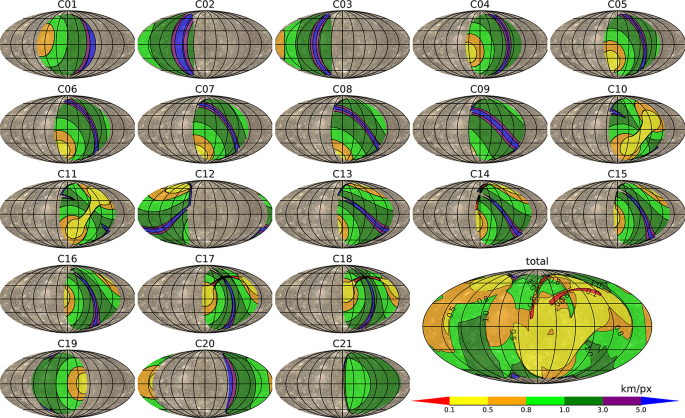
The alternative text for this image may have been generated using AI.
Plots of maximum diurnal coverage obtainable by MAJIS during the Callisto flybys, labelled C01 to C21, assuming a recently predicted JUICE mission profile (CReMA 5.0). Solar incidence angle is imposed <75° and viewing geometry in near-nadir direction (within 15° from nadir). The colour scale in each plot represents the best spatial resolution achievable by MAJIS. The larger map in the lower-right panel displays the potential coverage achievable by merging the coverage of all flybys with the best spatial resolution
Mapping the distribution of volatiles across the surfaces of the icy moons is also a key goal of the JUICE UVS imaging spectrograph. Important surface materials, including O2, O3, CO2, SO2 and H2O2, have absorption features that fall partially or entirely within the 50–204 nm UVS bandpass (Retherford et al., this collection). An absorption feature at ∼180 nm, potentially related to NH3 and recently detected on Ganymede by Juno/UVS (Molyneux et al. [2022](/article/10.1007/s11214-024-01089-8#ref-CR198 " Molyneux PM, Greathouse TK, Gladstone GR, Versteeg MH, Hue V, Kammer J, Davis MW, Bolton SJ, Giles R, Connerney JEP, Gérard J-C, Grodent DC (2022) Ganymede’s UV reflectance from Juno UVS data. Geophys Res Lett 49(23):e2022GL099532. https://doi.org/10.1029/2022GL099532
            ")), will also be observable by JUICE UVS. Several organic materials additionally have distinctive spectral features in the far UV; for example, benzene absorbs strongly around 180 nm, and methane ice absorbs at wavelengths <140 nm. The presence of other non-ice materials, including tholins and silicates, may also be inferred from the observed UV spectral slope at wavelengths >170 nm (Molyneux et al. [2020](/article/10.1007/s11214-024-01089-8#ref-CR197 "
                Molyneux PM, Nichols JD, Becker TM, Raut U, Retherford KD (2020) Ganymede’s far-ultraviolet reflectance: constraining impurities in the surface ice. J Geophys Res, Planets 125(9):e2020JE006476.
              https://doi.org/10.1029/2020JE006476

            ")). UVS will map at least 50% of Ganymede’s surface with spectral resolution ≤2 nm, to discriminate between signatures of different non-ice materials, and with spatial resolution ≤3 km, to investigate correlations with geology and/or surface processing by the Jovian magnetospheric plasma (GE.1b, GE.2f, GE.3a, GE.4c). Similar mapping will be performed across large areas of the surfaces of Callisto (CB.1b, CB.2d, CC.3c) and Europa (EA.1b, EA.2b, EA.3e, EC.3b), with spatial resolution ranging from ∼10 km, to study compositional asymmetry between the leading and trailing hemispheres, to ∼1 km or better for selected targets of highest scientific interest on Europa.
3.3 Characterization of Physical Properties of the Surface
To spectrally characterise the physical properties of water ice, a high spectral resolution combined with good-to-adequate SNR in the spectral range 1.0–3.6 μm are mandatory. Particularly, the weak and narrow absorption bands at 1.31, 1.57 and 1.65 μm, superimposed on the deeper bands (Grundy and Schmitt [1998](/article/10.1007/s11214-024-01089-8#ref-CR95 " Grundy WM, Schmitt B (1998) The temperature-dependent near-infrared absorption spectrum of hexagonal H2O ice. J Geophys Res, Planets 103(E11):25809–25822. https://doi.org/10.1029/98JE00738
            "); Stephan et al. [2021b](/article/10.1007/s11214-024-01089-8#ref-CR292 "
                Stephan K, Ciarniello M, Poch O, Schmitt B, Haack D, Raponi A (2021b) VIS-NIR/SWIR spectral properties of H2O ice depending on particle size and surface temperature. Minerals 11(12):1328.
              https://doi.org/10.3390/min11121328

            ")) as well as the reflection peak at 3.1 μm, are needed to distinguish between abundance, crystallinity, grain size, micro-porosity, and temperature variations of water ice on the surfaces of the icy Galilean satellites. The best possible knowledge of variations in these properties is also essential to correctly interpret the non-ice spectral signatures, particularly in case of hydroxylated and hydrated minerals.
The spectral characterization of the ice properties is one of the main objectives of MAJIS. While the visible spectral range, where water ice is highly transparent, can be used to characterise the abundance of water ice on their surfaces, the NIR is essential to characterise the physical properties of water ice (GC.4b, GE.1a, GE.3b, CB.1a). The spatial resolution of the MAJIS observations carried out during the GCO5000 orbital sub-phase will enable the study of the global variations in abundance, grain size, and crystallinity similar to the available Galileo/NIMS observations. However, MAJIS will provide the first global spectral coverage of Ganymede’s surface. Together with the knowledge of surface temperature and the distribution of exogenous products, the characterization of water ice will help decipher the mystery of Ganymede’s polar caps. As the north polar region of Ganymede will be in shadow during GCO500, it will be essential to observe it in previous orbital subphases to allow studying local ice properties, such as grain size and crystallinity, as a function of latitude and given local topography and geological features such as fresh impact craters (Stephan et al. [2020](/article/10.1007/s11214-024-01089-8#ref-CR291 " Stephan K, Hibbitts CA, Jaumann R (2020) H2O-ice particle size variations across Ganymede’s and Callisto’s surface. Icarus 337:113440. https://doi.org/10.1016/j.icarus.2019.113440
            "), [2021a](/article/10.1007/s11214-024-01089-8#ref-CR293 "
                Stephan K, Roatsch T, Tosi F, Matz K-D, Kersten E, Wagner R, Molyneux P, Palumbo P, Poulet F, Hussmann H, Barabash S, Bruzzone L, Dougherty M, Gladstone R, Gurvits LI, Hartogh P, Iess L, Wahlund J-E, Wurz P, Witasse O, Grasset O, Altobelli N, Carter J, Cavalié T, D’Aversa E, Della Corte V, Filacchione G, Galli A, Galluzzi V, Gwinner K, Hauber E, Jaumann R, Krohn K, Langevin Y, Lucchetti A, Piccioni G, Solomonidou A, Stark A, Tobie G, Tubiana C, Vallat C, Van Hoolst T (the JUICE SWT Team) (2021a) Regions of interest on Ganymede’s and Callisto’s surfaces as potential targets for ESA’s JUICE mission. Planet Space Sci 208:105324.
              https://doi.org/10.1016/j.pss.2021.105324

            ")). JANUS can highlight local variations in water ice abundance. In this regard, special care must be taken when patches with both strongly ice-ich and highly concentrated dark non-ice materials are close to each other and captured in the same image, resulting in a very high albedo contrast.
On Ganymede and particularly on Europa, grain size and crystallinity could also provide evidence for local surface features of recent cryovolcanic origin with possible erupted subsurface liquids. For example, on Enceladus, large crystalline ice grains have been found to dominate the ‘tiger stripes’ in the southern polar region, where ice grains crystallise from a warm liquid (Jaumann et al. [2008](/article/10.1007/s11214-024-01089-8#ref-CR133 " Jaumann R, Stephan K, Hansen GB, Clark RN, Buratti BJ, Brown RH, Baines KH, Newman SF, Bellucci G, Filacchione G, Coradini A, Cruikshank DP, Griffith CA, Hibbitts CA, McCord TB, Nelson RM, Nicholson PD, Sotin C, Wagner R (2008) Distribution of icy particles across Enceladus’ surface as derived from Cassini-VIMS measurements. Icarus 193(2):407–419. https://doi.org/10.1016/j.icarus.2007.09.013
            "); Brown et al. [2006](/article/10.1007/s11214-024-01089-8#ref-CR25 "
                Brown RH, Clark RN, Buratti BJ, Cruikshank DP, Barnes JW, Mastrapa RME, Bauer J, Newman S, Momary T, Baines KH, Bellucci G, Capaccioni F, Cerroni P, Combes M, Coradini A, Drossart P, Formisano V, Jaumann R, Langevin Y, Matson DL, McCord TB, Nelson RM, Nicholson PD, Sicardy B, Sotin C (2006) Composition and physical properties of Enceladus’ surface. Science 311(5766):1425–1428.
              https://doi.org/10.1126/science.1121031

            ")) and geysers continuously emanate smaller water ice particles and more into space (Postberg et al. [2009](/article/10.1007/s11214-024-01089-8#ref-CR232 "
                Postberg F, Kempf S, Schmidt J, Brilliantov N, Beinsen A, Abel B, Buck U, Srama R (2009) Sodium salts in E-ring ice grains from an ocean below the surface of Enceladus. Nature 459(7250):1098–1101.
              https://doi.org/10.1038/nature08046

            "), [2011a](/article/10.1007/s11214-024-01089-8#ref-CR234 "
                Postberg F, Schmidt J, Hillier JK, Kempf S, Srama R (2011a) A salt-water reservoir as the source of a compositionally stratified plume on Enceladus. Nature 474(7353):620–622.
              https://doi.org/10.1038/nature10175

            ")).
On Callisto, MAJIS can verify the global grain size variations indicated by NIMS (Stephan et al. [2020](/article/10.1007/s11214-024-01089-8#ref-CR291 " Stephan K, Hibbitts CA, Jaumann R (2020) H2O-ice particle size variations across Ganymede’s and Callisto’s surface. Icarus 337:113440. https://doi.org/10.1016/j.icarus.2019.113440
")) in comparison with Ganymede, to characterise how the competition between diurnal temperature variations and the plasma bombardment influences the surface ice properties at global and local scale. Further deciphering the local effects of temperature variations and irradiation by charged magnetospheric particles onto the surface ice of Callisto in comparison to Ganymede is essential to correctly interpret the composition and the formation and evolution of individual surface features on these bodies.In the thermal range, diurnal temperature variations constrain thermal inertia of the surface. The 600 and 1200 GHz channels of SWI (Hartogh et al., this collection) will sense depths of about 2–8 mm (10–15 times the wavelength), yielding clues on the vertical variation of thermal inertia. In the Ganymede orbit phase, this will be achieved at spatial scales of respectively about 10 km (600 GHz) and 5 km (1200 GHz) during GCO5000, and at spatial scales of about 1 km (600 GHz) and 0.5 km (1200 GHz) during GCO500. With these two channels the emissivity properties of the regolith can also be estimated, which in turn encapsulates its physical characteristics such as porosity, grain size, and composition to some degree (GE.4b and CB.1e). In particular, the measurement of polarised thermal emission at a range of emission angles permits the separation of physical temperature and emissivity effects in producing the observed brightness temperatures, and the effective dielectric constant may be determined, bearing information on the surface and near-subsurface density and composition. The first dedicated study of the relevant inverse problem by Ilyushin and Hartogh ([2020](/article/10.1007/s11214-024-01089-8#ref-CR131 " Ilyushin YA, Hartogh P (2020) Submillimeter Wave Instrument radiometry of the Jovian icy moons. Numerical simulation of the microwave thermal radiative transfer and Bayesian retrieval of the physical properties. Astron Astrophys 644:A24. https://doi.org/10.1051/0004-6361/201937220
")) demonstrated a reliable retrieval of the single scattering albedo and thermal skin depth from SWI radiometric measurement. Furthermore, thermophysical and dielectric properties of the surfaces will be correlated with the visible and infrared surface and albedo features. Thus, in synergy with properties constrained by other instruments, thermophysical models of the surface of the icy Galilean moons will enable to address a range of scientific questions on the (regolith) surface evolution. Finally, SWI will correlate atmospheric properties as described in Sect. [4.3](/article/10.1007/s11214-024-01089-8#Sec28) with brightness temperature maps. This will permit distinguishing between sputtering and sublimation processes, indicate potential cryovolcanic activity, and assess sublimation mechanisms at the surface or the shallow subsurface.In the framework of the JUICE mission, quasi-specular bistatic radar (BSR) observations of Ganymede can be planned by using the 3GM radio science experiment in a downlink configuration such that JUICE is the transmitter (in either X- or Ka-band), Earth is the receiver in the specular direction of reflection, and the icy satellite is the target reflecting the radio waves.
When a polarised radio signal impacts a natural surface, reflections are altered by its statistical and electrical properties. The roughness, on an effective length-scale of a few hundreds of wavelengths, produces a frequency broadening of the echo. The terrain’s permittivity determines how the incoming polarised power is partially reflected with a same-sense and orthogonal-sense of polarisation compared to transmission. Therefore, from the reflected signal it is possible to infer physical properties of the uppermost surface layer complementary to those derived by other instruments at different wavelengths (MAJIS, GALA, RIME, SWI), such as average surface slope (roughness), near-surface dielectric constant and, with some knowledge of surface composition and porosity (Simpson et al. [1993](/article/10.1007/s11214-024-01089-8#ref-CR274 " Simpson RA (1993) Spacecraft studies of planetary surfaces using bistatic radar. Remote Sens 31(2):465–482. https://doi.org/10.1109/36.214923
")).The near-surface material of the Galilean moons is expected to be mostly water ice, with a various fraction of non-ice contaminants (Black et al. [2001](/article/10.1007/s11214-024-01089-8#ref-CR9 " Black GJ, Campbell DP, Nicholson PD (2001) Icy Galilean Satellites: Modeling Radar reflectivities as a coherent backscatter effect. Icarus 151(2):167–180. https://doi.org/10.1006/icar.2001.6616
            ")). The relative permittivity of pure water ice is 3.1 (Thompson and Squyres [1990](/article/10.1007/s11214-024-01089-8#ref-CR300 "
                Thompson WR, Squyres SW (1990) Titan and other icy satellites: Dielectric properties of constituent materials and implications for radar sounding. Icarus 86(2):336–354.
              https://doi.org/10.1016/0019-1035(90)90224-W

            ")). Any observed deviation from that value can be explained with the presence of different surface materials, or with a different porosity or purity of the water-ice layer (Heggy et al. [2017](/article/10.1007/s11214-024-01089-8#ref-CR113 "
                Heggy E, Scabbia G, Bruzzone L, Pappalardo RT (2017) Radar probing of Jovian icy moons: understanding subsurface water and structure detectability in the JUICE and Europa missions. Icarus 285:237–251.
              https://doi.org/10.1016/j.icarus.2016.11.039

            ")). If specular BSR experiments are carried out at an incident angle close to the Brewster’s angle (for pure water ice roughly 60 degrees), the circular power ratio equals 1\. When far from this value, a polarised component of the two will be weaker, and the computation of polarised reflected power in that sense will be more uncertain (Simpson et al. [2011](/article/10.1007/s11214-024-01089-8#ref-CR275 "
                Simpson RA, Tyler LG, Pätzold M, Häusler B, Asmar SW, Sultan-Salem AK (2011) Polarization in bistatic radar probing of planetary surfaces: Application to Mars Express data. Proceedings of the IEEE 99(5):858–874.
              https://doi.org/10.1109/JPROC.2011.2106190

            ")). In addition, large angles of incidence are always dangerous for potential shadowing effects and for the failure of the traditional model relating surface properties to echoes’ spectra (Simpson and Tyler [1981](/article/10.1007/s11214-024-01089-8#ref-CR272 "
                Simpson RA, Tyler LG (1981) Viking bistatic radar experiment: Summary of first-order results emphasizing north polar data. Icarus 46(3):361–389.
              https://doi.org/10.1016/0019-1035(81)90139-1

            ")).
Before entering the Ganymede orbital phase (20 December 2034), JUICE will perform 9 flybys of Ganymede spanning equatorial regions at observation angles that rarely get close to Brewster for water ice. The >9-month long Ganymede orbital phase is more suitable for specular BSR observations of the moon. The coverage is longitudinally complete, and spans between 60° North and South, with an incidence angle between 50° and 70° the 50% of the time.
Ground-based observations of the Galilean moons suggest that surface echoes may be dominated by an enhanced backscattering component resulting from multiple subsurface scattering mechanisms (Black et al. [2001](/article/10.1007/s11214-024-01089-8#ref-CR9 " Black GJ, Campbell DP, Nicholson PD (2001) Icy Galilean Satellites: Modeling Radar reflectivities as a coherent backscatter effect. Icarus 151(2):167–180. https://doi.org/10.1006/icar.2001.6616
            ")). Alongside traditional oblique observations, BSR experiments may be also carried out in a near-backscatter geometry to derive information about the geometric structure of the regolith from features of the backscatter enhancement of the icy surface of Ganymede, such as angular width and its variation with wavelength (Hapke [1990](/article/10.1007/s11214-024-01089-8#ref-CR107 "
                Hapke B (1990) Coherent backscatter and the radar characteristics of outer planet satellites. Icarus 88(2):407–417.
              https://doi.org/10.1016/0019-1035(90)90091-M

            ")). When in this geometry, it is possible to distinguish enhanced backscattering from ice from specular reflections thanks to their different polarisation properties (Black et al. [2001](/article/10.1007/s11214-024-01089-8#ref-CR9 "
                Black GJ, Campbell DP, Nicholson PD (2001) Icy Galilean Satellites: Modeling Radar reflectivities as a coherent backscatter effect. Icarus 151(2):167–180.
              https://doi.org/10.1006/icar.2001.6616

            "); Simpson and Tyler [1991](/article/10.1007/s11214-024-01089-8#ref-CR273 "
                Simpson RA, Tyler LG (1991) Surface properties of Galilean satellites from bistatic radar experiments. NASA, Washington, Reports of Planetary Geology and Geophysics Program, 1990.
              https://ntrs.nasa.gov/citations/19920001631

            ")).
For BSR experiments, ground antennas in the 64–70 m diameter range, with the ability to receive in both X- and Ka-band, would help increase the detectability of echoes from Ganymede, improving the accuracy and spatial resolution of the retrieved surface properties.
3.4 Connections Between Surface and Subsurface Processes
The purpose of a combination of data from several remote sensing instruments, for specific regions of interest on the icy Galilean satellites, is to return a three-dimensional view of those regions, impossible to achieve from individual datasets. In the case of Europa and Ganymede, this data fusion could reveal locations where the exchange of liquid material between the shallow subsurface and the surface was more frequent and intense in the past. The potential deriving from such a multidisciplinary analysis is remarkable (e.g. Tosi et al. [2023](/article/10.1007/s11214-024-01089-8#ref-CR303 " Tosi F, Galluzzi V, Lucchetti A, Orosei R, Filacchione G, Zambon F, Cremonese G, Palumbo P, Piccioni G (2023) Mutidisciplinary analysis of the Nippur Sulcus region on Ganymede. J Geophys Res, Planets 128(7):e2023JE007836. https://doi.org/10.1029/2023JE007836
")).The RIME ice penetrating radar is the key instrument to characterise the near-subsurface of the ice crust, detecting subsurface horizons and structures with differing dielectric constants up to a depth of a few km. RIME will provide constraints on the distribution and emplacement of subsurface materials having contrasting dielectric constants, which will be key to understanding the formation of various surface features. Combined with surface composition as derived by MAJIS and UVS, this could confirm recent activity and the possible presence of pockets of liquid water on Europa essential to habitability. RIME observations relate to different phenomena and surface and subsurface features depending on the icy moon under consideration. This prospecting will be supported by JANUS and GALA, which will provide topographic information required to properly model the off-nadir reflections (clutter) (see Bruzzone et al., this collection; Van Hoolst et al. [2024](/article/10.1007/s11214-024-01089-8#ref-CR312 " Van Hoolst T, Tobie G, Vallat C, Altobelli N, Bruzzone L, Cao H, Iess L, Kimura J, Khurana K, Dirkx D, Genova A, Hussmann H, Lucchetti A, Mitri G, Moore W, Saur J, Stark A, Vorburger A, Wieczorek M, Aboudan A, Bergman J, Bovolo F, Breuer D, Cappuccio P, Carrer L, Cecconi B, Choblet G, De Marchi F, Fayolle M, Fienga A, Futaana Y, Hauber E, Kofman W, Kumamoto A, Lainey V, Molyneux P, Mousis O, Plaut J, Puccio W, Retherford K, Roth L, Seignovert B, Steinbrügge G, Thakur S, Tortora P, Tosi F, Zannoni M, Barabash S, Dougherty M, Gladstone R, Gurvits LI, Hartogh P, Palumbo P, Poulet F, Wahlund J-F, Grasset O, Witasse O (2024) Geophysical characterization of the interiors of Ganymede, Callisto and Europa by ESA’s JUpiter ICy moons Explorer. Space Sci Rev 220:54. https://doi.org/10.1007/s11214-024-01085-y
"), this collection for more details).At Ganymede, RIME will characterise the ice shell (GB.1, GB.2), explore the formation of surface features, search for past and present activity (GD.1, GD.2) and determine the global composition, distribution, and evolution of surface materials (GE.2). In detail, RIME will measure composition interfaces being generated by: the thermal segregation of impurities (e.g., Pappalardo and Barr [2004](/article/10.1007/s11214-024-01089-8#ref-CR215 " Pappalardo RT, Barr AC (2004) The origin of domes on Europa: the role of thermally induced compositional diapirism. Geophys Res Lett 31(1):L01701. https://doi.org/10.1029/2003GL019202
            ")) and/or abrupt changes in crystal fabric (Barr and Stillman [2011](/article/10.1007/s11214-024-01089-8#ref-CR5 "
                Barr AC, Stillman DE (2011) Strain history of ice shells of the Galilean satellites from radar detection of crystal orientation fabric. Geophys Res Lett 38(6):L06203.
              https://doi.org/10.1029/2010GL046616

            ")) associated with relict Brittle-Ductile Transitions (BDT) within the ice shell and considered as a physical indicator of heat flow causing spatial and temporal variations in the thickness of the ice shell; the dust and insoluble impurity laden lag deposit and the solid, cleaner ice beneath it; cryovolcanic flows (Golombek and Allison [1981](/article/10.1007/s11214-024-01089-8#ref-CR89 "
                Golombek MP, Allison ML (1981) Sequential development of grooved terrain and polygons on Ganymede. Geophys Res Lett 8(11):1139–1142.
              https://doi.org/10.1029/GL008i011p01139

            "); Collins et al. [1998](/article/10.1007/s11214-024-01089-8#ref-CR47 "
                Collins GC, Head JW, Pappalardo RT (1998) Formation of Ganymede Grooved Terrain by sequential extensional episodes: implications of Galileo observations for regional stratigraphy. Icarus 135(1):345–359.
              https://doi.org/10.1006/icar.1998.5978

            "); Pappalardo et al. [2004](/article/10.1007/s11214-024-01089-8#ref-CR218 "
                Pappalardo RT, Collins GC, Head JW, Helfenstein P, McCord TB, Moore JM, Prockter LM, Schenk PM, Spencer J (2004) Geology of Ganymede. In: Bagenal F, Dowling TE, McKinnon WB (eds) Jupiter – the planet, satellites and magnetosphere. Cambridge University Press, Cambridge, pp 363–396
            ")) and/or absorption associated with subsurface cryomagmatic source regions (Schenk et al. [2001](/article/10.1007/s11214-024-01089-8#ref-CR260 "
                Schenk PM, McKinnon WB, Gwynn D, Moore JM (2001) Flooding of Ganymede’s bright terrains by low-viscosity water-ice lavas. Nature 410(6824):57–60.
              https://doi.org/10.1038/35065027

            "); Pappalardo et al. [2004](/article/10.1007/s11214-024-01089-8#ref-CR218 "
                Pappalardo RT, Collins GC, Head JW, Helfenstein P, McCord TB, Moore JM, Prockter LM, Schenk PM, Spencer J (2004) Geology of Ganymede. In: Bagenal F, Dowling TE, McKinnon WB (eds) Jupiter – the planet, satellites and magnetosphere. Cambridge University Press, Cambridge, pp 363–396
            ")); faulting within grooved terrain by searching for offsets horst-and-graben structures and/or domino-style tilt blocks (Golombek and Allison [1981](/article/10.1007/s11214-024-01089-8#ref-CR89 "
                Golombek MP, Allison ML (1981) Sequential development of grooved terrain and polygons on Ganymede. Geophys Res Lett 8(11):1139–1142.
              https://doi.org/10.1029/GL008i011p01139

            "); Collins et al. [1998](/article/10.1007/s11214-024-01089-8#ref-CR47 "
                Collins GC, Head JW, Pappalardo RT (1998) Formation of Ganymede Grooved Terrain by sequential extensional episodes: implications of Galileo observations for regional stratigraphy. Icarus 135(1):345–359.
              https://doi.org/10.1006/icar.1998.5978

            ")); manifestation of the impact process (Schenk et al. [2004](/article/10.1007/s11214-024-01089-8#ref-CR261 "
                Schenk PM, Chapman CR, Zahnle K, Moore JM (2004) Ages and interiors: the cratering record of the Galilean satellites. In: Bagenal F, Dowling TE, McKinnon WB (eds) Jupiter: the planet, satellites and magnetosphere. Cambridge University Press, Cambridge, pp 427–456
            ")) by observing composition interfaces, structural interfaces, offsets, and distributed subsurface scatterers associated with the deposition of impact ejecta and/or impact melt; fracturing and injection of melt; and abrupt changes in crystal size and/or fabric associated with crater formation.
At Europa, RIME will contribute to determining the composition of the non-ice material especially as related to habitability, and to look for liquid water under the most active sites. Subsurface exploration will provide information about the complex geological activity of young surfaces and the relationship with a subsurface ocean (e.g., Carr et al. [1998](/article/10.1007/s11214-024-01089-8#ref-CR40 " Carr MH, Belton MJS, Chapman CR, Davies ME, Geissler P, Greenberg R, McEwen AS, Tufts BR, Greeley R, Sullivan R, Head JW, Pappalardo RT, Klaasen KP, Johnson TV, Kaufman J, Senske D, Moore J, Neukum G, Schubert G, Burns JA, Thomas P, Veverka J (1998) Evidence for a subsurface ocean on Europa. Nature 391(6665):363–365. https://doi.org/10.1038/34857
            "); Greenberg et al. [1999](/article/10.1007/s11214-024-01089-8#ref-CR94 "
                Greenberg R, Hoppa GV, Tufts BR, Geissler P, Riley J, Kadel S (1999) Chaos on Europa. Icarus 141(2):263–286.
              https://doi.org/10.1006/icar.1999.6187

            ")), processes internal to the ice shell (Pappalardo et al. [1998](/article/10.1007/s11214-024-01089-8#ref-CR217 "
                Pappalardo RT, Head JW, Greeley R, Sullivan RJ, Pilcher C, Schubert G, Moore WB, Carr MH, Moore JM, Belton MJS, Goldsby DL (1998) Geological evidence for solid-state convection in Europa’s ice shell. Nature 391(6665):365–368.
              https://doi.org/10.1038/34862

            "); McKinnon [1999](/article/10.1007/s11214-024-01089-8#ref-CR190 "
                McKinnon WB (1999) Convective instability in Europa’s floating ice shell. Geophys Res Lett 26(7):951–954.
              https://doi.org/10.1029/1999GL900125

            "); Pappalardo and Barr [2004](/article/10.1007/s11214-024-01089-8#ref-CR215 "
                Pappalardo RT, Barr AC (2004) The origin of domes on Europa: the role of thermally induced compositional diapirism. Geophys Res Lett 31(1):L01701.
              https://doi.org/10.1029/2003GL019202

            "); Mitri and Showman [2005](/article/10.1007/s11214-024-01089-8#ref-CR194 "
                Mitri G, Showman AP (2005) Convective conductive transitions and sensitivity of a convecting ice shell to perturbations in heat flux and tidal-heating rate: Implications for Europa. Icarus 177(2):447–460.
              https://doi.org/10.1016/j.icarus.2005.03.019

            "); Schmidt et al. [2011](/article/10.1007/s11214-024-01089-8#ref-CR263 "
                Schmidt BE, Blankenship DD, Patterson GW, Schenk PM (2011) Active formation of ‘chaos terrain’ over shallow subsurface water on Europa. Nature 479(7374):502–505.
              https://doi.org/10.1038/nature10608

            ")) and/or arising from tidal interactions with Jupiter (McEwen [1986](/article/10.1007/s11214-024-01089-8#ref-CR187 "
                McEwen AS (1986) Tidal reorientation and the fracturing of Jupiter’s moon Europa. Nature 321(6065):49–51.
              https://doi.org/10.1038/321049a0

            "); Hoppa et al. [1999a](/article/10.1007/s11214-024-01089-8#ref-CR123 "
                Hoppa GV, Tufts BR, Greenberg R, Geissler P (1999a) Strike-slip faults on Europa: global shear patterns driven by tidal stress. Icarus 141(2):287–298.
              https://doi.org/10.1006/icar.1999.6185

            "),[b](/article/10.1007/s11214-024-01089-8#ref-CR124 "
                Hoppa GV, Tufts BR, Greenberg R, Geissler PE (1999b) Formation of cycloidal features on Europa. Science 285(5435):1899–1902.
              https://doi.org/10.1126/science.285.5435.1899

            "); Kattenhorn [2004](/article/10.1007/s11214-024-01089-8#ref-CR145 "
                Kattenhorn SA (2004) Strike-slip fault evolution on Europa: evidence from tailcrack geometries. Icarus 172(2):582–602.
              https://doi.org/10.1016/j.icarus.2004.07.005

            "); Hurford et al. [2005](/article/10.1007/s11214-024-01089-8#ref-CR126 "
                Hurford TA, Beyer RA, Schmidt B, Preblich B, Sarid AR, Greenberg R (2005) Flexure of Europa’s lithosphere due to ridge-loading. Icarus 177(2):380–396.
              https://doi.org/10.1016/j.icarus.2005.06.019

            "); Sotin et al. [2002](/article/10.1007/s11214-024-01089-8#ref-CR282 "
                Sotin C, Head JW, Tobie G (2002) Europa: tidal heating of upwelling thermal plumes and the origin of lenticulae and chaos melting. Geophys Res Lett 29(8):1233.
              https://doi.org/10.1029/2001GL013844

            . 74-1–74-4
            "); Mitri and Showman [2008](/article/10.1007/s11214-024-01089-8#ref-CR195 "
                Mitri G, Showman AP (2008) A model for the temperature-dependence of tidal dissipation in convective plumes on icy satellites: implications for Europa and Enceladus. Icarus 195(2):758–764.
              https://doi.org/10.1016/j.icarus.2008.01.010

            ")). A key element to explore is the relationship between the distribution of non-ice material to geological features and processes, especially material exchange with the interior (EA.2), combining JANUS, MAJIS, UVS, and SWI observations. The search for liquid water being related to young surfaces (Collins and Nimmo [2009](/article/10.1007/s11214-024-01089-8#ref-CR46 "
                Collins GC, Nimmo F (2009) Chaotic terrain on Europa. In: Pappalardo RT, McKinnon WB, Khurana KK (eds) Europa. University of Arizona Press, Tucson, pp 259–282
            ")), RIME, in conjunction with other remote sensing instruments (JANUS, MAJIS, UVS, SWI), will determine the location of active sites and their relationship to subsurface water by detecting possible water interfaces and provide information about the rate of material exchange between the surface and the ocean as a function of the ice thickness (EB.1, EB.2, EB.3).
At Callisto, RIME will characterise the upper kilometres of the ice shell (CA.1), determine the composition of the non-ice material (CB.2) and search for past and potentially recent activity (CC.1, CC.3). Subsurface radar sounding will probe the icy shell providing a unique way to evaluate the origin and composition of the crust and the nature of the icy mantle beneath, and insights into the processes that have contributed to the formation of geological features (predominantly impacts and to a much lesser extent faulting). Subsurface sounding determines the regolith thickness at the surface and measures the depths to relict brittle-ductile transitions within the shell. It also contributes to constraining the nature and distribution of surface materials (e.g., primordial, accreted rock, or later meteoritic debris) providing scattering measurements complementary to those returned by JUICE’s spectroscopic instruments. These materials and their distributions will then be related to geological processes (e.g. impacts, see Greeley et al. [2000](/article/10.1007/s11214-024-01089-8#ref-CR92 " Greeley R, Klemaszewski JE, Wagner R (2000) Galileo views of the geology of Callisto. Planet Space Sci 48:829–853. https://doi.org/10.1016/S0032-0633(00)00050-7
            "); Moore et al. [2004](/article/10.1007/s11214-024-01089-8#ref-CR201 "
                Moore JM, Chapman CR, Bierhaus EB, Greeley R, Chuang FC, Klemaszewski J, Clark RN, Dalton JB, Hibbitts CA, Schenk PM, Spencer JR, Wagner R (2004) Callisto. In: Bagenal F, Dowling TE, McKinnon WB (eds) Jupiter – the planet, satellites and magnetosphere. Cambridge University Press, Cambridge, pp 397–426
            "); Prockter et al. [2010](/article/10.1007/s11214-024-01089-8#ref-CR238 "
                Prockter LM, Lopes RMC, Giese B, Jaumann R, Lorenz RD, Pappalardo RT, Patterson GW, Thomas PC, Turtle EP, Wagner RJ (2010) Characteristics of icy surfaces. Space Sci Rev 153(1–4):63–111.
              https://doi.org/10.1007/s11214-010-9649-8

            ")), which will provide powerful synergy by extending compositional information from the surface to the ice shell via detection of composition interfaces. The RIME observations, together with JANUS-derived DEMs and GALA data, will be used to determine the formation and characteristics of tectonic and impact landforms (e.g., bombardment history and faulting characteristics); to constrain global and regional surface ages; identify and locally characterise compositional or structural interfaces, distributed subsurface scatterers, as well as offsets associated with impact facies. RIME detections of up-warped subsurface reflectors will place limits on the depths of impact excavation and post-impact deformation.
4 Near-Surface Atmospheres
4.1 Current Knowledge of the Satellites’ Atmosphere Properties from Previous Observations and Modelling
The earliest models of the atmospheres of Jupiter’s icy moons were produced long before the direct detection of any specific atmospheric species there. Motivated by a stellar occultation measurement of a ∼1 bar atmosphere at Ganymede by Carlson et al. ([1973](/article/10.1007/s11214-024-01089-8#ref-CR34 " Carlson RW, Bhattacharyya JC, Smith BA, Johnson TV, Hidayat B, Smith SA, Taylor GE, O’Leary B, Brinkmann RT (1973) An atmosphere on Ganymede from its occultation of SAO 186800 on 7 June 1972. Science 182(4107):53–55. https://doi.org/10.1126/science.182.4107.53
            ")) (later found to have been an incorrect interpretation of the data), Yung and McElroy ([1977](/article/10.1007/s11214-024-01089-8#ref-CR322 "
                Yung YL, McElroy MB (1977) Stability of an oxygen atmosphere on Ganymede. Icarus 30(1):97–103.
              https://doi.org/10.1016/0019-1035(77)90124-5

            ")) developed a photochemical model of a sublimation-driven atmosphere comprising water group species. They suggested that photolysis of water vapour and subsequent escape of hydrogen should lead to a stable oxygen atmosphere at Ganymede. A similar atmosphere was also predicted to exist at Callisto, although an oxygen atmosphere at Europa was considered less likely due to the higher albedo there inhibiting sublimation.
The importance of sputtering to the generation of the satellite atmospheres was first demonstrated through laboratory studies described by Lanzerotti et al. ([1978](/article/10.1007/s11214-024-01089-8#ref-CR163 " Lanzerotti LJ, Brown WL, Poate JM, Augustyniak WM (1978) On the contribution of water products from Galilean satellites to the Jovian magnetosphere. Geophys Res Lett 5(2):155–158. https://doi.org/10.1029/GL005i002p00155
            ")). They found that the H2O partial pressure assumed by Yung and McElroy ([1977](/article/10.1007/s11214-024-01089-8#ref-CR322 "
                Yung YL, McElroy MB (1977) Stability of an oxygen atmosphere on Ganymede. Icarus 30(1):97–103.
              https://doi.org/10.1016/0019-1035(77)90124-5

            ")) in their Ganymede models could be supported entirely by charged particle sputtering of H2O from Ganymede’s surface. Sputtering rates were expected to be higher at Europa and lower at Callisto. Further experiments by Johnson et al. ([1981](/article/10.1007/s11214-024-01089-8#ref-CR138 "
                Johnson RE, Lanzerotti LJ, Brown WL, Armstrong TP (1981) Erosion of Galilean satellite surfaces by Jovian magnetosphere particles. Science 212(4498):1027–1030.
              https://doi.org/10.1126/science.212.4498.1027

            ")), combined with analysis of plasma ion flux measurements from within the Jovian magnetosphere by Voyager, confirmed that production of gas phase species at Jupiter’s icy moons by sputtering could dominate over sublimation, depending on the local surface temperature. Brown et al. ([1982](/article/10.1007/s11214-024-01089-8#ref-CR23 "
                Brown WL, Lanzerotti LJ, Johnson RE (1982) Fast ion bombardment of ices and its astrophysical implications. Science 218(4572):525–531.
              https://doi.org/10.1126/science.218.4572.525

            ")) then showed that the primary species ejected from icy surfaces are H2O, O2, and H2, leading to O2\-dominated atmospheres as H2 readily escapes and H2O condenses back onto the surface.
Confirmation of O2 atmospheres at Europa and Ganymede was finally provided by HST in the 1990s (Hall et al. [1995](/article/10.1007/s11214-024-01089-8#ref-CR97 " Hall DT, Strobel DF, Feldman PD, McGrath MA, Weaver HA (1995) Detection of an oxygen atmosphere on Jupiter’s moon Europa. Nature 373(6516):677–679. https://doi.org/10.1038/373677a0
            "), [1998](/article/10.1007/s11214-024-01089-8#ref-CR98 "
                Hall DT, Feldman PD, McGrath MA, Strobel DF (1998) The far-ultraviolet oxygen airglow of Europa and Ganymede. Astrophys J 499(5):475–481.
              https://doi.org/10.1086/305604

            ")). Callisto’s O2 atmosphere, although denser than Europa’s and Ganymede’s, was not successfully detected until 2015 (Cunningham et al. [2015](/article/10.1007/s11214-024-01089-8#ref-CR53 "
                Cunningham NJ, Spencer JR, Feldman PD, Strobel DF, France K, Osterman SN (2015) Detection of Callisto’s oxygen atmosphere with the Hubble Space Telescope. Icarus 254:178–189.
              https://doi.org/10.1016/j.icarus.2015.03.021

            ")). Other water group species have also been observed – H2O vapour at Ganymede and Europa (Roth et al. [2021](/article/10.1007/s11214-024-01089-8#ref-CR252 "
                Roth L, Ivchenko N, Gladstone GR, Saur J, Grodent D, Bonfond B, Molyneux PM, Retherford KD (2021) A sublimated water atmosphere on Ganymede detected from Hubble Space Telescope observations. Nat Astron 5(10):1043–1051.
              https://doi.org/10.1038/s41550-021-01426-9

            "); Roth [2021](/article/10.1007/s11214-024-01089-8#ref-CR246 "
                Roth L (2021) A stable H2O atmosphere on Europa’s trailing hemisphere from HST images. Geophys Res Lett 48(20):e2021GL094289.
              https://doi.org/10.1029/2021GL094289

            ")); H coronas at all three moons (Barth et al. [1997](/article/10.1007/s11214-024-01089-8#ref-CR6 "
                Barth CA, Hord CW, Stewart AIF, Pryor WR, Simmons KE, McClintock WE, Ajello JM, Naviaux KL, Aiello JJ (1997) Galileo ultraviolet spectrometer observations of atomic hydrogen in the atmosphere at Ganymede. Geophys Res Lett 24(17):2147–2150.
              https://doi.org/10.1029/97GL01927

            "); Alday et al. [2017](/article/10.1007/s11214-024-01089-8#ref-CR1 "
                Alday J, Roth L, Ivchenko N, Retherford KD, Becker TM, Molyneux P, Saur J (2017) New constraints on Ganymede’s hydrogen corona: analysis of Lyman-


                α

              <span class="katex"><span class="katex-mathml"><math xmlns="http://www.w3.org/1998/Math/MathML"><semantics><mrow><mi>α</mi></mrow><annotation encoding="application/x-tex">\alpha </annotation></semantics></math></span><span class="katex-html" aria-hidden="true"><span class="base"><span class="strut" style="height:0.4306em;"></span><span class="mord mathnormal" style="margin-right:0.0037em;">α</span></span></span></span>
             emissions observed by HST/STIS between 1998 and 2014. Planet Space Sci 148:35–44.
              https://doi.org/10.1016/j.pss.2017.10.006

            "); Roth et al. [2017a](/article/10.1007/s11214-024-01089-8#ref-CR251 "
                Roth L, Retherford K, Ivchenko N, Schlatter N, Strobel DF, Becker TM, Grava C (2017a) Detection of a hydrogen corona in HST Ly


                α

              <span class="katex"><span class="katex-mathml"><math xmlns="http://www.w3.org/1998/Math/MathML"><semantics><mrow><mi>α</mi></mrow><annotation encoding="application/x-tex">\alpha </annotation></semantics></math></span><span class="katex-html" aria-hidden="true"><span class="base"><span class="strut" style="height:0.4306em;"></span><span class="mord mathnormal" style="margin-right:0.0037em;">α</span></span></span></span>
             images of Europa in transit of Jupiter. Astron J 153(2):67.
              https://doi.org/10.3847/1538-3881/153/2/67

            "), [2017b](/article/10.1007/s11214-024-01089-8#ref-CR250 "
                Roth L, Alday J, Becker TM, Ivchenko N, Retherford KD (2017b) Detection of a hydrogen corona at Callisto. J Geophys Res, Planets 122(5):1046–1055.
              https://doi.org/10.1002/2017JE005294

            ")) – as well as CO2 at Callisto (Carlson [1999](/article/10.1007/s11214-024-01089-8#ref-CR33 "
                Carlson RW (1999) A tenuous carbon dioxide atmosphere on Jupiter’s moon Callisto. Science 283(5403):820–821.
              https://doi.org/10.1126/science.283.5403.820

            ")) and Na and K at Europa (Brown and Hill [1996](/article/10.1007/s11214-024-01089-8#ref-CR21 "
                Brown ME, Hill RE (1996) Discovery of an extended sodium atmosphere around Europa. Nature 380(6571):229–231.
              https://doi.org/10.1038/380229a0

            "); Brown [2001](/article/10.1007/s11214-024-01089-8#ref-CR19 "
                Brown ME (2001) Potassium in Europa’s atmosphere. Icarus 151(2):190–195.
              https://doi.org/10.1006/icar.2001.6612

            ")). The following subsections summarise our current understanding of the atmospheres of Europa ([4.1.1](/article/10.1007/s11214-024-01089-8#Sec21)), Ganymede ([4.1.2](/article/10.1007/s11214-024-01089-8#Sec22)), and Callisto ([4.1.3](/article/10.1007/s11214-024-01089-8#Sec23)).
4.1.1 Europa
Europa’s atmosphere was first observed by Hall et al. ([1995](/article/10.1007/s11214-024-01089-8#ref-CR97 " Hall DT, Strobel DF, Feldman PD, McGrath MA, Weaver HA (1995) Detection of an oxygen atmosphere on Jupiter’s moon Europa. Nature 373(6516):677–679. https://doi.org/10.1038/373677a0
            ")) via HST Goddard High Resolution Spectrograph (HST/GHRS) observations of neutral atomic oxygen emissions at 135.6 nm and 130.4 nm. Hall et al. ([1995](/article/10.1007/s11214-024-01089-8#ref-CR97 "
                Hall DT, Strobel DF, Feldman PD, McGrath MA, Weaver HA (1995) Detection of an oxygen atmosphere on Jupiter’s moon Europa. Nature 373(6516):677–679.
              https://doi.org/10.1038/373677a0

            ")) showed that the emissions were too bright to have been caused by resonant scattering of UV sunlight and were primarily due to electron impact excitation of an oxygen atmosphere. From the OI 135.6 nm / 130.4 nm intensity ratio of 1.9 it was inferred that the atmosphere is dominated by O2 since electron impact dissociative excitation of O2 produces an intensity ratio of >2.2 for electron temperatures (Te) in the range 5–500 eV (Kanik et al. [2003](/article/10.1007/s11214-024-01089-8#ref-CR143 "
                Kanik I, Noren C, Makarov OP, Vatti Palle P, Ajello JM, Shemansky DE (2003) Electron impact dissociative excitation of O2: 2. Absolute emission cross sections of the OI(130.4 nm) and OI(135.6 nm) lines. J Geophys Res, Planets 108(E11):5126.
              https://doi.org/10.1029/2000JE001423

            ")), while electron impact excitation of O and H2O lead to smaller emission ratios of <0.4 (Kanik et al. [2001](/article/10.1007/s11214-024-01089-8#ref-CR142 "
                Kanik I, Johnson PV, Das MB, Khakoo MA, Tayal SS (2001) Electron-impact studies of atomic oxygen: I. Differential and integral cross sections; experiment and theory. J Phys B, At Mol Opt Phys 34:2647–2665.
              https://doi.org/10.1088/0953-4075/34/13/308

            ")) and ∼0.2 (Makarov et al. [2004](/article/10.1007/s11214-024-01089-8#ref-CR175 "
                Makarov OP, Ajello JM, Vatti Palle P, Kanik I, Festou MC, Bhardwaj A (2004) Kinetic energy distributions and line profile measurements of dissociation products of water upon electron impact. J Geophys Res 109(A18):A09303.
              https://doi.org/10.1029/2002JA009353

            ")), respectively. Subsequent observations by Cassini UVIS detected an extended atomic oxygen corona around Europa, in addition to the bound O2 atmosphere (Hansen et al. [2005](/article/10.1007/s11214-024-01089-8#ref-CR102 "
                Hansen CJ, Shemansky DE, Hendrix AR (2005) Cassini UVIS observations of Europa’s oxygen atmosphere and torus. Icarus 176(2):305–315.
              https://doi.org/10.1016/j.icarus.2005.02.007

            ")).
The emission intensities measured by Hall et al. ([1995](/article/10.1007/s11214-024-01089-8#ref-CR97 " Hall DT, Strobel DF, Feldman PD, McGrath MA, Weaver HA (1995) Detection of an oxygen atmosphere on Jupiter’s moon Europa. Nature 373(6516):677–679. https://doi.org/10.1038/373677a0
            ")) are consistent with an O2 column density of \\((1.5 \\pm 0.5) \\times 10^{15}\\text{ cm}^{-2}\\) and a maximum O column density of \\(2 \\times 10^{14}\\text{ cm}^{-2}\\). Further observations using HST/GHRS (Hall et al. [1998](/article/10.1007/s11214-024-01089-8#ref-CR98 "
                Hall DT, Feldman PD, McGrath MA, Strobel DF (1998) The far-ultraviolet oxygen airglow of Europa and Ganymede. Astrophys J 499(5):475–481.
              https://doi.org/10.1086/305604

            ")) and the Space Telescope Imaging Spectrograph (HST/STIS – McGrath et al. [2009](/article/10.1007/s11214-024-01089-8#ref-CR188 "
                McGrath MA, Hansen CJ, Hendrix AR (2009) Observations of Europa’s tenuous atmosphere. In: Pappalardo RT, McKinnon WB, Khurana KK (eds) Europa. University of Arizona Press, Tucson, pp 485–505
            "); Roth et al. [2014a](/article/10.1007/s11214-024-01089-8#ref-CR248 "
                Roth L, Saur J, Retherford KD, Strobel DF, Feldman PD, McGrath MA, Nimmo F (2014a) Transient water vapor at Europa’s south pole. Science 343(6167):171–174.
              https://doi.org/10.1126/science.1247051

            "), [2014b](/article/10.1007/s11214-024-01089-8#ref-CR247 "
                Roth L, Retherford KD, Saur J, Strobel DF, Feldman PD, McGrath MA, Nimmo F (2014b) Orbital apocenter is not a sufficient condition for HST/STIS detection of Europa’s water vapor atmosphere. Proc Natl Acad Sci USA 111(48):E5123–E5132.
              https://doi.org/10.1073/pnas.1416671111

            ")) similarly indicated that O2 is the dominant atmospheric species at low altitudes and demonstrated that the OI 135.6 nm / 130.4 nm emission ratio is consistently lower on the orbital trailing hemisphere than on the leading hemisphere. Roth et al. ([2016](/article/10.1007/s11214-024-01089-8#ref-CR249 "
                Roth L, Saur J, Retherford KD, Strobel DF, Feldman PD, McGrath MA, Spencer JR, Blöcker A, Ivchenko N (2016) Europa’s far ultraviolet oxygen aurora from a comprehensive set of HST observations. J Geophys Res Space Phys 121(3):2143–2170.
              https://doi.org/10.1002/2015JA022073

            ")) performed a comprehensive analysis of STIS images obtained over 20 visits between 1999 and 2015, measuring average intensity ratios of 2.3 ± 0.3 and 1.6 ± 0.1 on the leading and trailing hemispheres, respectively. They attributed this to different atmospheric O/O2 mixing ratios of ∼0.05 on the trailing hemisphere and ≤0.01 on the leading hemisphere. However, further work by Roth ([2021](/article/10.1007/s11214-024-01089-8#ref-CR246 "
                Roth L (2021) A stable H2O atmosphere on Europa’s trailing hemisphere from HST images. Geophys Res Lett 48(20):e2021GL094289.
              https://doi.org/10.1029/2021GL094289

            ")) demonstrated that the reduced 135.6 nm / 130.4 nm ratio on Europa’s trailing hemisphere cannot be fully explained by atomic oxygen but instead requires the presence of a persistent H2O atmosphere above the trailing hemisphere, with H2O/O2 mixing ratios between 12 and 22.
Before the inference of a persistent H2O atmosphere at Europa, there had been several tentative indications of transient H2O vapour, suggestive of active plumes. Roth et al. ([2014a](/article/10.1007/s11214-024-01089-8#ref-CR248 " Roth L, Saur J, Retherford KD, Strobel DF, Feldman PD, McGrath MA, Nimmo F (2014a) Transient water vapor at Europa’s south pole. Science 343(6167):171–174. https://doi.org/10.1126/science.1247051
            ")) observed excess oxygen 130.4 nm and hydrogen Lyman-\\(\\alpha \\) (121.6 nm) emissions above Europa’s southern limb, with no corresponding increase in the 135.6 nm oxygen emission, which is consistent with the emissions expected from electron impact dissociation of H2O. The observed emissions were consistent with water vapour plumes 200 km high, with line-of-sight column densities of \\(\\sim 10^{20}\\text{ m}^{-2}\\). Additional plume candidates with similar column densities were identified via ultraviolet observations of Europa transiting Jupiter, during which regions of increased absorption above Europa’s limb were detected (Sparks et al. [2016](/article/10.1007/s11214-024-01089-8#ref-CR283 "
                Sparks WB, Hand KP, McGrath MA, Bergeron E, Cracraft M, Deustua SE (2016) Probing for evidence of plumes on Europa with HST/STIS. Astrophys J 829(2):121.
              https://doi.org/10.3847/0004-637X/829/2/121

            "), [2017](/article/10.1007/s11214-024-01089-8#ref-CR284 "
                Sparks WB, Schmidt BE, McGrath MA, Hand KP, Spencer JR, Cracraft M, Deustua SE (2017) Active cryovolcanism on Europa? Astrophys J Lett 839(2):L18.
              https://doi.org/10.3847/2041-8213/aa67f8

            ")), although these apparent detections may also result from statistical fluctuations (Giono et al. [2020](/article/10.1007/s11214-024-01089-8#ref-CR88 "
                Giono G, Roth L, Ivchenko N, Saur J, Retherford K, Schlegel S, Ackland M, Strobel D (2020) An analysis of the statistics and systematics of limb anomaly detections in HST/STIS transit images of Europa. Astron J 159(4):155.
              https://doi.org/10.3847/1538-3881/ab7454

            ")). Attempts to detect water vapour at infrared wavelengths have proven similarly difficult, yielding only upper limits (Sparks et al. [2019](/article/10.1007/s11214-024-01089-8#ref-CR285 "
                Sparks WB, Richter M, deWitt C, Montiel E, Dello Russo N, Grunsfeld JM, McGrath MA, Weaver H, Hand KP, Bergeron E, Reach W (2019) A search for water vapor plumes on Europa using SOFIA. Astrophys J 871(1):L5.
              https://doi.org/10.3847/2041-8213/aafb0a

            ")) and a single tentative detection that may originate from general outgassing (Paganini et al. [2020](/article/10.1007/s11214-024-01089-8#ref-CR213 "
                Paganini L, Villanueva GL, Roth L, Mandell AM, Hurford TA, Retherford KD, Mumma MJ (2020) A measurement of water vapour amid a largely quiescent environment on Europa. Nat Astron 4(3):266–272.
              https://doi.org/10.1038/s41550-019-0933-6

            ")).
Further constraints on the density and composition of water group species may be derived from measurements of absorption by Europa’s atmosphere. HST/STIS observations of Europa transiting Jupiter in 2014 and 2015 revealed the presence of an atomic hydrogen corona, which was seen to absorb Jupiter’s Lyman-\(\alpha \) dayglow (Roth et al. [2017a](/article/10.1007/s11214-024-01089-8#ref-CR251 " Roth L, Retherford K, Ivchenko N, Schlatter N, Strobel DF, Becker TM, Grava C (2017a) Detection of a hydrogen corona in HST Ly
                α

              <span class="katex"><span class="katex-mathml"><math xmlns="http://www.w3.org/1998/Math/MathML"><semantics><mrow><mi>α</mi></mrow><annotation encoding="application/x-tex">\alpha </annotation></semantics></math></span><span class="katex-html" aria-hidden="true"><span class="base"><span class="strut" style="height:0.4306em;"></span><span class="mord mathnormal" style="margin-right:0.0037em;">α</span></span></span></span>
             images of Europa in transit of Jupiter. Astron J 153(2):67.
              https://doi.org/10.3847/1538-3881/153/2/67

            ")). The observations were best fit using surface H densities of \\((1.50\\text{--}2.25) \\times 10^{3}\\text{ cm}^{-3}\\) and a line-of-sight 1/\\(r\\) profile, consistent with the results of Monte Carlo simulations by Smyth and Marconi ([2006](/article/10.1007/s11214-024-01089-8#ref-CR279 "
                Smyth WH, Marconi ML (2006) Europa’s atmosphere, gas tori, and magnetospheric implications. Icarus 181(2):510–526.
              https://doi.org/10.1016/j.icarus.2005.10.019

            ")), who predicted a surface density of \\(\\sim 2 \\times 10^{3}\\text{ cm}^{-3}\\).
In addition to water group species, extended coronas of the minor species Na and K have been detected thanks to their bright visible emissions (Brown and Hill [1996](/article/10.1007/s11214-024-01089-8#ref-CR21 " Brown ME, Hill RE (1996) Discovery of an extended sodium atmosphere around Europa. Nature 380(6571):229–231. https://doi.org/10.1038/380229a0
            "); Brown [2001](/article/10.1007/s11214-024-01089-8#ref-CR19 "
                Brown ME (2001) Potassium in Europa’s atmosphere. Icarus 151(2):190–195.
              https://doi.org/10.1006/icar.2001.6612

            ")). Brown and Hill ([1996](/article/10.1007/s11214-024-01089-8#ref-CR21 "
                Brown ME, Hill RE (1996) Discovery of an extended sodium atmosphere around Europa. Nature 380(6571):229–231.
              https://doi.org/10.1038/380229a0

            ")) observed atomic sodium emissions at 589.592 nm and 588.995 nm extending to at least 25 RE from Europa’s surface. Subsequent observations of a potassium emission line at 769.896 nm indicated that the Na/K ratio at Europa is a factor of >2.5× larger than expected if the source of the material is Io (Brown [2001](/article/10.1007/s11214-024-01089-8#ref-CR19 "
                Brown ME (2001) Potassium in Europa’s atmosphere. Icarus 151(2):190–195.
              https://doi.org/10.1006/icar.2001.6612

            ")), as initially suggested by Brown and Hill ([1996](/article/10.1007/s11214-024-01089-8#ref-CR21 "
                Brown ME, Hill RE (1996) Discovery of an extended sodium atmosphere around Europa. Nature 380(6571):229–231.
              https://doi.org/10.1038/380229a0

            ")). However, Carlson et al. ([2009](/article/10.1007/s11214-024-01089-8#ref-CR38 "
                Carlson RW, Calvin WM, Dalton JB, Hansen GB, Hudson RL, Johnson RE, McCord TB, Moore MH (2009) Europa’s surface composition. In: Pappalardo RT, McKinnon WB, Khurana KK (eds) Europa. University of Arizona Press, Tucson, pp 283–327
            ")) note that differing sputtering yields and escape fractions for K and Na may lead to escape flux ratios that vary from the source Na/K ratio, and the endogenic or exogenic nature of alkalis in Europa’s extended corona remains an open question. The maximum column densities observed (at 5 RE) were \\(\\sim 4 \\times 10^{9}\\text{ cm}^{-2}\\) and \\(\\sim 1.4 \\times 10^{8}\\text{ cm}^{-2}\\) for Na and K, respectively (Brown [2001](/article/10.1007/s11214-024-01089-8#ref-CR19 "
                Brown ME (2001) Potassium in Europa’s atmosphere. Icarus 151(2):190–195.
              https://doi.org/10.1006/icar.2001.6612

            ")).
Models of Europa’s atmosphere are consistent with sputtering of water ice as the primary source of the neutral gases (e.g., Shematovich et al. [2005](/article/10.1007/s11214-024-01089-8#ref-CR270 " Shematovich VI, Johnson RE, Cooper JF, Wong MC (2005) Surface-bounded atmosphere of Europa. Icarus 173(2):480–498. https://doi.org/10.1016/j.icarus.2004.08.013
            "); Smyth and Marconi [2006](/article/10.1007/s11214-024-01089-8#ref-CR279 "
                Smyth WH, Marconi ML (2006) Europa’s atmosphere, gas tori, and magnetospheric implications. Icarus 181(2):510–526.
              https://doi.org/10.1016/j.icarus.2005.10.019

            "); Plainaki et al. [2018](/article/10.1007/s11214-024-01089-8#ref-CR226 "
                Plainaki P, Cassidy TA, Shematovich VI, Milillo A, Wurz P, Vorburger A, Roth L, Galli A, Rubin M, Blöcker A, Brandt PC, Crary F, Dandouras I, Jia X, Grassi D, Hartogh P, Lucchetti A, McGrath M, Mangano V, Mura A (2018) Towards a global unified model of Europa’s tenuous atmosphere. Space Sci Rev 214(1):71.
              https://doi.org/10.1007/s11214-018-0469-6

            ")). Molecular oxygen is expected to be the globally dominant constituent at low altitudes since sputtered H2O readily sticks to the surface on impact whereas O2 does not. Sublimation of H2O is generally unimportant except near the subsolar point (Smyth and Marconi [2006](/article/10.1007/s11214-024-01089-8#ref-CR279 "
                Smyth WH, Marconi ML (2006) Europa’s atmosphere, gas tori, and magnetospheric implications. Icarus 181(2):510–526.
              https://doi.org/10.1016/j.icarus.2005.10.019

            ")). More recent models accounting for Europa’s rotation and diurnal surface temperature variations predict a dawn-dusk asymmetry in Europa’s O2 atmosphere, with O2 accumulating on the dusk hemisphere (Oza et al. [2019](/article/10.1007/s11214-024-01089-8#ref-CR212 "
                Oza AV, Leblanc F, Johnson RE, Schmidt C, Leclercq L, Cassidy TA, Chaufray J-Y (2019) Dusk over dawn O2 asymmetry in Europa’s near-surface atmosphere. Planet Space Sci 167:23–32.
              https://doi.org/10.1016/j.pss.2019.01.006

            ")). This result is consistent with brighter aurora near dusk local time observed by Roth et al. ([2016](/article/10.1007/s11214-024-01089-8#ref-CR249 "
                Roth L, Saur J, Retherford KD, Strobel DF, Feldman PD, McGrath MA, Spencer JR, Blöcker A, Ivchenko N (2016) Europa’s far ultraviolet oxygen aurora from a comprehensive set of HST observations. J Geophys Res Space Phys 121(3):2143–2170.
              https://doi.org/10.1002/2015JA022073

            ")), who note that asymmetric plasma flow could also lead to brightness asymmetries. Improved mapping of the atmospheric emissions and characterization of the local plasma environment by JUICE will address this question.
At higher altitudes, lighter H2 molecules dominate Europa’s atmosphere. The efficient escape of H2 means this species is predicted to be the dominant constituent of a toroidal cloud of neutrals distributed around Europa’s orbit (Smyth and Marconi [2006](/article/10.1007/s11214-024-01089-8#ref-CR279 " Smyth WH, Marconi ML (2006) Europa’s atmosphere, gas tori, and magnetospheric implications. Icarus 181(2):510–526. https://doi.org/10.1016/j.icarus.2005.10.019
            "); Smith et al. [2019](/article/10.1007/s11214-024-01089-8#ref-CR278 "
                Smith HT, Mitchell DG, Johnson RE, Mauk BH, Smith JE (2019) Europa neutral torus confirmation and characterization based on observations and modeling. Astrophys J 871(1):692019.
              https://doi.org/10.3847/1538-4357/aaed38

            ")). Electron impact ionisation of the H2 neutrals within this cloud produces \\(\\text{H}\_{2}^{+}\\) pickup ions, which were recently detected in the region between Europa and Ganymede by the Juno JADE instrument (Szalay et al. [2022](/article/10.1007/s11214-024-01089-8#ref-CR295 "
                Szalay JR, Smith HT, Zirnstein EJ, McComas DJ, Begley LJ, Bagenal F, Delamere PA, Wilson RJ, Valek PW, Poppe AR, Nénon Q, Allegrini F, Ebert RW, Bolton SJ (2022) Water-group pickup ions from Europa-genic neutrals orbiting Jupiter. Geophys Res Lett 49(9):e2022GL098111.
              https://doi.org/10.1029/2022GL098111

            ")). The observed ion density distribution can be used to estimate H2 loss rates from Europa, which were found to be smaller than the original Smyth and Marconi ([2006](/article/10.1007/s11214-024-01089-8#ref-CR279 "
                Smyth WH, Marconi ML (2006) Europa’s atmosphere, gas tori, and magnetospheric implications. Icarus 181(2):510–526.
              https://doi.org/10.1016/j.icarus.2005.10.019

            ")) estimates but consistent with more recent models (Cassidy et al. [2013](/article/10.1007/s11214-024-01089-8#ref-CR42 "
                Cassidy TA, Paranicas CP, Shirley JH, Dalton JB III, Teolis BD, Johnson RE, Kamp L, Hendrix RA (2013) Magnetospheric ion sputtering and water ice grain size at Europa. Planet Space Sci 77:64–73.
              https://doi.org/10.1016/j.pss.2012.07.008

            "); Dols et al. [2016](/article/10.1007/s11214-024-01089-8#ref-CR67 "
                Dols VJ, Bagenal F, Cassidy TA, Crary FJ, Delamere PA (2016) Europa’s atmospheric neutral escape: importance of symmetrical O2 charge exchange. Icarus 264:387–397.
              https://doi.org/10.1016/j.icarus.2015.09.026

            "); Plainaki et al. [2012](/article/10.1007/s11214-024-01089-8#ref-CR224 "
                Plainaki C, Milillo A, Mura A, Orsini S, Massetti S, Cassidy T (2012) The role of sputtering and radiolysis in the generation of Europa exosphere. Icarus 218(2):956–966.
              https://doi.org/10.1016/j.icarus.2012.01.023

            "); Vorburger and Wurz [2018](/article/10.1007/s11214-024-01089-8#ref-CR315 "
                Vorburger A, Wurz P (2018) Europa’s ice-related atmosphere: the sputter contribution. Icarus 311:135–145.
              https://doi.org/10.1016/j.icarus.2018.03.022

            ")). Dissociation of O2 within Europa’s atmosphere by magnetospheric electron impact or ion-neutral collisions produces excited O atoms which are similarly expected to escape into the neutral cloud, but this component of the cloud has not yet been detected.
Juno performed a close flyby of Europa on 29 September 2022, during which JADE directly detected \(\text{H}_{2}^{+}\) and \(\text{O}_{2}^{+}\) pickup ions down to ∼1.2 RE, allowing atmospheric neutral densities to be inferred (Szalay et al. [2024](/article/10.1007/s11214-024-01089-8#ref-CR296 " Szalay JR, Allegrini F, Ebert RW, Bagenal F, Bolton SJ, Fatemi S, McComas DJ, Pontoni A, Saur J, Smith HT, Strobel DF, Vance SD, Vorburger A, Wilson RJ (2024) Oxygen production from dissociation of Europa’s water-ice surface. Nat Astron 8(5):567–576. https://doi.org/10.1038/s41550-024-02206-x
            ")). The derived O2 density is a factor of ∼2–4 lower than previous estimates based on UV observations, and the source rate of O2 produced within Europa’s surface can be constrained to < 12±6 kg s−1, at the low end of previous estimates. While the H2 column density of \\(1.8\\pm 0.1\\times 10^{13}\\text{ cm}^{-2}\\) falls within the range of previous models (Smyth and Marconi [2006](/article/10.1007/s11214-024-01089-8#ref-CR279 "
                Smyth WH, Marconi ML (2006) Europa’s atmosphere, gas tori, and magnetospheric implications. Icarus 181(2):510–526.
              https://doi.org/10.1016/j.icarus.2005.10.019

            "); Teolis et al. [2017a](/article/10.1007/s11214-024-01089-8#ref-CR298 "
                Teolis BD, Plainaki C, Cassidy TA, Raut U (2017a) Water ice radiolytic O2, H2, and H2O2 yields for any projectile species, energy, or temperature: a model for icy astrophysical bodies. J Geophys Res, Planets 122(10):1996–2012.
              https://doi.org/10.1002/2017JE005285

            "); Vorburger and Wurz [2018](/article/10.1007/s11214-024-01089-8#ref-CR315 "
                Vorburger A, Wurz P (2018) Europa’s ice-related atmosphere: the sputter contribution. Icarus 311:135–145.
              https://doi.org/10.1016/j.icarus.2018.03.022

            ")), the observed \\(\\text{H}\_{2}^{+}\\) altitude profile indicates that the neutral hydrogen atmosphere is dominated by non-thermal escaping H2, in contrast to the expected thermalized population.
4.1.2 Ganymede
As at Europa, water species dominate Ganymede’s exosphere: O2, H, and H2O have been directly observed through ultraviolet emission and absorption measurements (Barth et al. [1997](/article/10.1007/s11214-024-01089-8#ref-CR6 " Barth CA, Hord CW, Stewart AIF, Pryor WR, Simmons KE, McClintock WE, Ajello JM, Naviaux KL, Aiello JJ (1997) Galileo ultraviolet spectrometer observations of atomic hydrogen in the atmosphere at Ganymede. Geophys Res Lett 24(17):2147–2150. https://doi.org/10.1029/97GL01927
            "); Hall et al. [1998](/article/10.1007/s11214-024-01089-8#ref-CR98 "
                Hall DT, Feldman PD, McGrath MA, Strobel DF (1998) The far-ultraviolet oxygen airglow of Europa and Ganymede. Astrophys J 499(5):475–481.
              https://doi.org/10.1086/305604

            "); Feldman et al. [2000](/article/10.1007/s11214-024-01089-8#ref-CR78 "
                Feldman PD, McGrath MA, Strobel DF, Moos HW, Retherford KD, Wolven BC (2000) HST/STIS Ultraviolet imaging of polar aurora on Ganymede. Astrophys J 535(2):1085–1090.
              https://doi.org/10.1086/308889

            "); Alday et al. [2017](/article/10.1007/s11214-024-01089-8#ref-CR1 "
                Alday J, Roth L, Ivchenko N, Retherford KD, Becker TM, Molyneux P, Saur J (2017) New constraints on Ganymede’s hydrogen corona: analysis of Lyman-


                α

              <span class="katex"><span class="katex-mathml"><math xmlns="http://www.w3.org/1998/Math/MathML"><semantics><mrow><mi>α</mi></mrow><annotation encoding="application/x-tex">\alpha </annotation></semantics></math></span><span class="katex-html" aria-hidden="true"><span class="base"><span class="strut" style="height:0.4306em;"></span><span class="mord mathnormal" style="margin-right:0.0037em;">α</span></span></span></span>
             emissions observed by HST/STIS between 1998 and 2014. Planet Space Sci 148:35–44.
              https://doi.org/10.1016/j.pss.2017.10.006

            "); Roth et al. [2021](/article/10.1007/s11214-024-01089-8#ref-CR252 "
                Roth L, Ivchenko N, Gladstone GR, Saur J, Grodent D, Bonfond B, Molyneux PM, Retherford KD (2021) A sublimated water atmosphere on Ganymede detected from Hubble Space Telescope observations. Nat Astron 5(10):1043–1051.
              https://doi.org/10.1038/s41550-021-01426-9

            ")). The first direct detection of any atmospheric species at Ganymede was achieved by the Galileo UVS instrument, which observed Lyman-\\(\\alpha \\) emissions that gradually decreased in density with increasing altitude from the surface, consistent with an atomic hydrogen corona with maximum surface density \\(1.5 \\times 10^{4}\\text{ cm}^{-3}\\) (Barth et al. [1997](/article/10.1007/s11214-024-01089-8#ref-CR6 "
                Barth CA, Hord CW, Stewart AIF, Pryor WR, Simmons KE, McClintock WE, Ajello JM, Naviaux KL, Aiello JJ (1997) Galileo ultraviolet spectrometer observations of atomic hydrogen in the atmosphere at Ganymede. Geophys Res Lett 24(17):2147–2150.
              https://doi.org/10.1029/97GL01927

            ")). The hydrogen corona was confirmed using HST/STIS observations (Feldman et al. [2000](/article/10.1007/s11214-024-01089-8#ref-CR78 "
                Feldman PD, McGrath MA, Strobel DF, Moos HW, Retherford KD, Wolven BC (2000) HST/STIS Ultraviolet imaging of polar aurora on Ganymede. Astrophys J 535(2):1085–1090.
              https://doi.org/10.1086/308889

            ")), and the surface density further constrained to the range \\((5\\text{--}8) \\times 10^{3}\\text{ cm}^{-3}\\) (Alday et al. [2017](/article/10.1007/s11214-024-01089-8#ref-CR1 "
                Alday J, Roth L, Ivchenko N, Retherford KD, Becker TM, Molyneux P, Saur J (2017) New constraints on Ganymede’s hydrogen corona: analysis of Lyman-


                α

              <span class="katex"><span class="katex-mathml"><math xmlns="http://www.w3.org/1998/Math/MathML"><semantics><mrow><mi>α</mi></mrow><annotation encoding="application/x-tex">\alpha </annotation></semantics></math></span><span class="katex-html" aria-hidden="true"><span class="base"><span class="strut" style="height:0.4306em;"></span><span class="mord mathnormal" style="margin-right:0.0037em;">α</span></span></span></span>
             emissions observed by HST/STIS between 1998 and 2014. Planet Space Sci 148:35–44.
              https://doi.org/10.1016/j.pss.2017.10.006

            ")). The H may be produced through dissociation of both H2O (Barth et al. [1997](/article/10.1007/s11214-024-01089-8#ref-CR6 "
                Barth CA, Hord CW, Stewart AIF, Pryor WR, Simmons KE, McClintock WE, Ajello JM, Naviaux KL, Aiello JJ (1997) Galileo ultraviolet spectrometer observations of atomic hydrogen in the atmosphere at Ganymede. Geophys Res Lett 24(17):2147–2150.
              https://doi.org/10.1029/97GL01927

            ")) and H2 (Alday et al. [2017](/article/10.1007/s11214-024-01089-8#ref-CR1 "
                Alday J, Roth L, Ivchenko N, Retherford KD, Becker TM, Molyneux P, Saur J (2017) New constraints on Ganymede’s hydrogen corona: analysis of Lyman-


                α

              <span class="katex"><span class="katex-mathml"><math xmlns="http://www.w3.org/1998/Math/MathML"><semantics><mrow><mi>α</mi></mrow><annotation encoding="application/x-tex">\alpha </annotation></semantics></math></span><span class="katex-html" aria-hidden="true"><span class="base"><span class="strut" style="height:0.4306em;"></span><span class="mord mathnormal" style="margin-right:0.0037em;">α</span></span></span></span>
             emissions observed by HST/STIS between 1998 and 2014. Planet Space Sci 148:35–44.
              https://doi.org/10.1016/j.pss.2017.10.006

            "); Marconi [2007](/article/10.1007/s11214-024-01089-8#ref-CR177 "
                Marconi ML (2007) A kinetic model of Ganymede’s atmosphere. Icarus 190(1):155–174.
              https://doi.org/10.1016/j.icarus.2007.02.016

            ")).
Ganymede’s oxygen atmosphere was initially reported by Hall et al. ([1998](/article/10.1007/s11214-024-01089-8#ref-CR98 " Hall DT, Feldman PD, McGrath MA, Strobel DF (1998) The far-ultraviolet oxygen airglow of Europa and Ganymede. Astrophys J 499(5):475–481. https://doi.org/10.1086/305604
            ")) using HST/GHRS measurements. The observed neutral atomic oxygen 135.6 nm emission had a double peaked spatial profile not observed at Europa, which was interpreted as evidence of two distinct emission regions near Ganymede’s poles. Images at 135.6 nm obtained using HST/STIS confirmed that Ganymede’s oxygen emissions are concentrated in two auroral ovals (Feldman et al. [2000](/article/10.1007/s11214-024-01089-8#ref-CR78 "
                Feldman PD, McGrath MA, Strobel DF, Moos HW, Retherford KD, Wolven BC (2000) HST/STIS Ultraviolet imaging of polar aurora on Ganymede. Astrophys J 535(2):1085–1090.
              https://doi.org/10.1086/308889

            ")). The observed location of the auroral ovals coincides with the position of the boundary between the open and closed field lines of Ganymede’s mini magnetosphere (McGrath et al. [2013](/article/10.1007/s11214-024-01089-8#ref-CR189 "
                McGrath MA, Jia X, Retherford K, Feldman PD, Strobel DF, Saur J (2013) Aurora on Ganymede. J Geophys Res Space Phys 118(5):2043–2054.
              https://doi.org/10.1002/jgra.50122

            "); Greathouse et al. [2022](/article/10.1007/s11214-024-01089-8#ref-CR91 "
                Greathouse TK, Gladstone GR, Molyneux PM, Versteeg MH, Hue V, Kammer JA, Davis MW, Bolton SJ, Giles RS, Connerney JEP, Gerard J-C, Grodent DC, Bonfond B, Saur J, Duling S (2022) UVS observations of Ganymede’s aurora during Juno orbits 34 and 35. Geophys Res Lett 49(23):e2022GL099794.
              https://doi.org/10.1029/2022GL099794

            ")). The observed 135.6 nm and 130.4 nm emission intensities are consistent with an O2 column density of \\((0.3\\text{--}5) \\times 10^{14}\\text{ cm}^{-2}\\).
Ganymede exhibits a similar asymmetry between the leading and trailing hemisphere in the OI 135.6 nm / 130.4 nm intensity ratio to Europa, with smaller ratios consistently observed on the trailing hemisphere (Molyneux et al. [2018](/article/10.1007/s11214-024-01089-8#ref-CR196 " Molyneux PM, Nichols JD, Bannister NP, Bunce EJ, Clarke JT, Cowley SWH, Gérard J-C, Grodent D, Milan SE, Paty C (2018) Hubble Space Telescope observations of variations in Ganymede’s oxygen atmosphere and aurora. J Geophys Res Space Phys 123(5):3777–3793. https://doi.org/10.1029/2018JA025243
            "); Roth et al. [2021](/article/10.1007/s11214-024-01089-8#ref-CR252 "
                Roth L, Ivchenko N, Gladstone GR, Saur J, Grodent D, Bonfond B, Molyneux PM, Retherford KD (2021) A sublimated water atmosphere on Ganymede detected from Hubble Space Telescope observations. Nat Astron 5(10):1043–1051.
              https://doi.org/10.1038/s41550-021-01426-9

            ")). This was initially interpreted as evidence of a significant atomic oxygen component (O/O2 ratio of ∼0.1–0.15) within the trailing hemisphere atmosphere (Molyneux et al. [2018](/article/10.1007/s11214-024-01089-8#ref-CR196 "
                Molyneux PM, Nichols JD, Bannister NP, Bunce EJ, Clarke JT, Cowley SWH, Gérard J-C, Grodent D, Milan SE, Paty C (2018) Hubble Space Telescope observations of variations in Ganymede’s oxygen atmosphere and aurora. J Geophys Res Space Phys 123(5):3777–3793.
              https://doi.org/10.1029/2018JA025243

            ")). However, Roth et al. ([2021](/article/10.1007/s11214-024-01089-8#ref-CR252 "
                Roth L, Ivchenko N, Gladstone GR, Saur J, Grodent D, Bonfond B, Molyneux PM, Retherford KD (2021) A sublimated water atmosphere on Ganymede detected from Hubble Space Telescope observations. Nat Astron 5(10):1043–1051.
              https://doi.org/10.1038/s41550-021-01426-9

            ")) subsequently used disk-resolved UV images to show that the low trailing hemisphere 135.6 nm / 130.4 nm ratio is instead due to a substantial H2O atmosphere, with \\(\\text{H}\_{2}\\text{O}/\\text{O}\_{2} = 22\\pm 10\\) on the centre of the sunlit trailing hemisphere. The intensity ratio on the leading hemisphere was also found to be reduced in the disk centre, requiring a H2O/O2 ratio of 3.5±1.5 near the subsolar point.
In contrast to Europa, where the H2O atmosphere may feasibly be produced by either sputtering or sublimation of surface H2O, Ganymede’s water vapour atmosphere is more consistent with a sublimation source, as predicted by models (Marconi [2007](/article/10.1007/s11214-024-01089-8#ref-CR177 " Marconi ML (2007) A kinetic model of Ganymede’s atmosphere. Icarus 190(1):155–174. https://doi.org/10.1016/j.icarus.2007.02.016
            "); Plainaki et al. [2015](/article/10.1007/s11214-024-01089-8#ref-CR225 "
                Plainaki C, Milillo A, Massetti S, Mura A, Jia X, Orsini S, Mangano V, De Angelis E, Rispoli R (2015) The H2O and O2 exospheres of Ganymede: The result of a complex interaction between the Jovian magnetospheric ions and the icy moon. Icarus 245:306–319.
              https://doi.org/10.1016/j.icarus.2014.09.018

            "); Leblanc et al. [2017](/article/10.1007/s11214-024-01089-8#ref-CR164 "
                Leblanc F, Oza AV, Leclercq L, Schmidt C, Cassidy T, Modolo R, Chaufray JY, Johnson RE (2017) On the orbital variability of Ganymede’s atmosphere. Icarus 293:185–198.
              https://doi.org/10.1016/j.icarus.2017.04.025

            ")). Vorburger et al. ([2023](/article/10.1007/s11214-024-01089-8#ref-CR318 "
                Vorburger A, Fatemi S, Galli A, Liuzzo L, Poppe AR, Wurz P (2023) 3D Monte-Carlo simulation of Ganymede’s water exosphere. Icarus 375:114810.
              https://doi.org/10.1016/j.icarus.2021.114810

            ")) showed that sublimation is the most important process to populate Ganymede’s atmosphere, and electrons impinging on the surface release H2 and O2 via radiolysis. Atomic O and H, which are the observed species in the UV spectra, are mainly added to the atmosphere through the dissociation of O2 and H2 by mostly auroral electrons. Interestingly, unpublished observations by the Herschel Space Observatory’s Heterodyne Instrument for the Far Infrared (HIFI) observed a 557 GHz signature of water on Ganymede’s leading hemisphere only (Hartogh et al. [2013](/article/10.1007/s11214-024-01089-8#ref-CR109 "
                Hartogh P, Bockelée-Morvan D, Rezac L, Moreno R, Lellouch E, Rengel M, Jarchow C, de Val-Borro M, Crovisier J, Biver N (2013) Detection and characterization of Ganymede’s and Callisto’s water atmospheres. In: International symposium “the universe explored by Herschel”, ESTEC, Netherlands, 15–18 October 2013.
              http://herschel.esac.esa.int/TheUniverseExploredByHerschel/presentations/13a-1720_HartoghP.pdf

            ")), in contrast with the Roth et al. ([2021](/article/10.1007/s11214-024-01089-8#ref-CR252 "
                Roth L, Ivchenko N, Gladstone GR, Saur J, Grodent D, Bonfond B, Molyneux PM, Retherford KD (2021) A sublimated water atmosphere on Ganymede detected from Hubble Space Telescope observations. Nat Astron 5(10):1043–1051.
              https://doi.org/10.1038/s41550-021-01426-9

            ")) results.
Recently, optical auroral emissions of neutral oxygen at 630.0 nm, 636.4 nm, 557.7 nm, 777.74 nm and 844.46 nm were detected on Ganymede’s sub-Jovian hemisphere in eclipse (de Kleer et al. [2023](/article/10.1007/s11214-024-01089-8#ref-CR64 " de Kleer K, Milby Z, Schmidt C, Camarca M, Brown ME (2023) The optical aurorae of Europa, Ganymede, and Callisto. Planet Sci J 4(2):37. https://doi.org/10.3847/PSJ/acb53c
            ")). From these emissions, de Kleer et al. ([2023](/article/10.1007/s11214-024-01089-8#ref-CR64 "
                de Kleer K, Milby Z, Schmidt C, Camarca M, Brown ME (2023) The optical aurorae of Europa, Ganymede, and Callisto. Planet Sci J 4(2):37.
              https://doi.org/10.3847/PSJ/acb53c

            ")) derive an O2 column density of \\((3.2\\text{--}4.8) \\times 10^{14}\\text{ cm}^{-2}\\) and upper limits of \\(3 \\times 10^{13}\\text{ cm}^{-2}\\) and \\(2 \\times 10^{12}\\text{ cm}^{-2}\\) for O and H2O, respectively. The authors argue that if this low H2O abundance were due to the collapse of a sublimated H2O atmosphere in eclipse, the UV aurora would be reduced in eclipse, whereas the UV emission intensity has been observed to remain similar in sunlight and shadow (Roth et al. [2021](/article/10.1007/s11214-024-01089-8#ref-CR252 "
                Roth L, Ivchenko N, Gladstone GR, Saur J, Grodent D, Bonfond B, Molyneux PM, Retherford KD (2021) A sublimated water atmosphere on Ganymede detected from Hubble Space Telescope observations. Nat Astron 5(10):1043–1051.
              https://doi.org/10.1038/s41550-021-01426-9

            ")); they suggest that an alternative explanation for the low 135.6 nm / 130.4 nm emission ratio may be required. However, Roth et al. ([2021](/article/10.1007/s11214-024-01089-8#ref-CR252 "
                Roth L, Ivchenko N, Gladstone GR, Saur J, Grodent D, Bonfond B, Molyneux PM, Retherford KD (2021) A sublimated water atmosphere on Ganymede detected from Hubble Space Telescope observations. Nat Astron 5(10):1043–1051.
              https://doi.org/10.1038/s41550-021-01426-9

            ")) show that the H2O component of Ganymede’s atmosphere contributes a negligible fraction of the disk-averaged 135.6 nm emission and only ∼15% of the 130.4 nm emission, which is on the order of the measurement uncertainty, and therefore any change in the UV oxygen emissions in eclipse would be difficult to identify in current datasets. JUICE will observe the UV emissions on both the dayside and nightside of Ganymede and provide in situ measurements of key atmospheric species including H2O and O2, constraining the relative contributions of sublimation and sputtering to the generation of the atmosphere.
While observations of atmospheric emissions can place constraints on atmospheric composition and provide some insight into expected variability, modelling work is required to understand the global distribution and temporal evolution of the atmosphere. In general, models agree that O2 is globally abundant near the surface, with a scale height of a few tens of km, since O2 is heavy enough to be gravitationally bound and does not condense at Ganymede’s surface temperatures. At higher altitudes, lighter H2 molecules are the primary constituent. Near the subsolar point, H2O dominates; the atmosphere is collisional or quasi-collisional in this region at low altitudes (<50 km) and collisionless elsewhere (Marconi [2007](/article/10.1007/s11214-024-01089-8#ref-CR177 " Marconi ML (2007) A kinetic model of Ganymede’s atmosphere. Icarus 190(1):155–174. https://doi.org/10.1016/j.icarus.2007.02.016
            "); Shematovich [2016](/article/10.1007/s11214-024-01089-8#ref-CR268 "
                Shematovich VI (2016) Neutral atmosphere near the icy surface of Jupiter’s moon Ganymede. Sol Syst Res 50(4):262–280.
              https://doi.org/10.1134/S0038094616040067

            "); Leblanc et al. [2017](/article/10.1007/s11214-024-01089-8#ref-CR164 "
                Leblanc F, Oza AV, Leclercq L, Schmidt C, Cassidy T, Modolo R, Chaufray JY, Johnson RE (2017) On the orbital variability of Ganymede’s atmosphere. Icarus 293:185–198.
              https://doi.org/10.1016/j.icarus.2017.04.025

            ")). Models of the varying interaction between the magnetospheres of Ganymede and Jupiter over Jupiter’s ∼10-hour rotation period (e.g. Carnielli et al. [2020](/article/10.1007/s11214-024-01089-8#ref-CR39 "
                Carnielli G, Galand M, Leblanc F, Modolo R, Beth A, Jia X (2020) Constraining Ganymede’s neutral and plasma environments through simulations of its ionosphere and Galileo observations. Icarus 343:113691.
              https://doi.org/10.1016/j.icarus.2020.113691

            "); Liuzzo et al. [2020](/article/10.1007/s11214-024-01089-8#ref-CR170 "
                Liuzzo L, Poppe AR, Paranicas C, Nénon Q, Fatemi S, Simon S (2020) Variability in the energetic electron bombardment of Ganymede. J Geophys Res Space Phys 125(9):e28347.
              https://doi.org/10.1029/2020JA028347

            "); Plainaki et al. [2015](/article/10.1007/s11214-024-01089-8#ref-CR225 "
                Plainaki C, Milillo A, Massetti S, Mura A, Jia X, Orsini S, Mangano V, De Angelis E, Rispoli R (2015) The H2O and O2 exospheres of Ganymede: The result of a complex interaction between the Jovian magnetospheric ions and the icy moon. Icarus 245:306–319.
              https://doi.org/10.1016/j.icarus.2014.09.018

            "), [2020a](/article/10.1007/s11214-024-01089-8#ref-CR227 "
                Plainaki C, Massetti S, Jia X, Mura A, Milillo A, Grassi D, Sindoni G, D’Aversa E, Filacchione G (2020a) Kinetic simulations of the Jovian energetic ion circulation around Ganymede. Astrophys J 900(1):74.
              https://doi.org/10.3847/1538-4357/aba94c

            "); Poppe et al. [2018](/article/10.1007/s11214-024-01089-8#ref-CR229 "
                Poppe AR, Fatemi S, Khurana KK (2018) Thermal and energetic ion dynamics in Ganymede’s magnetosphere. J Geophys Res Space Phys 123(6):4614–4637.
              https://doi.org/10.1029/2018JA025312

            ")) are essential for understanding which surface regions are accessible to charged particles capable of contributing to the sputter-generated fraction of the atmosphere. These simulations show that the trailing hemisphere is shielded by Ganymede’s intrinsic magnetic field, whereas energetic ions can access the surface at low latitudes on the leading hemisphere and in regions of open field lines in the polar caps (Khurana et al. [2007](/article/10.1007/s11214-024-01089-8#ref-CR150 "
                Khurana KK, Pappalardo RT, Murphy N, Denk T (2007) The origin of Ganymede’s polar caps. Icarus 191(1):193–202.
              https://doi.org/10.1016/j.icarus.2007.04.022

            ")). These variations in charged particle access to the surface, along with changes in surface temperature over Ganymede’s orbital period, are predicted to result in atmospheric asymmetries, including a dusk/dawn asymmetry in O2 (Leblanc et al. [2017](/article/10.1007/s11214-024-01089-8#ref-CR164 "
                Leblanc F, Oza AV, Leclercq L, Schmidt C, Cassidy T, Modolo R, Chaufray JY, Johnson RE (2017) On the orbital variability of Ganymede’s atmosphere. Icarus 293:185–198.
              https://doi.org/10.1016/j.icarus.2017.04.025

            "); Oza et al. [2018](/article/10.1007/s11214-024-01089-8#ref-CR211 "
                Oza AV, Johnson RE, Leblanc F (2018) Dusk/dawn atmospheric asymmetries on tidally-locked satellites: O2 at Europa. Icarus 305:50–55.
              https://doi.org/10.1016/j.icarus.2017.12.032

            ")), which will be detectable by JUICE if present.
4.1.3 Callisto
Callisto is expected to possess the most substantial atmosphere of Jupiter’s icy moons, but direct detection of water group species has proven difficult. The earliest atmospheric measurement at Callisto was instead the detection of CO2 by the Galileo NIMS instrument. Carlson ([1999](/article/10.1007/s11214-024-01089-8#ref-CR33 " Carlson RW (1999) A tenuous carbon dioxide atmosphere on Jupiter’s moon Callisto. Science 283(5403):820–821. https://doi.org/10.1126/science.283.5403.820
            ")) reported a NIMS observation of infrared limb emission in the 4.26 μm band of CO2 up to 100 km altitude above the surface, estimating a vertical CO2 column density of \\(\\sim 8 \\times 10^{14}\\text{ cm}^{-2}\\). This CO2 atmospheric profile could be explained by sublimation of water ice with trapped CO2 (Vorburger et al. [2015](/article/10.1007/s11214-024-01089-8#ref-CR316 "
                Vorburger A, Wurz P, Lammer H, Barabash S, Mousis O (2015) Monte-Carlo simulation of Callisto’s exosphere. Icarus 262:14–29.
              https://doi.org/10.1016/j.icarus.2015.07.035

            ")). Recent JWST/NIRSpec observations have detected CO2 vibrational emission lines between 4.2 and 4.3 μm on both hemispheres of Callisto (for the first time on the trailing side), confirming the global presence of CO2 gas in the atmosphere. The distribution of CO2 gas is offset from the subsolar region in both hemispheres, suggesting that sputtering, radiolysis and geological processes help sustain Callisto’s atmosphere (Cartwright et al. [2024](/article/10.1007/s11214-024-01089-8#ref-CR41 "
                Cartwright RJ, Villanueva GL, Holler BJ, Camarca M, Faggi S, Neveu M, Roth L, Raut U, Glein CR, Castillo-Rogez JC, Malaska MJ, Bockelée-Morvan D, Nordheim TA, Hand KP, Strazzulla G, Pendleton YJ, de Kleer K, Beddingfield CB, de Pater I, Cruikshank DP, Protopapa S (2024) Revealing Callisto’s carbon-rich surface and CO2 atmosphere with JWST. Planet Sci J 5(3):60.
              https://doi.org/10.3847/PSJ/ad23e6

            ")). The Galileo Callisto flybys also detected a dense ionosphere, which Kliore et al. ([2002](/article/10.1007/s11214-024-01089-8#ref-CR156 "
                Kliore AJ, Anabtawi A, Herrera RG, Asmar SW, Nagy AF, Hinson DP, Flasar F (2002) Ionosphere of Callisto from Galileo radio occultation observations. J Geophys Res 107(A11):1407.
              https://doi.org/10.1029/2002JA009365

            ")) argued to be consistent with the presence of an O2 atmosphere with column density \\(\\sim 3 \\times 10^{16}\\text{ cm}^{-2}\\) – approximately 100× denser than the O2 atmospheres of Ganymede and Europa.
Strobel et al. ([2002](/article/10.1007/s11214-024-01089-8#ref-CR294 " Strobel DF, Saur J, Feldman PD, McGrath MA (2002) Hubble Space Telescope space telescope imaging spectrograph search for an atmosphere on Callisto: a Jovian unipolar inductor. Astrophys J 581(1):L51–L54. https://doi.org/10.1086/345803
            ")) attempted to detect UV OI (130.4 nm and 135.6 nm), CI (156.1 nm), CII (133.5 nm) and CO fourth positive band emissions at Callisto using the same HST/STIS observation mode successfully used to map the 130.4 nm and 135.6 nm emissions at Ganymede and Europa but found no emissions above the 15 R detection limit. The lack of UV emissions was interpreted as a result of a strong electromagnetic interaction with Jupiter’s magnetosphere driving \\(\\sim 1.5 \\times 10^{5}\\) A through Callisto’s ionosphere. Strobel et al. ([2002](/article/10.1007/s11214-024-01089-8#ref-CR294 "
                Strobel DF, Saur J, Feldman PD, McGrath MA (2002) Hubble Space Telescope space telescope imaging spectrograph search for an atmosphere on Callisto: a Jovian unipolar inductor. Astrophys J 581(1):L51–L54.
              https://doi.org/10.1086/345803

            ")) demonstrated that this interaction reduces the electron impact emission rate by a factor of ∼1500.
A more recent analysis of the Callisto STIS images found faint Lyman-\(\alpha \) emissions consistent with a hydrogen corona with vertical column density in the range \((6\text{--}12) \times 10^{12}\text{ cm}^{-2}\) extending several Callisto radii from the surface (Roth et al. [2017b](/article/10.1007/s11214-024-01089-8#ref-CR250 " Roth L, Alday J, Becker TM, Ivchenko N, Retherford KD (2017b) Detection of a hydrogen corona at Callisto. J Geophys Res, Planets 122(5):1046–1055. https://doi.org/10.1002/2017JE005294
            ")). The inferred hydrogen abundance was ∼2× higher when Callisto’s leading hemisphere was illuminated than when the trailing hemisphere was in sunlight, which was interpreted as due to increased H2O sublimation on the visibly darker leading hemisphere. However, similar observations of Ganymede’s hydrogen corona by Alday et al. ([2017](/article/10.1007/s11214-024-01089-8#ref-CR1 "
                Alday J, Roth L, Ivchenko N, Retherford KD, Becker TM, Molyneux P, Saur J (2017) New constraints on Ganymede’s hydrogen corona: analysis of Lyman-


                α

              <span class="katex"><span class="katex-mathml"><math xmlns="http://www.w3.org/1998/Math/MathML"><semantics><mrow><mi>α</mi></mrow><annotation encoding="application/x-tex">\alpha </annotation></semantics></math></span><span class="katex-html" aria-hidden="true"><span class="base"><span class="strut" style="height:0.4306em;"></span><span class="mord mathnormal" style="margin-right:0.0037em;">α</span></span></span></span>
             emissions observed by HST/STIS between 1998 and 2014. Planet Space Sci 148:35–44.
              https://doi.org/10.1016/j.pss.2017.10.006

            ")) found no hemispheric asymmetry there, despite the increased concentration of sublimated H2O on Ganymede’s trailing hemisphere (Roth et al. [2021](/article/10.1007/s11214-024-01089-8#ref-CR252 "
                Roth L, Ivchenko N, Gladstone GR, Saur J, Grodent D, Bonfond B, Molyneux PM, Retherford KD (2021) A sublimated water atmosphere on Ganymede detected from Hubble Space Telescope observations. Nat Astron 5(10):1043–1051.
              https://doi.org/10.1038/s41550-021-01426-9

            ")). Direct Simulation Monte Carlo (DSMC) models by Carberry Mogan et al. ([2022](/article/10.1007/s11214-024-01089-8#ref-CR32 "
                Carberry Mogan SR, Tucker OJ, Johnson RE, Roth L, Alday J, Vorburger A, Wurz P, Galli A, Smith HT, Marchand B, Oza AV (2022) Callisto’s atmosphere: first evidence for H2 and constraints on H2O. J Geophys Res, Planets 127(11):e2022JE007294.
              https://doi.org/10.1029/2022JE007294

            ")) show that the observed structure of Callisto’s hydrogen corona may be more consistent with radiolytically produced H2 as a primary source, suggesting that the role of H2 versus H2O in the Europa and Ganymede coronae should also be re-examined.
In 2015, the presence of an O2 atmosphere at Callisto was finally deduced from observations of the UV atomic oxygen multiplets using the HST/COS instrument. Cunningham et al. ([2015](/article/10.1007/s11214-024-01089-8#ref-CR53 " Cunningham NJ, Spencer JR, Feldman PD, Strobel DF, France K, Osterman SN (2015) Detection of Callisto’s oxygen atmosphere with the Hubble Space Telescope. Icarus 254:178–189. https://doi.org/10.1016/j.icarus.2015.03.021
            ")) observed faint 130.4 nm and 135.6 nm emissions of atomic oxygen on the leading hemisphere and constrained the contributions from electron impact dissociation of O2 and resonance scattering of solar 130.4 nm. The observed intensities were consistent with excitation by electrons from solar photoionization rather than the Jovian magnetospheric electrons that produce the emissions at Ganymede and Europa. From the UV emission intensities, Cunningham et al. ([2015](/article/10.1007/s11214-024-01089-8#ref-CR53 "
                Cunningham NJ, Spencer JR, Feldman PD, Strobel DF, France K, Osterman SN (2015) Detection of Callisto’s oxygen atmosphere with the Hubble Space Telescope. Icarus 254:178–189.
              https://doi.org/10.1016/j.icarus.2015.03.021

            ")) derived a leading hemisphere O2 column density of \\(\\sim 4 \\times 10^{15}\\text{ cm}^{-2}\\) and suggested that a denser O2 atmosphere may exist on the trailing hemisphere. Recent detections of OI 630.0 nm and 636.4 nm emissions on Callisto’s sub-Jovian hemisphere in eclipse are similarly consistent with an O2 column density of \\((4.0\\pm 0.9) \\times 10^{15}\\text{ cm}^{-2}\\) (de Kleer et al. [2023](/article/10.1007/s11214-024-01089-8#ref-CR64 "
                de Kleer K, Milby Z, Schmidt C, Camarca M, Brown ME (2023) The optical aurorae of Europa, Ganymede, and Callisto. Planet Sci J 4(2):37.
              https://doi.org/10.3847/PSJ/acb53c

            ")).
Due to the difficulties in directly observing Callisto’s atmosphere, absolute column densities remain somewhat controversial (see recent publications by Galli et al. [2022](/article/10.1007/s11214-024-01089-8#ref-CR82 " Galli A, Vorburger A, Carberry Mogan SR, Roussos E, Stenberg Wieser G, Wurz P, Föhn M, Krupp N, Fränz M, Barabash S, Futaana Y, Brandt PC, Kollmann P, Haggerty DK, Jones GH, Johnson RE, Tucker OJ, Simon S, Tippens T, Liuzzo L (2022) Callisto’s atmosphere and its space environment: prospects for the particle environment package on board JUICE. Earth Space Sci 9(5):e2021EA002172. https://doi.org/10.1029/2021EA002172
            "); Carberry Mogan et al. [2021](/article/10.1007/s11214-024-01089-8#ref-CR31 "
                Carberry Mogan SR, Tucker OJ, Johnson RE, Vorburger A, Galli A, Marchand B, Tafuni A, Kumar S, Sahin I, Sreenivasan KR (2021) A tenuous, collisional atmosphere on Callisto. Icarus 368:114597.
              https://doi.org/10.1016/j.icarus.2021.114597

            "), [2022](/article/10.1007/s11214-024-01089-8#ref-CR32 "
                Carberry Mogan SR, Tucker OJ, Johnson RE, Roth L, Alday J, Vorburger A, Wurz P, Galli A, Smith HT, Marchand B, Oza AV (2022) Callisto’s atmosphere: first evidence for H2 and constraints on H2O. J Geophys Res, Planets 127(11):e2022JE007294.
              https://doi.org/10.1029/2022JE007294

            "); Vorburger et al. [2015](/article/10.1007/s11214-024-01089-8#ref-CR316 "
                Vorburger A, Wurz P, Lammer H, Barabash S, Mousis O (2015) Monte-Carlo simulation of Callisto’s exosphere. Icarus 262:14–29.
              https://doi.org/10.1016/j.icarus.2015.07.035

            "), [2019](/article/10.1007/s11214-024-01089-8#ref-CR317 "
                Vorburger A, Pfleger M, Lindkvist J, Holmström M, Lammer H, Lichtenegger HIM, Wurz P (2019) 3D-modeling of Callisto’s surface sputtered exosphere environment. J Geophys Res Space Phys 124(8):7151–7169.
              https://doi.org/10.1029/2019JA026610

            ")). The atmosphere of Callisto is not a pure exosphere everywhere: above the subsolar regions with their increased water sublimation rates, atmospheric densities are high enough that collisions must be taken into account for modelling (Carberry Mogan et al. [2021](/article/10.1007/s11214-024-01089-8#ref-CR31 "
                Carberry Mogan SR, Tucker OJ, Johnson RE, Vorburger A, Galli A, Marchand B, Tafuni A, Kumar S, Sahin I, Sreenivasan KR (2021) A tenuous, collisional atmosphere on Callisto. Icarus 368:114597.
              https://doi.org/10.1016/j.icarus.2021.114597

            ")). The CO2 component is generally assumed to be spherically symmetric (e.g., Carlson [1999](/article/10.1007/s11214-024-01089-8#ref-CR33 "
                Carlson RW (1999) A tenuous carbon dioxide atmosphere on Jupiter’s moon Callisto. Science 283(5403):820–821.
              https://doi.org/10.1126/science.283.5403.820

            ")), while H2O is expected to exhibit a strong day-night asymmetry due to the effects of surface temperature on the H2O vapour pressure (Hartkorn et al. [2017](/article/10.1007/s11214-024-01089-8#ref-CR108 "
                Hartkorn O, Saur J, Strobel DF (2017) Structure and density of Callisto’s atmosphere from a fluid-kinetic model of its ionosphere: comparison with Hubble Space Telescope and Galileo observations. Icarus 282:237–259.
              https://doi.org/10.1016/j.icarus.2016.09.020

            ")). Hartkorn et al. ([2017](/article/10.1007/s11214-024-01089-8#ref-CR108 "
                Hartkorn O, Saur J, Strobel DF (2017) Structure and density of Callisto’s atmosphere from a fluid-kinetic model of its ionosphere: comparison with Hubble Space Telescope and Galileo observations. Icarus 282:237–259.
              https://doi.org/10.1016/j.icarus.2016.09.020

            ")) compared O2 densities inferred from Galileo radio occultation observations at the terminator and HST/COS observations of the oxygen UV emissions on the dayside leading hemisphere and demonstrated that a similar day-night asymmetry in the O2 column density is likely also present, potentially resulting from the temperature-dependent sputtering yield of O2 molecules. The contribution of sputtering to the generation of Callisto’s atmosphere in general is complicated by the presence of a substantial ionosphere, which is expected to shield the surface from cold plasma ion sputtering while the hot plasma precipitation remains unaffected (e.g., Vorburger et al. [2019](/article/10.1007/s11214-024-01089-8#ref-CR317 "
                Vorburger A, Pfleger M, Lindkvist J, Holmström M, Lammer H, Lichtenegger HIM, Wurz P (2019) 3D-modeling of Callisto’s surface sputtered exosphere environment. J Geophys Res Space Phys 124(8):7151–7169.
              https://doi.org/10.1029/2019JA026610

            ")). The degree of shielding may vary considerably based on Callisto’s location relative to the centre of Jupiter’s current sheet (Galli et al. [2022](/article/10.1007/s11214-024-01089-8#ref-CR82 "
                Galli A, Vorburger A, Carberry Mogan SR, Roussos E, Stenberg Wieser G, Wurz P, Föhn M, Krupp N, Fränz M, Barabash S, Futaana Y, Brandt PC, Kollmann P, Haggerty DK, Jones GH, Johnson RE, Tucker OJ, Simon S, Tippens T, Liuzzo L (2022) Callisto’s atmosphere and its space environment: prospects for the particle environment package on board JUICE. Earth Space Sci 9(5):e2021EA002172.
              https://doi.org/10.1029/2021EA002172

            "); Liuzzo et al. [2019a](/article/10.1007/s11214-024-01089-8#ref-CR168 "
                Liuzzo L, Simon S, Regoli L (2019a) Energetic ion dynamics near Callisto. Planet Space Sci 166:23–53.
              https://doi.org/10.1016/j.pss.2018.07.014

            "), [2019b](/article/10.1007/s11214-024-01089-8#ref-CR169 "
                Liuzzo L, Simon S, Regoli L (2019b) Energetic electron dynamics near Callisto. Planet Space Sci 179:104726.
              https://doi.org/10.1016/j.pss.2019.104726

            ")). The predicted JUICE trajectory used for these simulations (CReMA 5.0) includes Callisto flybys at a range of magnetic latitudes, sampling both the upstream (trailing hemisphere) and downstream (leading hemisphere) plasma environments, providing the opportunity to constrain the varying plasma-moon interaction (e.g., Galli et al. [2022](/article/10.1007/s11214-024-01089-8#ref-CR82 "
                Galli A, Vorburger A, Carberry Mogan SR, Roussos E, Stenberg Wieser G, Wurz P, Föhn M, Krupp N, Fränz M, Barabash S, Futaana Y, Brandt PC, Kollmann P, Haggerty DK, Jones GH, Johnson RE, Tucker OJ, Simon S, Tippens T, Liuzzo L (2022) Callisto’s atmosphere and its space environment: prospects for the particle environment package on board JUICE. Earth Space Sci 9(5):e2021EA002172.
              https://doi.org/10.1029/2021EA002172

            ")). Predicted column densities for major atmospheric species at the JUICE closest approach altitude are shown in Fig. [12](/article/10.1007/s11214-024-01089-8#Fig12).
Fig. 12

The alternative text for this image may have been generated using AI.
Predicted height profiles of densities for sublimated H2O (blue) and radiolytically produced O2 (red) and H2 (green, magenta, orange) at Callisto for various solar zenith angles (solid lines: 0°, dashed lines: 90°, dotted lines: 180°). Figure taken from Galli et al. ([2022](/article/10.1007/s11214-024-01089-8#ref-CR82 " Galli A, Vorburger A, Carberry Mogan SR, Roussos E, Stenberg Wieser G, Wurz P, Föhn M, Krupp N, Fränz M, Barabash S, Futaana Y, Brandt PC, Kollmann P, Haggerty DK, Jones GH, Johnson RE, Tucker OJ, Simon S, Tippens T, Liuzzo L (2022) Callisto’s atmosphere and its space environment: prospects for the particle environment package on board JUICE. Earth Space Sci 9(5):e2021EA002172. https://doi.org/10.1029/2021EA002172
            ")), based on Carberry Mogan et al. ([2021](/article/10.1007/s11214-024-01089-8#ref-CR31 "
                Carberry Mogan SR, Tucker OJ, Johnson RE, Vorburger A, Galli A, Marchand B, Tafuni A, Kumar S, Sahin I, Sreenivasan KR (2021) A tenuous, collisional atmosphere on Callisto. Icarus 368:114597.
              https://doi.org/10.1016/j.icarus.2021.114597

            "))
While it is up to the JUICE mission to clarify whether Callisto is a fully differentiated body, about half of the material on the surface is of mineral composition, typically assumed to be compositions of CI as well as L type chondrites. Therefore, because of sputtering by magnetospheric ions, many different species related to these minerals are expected in Callisto’s atmosphere (Vorburger et al. [2019](/article/10.1007/s11214-024-01089-8#ref-CR317 " Vorburger A, Pfleger M, Lindkvist J, Holmström M, Lammer H, Lichtenegger HIM, Wurz P (2019) 3D-modeling of Callisto’s surface sputtered exosphere environment. J Geophys Res Space Phys 124(8):7151–7169. https://doi.org/10.1029/2019JA026610
")).4.2 Connections Between Surface Composition and Atmosphere
The surfaces of Jupiter’s icy moons act as both sources and sinks of atmospheric species. Each satellite experiences: 1) sputtering and radiolysis caused by charged particles, 2) sublimation of volatile surface species, 3) micrometeoroid impact vaporisation (MIV), and 4) photo-stimulated desorption. The latter process is usually assumed to be negligible at the Galilean moons (see e.g. Plainaki et al. [2010](/article/10.1007/s11214-024-01089-8#ref-CR223 " Plainaki C, Milillo A, Mura A, Orsini S, Cassidy T (2010) Neutral particle release from Europa’s surface. Icarus 210(1):385–395. https://doi.org/10.1016/j.icarus.2010.06.041
            ")), but the first three processes are relevant to varying degrees across the surfaces of Europa, Ganymede, and Callisto as mechanisms for the release of materials into the atmosphere and/or chemical and physical alteration of the surface (Galli et al. [2024](/article/10.1007/s11214-024-01089-8#ref-CR83 "
                Galli A, Vorburger A, Wurz P, Galand M, Oza A, Fatemi S, Plainaki C, Mura A (2024) Interactions between the space environment and Ganymede’s surface. In: Volwerk M, McGrath M, Jia X, Spohn T (eds) Ganymede. Planetary science series, vol 28. Cambridge University Press, Cambridge.
              https://wurz.space.unibe.ch/Ganymede_book_3p2_rev.pdf

            ") and references therein). Figure [13](/article/10.1007/s11214-024-01089-8#Fig13) illustrates the relative importance of sputtering, sublimation, and MIV for the case of water ice on Ganymede’s surface. In the following subsections we will briefly characterise these surface interaction processes and summarise how their relative importance varies for each of the icy moons.
Fig. 13
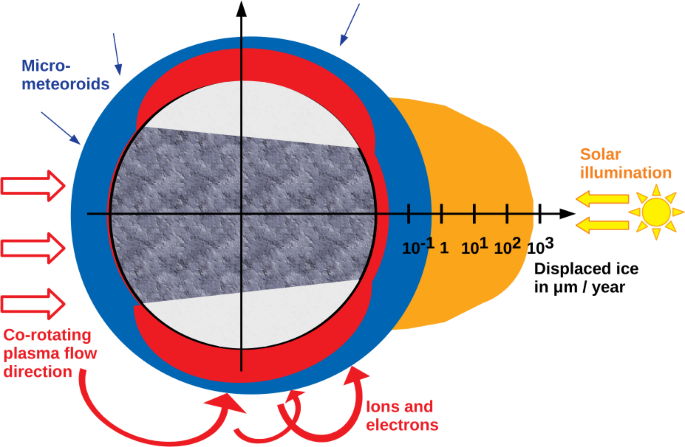
The alternative text for this image may have been generated using AI.
Sketch of water ice removal or turnover rates on Ganymede’s surface in units of μm yr−1. Orange shape: effect of thermal sublimation, blue: micrometeoroid impacts, red: irradiation-related rates (dominated by ion sputtering). Note the logarithmic scale of the rates (going from 0.1 to 1000 μm yr−1). The sketch is centred on the equatorial plane of the anti-Jovian side. Ganymede’s leading hemisphere with respect to Jupiter, the Jovian plasma is on the dayside to the right. The grey band and the white pole caps symbolise the surface areas of low and high albedo. Figure reproduced from Galli et al. ([2024](/article/10.1007/s11214-024-01089-8#ref-CR83 " Galli A, Vorburger A, Wurz P, Galand M, Oza A, Fatemi S, Plainaki C, Mura A (2024) Interactions between the space environment and Ganymede’s surface. In: Volwerk M, McGrath M, Jia X, Spohn T (eds) Ganymede. Planetary science series, vol 28. Cambridge University Press, Cambridge. https://wurz.space.unibe.ch/Ganymede_book_3p2_rev.pdf
"))4.2.1 Sputtering of Surface Materials
Precipitation of ions and electrons onto the moon surfaces, or charged particle surface irradiation, is a major contributor to the generation of the tenuous atmosphere of Europa (e.g., Ip [1996](/article/10.1007/s11214-024-01089-8#ref-CR132 " Ip W-H (1996) Europa’s oxygen exosphere and its magnetospheric interaction. Icarus 120(2):317–325. https://doi.org/10.1006/icar.1996.0052
            "); Shematovich and Johnson [2001](/article/10.1007/s11214-024-01089-8#ref-CR269 "
                Shematovich VI, Johnson RE (2001) Near-surface oxygen atmosphere of Europa. Adv Space Res 27(11):1881–1888.
              https://doi.org/10.1016/S0273-1177(01)00299-X

            "); Shematovich et al. [2005](/article/10.1007/s11214-024-01089-8#ref-CR270 "
                Shematovich VI, Johnson RE, Cooper JF, Wong MC (2005) Surface-bounded atmosphere of Europa. Icarus 173(2):480–498.
              https://doi.org/10.1016/j.icarus.2004.08.013

            "); Plainaki et al. [2018](/article/10.1007/s11214-024-01089-8#ref-CR226 "
                Plainaki P, Cassidy TA, Shematovich VI, Milillo A, Wurz P, Vorburger A, Roth L, Galli A, Rubin M, Blöcker A, Brandt PC, Crary F, Dandouras I, Jia X, Grassi D, Hartogh P, Lucchetti A, McGrath M, Mangano V, Mura A (2018) Towards a global unified model of Europa’s tenuous atmosphere. Space Sci Rev 214(1):71.
              https://doi.org/10.1007/s11214-018-0469-6

            ")), Ganymede (Marconi [2007](/article/10.1007/s11214-024-01089-8#ref-CR177 "
                Marconi ML (2007) A kinetic model of Ganymede’s atmosphere. Icarus 190(1):155–174.
              https://doi.org/10.1016/j.icarus.2007.02.016

            "); Shematovich [2016](/article/10.1007/s11214-024-01089-8#ref-CR268 "
                Shematovich VI (2016) Neutral atmosphere near the icy surface of Jupiter’s moon Ganymede. Sol Syst Res 50(4):262–280.
              https://doi.org/10.1134/S0038094616040067

            ")), and Callisto (Vorburger et al. [2019](/article/10.1007/s11214-024-01089-8#ref-CR317 "
                Vorburger A, Pfleger M, Lindkvist J, Holmström M, Lammer H, Lichtenegger HIM, Wurz P (2019) 3D-modeling of Callisto’s surface sputtered exosphere environment. J Geophys Res Space Phys 124(8):7151–7169.
              https://doi.org/10.1029/2019JA026610

            ")). Irradiation processes fall into two broad categories: sputtering and radiolysis. Sputtering describes the ejection of surface species by an impacting energetic particle (Brown et al. [1978](/article/10.1007/s11214-024-01089-8#ref-CR22 "
                Brown WL, Lanzerotti LJ, Poate JM, Augustyniak WM (1978) Sputtering of ice by MeV ions. Phys Rev Lett 49:1027–1030.
              https://doi.org/10.1103/PhysRevLett.40.1027

            ")). Radiolysis describes the chemical alteration of surface species induced by the deposited energy of the particles. The particles sputtered from the surface may be the original molecules (e.g., H2O), molecule or atomic fragments (e.g., OH, O), or radiolysis products such as O2 and O3 (Teolis et al. [2017a](/article/10.1007/s11214-024-01089-8#ref-CR298 "
                Teolis BD, Plainaki C, Cassidy TA, Raut U (2017a) Water ice radiolytic O2, H2, and H2O2 yields for any projectile species, energy, or temperature: a model for icy astrophysical bodies. J Geophys Res, Planets 122(10):1996–2012.
              https://doi.org/10.1002/2017JE005285

            "); Galli et al. [2018](/article/10.1007/s11214-024-01089-8#ref-CR81 "
                Galli A, Vorburger A, Wurz P, Pommerol A, Cerubini R, Jost B, Poch O, Tulej M, Thomas N (2018) 0.2 to 10 keV electrons interacting with water ice: radiolysis, sputtering, and sublimation. Planet Space Sci 155:91–98.
              https://doi.org/10.1016/j.pss.2017.11.016

            ")). The detection of O2 (Spencer et al. [1995](/article/10.1007/s11214-024-01089-8#ref-CR288 "
                Spencer JR, Calvin WM, Person MJ (1995) CCD spectra of the Galilean satellites: molecular oxygen on Ganymede. J Geophys Res 100(E9):19049–19056.
              https://doi.org/10.1029/95JE01503

            "); Migliorini et al. [2022](/article/10.1007/s11214-024-01089-8#ref-CR192 "
                Migliorini A, Kanuchova Z, Ioppolo S, Barbieri M, Jones NC, Hoffmann SV, Strazzulla G, Tosi F, Piccioni G (2022) On the origin of molecular oxygen on the surface of Ganymede. Icarus 383:115074.
              https://doi.org/10.1016/j.icarus.2022.115074

            ")) and O3 (Noll et al. [1996](/article/10.1007/s11214-024-01089-8#ref-CR209 "
                Noll KS, Johnson RE, Lane AL, Domingue DL, Weaver HA (1996) Detection of ozone on Ganymede. Science 273(5273):341–343.
              https://doi.org/10.1126/science.273.5273.34

            ")) in the surface of Ganymede, for example, indicates radiolysis of water ice. Dark material on Europa’s trailing hemisphere is thought to comprise radiolytically processed sulphur compounds (Carlson et al. [1999a](/article/10.1007/s11214-024-01089-8#ref-CR36 "
                Carlson RW, Anderson MS, Johnson RE, Smythe WD, Hendrix AR, Barth CA, Soderblom LA, Hansen GB, McCord TB, Dalton JB, Clark RN, Shirley JH, Ocampo AC, Matson DL (1999a) Hydrogen peroxide on the surface of Europa. Science 283(5410):2062–2064.
              https://doi.org/10.1126/science.283.5410.2062

            "), [1999b](/article/10.1007/s11214-024-01089-8#ref-CR37 "
                Carlson RW, Johnson RE, Anderson MS (1999b) Sulfuric acid on Europa and the radiolytic sulfur cycle. Science 286(5437):97–99.
              https://doi.org/10.1126/science.286.5437.97

            ")), and a possible UV signature of H2O2 on Callisto may similarly be a result of radiolysis (Hendrix and Johnson [2008](/article/10.1007/s11214-024-01089-8#ref-CR114 "
                Hendrix AR, Johnson RE (2008) Callisto: new insights from Galileo disk-resolved UV measurements. Astrophys J 687(1):706.
              https://doi.org/10.1086/591491

            ")). As well as being directly sputtered from the surfaces, radiolytic products produced in the icy surfaces of the Galilean moons can diffuse through the ice and escape to the atmospheres.
The sputtering yield (i.e., the number of ejected neutrals per charged particle incident on the surface) depends on the energy and mass of the impacting electron or ion, the angle of impact, and the surface temperature (e.g., Famá et al. [2008](/article/10.1007/s11214-024-01089-8#ref-CR76 " Famá M, Shi J, Baragiola RA (2008) Sputtering of ice by low-energy ions. Surf Sci 602(1):156–161. https://doi.org/10.1016/j.susc.2007.10.002
            ")). Hence, variations in the sputtering yield between different surface regions on each icy satellite are expected, as well as differences between moons. Although Europa has the coldest surface, it has the highest sputtering yield since it orbits in a region where the Jovian magnetospheric plasma density and magnetic field strength are increased relative to the environment experienced by Ganymede and Callisto. At Ganymede, the satellite’s mini magnetosphere restricts charged particle access to the trailing hemisphere mid-latitudes but charged particles can impact the surface on the leading hemisphere in the open field line regions near the poles (e.g., Poppe et al. [2018](/article/10.1007/s11214-024-01089-8#ref-CR229 "
                Poppe AR, Fatemi S, Khurana KK (2018) Thermal and energetic ion dynamics in Ganymede’s magnetosphere. J Geophys Res Space Phys 123(6):4614–4637.
              https://doi.org/10.1029/2018JA025312

            ")). The ∼10° offset between Jupiter’s magnetic dipole axis and its rotation axis means that all of the Galilean moons experience periodically varying plasma environments as Jupiter rotates. JUICE PEP will detect sputtered material in the exospheres of all three moons, determining how the sputtering yield varies temporally and as a function of surface position.
4.2.2 Sublimation of Surface Volatiles
Solar irradiation leads to sublimation of H2O and thermal desorption of non-condensable volatiles trapped in the regolith of the icy Galilean satellites. This process is straightforward to quantify in terms of theory and laboratory experiments. On Ganymede, thermal sublimation is the dominant source of atmospheric H2O (Marconi [2007](/article/10.1007/s11214-024-01089-8#ref-CR177 " Marconi ML (2007) A kinetic model of Ganymede’s atmosphere. Icarus 190(1):155–174. https://doi.org/10.1016/j.icarus.2007.02.016
            "); Plainaki et al. [2015](/article/10.1007/s11214-024-01089-8#ref-CR225 "
                Plainaki C, Milillo A, Massetti S, Mura A, Jia X, Orsini S, Mangano V, De Angelis E, Rispoli R (2015) The H2O and O2 exospheres of Ganymede: The result of a complex interaction between the Jovian magnetospheric ions and the icy moon. Icarus 245:306–319.
              https://doi.org/10.1016/j.icarus.2014.09.018

            "); Shematovich [2016](/article/10.1007/s11214-024-01089-8#ref-CR268 "
                Shematovich VI (2016) Neutral atmosphere near the icy surface of Jupiter’s moon Ganymede. Sol Syst Res 50(4):262–280.
              https://doi.org/10.1134/S0038094616040067

            ")). Sublimation rates are highest at the equatorial regions because they encounter the most solar illumination, and their surface is darker compared to the polar regions. Dayside surface temperatures on Ganymede range from ∼100 K near the poles to ∼150 K at the subsolar point (Orton et al. [1996](/article/10.1007/s11214-024-01089-8#ref-CR210 "
                Orton GS, Spencer JR, Travis LD, Martin TZ, Tamppari LK (1996) Galileo photopolarimeter-radiometer observations of Jupiter and the Galilean satellites. Science 274(5286):389–391.
              https://doi.org/10.1126/science.274.5286.389

            "); Ligier et al. [2019](/article/10.1007/s11214-024-01089-8#ref-CR167 "
                Ligier N, Paranicas C, Carter J, Poulet F, Calvin WM, Nordheim TA, Snodgrass C, Ferellec L (2019) Surface composition and properties of Ganymede: updates from ground-based observations with the near-infrared imaging spectrometer SINFONI/VLT/ESO. Icarus 333:496–515.
              https://doi.org/10.1016/j.icarus.2019.06.013

            "); Galli et al. [2024](/article/10.1007/s11214-024-01089-8#ref-CR83 "
                Galli A, Vorburger A, Wurz P, Galand M, Oza A, Fatemi S, Plainaki C, Mura A (2024) Interactions between the space environment and Ganymede’s surface. In: Volwerk M, McGrath M, Jia X, Spohn T (eds) Ganymede. Planetary science series, vol 28. Cambridge University Press, Cambridge.
              https://wurz.space.unibe.ch/Ganymede_book_3p2_rev.pdf

            ")). Sublimation of H2O is strongly temperature dependent: Roth et al. ([2021](/article/10.1007/s11214-024-01089-8#ref-CR252 "
                Roth L, Ivchenko N, Gladstone GR, Saur J, Grodent D, Bonfond B, Molyneux PM, Retherford KD (2021) A sublimated water atmosphere on Ganymede detected from Hubble Space Telescope observations. Nat Astron 5(10):1043–1051.
              https://doi.org/10.1038/s41550-021-01426-9

            ")) found that the temperature difference between Ganymede’s dayside trailing (∼148 K at the subsolar point) and leading (∼142 K) hemispheres was sufficient to explain a factor of five H2O density difference observed in the atmospheres above the centres of the two hemispheres. Since Callisto is darker and presumably warmer than Ganymede, it is likely that sublimation is also the dominant source of atmospheric H2O there. At Europa, the relative importance of sputtering and sublimation to the measured H2O abundance is less clear. While Roth ([2021](/article/10.1007/s11214-024-01089-8#ref-CR246 "
                Roth L (2021) A stable H2O atmosphere on Europa’s trailing hemisphere from HST images. Geophys Res Lett 48(20):e2021GL094289.
              https://doi.org/10.1029/2021GL094289

            ")) detected an H2O atmosphere on Europa’s warmer trailing hemisphere, the maximum surface temperature of 130 K is not warm enough to account for the inferred H2O density. However, the sputtering yields of H2O at 130 K are also too low to sustain the observed atmosphere. Roth ([2021](/article/10.1007/s11214-024-01089-8#ref-CR246 "
                Roth L (2021) A stable H2O atmosphere on Europa’s trailing hemisphere from HST images. Geophys Res Lett 48(20):e2021GL094289.
              https://doi.org/10.1029/2021GL094289

            ")) suggested that secondary sublimation of sputtered H2O molecules that fall back to the surface (e.g., Teolis et al. [2017a](/article/10.1007/s11214-024-01089-8#ref-CR298 "
                Teolis BD, Plainaki C, Cassidy TA, Raut U (2017a) Water ice radiolytic O2, H2, and H2O2 yields for any projectile species, energy, or temperature: a model for icy astrophysical bodies. J Geophys Res, Planets 122(10):1996–2012.
              https://doi.org/10.1002/2017JE005285

            "), [2017b](/article/10.1007/s11214-024-01089-8#ref-CR299 "
                Teolis BD, Wyrick DY, Bouquet A, Magee BA, Waite JH (2017b) Plume and surface feature structure and compositional effects on Europa’s global exosphere: preliminary Europa mission predictions. Icarus 284:18–29.
              https://doi.org/10.1016/j.icarus.2016.10.027

            ")) may explain the discrepancy. JUICE will study the contribution of sublimation to the satellite atmospheres by performing in situ measurements and remote observations of the daysides and nightsides during flybys of all three satellites.
4.2.3 Dust Exospheres of Europa, Ganymede and Callisto
Ganymede was the first object in the Solar System where an impact generated ballistic dust exosphere was detected. In 1996, during a series of close flybys of the Galileo spacecraft, the onboard dust detector recorded a series of impact events (Krüger et al. [1999](/article/10.1007/s11214-024-01089-8#ref-CR158 " Krüger H, Krivov AV, Hamilton DP, Grün E (1999) Detection of an impact-generated dust cloud around Ganymede. Nature 399(6736):558–560. https://doi.org/10.1038/21136
            ")). Later measurements found that all Galilean moons are enshrouded by a dust cloud (Krüger et al. [2003](/article/10.1007/s11214-024-01089-8#ref-CR159 "
                Krüger H, Krivov AV, Sremčević M, Grün E (2003) Impact-generated dust clouds surrounding the Galilean moons. Icarus 164(1):170–187.
              https://doi.org/10.1016/S0019-1035(03)00127-1

            ")) (Fig. [14](/article/10.1007/s11214-024-01089-8#Fig14)). The detected particle size distribution and their dependence on altitude is consistent with impact ejecta models (e.g., Krivov et al. [2003](/article/10.1007/s11214-024-01089-8#ref-CR157 "
                Krivov AV, Sremčević M, Spahn F, Dikarev VV, Kholshevnikov KV (2003) Impact-generated dust clouds around planetary satellites: spherically symmetric case. Planet Space Sci 51(3):251–269.
              https://doi.org/10.1016/S0032-0633(02)00147-2

            ")) where the most efficient impactor population consists of micrometeorites. These are relatively large interplanetary dust particles with typical sizes of approximately 10–100 μm (Divine [1993](/article/10.1007/s11214-024-01089-8#ref-CR66 "
                Divine N (1993) Five populations of interplanetary meteoroids. J Geophys Res 98(E9):17029–17048.
              https://doi.org/10.1029/93JE01203

            ")) and typical speeds of a few 10 km/s, which eject orders of magnitude more mass than the impacting particle in the form of mostly smaller dust ejecta at much lower speeds (on the order of 100 m/s). Due to the high escape speed of the Galilean moons nearly all ejected particles eventually fall back to the surface on ballistic trajectories, enshrouding them in a permanent dust exosphere and contributing to the regolith which is assumed to cover the moon’s surface.
Fig. 14

The alternative text for this image may have been generated using AI.
Number density of dust as a function of radial distance from the centre of Ganymede, Europa, Callisto, and Io, measured by the Galileo Dust Detector System. Adapted from Krüger et al. ([2003](/article/10.1007/s11214-024-01089-8#ref-CR159 " Krüger H, Krivov AV, Sremčević M, Grün E (2003) Impact-generated dust clouds surrounding the Galilean moons. Icarus 164(1):170–187. https://doi.org/10.1016/S0019-1035(03)00127-1
"))Based on Galileo measurements, model predictions can be made to estimate detection rates for in situ instrumentation onboard a spacecraft either during a flyby or in orbit (Postberg et al. [2011b](/article/10.1007/s11214-024-01089-8#ref-CR233 " Postberg F, Grün E, Horanyi M, Kempf S, Krüger H, Schmidt J, Spahn F, Srama R, Sternovsky Z, Trieloff M (2011b) Compositional mapping of planetary moons by mass spectrometry of dust ejecta. Planet Space Sci 59(14):1815–1825. https://doi.org/10.1016/j.pss.2011.05.001
")). For example, assuming apex pointing, JUICE PEP-NIM would encounter on the order of 10–30 dust samples lifted from Ganymede’s surface per day in a 500 km orbit, assuming a detection threshold radius of ∼200 nm. In a 200 km orbit this number would go up by about a factor of ∼5\. Per flyby with closest approach <500 km, 0–1 dust particles are expected to enter NIM. Upon impact in the NIM antechamber or entrance slit, the volatiles in the dust grain will evaporate and will thus be resolved in a mass spectrum like other neutral gas signals. However, no information on the impact speed can be derived with NIM. The JUICE RPWI instrument can also detect micrometeorite impacts and estimate dust charging. Together, these instruments will provide an improved understanding of interactions between the surfaces of the moons and their surrounding dusty exospheres.4.3 Atmosphere Characterization with JUICE Instruments
The diverse instruments carried by JUICE will perform complementary in situ and remote sensing studies of the composition, structure, and variability of the atmospheres of Jupiter’s icy moons. In situ detection and characterization of the moon atmospheric species will be achieved by the PEP-NIM mass spectrometer, which will measure ice and mineral species sputtered from the surfaces, as well as sublimating volatiles and any material outgassing from the subsurface or deeper interior (GC.4e, EB.3d, CB.3c) The volatile composition of sporadic dust grains entering NIM during the neutral gas measurements will also be evaluated. Other PEP instruments will provide remote sensing of the neutral atmospheres via Energetic Neutral Atom (ENA) imaging (PEP-JNA at low energy, PEP-JENI at high energies). Charge exchange between an energetic ion and a neutral atom results in a thermal ion and an ENA, the latter of which travels away on a straight trajectory with the energy of the parent ion, allowing remote sensing of the neutral environment around the icy moons by the PEP sensors.
For Callisto, the PEP measurement opportunities and goals were described by Galli et al. ([2022](/article/10.1007/s11214-024-01089-8#ref-CR82 " Galli A, Vorburger A, Carberry Mogan SR, Roussos E, Stenberg Wieser G, Wurz P, Föhn M, Krupp N, Fränz M, Barabash S, Futaana Y, Brandt PC, Kollmann P, Haggerty DK, Jones GH, Johnson RE, Tucker OJ, Simon S, Tippens T, Liuzzo L (2022) Callisto’s atmosphere and its space environment: prospects for the particle environment package on board JUICE. Earth Space Sci 9(5):e2021EA002172. https://doi.org/10.1029/2021EA002172
            ")). The baseline predicted trajectory (CReMA 5.0) foresees 21 Callisto flybys, with closest approaches both on the dayside and the nightside. The 13 flybys with a closest approach below 1000 km will be crucial to detect heavy neutrals and ions in-situ (see Fig. [15](/article/10.1007/s11214-024-01089-8#Fig15) for a simulated spectrum at an altitude of 200 km). Nevertheless, neutral measurements will be started at distances >40 RC away from Callisto to better constrain the putative neutral torus and the extended hydrogen corona. At the same time, remote ENA measurements will provide global images of the interaction of Callisto’s surface and atmosphere with the plasma environment and thus give important context. Fortunately, the background rates due to radiation levels in the Jovian magnetosphere at Callisto will be much lower than near Europa or Ganymede (Galli et al. [2022](/article/10.1007/s11214-024-01089-8#ref-CR82 "
                Galli A, Vorburger A, Carberry Mogan SR, Roussos E, Stenberg Wieser G, Wurz P, Föhn M, Krupp N, Fränz M, Barabash S, Futaana Y, Brandt PC, Kollmann P, Haggerty DK, Jones GH, Johnson RE, Tucker OJ, Simon S, Tippens T, Liuzzo L (2022) Callisto’s atmosphere and its space environment: prospects for the particle environment package on board JUICE. Earth Space Sci 9(5):e2021EA002172.
              https://doi.org/10.1029/2021EA002172

            ")).
Fig. 15

The alternative text for this image may have been generated using AI.
Predicted mass spectrum to be recorded by PEP/NIM at the closest distance of JUICE to Callisto (200 km) for an integration time of 5 s. Shown are the spectra of the sublimated species (blue), the icy sputtered species (green), the mineral sputtered species (magenta), and photon-desorbed H2O (red). Also shown is NIM’s expected detection threshold of 1 cm−3 (instrument background) in black. Figure taken from Galli et al. ([2022](/article/10.1007/s11214-024-01089-8#ref-CR82 " Galli A, Vorburger A, Carberry Mogan SR, Roussos E, Stenberg Wieser G, Wurz P, Föhn M, Krupp N, Fränz M, Barabash S, Futaana Y, Brandt PC, Kollmann P, Haggerty DK, Jones GH, Johnson RE, Tucker OJ, Simon S, Tippens T, Liuzzo L (2022) Callisto’s atmosphere and its space environment: prospects for the particle environment package on board JUICE. Earth Space Sci 9(5):e2021EA002172. https://doi.org/10.1029/2021EA002172
"))The JUICE remote sensing instruments will similarly perform comprehensive studies of the icy satellite atmospheres. The JUICE UVS bandpass of 50–204 nm encompasses emission lines of key atmospheric species including the neutral O (130.4 nm, 135.6 nm) and H (121.6 nm) emissions previously observed at Jupiter’s icy moons by HST. UVS will perform disk scans during the inbound and outbound phases of satellite flybys to map these emissions and study their variability with local time, longitude and latitude, and local magnetic environment (GC.4a, EC.2a, CB.3b). Long stares at the sunlit limbs of the satellites will be used to search for faint emissions of potential minor atmospheric species including N, C, CO (fourth positive band), H2 (Lyman and Werner bands), S, Cl, Ca, and Mg. UVS will also perform stellar occultation measurements, during which stellar spectra are collected as the line-of-sight from UVS to the star moves through a satellite atmosphere. The presence of any UV-absorbing species such as H2O, O2, CO2, H2, CH4, and C2H2 will modify the observed stellar signal in a predictable way, allowing the concentrations and distributions of these materials to be constrained. Similar but less frequent solar occultation measurements will facilitate searches for species absorbing at wavelengths <100 nm, where stellar flux is low due to extinction by the interstellar medium. Absorption of Jupiter’s dayglow by the satellite atmospheres as the moons transit across Jupiter’s disk will also be performed. These transit observations will be used to search for regions of increased Lyman-\(\alpha \) absorption on the satellite limb indicative of localised H2O from potential plume activity.
MAJIS will use limb scans to map non-LTE emissions of atmospheric species including H2O (2.4–3 μm), CO2 (4.26 μm) and O2 (1.27 μm), allowing retrieval of density profiles (GC.4b, EC.2b, CB.3a). The instrument is also sensitive to auroral emissions in the visible wavelength region – H\(\alpha \) at 656.3 nm and OI at 557.7 nm, 630.0 nm, 636.4 nm (GC.3d). The relative intensities of these emissions and the UV aurora measured by UVS will provide tighter constraints on atmospheric composition and density, as well as the density and energy of the electrons exciting the emissions. Stellar occultation measurements will be used to determine the distribution of atmospheric species that absorb light in the visible to near-infrared spectral region. Where possible, stellar occultations will be performed simultaneously with UVS, although only a small number of stars provide adequate flux at both UV and IR wavelengths (usually unresolved multiple star systems rather than single stars). MAJIS will also search for active plumes by observing forward scattered light from possible plume grains along the satellite limbs at high phase angle (see Sect. 4.4); similar observations by UVS and JANUS may also contribute to this goal. JANUS will contribute to atmospheric studies via global imaging of the sodium exosphere at Europa (EC.1d) and monitoring of optical auroral emissions at all three icy satellites.
SWI will complement the other remote sensing studies with observations of rotational transitions of water and its isotopes, and several other molecular species including CO, HCN, O2, SO2, and potentially also their main ionic counterparts, in the frequency ranges 530–625 and 1080–1275 GHz at high spectral resolution (\(\sim 10^{7}\)). SWI will study the atmospheric structure (density, temperature and winds), isotopic composition, and distribution of the water atmospheres of Ganymede, Callisto, and Europa from the surface to altitudes of a few hundred km (GC.4c, EB.3g, EC.2e, CB.3f). From measurements of the exact position and shape of the molecular lines, parameters such as the regions of transition between collision and non-collision dominated parts of the satellite atmospheres, as well as wind and temperature profiles, may be derived. SWI can also measure the ortho-to-para ratio of gaseous water, which serves as a proxy for the conditions under which the water formed. While SWI will map the atmosphere with high spatial resolution maps, limb stares and limb scans during the various flybys and GCO, its scanning mechanism also allows routine observations of the Jovian moons at almost any time from the orbit around Jupiter. On average, SWI will dedicate one hour per day to observations of the different moons. It will be sensitive enough to sample the moon’s atmospheric conditions as a function of solar illumination on the leading and trailing sides. The spatial resolution of this long baseline of observations will vary with time and range from point source observations to moderate resolution maps of surface and atmosphere emissions. In particular, 3D radiative transfer models demonstrate (Wirström et al. [2020](/article/10.1007/s11214-024-01089-8#ref-CR321 " Wirström ES, Bjerkeli P, Rezac L, Brinch C, Hartogh P (2020) Effect of the 3D distribution on water observations made with the SWI I. Ganymede. Astron Astrophys 637:A90. https://doi.org/10.1051/0004-6361/202037609
")) that sets of five-point cross maps of Ganymede in the 557 GHz water transition for a range of phase angles should allow us to determine the dominating source for the water atmosphere, thermal sublimation or sputtering. The long-term monitoring from the Jovian orbit will thus provide a global perspective on the neutral atmospheres around the moons and help to set up synergies with and for other instruments in preparation of the various flybys and GCO, so as to focus on potential regions of interests discovered during these campaigns.In addition to broad atmospheric studies by the in situ and remote sensing instruments discussed above, other JUICE instruments will contribute to more specific atmospheric science goals. RPWI will measure the mass and size distribution of charged dust particles within the satellite exospheres (GE.2c, EC.1c, CB.1f, CB.2f), studying how they are accelerated towards the surface where they contribute to sputtering of material into the exospheres. JMAG may detect magnetic field perturbations due to atmospheric inhomogeneities: for example, models by Blöcker et al. ([2016](/article/10.1007/s11214-024-01089-8#ref-CR12 " Blöcker A, Saur J, Roth L (2016) Europa’s plasma interaction with an inhomogeneous atmosphere: development of Alfvén winglets within the Alfvén wings. J Geophys Res Space Phys 121(10):9794–9828. https://doi.org/10.1002/2016JA02247
")) show that Alfvén winglets are expected to develop within Europa’s Alfvén wing if plume activity occurs near the north or south pole of Europa.3GM will probably not be able to contribute to measuring the density or temperature profiles of the neutral atmospheres at Callisto, Ganymede, or Europa. This is illustrated by Fig. 16 showing the refractivity profile calculated for radio occultations near Callisto (panel A) and Ganymede (panel B) (black line, evaluated for the number density and the chemical species expected according to Liang et al. [2005](/article/10.1007/s11214-024-01089-8#ref-CR165 " Liang M-C, Lane BF, Pappalardo RT, Allen M, Yung YL (2005) Atmosphere of Callisto. J Geophys Res 110(E2):E02003. https://doi.org/10.1029/2004JE002322
            ") and Marconi ([2007](/article/10.1007/s11214-024-01089-8#ref-CR177 "
                Marconi ML (2007) A kinetic model of Ganymede’s atmosphere. Icarus 190(1):155–174.
              https://doi.org/10.1016/j.icarus.2007.02.016

            ")) compared with the expected uncertainty (red dotted line) for 3GM measurements. The latter was computed using the algorithm developed by Bourgoin et al. ([2022](/article/10.1007/s11214-024-01089-8#ref-CR16 "
                Bourgoin A, Gramigna E, Zannoni M, Gomez Casajus L, Tortora P (2022) Determination of uncertainty profiles in neutral atmospheric properties measured by radio occultation experiments. Adv Space Res 70(8):2555–2570.
              https://doi.org/10.1016/j.asr.2022.07.015

            ")), assuming a radio link stability of \\(3 \\times 10^{13}\\) at 1 s integration time. The uncertainty is several orders of magnitude larger than the predicted value for the refractivity. For Europa, assuming CReMA 5.0, suitable radio occultation opportunities were not identified. However, being the expected refractivity (computed from the neutral number density reported in Johnson et al. ([2009](/article/10.1007/s11214-024-01089-8#ref-CR139 "
                Johnson RE, Burger MH, Cassidy TA, Leblanc F, Marconi M, Smyth WH, Dotson R (2009) Composition and detection of Europa’s sputter-induced atmosphere. In: Pappalardo RT, McKinnon WB, Khurana KK (eds) Europa. University of Arizona Press, Tucson, pp 507–528.
              https://doi.org/10.2307/j.ctt1xp3wdw.27

            "))) similar to the one of the other two moons, similar results and conclusions are expected.
Fig. 16

The alternative text for this image may have been generated using AI.
Predicted refractivity height profile of Callisto (panel A) and Ganymede (panel B) (black line), compared to the expected measurement’s uncertainty (red dotted line) of the 3GM radio science experiment (figure courtesy of A. Caruso)
4.4 Potential Plume Detection and Characterization (Both Direct Detection and Inferred from Surface Features at Europa and Ganymede)
Several pieces of evidence for water plumes at Europa have been reported over the last decade, but conclusive proof of active plumes has not yet been achieved. The question thus remains an active research topic. The first tentative detection came in the form of HST observations of auroral emissions consistent with electron impact dissociation of localised H2O vapour (Roth et al. [2014a](/article/10.1007/s11214-024-01089-8#ref-CR248 " Roth L, Saur J, Retherford KD, Strobel DF, Feldman PD, McGrath MA, Nimmo F (2014a) Transient water vapor at Europa’s south pole. Science 343(6167):171–174. https://doi.org/10.1126/science.1247051
            ")). Additional HST observations of shadowy features on the limb of Europa as it transited Jupiter were interpreted as absorption of Jupiter dayglow by water plumes (Sparks et al. [2016](/article/10.1007/s11214-024-01089-8#ref-CR283 "
                Sparks WB, Hand KP, McGrath MA, Bergeron E, Cracraft M, Deustua SE (2016) Probing for evidence of plumes on Europa with HST/STIS. Astrophys J 829(2):121.
              https://doi.org/10.3847/0004-637X/829/2/121

            "), [2017](/article/10.1007/s11214-024-01089-8#ref-CR284 "
                Sparks WB, Schmidt BE, McGrath MA, Hand KP, Spencer JR, Cracraft M, Deustua SE (2017) Active cryovolcanism on Europa? Astrophys J Lett 839(2):L18.
              https://doi.org/10.3847/2041-8213/aa67f8

            "), [2019](/article/10.1007/s11214-024-01089-8#ref-CR285 "
                Sparks WB, Richter M, deWitt C, Montiel E, Dello Russo N, Grunsfeld JM, McGrath MA, Weaver H, Hand KP, Bergeron E, Reach W (2019) A search for water vapor plumes on Europa using SOFIA. Astrophys J 871(1):L5.
              https://doi.org/10.3847/2041-8213/aafb0a

            ")), though this interpretation is disputed (Giono et al. [2020](/article/10.1007/s11214-024-01089-8#ref-CR88 "
                Giono G, Roth L, Ivchenko N, Saur J, Retherford K, Schlegel S, Ackland M, Strobel D (2020) An analysis of the statistics and systematics of limb anomaly detections in HST/STIS transit images of Europa. Astron J 159(4):155.
              https://doi.org/10.3847/1538-3881/ab7454

            ")). Furthermore, magnetic field perturbations detected during the E12 and E26 flyby by the Galileo mission have been shown to be consistent with the presence of water plumes (Blöcker et al. [2016](/article/10.1007/s11214-024-01089-8#ref-CR12 "
                Blöcker A, Saur J, Roth L (2016) Europa’s plasma interaction with an inhomogeneous atmosphere: development of Alfvén winglets within the Alfvén wings. J Geophys Res Space Phys 121(10):9794–9828.
              https://doi.org/10.1002/2016JA02247

            "); Jia et al. [2018](/article/10.1007/s11214-024-01089-8#ref-CR134 "
                Jia X, Kivelson MG, Khurana KK, Kurth WS (2018) Evidence of a plume on Europa from Galileo magnetic and plasma wave signatures. Nat Astron 2(6):459–464.
              https://doi.org/10.1038/s41550-018-0450-z

            "); Arnold et al. [2020](/article/10.1007/s11214-024-01089-8#ref-CR2 "
                Arnold H, Liuzzo L, Simon S (2020) Plasma interaction signatures of plumes at Europa. J Geophys Res Space Phys 125(1):e2019JA027346.
              https://doi.org/10.1029/2019JA027147

            ")). Dropouts of energetic protons during E26 were reported to be caused by the plume from Arnold et al. ([2020](/article/10.1007/s11214-024-01089-8#ref-CR2 "
                Arnold H, Liuzzo L, Simon S (2020) Plasma interaction signatures of plumes at Europa. J Geophys Res Space Phys 125(1):e2019JA027346.
              https://doi.org/10.1029/2019JA027147

            ")) by Huybrighs et al. [2020](/article/10.1007/s11214-024-01089-8#ref-CR129 "
                Huybrighs HLF, Roussos E, Blöcker A, Krupp N, Futaana Y, Barabash S, Hadid LZ, Holmberg MKG, Lomax O, Witasse O (2020) An active plume eruption on Europa during Galileo flyby E26 as indicated by energetic proton depletions. Geophys Res Lett 47(10):e2020GL087806.
              https://doi.org/10.1029/2020GL087806

            "); however, an artefact in the data prevents a definitive conclusion (Jia et al. [2021](/article/10.1007/s11214-024-01089-8#ref-CR135 "
                Jia X, Kivelson MG, Paranicas C (2021) Comment on “An active plume eruption on Europa during Galileo flyby E26 as indicated by energetic proton depletions” by Huybrighs et al. Geophys Res Lett 48(6):e2020GL091550.
              https://doi.org/10.1029/2020GL091550

            "); Huybrighs et al. [2021](/article/10.1007/s11214-024-01089-8#ref-CR130 "
                Huybrighs HLF, Roussos E, Blöcker A, Krupp N, Futaana Y, Barabash S, Hadid LZ, Holmberg MKG, Witasse O (2021) Reply to comment on “An active plume eruption on Europa during Galileo flyby E26 as indicated by energetic proton depletions”. Geophys Res Lett 48(18):e2021GL095240.
              https://doi.org/10.1029/2021GL095240

            ")). Infrared Keck telescope detections of H2O have also been interpreted as a potential plume eruption (Paganini et al. [2020](/article/10.1007/s11214-024-01089-8#ref-CR213 "
                Paganini L, Villanueva GL, Roth L, Mandell AM, Hurford TA, Retherford KD, Mumma MJ (2020) A measurement of water vapour amid a largely quiescent environment on Europa. Nat Astron 4(3):266–272.
              https://doi.org/10.1038/s41550-019-0933-6

            ")). If plumes are present, their activity appears to be intermittent and unrelated to Europa’s orbital position (Roth et al. [2014b](/article/10.1007/s11214-024-01089-8#ref-CR247 "
                Roth L, Retherford KD, Saur J, Strobel DF, Feldman PD, McGrath MA, Nimmo F (2014b) Orbital apocenter is not a sufficient condition for HST/STIS detection of Europa’s water vapor atmosphere. Proc Natl Acad Sci USA 111(48):E5123–E5132.
              https://doi.org/10.1073/pnas.1416671111

            "); Paganini et al. [2020](/article/10.1007/s11214-024-01089-8#ref-CR213 "
                Paganini L, Villanueva GL, Roth L, Mandell AM, Hurford TA, Retherford KD, Mumma MJ (2020) A measurement of water vapour amid a largely quiescent environment on Europa. Nat Astron 4(3):266–272.
              https://doi.org/10.1038/s41550-019-0933-6

            ")). Recently, JWST searched for plumes at Europa but yielded no detection of water, carbon monoxide, methanol, ethane, or methane fluorescence emissions (Villanueva et al. [2023](/article/10.1007/s11214-024-01089-8#ref-CR314 "
                Villanueva GL, Hammel HB, Milam SN, Faggi S, Kofman V, Roth L, Hand KP, Paganini L, Stansberry J, Spencer J, Protopapa S, Strazzulla G, Cruz-Mermy G, Glein CR, Cartwright R, Liuzzi G (2023) Endogenous CO2 ice mixture on the surface of Europa and no detection of plume activity. Science 381(6664):1305–1308.
              https://doi.org/10.1126/science.adg4270

            ")). During the Juno close flyby of Europa occurred in September 2022, data collected by the JunoCam framing camera (Hansen et al. [2024](/article/10.1007/s11214-024-01089-8#ref-CR106 "
                Hansen CJ, Ravine MA, Schenk PM, Collins GC, Leonard EJ, Phillips CB, Caplinger MA, Tosi F, Bolton SJ, Jónsson B (2024) Juno’s JunoCam images of Europa. Planet Sci J 5(3):76.
              https://doi.org/10.3847/PSJ/ad24f4

            ")) and by the plasma wave instrument (Kurth et al. [2023](/article/10.1007/s11214-024-01089-8#ref-CR162 "
                Kurth WS, Wilkinson DR, Hospodarsky GB, Santolík O, Averkamp TF, Sulaiman AH, Menietti JD, Connerney JEP, Allegrini F, Mauk BH, Bolton SJ (2023) Juno plasma wave observations at Europa. Geophys Res Lett 50(24):e2023GL105775.
              https://doi.org/10.1029/2023GL105775

            ")) did not find evidence of active plume eruptions.
Any ongoing or very recent plume activity at Europa would be detectable through atmospheric observations by JUICE and may also result in surface features observable by the remote sensing instruments. Freshly deposited water ice will appear brighter than older terrain that has been processed by the impinging Jovian plasma or experienced thermal segregation, where ice sublimating from warmer, darker regions is preferentially deposited in cooler, brighter regions (Spencer [1987](/article/10.1007/s11214-024-01089-8#ref-CR287 " Spencer JR (1987) Thermal segregation of water ice on the Galilean satellites. Icarus 69(2):297–313. https://doi.org/10.1016/0019-1035(87)90107-2
            ")). The size distribution of ice grains on the surface could also be an indicator for recent plume activity, but it is also an important and ill-constrained parameter for modelling plumes (Quick and Hedman [2020](/article/10.1007/s11214-024-01089-8#ref-CR239 "
                Quick LC, Hedman MM (2020) Characterizing deposits emplaced by cryovolcanic plumes on Europa. Icarus 343:113667.
              https://doi.org/10.1016/j.icarus.2020.113667

            ")). Fresh H2O deposits will be detectable by UVS and MAJIS via characteristic UV and IR spectral features, as well as appearing as bright regions in JANUS visible images. Belgacem et al. ([2020](/article/10.1007/s11214-024-01089-8#ref-CR7 "
                Belgacem I, Schmidt F, Jonniaux G (2020) Regional study of Europa’s photometry. Icarus 338:113525.
              https://doi.org/10.1016/j.icarus.2019.113525

            ")) identified two potential regions of fresh water ice in Voyager and New Horizons images of Europa’s leading hemisphere that may be related to plume activity. Although there are currently no constraints on any non-water constituents of the plumes, by analogy with the Enceladus plumes (Dougherty et al. [2006](/article/10.1007/s11214-024-01089-8#ref-CR71 "
                Dougherty MK, Khurana KK, Neubauer FM, Russell CT, Saur J, Leisner JS, Burton ME (2006) Identification of a dynamic atmosphere at Enceladus with the Cassini magnetometer. Science 311(5766):1406–1409.
              https://doi.org/10.1126/science.1120985

            ")) it is possible that they would contain darker materials such as salts and organics, which may be detected on the surface. This low-albedo plume material may be responsible for dark deposits observed around lenticulae and along lineae on Europa (Fagents et al. [2000](/article/10.1007/s11214-024-01089-8#ref-CR74 "
                Fagents SA, Greeley R, Sullivan RJ, Pappalardo RT, Prockter LM (Galileo SSI Team) (2000) Cryomagmatic mechanisms for the formation of Rhadamanthys Linea, triple band margins, and other low-albedo features on Europa. Icarus 144(1):54–88.
              https://doi.org/10.1006/icar.1999.6254

            "); Quick et al. [2013](/article/10.1007/s11214-024-01089-8#ref-CR240 "
                Quick LC, Barnouin OS, Prockter LM, Patterson GW (2013) Constraints on the detection of cryovolcanic plumes on Europa. Planet Space Sci 86:1–9.
              https://doi.org/10.1016/j.pss.2013.06.028

            ")), the distribution and composition of which will be studied by MAJIS, JANUS and UVS.
Similarly, JUICE will search for evidence of past or present plume activity on Ganymede’s surface, focusing on paterae – small, scalloped-edged depressions potentially linked to cryovolcanism (Lucchitta [1980](/article/10.1007/s11214-024-01089-8#ref-CR173 " Lucchitta BK (1980) Grooved terrain on Ganymede. Icarus 44(2):481–501. https://doi.org/10.1016/0019-1035(80)90039-1
            "); Schenk and Moore [1995](/article/10.1007/s11214-024-01089-8#ref-CR258 "
                Schenk PM, Moore JM (1995) Volcanic constructs on Ganymede and Enceladus: topographic evidence from stereo images and photoclinometry. J Geophys Res 100(E9):19009–19022.
              https://doi.org/10.1029/95JE01854

            "); Kay and Head [1999](/article/10.1007/s11214-024-01089-8#ref-CR147 "
                Kay JE, Head JWI (1999) Geological mapping of the Ganymede G8 calderas region: evidence for cryovolcanism. In: Lunar and Planetary Science Conference, vol 30, p 1103
            "); Schenk et al. [2001](/article/10.1007/s11214-024-01089-8#ref-CR260 "
                Schenk PM, McKinnon WB, Gwynn D, Moore JM (2001) Flooding of Ganymede’s bright terrains by low-viscosity water-ice lavas. Nature 410(6824):57–60.
              https://doi.org/10.1038/35065027

            "); Spaun et al. [2001](/article/10.1007/s11214-024-01089-8#ref-CR286 "
                Spaun NA, Head JW III, Pappalardo RT (Galileo SSI Team) (2001) Scalloped depressions on Ganymede from Galileo (G28) very high resolution imaging. In: Lunar and Planetary Science Conference, vol. 32, p. 1448
            ")), which are currently the only known surface features indicative of activity. JUICE will study the origin and formation of these features using high-resolution imaging and spectral imaging (JANUS, UVS, MAJIS, SWI) together with laser altimetry (GALA) and subsurface radar (RIME) measurements (Stephan et al. [2020](/article/10.1007/s11214-024-01089-8#ref-CR291 "
                Stephan K, Hibbitts CA, Jaumann R (2020) H2O-ice particle size variations across Ganymede’s and Callisto’s surface. Icarus 337:113440.
              https://doi.org/10.1016/j.icarus.2019.113440

            ")). We note that the recent flyby of Ganymede by Juno (Hansen et al. [2022](/article/10.1007/s11214-024-01089-8#ref-CR105 "
                Hansen CJ, Bolton S, Sulaiman AH, Duling S, Bagenal F, Brennan M, Connerney J, Clark G, Lunine J, Levin S, Kurth W, Mura M, Paranicas C, Tosi F, Withers P (2022) Juno’s close encounter with Ganymede – an overview. Geophys Res Lett 49(23):e2022GL099285.
              https://doi.org/10.1029/2022GL099285

            ")) identified 10 previously unknown paterae in the region covering Phrygia Sulcus, Sicyon Sulcus, and eastern Perrine Regio (∼10°E–50°W longitude and 10°S–50°N latitudes), bringing the total to 47 known paterae across the full surface (Ravine et al. [2022](/article/10.1007/s11214-024-01089-8#ref-CR241 "
                Ravine MA, Hansen CJ, Collins GC, Schenk PM, Caplinger MA, Lipkaman Vittling L, Krysak DJ, Zimdar RP, Garvin JB, Bolton SJ (2022) Ganymede observations by JunoCam on Juno Perijove 34. Geophys Res Lett 49(23):e2022GL099211.
              https://doi.org/10.1029/2022GL099211

            ")). This suggests that either the features are atypically concentrated in specific surface regions, potentially providing clues as to their history, or more remain to be discovered by JUICE. While Ganymede’s paterae appear ancient, improved constraints on their ages and formation mechanisms will help us to better understand whether ongoing cryovolcanism is likely. Any ancient plume material present may be identified by correlating potentially endogenic materials such as salts and ammoniated species with the geology, while the age of such material may be constrained by comparing the observed reflectance spectra to pristine and irradiated sample spectra. Salts, for example, develop characteristic colour centres when exposed to charged particle radiation, leading to the identification of NaCl on Europa (Trumbo et al. [2019a](/article/10.1007/s11214-024-01089-8#ref-CR306 "
                Trumbo SK, Brown ME, Hand KP (2019a) Sodium chloride on the surface of Europa. Sci Adv 5(6):aaw7123.
              https://doi.org/10.1126/sciadv.aaw7123

            ")). Any ongoing plume activity will be characterised using the same methods described for the Europan plumes in the remainder of this Section. A recent search for active water plumes via attenuation of Jupiter’s Lyman-\\(\\alpha \\) airglow as Ganymede transited Jupiter placed an upper limit for localised (plume) H2O column densities of \\((2\\text{--}3) \\times 10^{16}\\text{ cm}^{-2}\\) (Roth et al. [2023](/article/10.1007/s11214-024-01089-8#ref-CR253 "
                Roth L, Marchesini G, Becker TM, Hoeijmakers HJ, Molyneux PM, Retherford KD, Saur J, Carberry Mogan SR, Szalay JR (2023) Probing Ganymede’s atmosphere with HST Ly


                α

              <span class="katex"><span class="katex-mathml"><math xmlns="http://www.w3.org/1998/Math/MathML"><semantics><mrow><mi>α</mi></mrow><annotation encoding="application/x-tex">\alpha </annotation></semantics></math></span><span class="katex-html" aria-hidden="true"><span class="base"><span class="strut" style="height:0.4306em;"></span><span class="mord mathnormal" style="margin-right:0.0037em;">α</span></span></span></span>
             images in transit of Jupiter. Planet Sci J 4(1):12.
              https://doi.org/10.3847/PSJ/acaf7f

            ")), which is similar to the plume column density derived by Roth et al. ([2014a](/article/10.1007/s11214-024-01089-8#ref-CR248 "
                Roth L, Saur J, Retherford KD, Strobel DF, Feldman PD, McGrath MA, Nimmo F (2014a) Transient water vapor at Europa’s south pole. Science 343(6167):171–174.
              https://doi.org/10.1126/science.1247051

            ")) at Europa.
UVS will search active outgassing at plumes using different methods. Emissions from excited atomic oxygen and hydrogen, which might be indicative of electron-impact dissociation of plume molecules, are used as diagnostic in global scans. This method is analogous to the plume aurora observations by HST (Roth et al. [2014a](/article/10.1007/s11214-024-01089-8#ref-CR248 " Roth L, Saur J, Retherford KD, Strobel DF, Feldman PD, McGrath MA, Nimmo F (2014a) Transient water vapor at Europa’s south pole. Science 343(6167):171–174. https://doi.org/10.1126/science.1247051
            ")). In addition, UVS will probe continuum absorption by H2O (or other gases) during star occultations and Jupiter transits, similar to the Enceladus plume gas observations by Cassini UVIS (e.g., Hansen et al. [2019](/article/10.1007/s11214-024-01089-8#ref-CR103 "
                Hansen CJ, Esposito LW, Hendrix AR (2019) Ultraviolet observation of Enceladus’ plume in transit across Saturn, compared to Europa. Icarus 330:256–260.
              https://doi.org/10.1016/j.icarus.2019.04.031

            "), [2020](/article/10.1007/s11214-024-01089-8#ref-CR104 "
                Hansen CJ, Esposito LW, Colwell JE, Hendrix AR, Portyankina G, Stewart AIF, West RA (2020) The composition and structure of Enceladus’ plume from the complete set of Cassini UVIS occultation observations. Icarus 344:113461.
              https://doi.org/10.1016/j.icarus.2019.113461

            ")).
Ongoing plume activity will also be targeted by SWI with daily monitoring of the moons. SWI will have the sensitivity to detect H2O plumes from large distances, and even more so during flybys and GCO phases which may allow detection of other species from confirmed active sources. The clues that a given measurement is dominated by molecules from a transient source come from a) horizontal and/or vertical gradients on the measured densities and b) directly through the resolved line shapes at 600 or 1200 GHz, i.e., their amplitudes and Doppler shifts, as they will be statistically different from the baseline established during quiescent atmospheric conditions. Since SWI targets low excitation rotation lines it may also be able to detect transient sources more directly from observations at the terminator in nadir or limb geometry, and even over the cold night-time surface over the un-illuminated hemisphere.
The possibility that ongoing plume activity could transport material from Europa’s subsurface, or from water reservoirs contained in the ice layer, creates an unprecedented opportunity to sample Europa’s subsurface environment and investigate its habitability. PEP-NIM and PEP-JDC are suitable for directly detecting H2O and H2O+ from Europa’s water plumes and separating it from atmospheric H2O and H2O+ based on the observed density distribution (Huybrighs et al. [2017](/article/10.1007/s11214-024-01089-8#ref-CR128 " Huybrighs HLF, Futaana Y, Barabash S, Wieser M, Wurz P, Krupp N, Glassmeier K-H, Vermeersen B (2017) On the in-situ detectability of Europa’s water vapour plumes from a flyby mission. Icarus 289:270–280. https://doi.org/10.1016/j.icarus.2016.10.026
            ")). If the locations of plume activity identified in previous tentative detections are accurate guides to the plume distribution, the coverage of the southern hemisphere JUICE flyby is most suitable to detect the presumptive plume sources, since most are located on Europa’s southern hemisphere (Fig. [17](/article/10.1007/s11214-024-01089-8#Fig17)). Due to its location, the potential plume reported by (Roth et al. [2014a](/article/10.1007/s11214-024-01089-8#ref-CR248 "
                Roth L, Saur J, Retherford KD, Strobel DF, Feldman PD, McGrath MA, Nimmo F (2014a) Transient water vapor at Europa’s south pole. Science 343(6167):171–174.
              https://doi.org/10.1126/science.1247051

            ")) is the most likely to be detected even when the plume mass flux is as low as 1 kg/s (Fig. [17](/article/10.1007/s11214-024-01089-8#Fig17) and Winterhalder and Huybrighs ([2022](/article/10.1007/s11214-024-01089-8#ref-CR320 "
                Winterhalder TO, Huybrighs HLF (2022) Assessing JUICE’s ability of in situ plume detection in Europa’s atmosphere. Planet Space Sci 210:105375.
              https://doi.org/10.1016/j.pss.2021.105375

            "))). If the plume flux is larger than 1 kg/s, the formation of a canopy shock due to collisions between plume particles may limit the height of the plume and reduce the H2O density along the JUICE trajectory (Dayton-Oxland et al. [2023](/article/10.1007/s11214-024-01089-8#ref-CR59 "
                Dayton-Oxland R, Huybrighs HLF, Winterhalder TO, Mahieux A, Goldstein D (2023) In-situ detection of Europa’s water plumes is harder than previously thought. Icarus 395:115488.
              https://doi.org/10.1016/j.icarus.2023.115488

            ")). This could result in a reduction of the region over Europa’s surface within which plumes would be separable from the H2O atmosphere by JUICE by up to a half. Lowering the flyby altitude would result in an increase in the signal strength of detected plume particles by an order of magnitude in the non-collisional and low mass flux case (Fig. [18](/article/10.1007/s11214-024-01089-8#Fig18)) and would increase the likelihood of flying through or below the canopy shock in the collisional and high mass flux case. Flying below the shock decreases the risk of losing detection coverage, decreased density and duration (Dayton-Oxland et al. [2023](/article/10.1007/s11214-024-01089-8#ref-CR59 "
                Dayton-Oxland R, Huybrighs HLF, Winterhalder TO, Mahieux A, Goldstein D (2023) In-situ detection of Europa’s water plumes is harder than previously thought. Icarus 395:115488.
              https://doi.org/10.1016/j.icarus.2023.115488

            ")). A flyby with a closest approach of 400 km that passes directly over a plume would encounter the plume for several minutes (see Fig. [19](/article/10.1007/s11214-024-01089-8#Fig19)), which is much longer than the PEP-NIM integration time (5 s), giving good temporal (and therefore spatial) resolution of samples of the plume. Measurements of the structure of the plume would provide an empirical constraint on plume models, by which we can investigate the underlying physics and typical characteristics of Europa’s plumes (Dayton-Oxland et al. [2023](/article/10.1007/s11214-024-01089-8#ref-CR59 "
                Dayton-Oxland R, Huybrighs HLF, Winterhalder TO, Mahieux A, Goldstein D (2023) In-situ detection of Europa’s water plumes is harder than previously thought. Icarus 395:115488.
              https://doi.org/10.1016/j.icarus.2023.115488

            ")).
Fig. 17

The alternative text for this image may have been generated using AI.
Colour maps expressing the H2O density predicted along the JUICE trajectory as a function of plume location on the surface. Left two columns first flyby, second two columns second flyby. Blacked out areas correspond to regions where the plume density along the trajectory does not exceed the atmospheric H2O density using an atmospheric profile from Shematovich et al. [2005](/article/10.1007/s11214-024-01089-8#ref-CR270 " Shematovich VI, Johnson RE, Cooper JF, Wong MC (2005) Surface-bounded atmosphere of Europa. Icarus 173(2):480–498. https://doi.org/10.1016/j.icarus.2004.08.013
            "). Black line indicates the spacecraft trajectory. Presumptive plume sources indicated by coloured lines and dots. \[Reproduced from Winterhalder and Huybrighs ([2022](/article/10.1007/s11214-024-01089-8#ref-CR320 "
                Winterhalder TO, Huybrighs HLF (2022) Assessing JUICE’s ability of in situ plume detection in Europa’s atmosphere. Planet Space Sci 210:105375.
              https://doi.org/10.1016/j.pss.2021.105375

            "))\]
Fig. 18

The alternative text for this image may have been generated using AI.
Density encountered by the spacecraft if an active plume source was present right beneath the closest approach point. As expected, the signal increases as the spacecraft’s closest approach point moves closer to the moon’s surface. [Reproduced from Winterhalder and Huybrighs ([2022](/article/10.1007/s11214-024-01089-8#ref-CR320 " Winterhalder TO, Huybrighs HLF (2022) Assessing JUICE’s ability of in situ plume detection in Europa’s atmosphere. Planet Space Sci 210:105375. https://doi.org/10.1016/j.pss.2021.105375
"))\]Fig. 19

The alternative text for this image may have been generated using AI.
JUICE trajectory through a model 100 kg/s collisional plume, with closest approach at an altitude of 400 km. The time that JUICE encounters the plume (∼10 mins) well exceeds the PEP-NIM integration time (5 s), therefore the plume structure (e.g. the canopy shock) can be discerned, allowing to empirically constrain plume models and study internal plume physics. [Reproduced from Dayton-Oxland et al. [2023](/article/10.1007/s11214-024-01089-8#ref-CR59 " Dayton-Oxland R, Huybrighs HLF, Winterhalder TO, Mahieux A, Goldstein D (2023) In-situ detection of Europa’s water plumes is harder than previously thought. Icarus 395:115488. https://doi.org/10.1016/j.icarus.2023.115488
")\]Besides direct in situ detections of plume particles, other in situ instruments can also be used to infer the presence of plumes. JMAG could be used to infer the presence of plumes from magnetic field perturbations, while PEP-JENI could detect plumes through dropouts of energetic ions and ENA emissions (e.g., Huybrighs et al. [2020](/article/10.1007/s11214-024-01089-8#ref-CR129 " Huybrighs HLF, Roussos E, Blöcker A, Krupp N, Futaana Y, Barabash S, Hadid LZ, Holmberg MKG, Lomax O, Witasse O (2020) An active plume eruption on Europa during Galileo flyby E26 as indicated by energetic proton depletions. Geophys Res Lett 47(10):e2020GL087806. https://doi.org/10.1029/2020GL087806
            "), [2021](/article/10.1007/s11214-024-01089-8#ref-CR130 "
                Huybrighs HLF, Roussos E, Blöcker A, Krupp N, Futaana Y, Barabash S, Hadid LZ, Holmberg MKG, Witasse O (2021) Reply to comment on “An active plume eruption on Europa during Galileo flyby E26 as indicated by energetic proton depletions”. Geophys Res Lett 48(18):e2021GL095240.
              https://doi.org/10.1029/2021GL095240

            ")). RWPI could detect enhancements in the ionospheric density related to potential plumes. Furthermore, remote sensing observations can be used to detect plumes, both during flybys and in more distant limb stares and disk scan observations. UVS will search for localised hydrogen and oxygen auroral emission associated with plumes that are being bombarded by magnetospheric plasma, as well as localised absorption of stellar or solar light or Jupiter airglow by H2O during occultation and transit events. MAJIS is similarly capable of remote mapping of H2O in Europa’s exosphere, and SWI will also investigate the distribution and variability of exospheric H2O, searching for localised, transient enhancements of water vapour. Evidence for a recently terminated plume eruption could be detected via remote sensing of the surface (heavy molecules close to the eruption site resulting in localised surface enrichments) or in the global exospheric composition as a ratio to O2 (Teolis et al. [2017b](/article/10.1007/s11214-024-01089-8#ref-CR299 "
                Teolis BD, Wyrick DY, Bouquet A, Magee BA, Waite JH (2017b) Plume and surface feature structure and compositional effects on Europa’s global exosphere: preliminary Europa mission predictions. Icarus 284:18–29.
              https://doi.org/10.1016/j.icarus.2016.10.027

            ")).
Finally, MAJIS, JANUS and UVS can potentially search for active plumes by observing solar light scattered by plume grains along the satellite limb. This technique is most effective in high phase angle configurations, similar to those yielding the first images of Enceladus’ plumes (Porco et al. [2006](/article/10.1007/s11214-024-01089-8#ref-CR230 " Porco CC, Helfenstein P, Thomas PC, Ingersoll AP, Wisdom J, West R, Neukum G, Denk T, Wagner R, Roatsch T, Kieffer S, Turtle E, McEwen A, Johnson TV, Rathbun J, Veverka J, Wilson D, Perry J, Spitale J, Brahic A, Burns JA, Del Genio AD, Dones L, Murray CD, Squyres S (2006) Cassini observes the active south pole of Enceladus. Science 311(5766):1393–1401. https://doi.org/10.1126/science.11230
            ")) and their subsequent imaging by both the Cassini/ISS camera (Porco et al. [2014](/article/10.1007/s11214-024-01089-8#ref-CR231 "
                Porco C, DiNino D, Nimmo F (2014) How the geysers, tidal stresses, and thermal emission across the south polar terrain of Enceladus are related. Astron J 148(3):45.
              https://doi.org/10.1088/0004-6256/148/3/45

            ")) and the Cassini/VIMS spectrometer (Hedman et al. [2009](/article/10.1007/s11214-024-01089-8#ref-CR112 "
                Hedman MM, Nicholson PD, Showalter MR, Brown RH, Buratti BJ, Clark RN (2009) Spectral observations of the Enceladus plume with Cassini-VIMS. Astrophys J 693(2):1749.
              https://doi.org/10.1088/0004-637X/693/2/1749

            ")). Here, we provide an assessment of the feasibility of this plume detection technique at Europa and Ganymede, using MAJIS as a case study. We note that this technique will likely be difficult for UVS due to the lower solar flux at UV wavelengths and low particle scattering efficiencies, but the method has previously been used by the Lyman Alpha Mapping Project (LAMP) – a UVS sister instrument on NASA’s Lunar Reconnaissance Orbiter – to place limits on the lunar dust population (Feldman et al. [2014](/article/10.1007/s11214-024-01089-8#ref-CR79 "
                Feldman PD, Glenar DA, Stubbs TJ, Retherford KD, Gladstone GR, Miles PF, Greathouse TK, Kaufmann DE, Parker JW, Stern SA (2014) Upper limits for a lunar dust exosphere from far-ultraviolet spectroscopy by LRO/LAMP. Icarus 233:106–133.
              https://doi.org/10.1016/j.icarus.2014.01.039

            ")).
The scattering efficiency of a plume is a function of the microphysics of its grains, the solar phase angle, and wavelength (\(\lambda \)), and all these quantities must be considered when evaluating the possibility of a direct detection by MAJIS. The enhancement of light scattering close to the forward direction is a well-known feature for grains of size larger than the wavelength. Figure 20A shows the single scattering phase functions of water ice grains at \(\lambda = 1.2~\upmu \text{m}\) for three grain radii in the range 0.5–20 μm (evaluated through the Mie theory applied to lognormal distributions and refractive index from Mastrapa et al. [2008](/article/10.1007/s11214-024-01089-8#ref-CR178 " Mastrapa RM, Bernstein MP, Sandford SA, Roush TL, Cruikshank DP, Dalle Ore CM (2008) Optical constants of amorphous and crystalline H2O-ice in the near infrared from 1.1 to 2.6 μm. Icarus 197(1):307–320. https://doi.org/10.1016/j.icarus.2008.04.008
            ")). For reference, the grain radius at Enceladus inferred from VIMS analysis is in the range 2–5 μm (Hedman et al. [2009](/article/10.1007/s11214-024-01089-8#ref-CR112 "
                Hedman MM, Nicholson PD, Showalter MR, Brown RH, Buratti BJ, Clark RN (2009) Spectral observations of the Enceladus plume with Cassini-VIMS. Astrophys J 693(2):1749.
              https://doi.org/10.1088/0004-637X/693/2/1749

            ")). The fact that both the intensity and the width of the forward scattering lobe are quite dependent on the grain size parameter (\\(2 \\frac{\\pi r}{\\lambda} \\)), may allow limb satellite imaging at different phases to help constrain the microphysics of eventual plumes but in any case, observations at smaller phase angles are much less likely to succeed. Information about the grain size distribution may also be gained by comparison with complementary observations by UVS and JANUS, due to the wavelength dependency.
Fig. 20

The alternative text for this image may have been generated using AI.
Panel A: Variation of water ice scattering phase function with respect to grain size, evaluated at 1.2 μm wavelength through the Mie theory for lognormal distributions with effective radius of 0.5 μm (dotted line), 5 μm (dashed line), and 20 μm (dot-dashed line). The angular values on the grid represent the phase angle, hence the light source is at the left (star symbol). All curves are normalised to their maximum value, which is at 180° phase angle. Panel B: Enceladus plume reflectance level (∼1.0–2.4 μm) resulting from a preliminary overview of a sample of Cassini/VIMS data as a function of solar phase angle (orange circles). Cases of non-detection are reported as upper limits in blue
To determine a suitable phase angle threshold for MAJIS, we consider the Cassini/VIMS dataset about the Enceladus plume. A preliminary analysis is shown in Fig. 20B, where a collection of VIMS plume reflectance levels at \(\lambda = 2.2\)–2.4 μm is plotted as a function of phase angle, along with the cases where no plume signal is detected. Although the selected VIMS data refer to a rather wide range of spatial resolutions (10–100 km/px), a detection threshold on phase angle between 135°–140° can be envisaged.
An additional parameter affecting the chance of plume detection by MAJIS is the achievable spatial resolution, which directly impacts the filling factor of the MAJIS pixel (angular resolution = 150 μrad). The tentative detections at Europa suggest a vertical extension of 200 km (Roth et al. [2014a](/article/10.1007/s11214-024-01089-8#ref-CR248 " Roth L, Saur J, Retherford KD, Strobel DF, Feldman PD, McGrath MA, Nimmo F (2014a) Transient water vapor at Europa’s south pole. Science 343(6167):171–174. https://doi.org/10.1126/science.1247051
")). In the absence of constraints at the more massive Ganymede, our analysis also assumes this scale length as an upper limit for any plumes that may exist there.However, the typically narrow shape of plumes, and their possible apparent shortening due to satellite surface curvature, can make the scattered light signal dilute into background sky at lower altitudes. One example of the effect of spatial resolution on images can be seen in Fig. 21, where Cassini images in the visible (ISS) and in the near infrared (VIMS) at different resolution levels are shown. While investigating plume structures requires resolution of at least 5–10 km/px, VIMS detected plume signals at a resolution as low as 30–40 km/px. However, the extrapolation of these values to the Galilean’s case is not straightforward, since the activity level of Enceladus plumes is quite high and the gravity is much lower, resulting in a very diffuse feature like the E-ring which is not observed in the Jovian system.
Fig. 21

The alternative text for this image may have been generated using AI.
Effect of spatial resolution on the appearance of plumes on Enceladus’ South Pole. Panel a: Cassini/ISS image taken on 21 Nov 2009 at 145° solar phase angle, with a pixel scale of about 0.8 km/px (published in Porco et al. [2014](/article/10.1007/s11214-024-01089-8#ref-CR231 " Porco C, DiNino D, Nimmo F (2014) How the geysers, tidal stresses, and thermal emission across the south polar terrain of Enceladus are related. Astron J 148(3):45. https://doi.org/10.1088/0004-6256/148/3/45
")). **Panel b**: The same image of Panel A degraded in resolution to simulate a view at 5 km/px. **Panel c**: Enceladus plumes imaged by Cassini/VIMS at near-infrared wavelengths (about 1–2 μm), nearly simultaneously to the image in Panel A, but with a resolution of about 33 km/pixel. **Panel d**: Another near-infrared VIMS image of Enceladus plumes at a resolution of about 40 km/pixel along the vertical direction. In all panels, dashed orange lines indicate different tangent altitudes above the satellite limb (solid line)A first analysis of a recent predicted JUICE trajectory (CReMA 5.0) shows that the best conditions for plume detection in terms of both phase (>135°) and spatial resolution (<30 km/px) are met only in the two Europa flybys in July 2032 and in six opportunities for Ganymede (see Table 2). During the Jovian tour mission phase, additional high phase angle opportunities are encountered for both targets, but with spatial resolutions worse than 80 km/px for Europa and 60 km/px for Ganymede. These conditions correspond to full disk images of the satellites (diameter smaller than 40 and 90 pixels respectively for Europa and Ganymede), that may only allow detection of rather dense plumes in single pixels.
Table 2 Opportunities for high phase angle views of Europa and Ganymede during the Jupiter tour mission phase, based on a recently predicted JUICE trajectory (CReMA 5.0)
Detection limits for plume detectability with MAJIS at Ganymede have been quantitatively investigated in Plainaki et al. ([2020a](/article/10.1007/s11214-024-01089-8#ref-CR227 " Plainaki C, Massetti S, Jia X, Mura A, Milillo A, Grassi D, Sindoni G, D’Aversa E, Filacchione G (2020a) Kinetic simulations of the Jovian energetic ion circulation around Ganymede. Astrophys J 900(1):74. https://doi.org/10.3847/1538-4357/aba94c
            "), [2020b](/article/10.1007/s11214-024-01089-8#ref-CR228 "
                Plainaki C, Sindoni G, Grassi D, Cafarelli L, D’Aversa E, Massetti S, Mura A, Milillo A, Filacchione G, Piccioni G, Langevin Y, Poulet F, Tosi F, Migliorini A, Altieri F (2020b) Preliminary estimation of the detection possibilities of Ganymede’s water vapor environment with MAJIS. Planet Space Sci 191:105004.
              https://doi.org/10.1016/j.pss.2020.105004

            ")) for three mission phases (a distant flyby, a close flyby, and a high-altitude orbit like GCO5000), as a function of MAJIS exposure times and plume column densities. For the calculation, spherical homogeneous particles with a pure water composition and 3 μm effective radius are considered. Figure [22](/article/10.1007/s11214-024-01089-8#Fig22) shows the detectability of the column density with a signal-to-noise of 1, 2 or 3\. The models show that the detection of possible plumes would be more favourable in case of a close flyby (Fig. [22](/article/10.1007/s11214-024-01089-8#Fig22)b), which ensures the best conditions of resolution and phase angle suitable for low density plumes detection (1–2 orders of magnitude less dense than the Enceladus plumes), with low exposure times. In the other two cases analysed in Plainaki et al. ([2020a](/article/10.1007/s11214-024-01089-8#ref-CR227 "
                Plainaki C, Massetti S, Jia X, Mura A, Milillo A, Grassi D, Sindoni G, D’Aversa E, Filacchione G (2020a) Kinetic simulations of the Jovian energetic ion circulation around Ganymede. Astrophys J 900(1):74.
              https://doi.org/10.3847/1538-4357/aba94c

            "), [2020b](/article/10.1007/s11214-024-01089-8#ref-CR228 "
                Plainaki C, Sindoni G, Grassi D, Cafarelli L, D’Aversa E, Massetti S, Mura A, Milillo A, Filacchione G, Piccioni G, Langevin Y, Poulet F, Tosi F, Migliorini A, Altieri F (2020b) Preliminary estimation of the detection possibilities of Ganymede’s water vapor environment with MAJIS. Planet Space Sci 191:105004.
              https://doi.org/10.1016/j.pss.2020.105004

            ")) plume detection is more uncertain because of inadequate spatial resolution (distant flyby; Fig. [22](/article/10.1007/s11214-024-01089-8#Fig22)a) or long integration times (GCO5000; Fig. [22](/article/10.1007/s11214-024-01089-8#Fig22)c). These predictions are preliminary due to the use of a modelled instrument response and will be refined using in-flight measurements of the instrument performance.
Fig. 22

The alternative text for this image may have been generated using AI.
Detection limits of a water ice plume on Ganymede in three different JUICE mission phases: distant flyby (panel a), close flyby (panel b), high orbit (panel c). Red, orange, and green lines indicate the plume column density detectable with SNR values of 1, 2, or 3, respectively (as average value in the 0.8–1.0 μm range), compared to the Enceladus plume density range [Reproduced from Plainaki et al. [2020b](/article/10.1007/s11214-024-01089-8#ref-CR228 " Plainaki C, Sindoni G, Grassi D, Cafarelli L, D’Aversa E, Massetti S, Mura A, Milillo A, Filacchione G, Piccioni G, Langevin Y, Poulet F, Tosi F, Migliorini A, Altieri F (2020b) Preliminary estimation of the detection possibilities of Ganymede’s water vapor environment with MAJIS. Planet Space Sci 191:105004. https://doi.org/10.1016/j.pss.2020.105004
")\]References
- Alday J, Roth L, Ivchenko N, Retherford KD, Becker TM, Molyneux P, Saur J (2017) New constraints on Ganymede’s hydrogen corona: analysis of Lyman-\(\alpha \) emissions observed by HST/STIS between 1998 and 2014. Planet Space Sci 148:35–44. https://doi.org/10.1016/j.pss.2017.10.006
Article ADS Google Scholar - Arnold H, Liuzzo L, Simon S (2020) Plasma interaction signatures of plumes at Europa. J Geophys Res Space Phys 125(1):e2019JA027346. https://doi.org/10.1029/2019JA027147
Article ADS Google Scholar - Aydin A (2006) Failure modes of the lineaments on Jupiter’s moon, Europa: implications for the evolution of its icy crust. J Struct Geol 28(12):2222–2236. https://doi.org/10.1016/j.jsg.2006.08.003
Article ADS Google Scholar - Baby NR, Kenkmann T, Stephan K, Wagner R (2024) Polygonal impact craters on Ganymede. Meteorit Planet Sci 59(3):544–559. https://doi.org/10.1111/maps.14138
Article ADS Google Scholar - Barr AC, Stillman DE (2011) Strain history of ice shells of the Galilean satellites from radar detection of crystal orientation fabric. Geophys Res Lett 38(6):L06203. https://doi.org/10.1029/2010GL046616
Article ADS Google Scholar - Barth CA, Hord CW, Stewart AIF, Pryor WR, Simmons KE, McClintock WE, Ajello JM, Naviaux KL, Aiello JJ (1997) Galileo ultraviolet spectrometer observations of atomic hydrogen in the atmosphere at Ganymede. Geophys Res Lett 24(17):2147–2150. https://doi.org/10.1029/97GL01927
Article ADS Google Scholar - Belgacem I, Schmidt F, Jonniaux G (2020) Regional study of Europa’s photometry. Icarus 338:113525. https://doi.org/10.1016/j.icarus.2019.113525
Article Google Scholar - Bjonnes E, Johnson BC, Silber EA, Singer KN, Evans AJ (2022) Ice shell structure of Ganymede and Callisto based on impact crater morphology. J Geophys Res, Planets 127(4):e2021JE007028. https://doi.org/10.1029/2021JE007028
Article ADS Google Scholar - Black GJ, Campbell DP, Nicholson PD (2001) Icy Galilean Satellites: Modeling Radar reflectivities as a coherent backscatter effect. Icarus 151(2):167–180. https://doi.org/10.1006/icar.2001.6616
Article ADS Google Scholar - Bland MT, McKinnon WB (2015) Forming Ganymede’s grooves at smaller strain: toward a self-consistent local and global strain history for Ganymede. Icarus 245:247–262. https://doi.org/10.1016/j.icarus.2014.09.008
Article ADS Google Scholar - Bland MT, Singer KN, McKinnon WB, Schenk PM (2017) Viscous relaxation of Ganymede’s impact craters: constraints on heat flux. Icarus 296:275–288. https://doi.org/10.1016/j.icarus.2017.06.012
Article ADS Google Scholar - Blöcker A, Saur J, Roth L (2016) Europa’s plasma interaction with an inhomogeneous atmosphere: development of Alfvén winglets within the Alfvén wings. J Geophys Res Space Phys 121(10):9794–9828. https://doi.org/10.1002/2016JA02247
Article ADS Google Scholar - Bockelée-Morvan D, Lellouch E, Poch O, Quirico E, Cazaux S, de Pater I, Fouchet T, Fry PM, Rodriguez-Ovalle P, Tosi F, Wong MH, Boshuizen I, de Kleer K, Fletcher LN, Mura A, Roth L, Saur J, Schmitt B, Trumbo SK, Brown ME, O’Donoghue J, Showalter MR (2024) Composition and thermal properties of Ganymede’s surface from JWST/NIRSpec and MIRI observations. Astron Astrophys 681:A27. https://doi.org/10.1051/0004-6361/202347326
Article Google Scholar - Bottke WF, Vokrouhlický D, Nesvorný D, Moore JM (2013) Black rain: the burial of the Galilean satellites in irregular satellite debris. Icarus 223(2):775–795. https://doi.org/10.1016/j.icarus.2013.01.008
Article ADS Google Scholar - Bottke WF, Vokrouhlický D, Nesvorný D, Marschall R, Morbidelli A, Deienno R, Marchi S, Kirchoff M, Dones L, Levison HF (2024) The bombardment history of the giant planet satellites. Planet Sci J 5(4):88. https://doi.org/10.3847/PSJ/ad29f4
Article Google Scholar - Bourgoin A, Gramigna E, Zannoni M, Gomez Casajus L, Tortora P (2022) Determination of uncertainty profiles in neutral atmospheric properties measured by radio occultation experiments. Adv Space Res 70(8):2555–2570. https://doi.org/10.1016/j.asr.2022.07.015
Article ADS Google Scholar - Boutonnet A, Langevin Y, Erd C (2024) Designing the JUICE Trajectory. Space Sci Rev 220
- Bray VJ, Schenk PM, Melosh HJ, Morgan JV, Collins GS (2012) Ganymede crater dimensions – implications for central peak and central pit formation and development. Icarus 217(1):115–129. https://doi.org/10.1016/j.icarus.2011.10.004
Article ADS Google Scholar - Brown ME (2001) Potassium in Europa’s atmosphere. Icarus 151(2):190–195. https://doi.org/10.1006/icar.2001.6612
Article ADS Google Scholar - Brown RH, Cruikshank DP (1997) Determination of the composition and state of icy surfaces in the outer Solar System. Annu Rev Earth Planet Sci 25:243–277. https://doi.org/10.1146/annurev.earth.25.1.243
Article ADS Google Scholar - Brown ME, Hill RE (1996) Discovery of an extended sodium atmosphere around Europa. Nature 380(6571):229–231. https://doi.org/10.1038/380229a0
Article ADS Google Scholar - Brown WL, Lanzerotti LJ, Poate JM, Augustyniak WM (1978) Sputtering of ice by MeV ions. Phys Rev Lett 49:1027–1030. https://doi.org/10.1103/PhysRevLett.40.1027
Article ADS Google Scholar - Brown WL, Lanzerotti LJ, Johnson RE (1982) Fast ion bombardment of ices and its astrophysical implications. Science 218(4572):525–531. https://doi.org/10.1126/science.218.4572.525
Article ADS Google Scholar - Brown RH, Cruikshank DP, Tokunaga AT, Smith RG, Clark RN (1988) Search for volatiles on icy satellites: I. Europa. Icarus 74(2):262–271. https://doi.org/10.1016/0019-1035(88)90041-3
Article ADS Google Scholar - Brown RH, Clark RN, Buratti BJ, Cruikshank DP, Barnes JW, Mastrapa RME, Bauer J, Newman S, Momary T, Baines KH, Bellucci G, Capaccioni F, Cerroni P, Combes M, Coradini A, Drossart P, Formisano V, Jaumann R, Langevin Y, Matson DL, McCord TB, Nelson RM, Nicholson PD, Sicardy B, Sotin C (2006) Composition and physical properties of Enceladus’ surface. Science 311(5766):1425–1428. https://doi.org/10.1126/science.1121031
Article ADS Google Scholar - Bruzzone L, Plaut JJ et al (2024) RIME: Radar for Icy Moon Exploration. Space Sci Rev 220
- Burchell MJ (2013) Cratering on icy bodies. In: Gudipati MS, Castillo-Rogez J (eds) The science of Solar System ices. Springer, New York, pp 253–278. https://doi.org/10.1007/978-1-4614-3076-6_9
Chapter Google Scholar - Calvin WM, Clark RN (1991) Modeling the reflectance spectrum of Callisto 0.25 to 4.1 μm. Icarus 89(2):305–317. https://doi.org/10.1016/0019-1035(91)90180-2
Article ADS Google Scholar - Cameron ME, Smith-Konter BR, Burkhard L, Collins GC, Seifert F, Pappalardo RT (2018) Morphological mapping of Ganymede: investigating the role of strike-slip tectonics in the evolution of terrain types. Icarus 315:92–114. https://doi.org/10.1016/j.icarus.2018.06.024
Article ADS Google Scholar - Cameron ME, Smith-Konter BR, Collins GC, Patthoff DA, Pappalardo RT (2019) Tidal stress modeling of Ganymede: strike-slip tectonism and Coulomb failure. Icarus 319:99–120. https://doi.org/10.1016/j.icarus.2018.09.002
Article ADS Google Scholar - Carberry Mogan SR, Tucker OJ, Johnson RE, Vorburger A, Galli A, Marchand B, Tafuni A, Kumar S, Sahin I, Sreenivasan KR (2021) A tenuous, collisional atmosphere on Callisto. Icarus 368:114597. https://doi.org/10.1016/j.icarus.2021.114597
Article Google Scholar - Carberry Mogan SR, Tucker OJ, Johnson RE, Roth L, Alday J, Vorburger A, Wurz P, Galli A, Smith HT, Marchand B, Oza AV (2022) Callisto’s atmosphere: first evidence for H2 and constraints on H2O. J Geophys Res, Planets 127(11):e2022JE007294. https://doi.org/10.1029/2022JE007294
Article ADS Google Scholar - Carlson RW (1999) A tenuous carbon dioxide atmosphere on Jupiter’s moon Callisto. Science 283(5403):820–821. https://doi.org/10.1126/science.283.5403.820
Article ADS Google Scholar - Carlson RW, Bhattacharyya JC, Smith BA, Johnson TV, Hidayat B, Smith SA, Taylor GE, O’Leary B, Brinkmann RT (1973) An atmosphere on Ganymede from its occultation of SAO 186800 on 7 June 1972. Science 182(4107):53–55. https://doi.org/10.1126/science.182.4107.53
Article ADS Google Scholar - Carlson RW, Weissman PR, Smythe WD, Mahoney JC (1992) Near-Infrared Mapping Spectrometer experiment on Galileo. Space Sci Rev 60(1–4):457–502. https://doi.org/10.1007/BF00216865
Article ADS Google Scholar - Carlson RW, Anderson MS, Johnson RE, Smythe WD, Hendrix AR, Barth CA, Soderblom LA, Hansen GB, McCord TB, Dalton JB, Clark RN, Shirley JH, Ocampo AC, Matson DL (1999a) Hydrogen peroxide on the surface of Europa. Science 283(5410):2062–2064. https://doi.org/10.1126/science.283.5410.2062
Article ADS Google Scholar - Carlson RW, Johnson RE, Anderson MS (1999b) Sulfuric acid on Europa and the radiolytic sulfur cycle. Science 286(5437):97–99. https://doi.org/10.1126/science.286.5437.97
Article ADS Google Scholar - Carlson RW, Calvin WM, Dalton JB, Hansen GB, Hudson RL, Johnson RE, McCord TB, Moore MH (2009) Europa’s surface composition. In: Pappalardo RT, McKinnon WB, Khurana KK (eds) Europa. University of Arizona Press, Tucson, pp 283–327
Google Scholar - Carnielli G, Galand M, Leblanc F, Modolo R, Beth A, Jia X (2020) Constraining Ganymede’s neutral and plasma environments through simulations of its ionosphere and Galileo observations. Icarus 343:113691. https://doi.org/10.1016/j.icarus.2020.113691
Article Google Scholar - Carr MH, Belton MJS, Chapman CR, Davies ME, Geissler P, Greenberg R, McEwen AS, Tufts BR, Greeley R, Sullivan R, Head JW, Pappalardo RT, Klaasen KP, Johnson TV, Kaufman J, Senske D, Moore J, Neukum G, Schubert G, Burns JA, Thomas P, Veverka J (1998) Evidence for a subsurface ocean on Europa. Nature 391(6665):363–365. https://doi.org/10.1038/34857
Article ADS Google Scholar - Cartwright RJ, Villanueva GL, Holler BJ, Camarca M, Faggi S, Neveu M, Roth L, Raut U, Glein CR, Castillo-Rogez JC, Malaska MJ, Bockelée-Morvan D, Nordheim TA, Hand KP, Strazzulla G, Pendleton YJ, de Kleer K, Beddingfield CB, de Pater I, Cruikshank DP, Protopapa S (2024) Revealing Callisto’s carbon-rich surface and CO2 atmosphere with JWST. Planet Sci J 5(3):60. https://doi.org/10.3847/PSJ/ad23e6
Article Google Scholar - Cassidy TA, Paranicas CP, Shirley JH, Dalton JB III, Teolis BD, Johnson RE, Kamp L, Hendrix RA (2013) Magnetospheric ion sputtering and water ice grain size at Europa. Planet Space Sci 77:64–73. https://doi.org/10.1016/j.pss.2012.07.008
Article ADS Google Scholar - Choukroun M, Grasset O (2010) Thermodynamic data and modeling of the water and ammonia-water phase diagrams up to 2.2 GPa for planetary geophysics. J Chem Phys 133(14):144502. https://doi.org/10.1063/1.3487520
Article ADS Google Scholar - Chuang FC, Greeley R (2000) Large mass movements on Callisto. J Geophys Res 105(E8):20227–20244. https://doi.org/10.1029/2000JE001249
Article ADS Google Scholar - Collins GC, Johnson TV (2014) Ganymede and Callisto. In: Spohn T, Breuer D, Johnson TV (eds) Encyclopedia of the Solar System, 3rd edn. Elsevier, Amsterdam, pp 813–829. https://doi.org/10.1016/B978-0-12-415845-0.00037-2
Chapter Google Scholar - Collins GC, Nimmo F (2009) Chaotic terrain on Europa. In: Pappalardo RT, McKinnon WB, Khurana KK (eds) Europa. University of Arizona Press, Tucson, pp 259–282
Google Scholar - Collins GC, Head JW, Pappalardo RT (1998) Formation of Ganymede Grooved Terrain by sequential extensional episodes: implications of Galileo observations for regional stratigraphy. Icarus 135(1):345–359. https://doi.org/10.1006/icar.1998.5978
Article ADS Google Scholar - Collins GC, McKinnon WB, Moore JM, Nimmo F, McGill GE, Pappalardo RT, Schultz RA, Watters TR (2010) Tectonics of the outer planet satellites. In: Watters TR, Schultz RA (eds) Planetary tectonics. Cambridge University Press, Cambridge, pp 264–350. https://doi.org/10.1017/CBO9780511691645.008
Chapter Google Scholar - Collins GC, Patterson GW, Head JW, Pappalardo RT, Prockter LM, Lucchitta BK, Kay JP (2013) Global geological map of Ganymede: U.S. Geological Survey Scientific Investigations Map 3237, pamphlet 4 p., 1 sheet, scale 1:15,000,000. https://doi.org/10.3133/sim3237
- Collins GC, Patterson GW, Detelich CE, Prockter LM, Kattenhorn SA, Cooper CM, Rhoden AR, Cutler BB, Oldrid SR, Perkins RP, Rezza CA (2022) Episodic plate tectonics on Europa: evidence for widespread patches of mobile-lid behavior in the antijovian hemisphere. J Geophys Res, Planets 127(11):e2022JE007492. https://doi.org/10.1029/2022JE007492
Article ADS Google Scholar - Cooper JF, Johnson RE, Mauk MH, Garrett HB, Gerhels N (2001) Energetic ion and electron irradiation of the icy Galilean satellites. Icarus 149(1):133–159. https://doi.org/10.1006/icar.2000.6498
Article ADS Google Scholar - Cruz Mermy G, Schmidt F, Andrieu F, Cornet T, Belgacem I, Altobelli N (2023) Selection of chemical species for Europa’s surface using Galileo/NIMS. Icarus 394:115379. https://doi.org/10.1016/j.icarus.2022.115379
Article Google Scholar - Cunningham NJ, Spencer JR, Feldman PD, Strobel DF, France K, Osterman SN (2015) Detection of Callisto’s oxygen atmosphere with the Hubble Space Telescope. Icarus 254:178–189. https://doi.org/10.1016/j.icarus.2015.03.021
Article ADS Google Scholar - Dalton JB (2003) Spectral behavior of hydrated sulfate salts: implications for Europa mission spectrometer design. Astrobiology 3(4):771–784. https://doi.org/10.1089/153110703322736097
Article ADS Google Scholar - Dalton JB (2007) Linear mixture modeling of Europa’s non-ice material based on cryogenic laboratory spectroscopy. Geophys Res Lett 34(21):L21205. https://doi.org/10.1029/2007GL031497
Article ADS Google Scholar - Dalton JB, Prieto-Ballesteros O, Kargel JS, Jamieson CS, Jolivet J, Quinn R (2005) Spectral comparison of heavily hydrated salts with disrupted terrains on Europa. Icarus 177(2):472–490. https://doi.org/10.1016/j.icarus.2005.02.023
Article ADS Google Scholar - Dalton JB, Shirley JH, Kamp LW (2012) Europa’s icy bright plains and dark linea: exogenic and endogenic contributions to composition and surface properties. J Geophys Res, Planets 117(E3):E03003. https://doi.org/10.1029/2011JE003909
Article ADS Google Scholar - Dalton JB, Cassidy T, Paranicas C, Shirley JH, Prockter LM, Kamp LW (2013) Exogenic controls on sulfuric acid hydrate production at the surface of Europa. Planet Space Sci 77:45–63. https://doi.org/10.1016/j.pss.2012.05.013
Article ADS Google Scholar - Dayton-Oxland R, Huybrighs HLF, Winterhalder TO, Mahieux A, Goldstein D (2023) In-situ detection of Europa’s water plumes is harder than previously thought. Icarus 395:115488. https://doi.org/10.1016/j.icarus.2023.115488
Article Google Scholar - De Angelis S, Carli C, Tosi F, Beck P, Schmitt B, Piccioni G, De Sanctis MC, Capaccioni F, Di Iorio T, Philippe S (2017) Temperature-dependent VNIR spectroscopy of hydrated Mg-sulfates. Icarus 281:444–458. https://doi.org/10.1016/j.icarus.2016.07.022
Article ADS Google Scholar - De Angelis S, Carli C, Tosi F, Beck P, Brissaud O, Schmitt B, Potin S, De Sanctis MC, Capaccioni F, Piccioni G (2019) NIR reflectance spectroscopy of hydrated and anhydrous sodium carbonates at different temperatures. Icarus 317:388–411. https://doi.org/10.1016/j.icarus.2018.08.012
Article ADS Google Scholar - De Angelis S, Tosi F, Carli C, Potin S, Beck P, Brissaud O, Schmitt B, Piccioni G, De Sanctis MC, Capaccioni F (2021) Temperature-dependent, VIS-NIR reflectance spectroscopy of sodium sulfates. Icarus 357:114165. https://doi.org/10.1016/j.icarus.2020.114165
Article Google Scholar - De Angelis S, Tosi F, Carli C, Beck P, Brissaud O, Schmitt B (2022) VIS-IR spectroscopy of magnesium chlorides at cryogenic temperatures. Icarus 373:114756. https://doi.org/10.1016/j.icarus.2021.114756
Article Google Scholar - de Kleer K, Milby Z, Schmidt C, Camarca M, Brown ME (2023) The optical aurorae of Europa, Ganymede, and Callisto. Planet Sci J 4(2):37. https://doi.org/10.3847/PSJ/acb53c
Article Google Scholar - Denk T, Williams DA, Tosi F, Bell JF III, Mottola S, de Pater I, Lainey V, Molyneux P, Matz K-D, Hartogh P, Lopes RM, Solomonidou A, Thomas PC, Huybrighs HLF, Gurvits LI, Mura A, Retherford KD, Rezac L, Roatsch T, Roth L, Haslebacher N, Tubiana C, Langevin Y, Lellouch E, Lucchettii A, Poulet P, Tsuchiya F, Vallat C, van Hoolst T, Vorburger A, Wurz P, D’Aversa E, Gladstone R, Greathouse T, Schneider N, Zambon F, Altobelli N, Palumbo P, Portyankina A, Aharonson O, Bruzzone L, Carter J, Cecconi B, Cooper N, Costa Sitja M, Escalante Lopez A, FutaanaY MA, Moore WB, Moreno R, Murray C, Penasa L, Piccioni G, Schmidt J, Wahlund J-E, Witasse O (2024) Io and the Minor Jovian Moons – Prospects for JUICE. Space Sci Rev 220
- Divine N (1993) Five populations of interplanetary meteoroids. J Geophys Res 98(E9):17029–17048. https://doi.org/10.1029/93JE01203
Article ADS Google Scholar - Dols VJ, Bagenal F, Cassidy TA, Crary FJ, Delamere PA (2016) Europa’s atmospheric neutral escape: importance of symmetrical O2 charge exchange. Icarus 264:387–397. https://doi.org/10.1016/j.icarus.2015.09.026
Article ADS Google Scholar - Dombard AJ, McKinnon WB (2001) Formation of grooved terrain on Ganymede: extensional instability mediated by cold, superplastic creep. Icarus 154(2):321–336. https://doi.org/10.1006/icar.2001.6728
Article ADS Google Scholar - Domingue DL, Lane AL, Beyer RA (1998) IUE’s detection of tenuous SO2 frost on Ganymede and its rapid time variability. Geophys Res Lett 25(16):3117–3120. https://doi.org/10.1029/98GL02386
Article ADS Google Scholar - Dones L, Chapman CR, McKinnon WB, Melosh HJ, Kirchoff MR, Neukum R, Zahnle KJ (2009) Icy satellites of Saturn: impact cratering and age determination. In: Dougherty MK, Esposito LW, Krimigis SM (eds) Saturn from Cassini-Huygens. Springer, Dordrecht, pp 613–635. https://doi.org/10.1007/978-1-4020-9217-6_19
Chapter Google Scholar - Dougherty MK, Khurana KK, Neubauer FM, Russell CT, Saur J, Leisner JS, Burton ME (2006) Identification of a dynamic atmosphere at Enceladus with the Cassini magnetometer. Science 311(5766):1406–1409. https://doi.org/10.1126/science.1120985
Article ADS Google Scholar - Douté S, Schmitt B, Lopes-Gautier R, Carlson RW, Soderblom L, Shirley J (the Galileo NIMS Team) (2001) Mapping SO2 frost on Io by the modeling of NIMS hyperspectral images. Icarus 149(1):107–132. https://doi.org/10.1006/icar.2000.6513
Article ADS Google Scholar - Fagents SA (2003) Considerations for effusive cryovolcanism on Europa: the post-Galileo perspective. J Geophys Res 108(E12):5139. https://doi.org/10.1029/2003JE002128
Article Google Scholar - Fagents SA, Greeley R, Sullivan RJ, Pappalardo RT, Prockter LM (Galileo SSI Team) (2000) Cryomagmatic mechanisms for the formation of Rhadamanthys Linea, triple band margins, and other low-albedo features on Europa. Icarus 144(1):54–88. https://doi.org/10.1006/icar.1999.6254
Article ADS Google Scholar - Fagents SA, Lopes RMC, Quick LC, Gregg TKP (2022) Cryovolcanism. In: Gregg TKP, Lopes RMC, Fagents SA (eds) Planetary volcanism across the Solar System. Elsevier, Amsterdam, pp 161–234. https://doi.org/10.1016/B978-0-12-813987-5.00005-5
Chapter Google Scholar - Famá M, Shi J, Baragiola RA (2008) Sputtering of ice by low-energy ions. Surf Sci 602(1):156–161. https://doi.org/10.1016/j.susc.2007.10.002
Article ADS Google Scholar - Fatemi S, Poppe AR, Khurana KK, Holmström M, Delory GT (2016) On the formation of Ganymede’s surface brightness asymmetries: kinetic simulations of Ganymede’s magnetosphere. Geophys Res Lett 43(10):4745–4754. https://doi.org/10.1029/2019JA026643
Article ADS Google Scholar - Feldman PD, McGrath MA, Strobel DF, Moos HW, Retherford KD, Wolven BC (2000) HST/STIS Ultraviolet imaging of polar aurora on Ganymede. Astrophys J 535(2):1085–1090. https://doi.org/10.1086/308889
Article ADS Google Scholar - Feldman PD, Glenar DA, Stubbs TJ, Retherford KD, Gladstone GR, Miles PF, Greathouse TK, Kaufmann DE, Parker JW, Stern SA (2014) Upper limits for a lunar dust exosphere from far-ultraviolet spectroscopy by LRO/LAMP. Icarus 233:106–133. https://doi.org/10.1016/j.icarus.2014.01.039
Article ADS Google Scholar - Gaidos E, Nimmo F (2000) Tectonics and water on Europa. Nature 405(6787):637. https://doi.org/10.1038/35015170
Article ADS Google Scholar - Galli A, Vorburger A, Wurz P, Pommerol A, Cerubini R, Jost B, Poch O, Tulej M, Thomas N (2018) 0.2 to 10 keV electrons interacting with water ice: radiolysis, sputtering, and sublimation. Planet Space Sci 155:91–98. https://doi.org/10.1016/j.pss.2017.11.016
Article ADS Google Scholar - Galli A, Vorburger A, Carberry Mogan SR, Roussos E, Stenberg Wieser G, Wurz P, Föhn M, Krupp N, Fränz M, Barabash S, Futaana Y, Brandt PC, Kollmann P, Haggerty DK, Jones GH, Johnson RE, Tucker OJ, Simon S, Tippens T, Liuzzo L (2022) Callisto’s atmosphere and its space environment: prospects for the particle environment package on board JUICE. Earth Space Sci 9(5):e2021EA002172. https://doi.org/10.1029/2021EA002172
Article ADS Google Scholar - Galli A, Vorburger A, Wurz P, Galand M, Oza A, Fatemi S, Plainaki C, Mura A (2024) Interactions between the space environment and Ganymede’s surface. In: Volwerk M, McGrath M, Jia X, Spohn T (eds) Ganymede. Planetary science series, vol 28. Cambridge University Press, Cambridge. https://wurz.space.unibe.ch/Ganymede_book_3p2_rev.pdf
Google Scholar - Geissler P (2015) Cryovolcanism in the outer Solar System. In: Sigurdsson H (ed) The encyclopedia of volcanoes, 2nd edn. Elsevier, Amsterdam, pp 763–776. https://doi.org/10.1016/B978-0-12-385938-9.00044-4
Chapter Google Scholar - Giese B, Oberst J, Roatsch T, Neukum G, Head JW, Pappalardo RT (1998) The local topography of Uruk Sulcus and Galileo Regio obtained from stereo images. Icarus 135(1):303–316. https://doi.org/10.1006/icar.1998.5967
Article ADS Google Scholar - Giese B, Wagner R, Hussmann H, Neukum G, Perry J, Helfenstein P, Thomas PC (2008) Enceladus: an estimate of heat flux and lithospheric thickness from flexurally supported topography. Geophys Res Lett 35(24):L24204. https://doi.org/10.1029/2008GL036149
Article ADS Google Scholar - Giese B, Hauber E, Hussmann H (2017) On the formation of caldera-like features on Ganymede: implications from Galileo-G28 images. 48th Lunar and Planetary Science Conference, LPI Contribution No. 1964, #2474
- Giono G, Roth L, Ivchenko N, Saur J, Retherford K, Schlegel S, Ackland M, Strobel D (2020) An analysis of the statistics and systematics of limb anomaly detections in HST/STIS transit images of Europa. Astron J 159(4):155. https://doi.org/10.3847/1538-3881/ab7454
Article ADS Google Scholar - Golombek MP, Allison ML (1981) Sequential development of grooved terrain and polygons on Ganymede. Geophys Res Lett 8(11):1139–1142. https://doi.org/10.1029/GL008i011p01139
Article ADS Google Scholar - Grasset O, Dougherty MK, Coustenis A, Bunce EJ, Erd C, Titov D, Blanc M, Coates A, Drossart P, Fletcher LN, Hussmann H, Jaumann R, Krupp N, Lebreton JP, Prieto-Ballesteros O, Tortora P, Tosi F, Van Hoolst T (2013) JUpiter ICy moons Explorer (JUICE): an ESA mission to orbit Ganymede and to characterise the Jupiter system. Planet Space Sci 78:1–21. https://doi.org/10.1016/j.pss.2012.12.002
Article ADS Google Scholar - Greathouse TK, Gladstone GR, Molyneux PM, Versteeg MH, Hue V, Kammer JA, Davis MW, Bolton SJ, Giles RS, Connerney JEP, Gerard J-C, Grodent DC, Bonfond B, Saur J, Duling S (2022) UVS observations of Ganymede’s aurora during Juno orbits 34 and 35. Geophys Res Lett 49(23):e2022GL099794. https://doi.org/10.1029/2022GL099794
Article ADS Google Scholar - Greeley R, Klemaszewski JE, Wagner R (2000) Galileo views of the geology of Callisto. Planet Space Sci 48:829–853. https://doi.org/10.1016/S0032-0633(00)00050-7
Article ADS Google Scholar - Greeley R, Pappalardo RT, Prockter LM, Hendrix AR, Lock RE (2009) Future exploration of Europa. In: Pappalardo RT, McKinnon WB, Khurana KK (eds) Europa. University of Arizona Press, Tucson, pp 655–696
Google Scholar - Greenberg R, Hoppa GV, Tufts BR, Geissler P, Riley J, Kadel S (1999) Chaos on Europa. Icarus 141(2):263–286. https://doi.org/10.1006/icar.1999.6187
Article ADS Google Scholar - Grundy WM, Schmitt B (1998) The temperature-dependent near-infrared absorption spectrum of hexagonal H2O ice. J Geophys Res, Planets 103(E11):25809–25822. https://doi.org/10.1029/98JE00738
Article Google Scholar - Haffoud P, Poulet F, Vincendon M, Filacchione G, Barbis A, Guiot P, Lecomte B, Langevin Y, Piccioni G, Dumesnil C, Rodriguez S, Carter J, Stefani S, Tommasi L, Tosi F, Pilorget C (2024) Calibration of MAJIS (Moons And Jupiter Imaging Spectrometer). III. Spectral calibration. Rev Sci Instrum 95(3):031301. https://doi.org/10.1063/5.0188944
Article ADS Google Scholar - Hall DT, Strobel DF, Feldman PD, McGrath MA, Weaver HA (1995) Detection of an oxygen atmosphere on Jupiter’s moon Europa. Nature 373(6516):677–679. https://doi.org/10.1038/373677a0
Article ADS Google Scholar - Hall DT, Feldman PD, McGrath MA, Strobel DF (1998) The far-ultraviolet oxygen airglow of Europa and Ganymede. Astrophys J 499(5):475–481. https://doi.org/10.1086/305604
Article ADS Google Scholar - Hanel R, Pearl JC, Lowman P, Kumar S, Horn L (1979) Preliminary results from Voyager 1 infrared observations of the Jovian satellites. EOS Trans 60
- Hansen GB, McCord TB (2004) Amorphous and crystalline ice on the Galilean satellites: a balance between thermal and radiolytic processes. J Geophys Res, Planets 109(E1):E01012. https://doi.org/10.1029/2003JE002149
Article ADS Google Scholar - Hansen GB, McCord TB (2008) Widespread CO2 and other non-ice compounds on the anti-Jovian and trailing sides of Europa from Galileo/NIMS observations. Geophys Res Lett 35(1):L01202. https://doi.org/10.1029/2007GL031748
Article ADS Google Scholar - Hansen CJ, Shemansky DE, Hendrix AR (2005) Cassini UVIS observations of Europa’s oxygen atmosphere and torus. Icarus 176(2):305–315. https://doi.org/10.1016/j.icarus.2005.02.007
Article ADS Google Scholar - Hansen CJ, Esposito LW, Hendrix AR (2019) Ultraviolet observation of Enceladus’ plume in transit across Saturn, compared to Europa. Icarus 330:256–260. https://doi.org/10.1016/j.icarus.2019.04.031
Article ADS Google Scholar - Hansen CJ, Esposito LW, Colwell JE, Hendrix AR, Portyankina G, Stewart AIF, West RA (2020) The composition and structure of Enceladus’ plume from the complete set of Cassini UVIS occultation observations. Icarus 344:113461. https://doi.org/10.1016/j.icarus.2019.113461
Article Google Scholar - Hansen CJ, Bolton S, Sulaiman AH, Duling S, Bagenal F, Brennan M, Connerney J, Clark G, Lunine J, Levin S, Kurth W, Mura M, Paranicas C, Tosi F, Withers P (2022) Juno’s close encounter with Ganymede – an overview. Geophys Res Lett 49(23):e2022GL099285. https://doi.org/10.1029/2022GL099285
Article ADS Google Scholar - Hansen CJ, Ravine MA, Schenk PM, Collins GC, Leonard EJ, Phillips CB, Caplinger MA, Tosi F, Bolton SJ, Jónsson B (2024) Juno’s JunoCam images of Europa. Planet Sci J 5(3):76. https://doi.org/10.3847/PSJ/ad24f4
Article Google Scholar - Hapke B (1990) Coherent backscatter and the radar characteristics of outer planet satellites. Icarus 88(2):407–417. https://doi.org/10.1016/0019-1035(90)90091-M
Article ADS Google Scholar - Hartkorn O, Saur J, Strobel DF (2017) Structure and density of Callisto’s atmosphere from a fluid-kinetic model of its ionosphere: comparison with Hubble Space Telescope and Galileo observations. Icarus 282:237–259. https://doi.org/10.1016/j.icarus.2016.09.020
Article ADS Google Scholar - Hartogh P, Bockelée-Morvan D, Rezac L, Moreno R, Lellouch E, Rengel M, Jarchow C, de Val-Borro M, Crovisier J, Biver N (2013) Detection and characterization of Ganymede’s and Callisto’s water atmospheres. In: International symposium “the universe explored by Herschel”, ESTEC, Netherlands, 15–18 October 2013. http://herschel.esac.esa.int/TheUniverseExploredByHerschel/presentations/13a-1720_HartoghP.pdf
Google Scholar - Hartogh P et al (2024) The sub-millimeter wave Instrument (SWI) for the JUICE mission. Space Sci Rev 220
- Hauber E, Grott M, Kronberg P (2010) Martian rifts: structural geology and geophysics. Earth Planet Sci Lett 294(3–4):393–410. https://doi.org/10.1016/j.epsl.2009.11.005
Article ADS Google Scholar - Hedman MM, Nicholson PD, Showalter MR, Brown RH, Buratti BJ, Clark RN (2009) Spectral observations of the Enceladus plume with Cassini-VIMS. Astrophys J 693(2):1749. https://doi.org/10.1088/0004-637X/693/2/1749
Article ADS Google Scholar - Heggy E, Scabbia G, Bruzzone L, Pappalardo RT (2017) Radar probing of Jovian icy moons: understanding subsurface water and structure detectability in the JUICE and Europa missions. Icarus 285:237–251. https://doi.org/10.1016/j.icarus.2016.11.039
Article ADS Google Scholar - Hendrix AR, Johnson RE (2008) Callisto: new insights from Galileo disk-resolved UV measurements. Astrophys J 687(1):706. https://doi.org/10.1086/591491
Article ADS Google Scholar - Hendrix AR, Barth CA, Hord CW, Lane AL (1998) Europa: disk-resolved ultraviolet measurements using the Galileo ultraviolet spectrometer. Icarus 135(1):79–84. https://doi.org/10.1006/icar.1998.5983
Article ADS Google Scholar - Hendrix AR, Barth CA, Hord CW (1999) Ganymede’s ozone-like absorber: observations by the Galileo ultraviolet spectrometer. J Geophys Res 104(E6):14169–14178. https://doi.org/10.1029/1999JE900001
Article ADS Google Scholar - Hendrix AR, Cassidy TA, Johnson RE, Paranicas C, Carlson RW (2011) Europa’s disk-resolved ultraviolet spectra: relationships with plasma flux and surface terrains. Icarus 212(2):736–743. https://doi.org/10.1016/j.icarus.2011.01.023
Article ADS Google Scholar - Hibbitts CA, Hansen GB (2001) The non-ice material on Callisto. EOS 82, abstract n. #P12B-0495
- Hibbitts CA, McCord TB, Hansen GB (2000) Distributions of CO2 and SO2 on the surface of Callisto. J Geophys Res 105(E9):22541–22558. https://doi.org/10.1029/1999JE001101
Article ADS Google Scholar - Hibbitts CA, Klemaszewski JE, McCord TB, Hansen GB, Greeley R (2002) CO2-rich impact craters on Callisto. J Geophys Res 107(E10):5084–5100. https://doi.org/10.1029/2000JE001412
Article Google Scholar - Hibbitts CA, Pappalardo RT, Hansen GB, McCord TB (2003) Carbon dioxide on Ganymede. J Geophys Res 108(E5):5036. https://doi.org/10.1029/2002JE001956
Article Google Scholar - Hibbitts CA, Stephan K, Collins G, Hansen GB (2009) Composition and distribution of nonice and trace materials on Ganymede as derived from Galileo observations. EPSC 2009, abstract n. 632. https://meetingorganizer.copernicus.org/epsc2009/epsc2009-632.pdf
- Hoppa GV, Tufts BR, Greenberg R, Geissler P (1999a) Strike-slip faults on Europa: global shear patterns driven by tidal stress. Icarus 141(2):287–298. https://doi.org/10.1006/icar.1999.6185
Article ADS Google Scholar - Hoppa GV, Tufts BR, Greenberg R, Geissler PE (1999b) Formation of cycloidal features on Europa. Science 285(5435):1899–1902. https://doi.org/10.1126/science.285.5435.1899
Article ADS Google Scholar - Hord CW, McClintock WE, Stewart AIF, Barth CA, Esposito LW, Thomas GE, Sandel BR, Hunten DM, Broadfoot AL, Shemansky DE (1992) Galileo ultraviolet spectrometer experiment. Space Sci Rev 60(1–4):503–530. https://doi.org/10.1007/BF00216866
Article ADS Google Scholar - Hurford TA, Beyer RA, Schmidt B, Preblich B, Sarid AR, Greenberg R (2005) Flexure of Europa’s lithosphere due to ridge-loading. Icarus 177(2):380–396. https://doi.org/10.1016/j.icarus.2005.06.019
Article ADS Google Scholar - Hussmann H et al (2024) The Ganymede Laser Altimeter (GALA) on the Jupiter Icy Moons Explorer (JUICE) Mission: Scientific Objectives and Experiment Description. Space Sci Rev 220
- Huybrighs HLF, Futaana Y, Barabash S, Wieser M, Wurz P, Krupp N, Glassmeier K-H, Vermeersen B (2017) On the in-situ detectability of Europa’s water vapour plumes from a flyby mission. Icarus 289:270–280. https://doi.org/10.1016/j.icarus.2016.10.026
Article ADS Google Scholar - Huybrighs HLF, Roussos E, Blöcker A, Krupp N, Futaana Y, Barabash S, Hadid LZ, Holmberg MKG, Lomax O, Witasse O (2020) An active plume eruption on Europa during Galileo flyby E26 as indicated by energetic proton depletions. Geophys Res Lett 47(10):e2020GL087806. https://doi.org/10.1029/2020GL087806
Article ADS Google Scholar - Huybrighs HLF, Roussos E, Blöcker A, Krupp N, Futaana Y, Barabash S, Hadid LZ, Holmberg MKG, Witasse O (2021) Reply to comment on “An active plume eruption on Europa during Galileo flyby E26 as indicated by energetic proton depletions”. Geophys Res Lett 48(18):e2021GL095240. https://doi.org/10.1029/2021GL095240
Article ADS Google Scholar - Ilyushin YA, Hartogh P (2020) Submillimeter Wave Instrument radiometry of the Jovian icy moons. Numerical simulation of the microwave thermal radiative transfer and Bayesian retrieval of the physical properties. Astron Astrophys 644:A24. https://doi.org/10.1051/0004-6361/201937220
Article ADS Google Scholar - Ip W-H (1996) Europa’s oxygen exosphere and its magnetospheric interaction. Icarus 120(2):317–325. https://doi.org/10.1006/icar.1996.0052
Article ADS Google Scholar - Jaumann R, Stephan K, Hansen GB, Clark RN, Buratti BJ, Brown RH, Baines KH, Newman SF, Bellucci G, Filacchione G, Coradini A, Cruikshank DP, Griffith CA, Hibbitts CA, McCord TB, Nelson RM, Nicholson PD, Sotin C, Wagner R (2008) Distribution of icy particles across Enceladus’ surface as derived from Cassini-VIMS measurements. Icarus 193(2):407–419. https://doi.org/10.1016/j.icarus.2007.09.013
Article ADS Google Scholar - Jia X, Kivelson MG, Khurana KK, Kurth WS (2018) Evidence of a plume on Europa from Galileo magnetic and plasma wave signatures. Nat Astron 2(6):459–464. https://doi.org/10.1038/s41550-018-0450-z
Article ADS Google Scholar - Jia X, Kivelson MG, Paranicas C (2021) Comment on “An active plume eruption on Europa during Galileo flyby E26 as indicated by energetic proton depletions” by Huybrighs et al. Geophys Res Lett 48(6):e2020GL091550. https://doi.org/10.1029/2020GL091550
Article ADS Google Scholar - Johnson RE (1997) Polar “caps” on Ganymede and Io revisited. Icarus 128(2):469–471. https://doi.org/10.1006/icar.1997.5746
Article ADS Google Scholar - Johnson TV (2005) Geology of the icy satellites. Space Sci Rev 116:401–420. https://doi.org/10.1007/s11214-005-1963-1
Article ADS Google Scholar - Johnson RE, Lanzerotti LJ, Brown WL, Armstrong TP (1981) Erosion of Galilean satellite surfaces by Jovian magnetosphere particles. Science 212(4498):1027–1030. https://doi.org/10.1126/science.212.4498.1027
Article ADS Google Scholar - Johnson RE, Burger MH, Cassidy TA, Leblanc F, Marconi M, Smyth WH, Dotson R (2009) Composition and detection of Europa’s sputter-induced atmosphere. In: Pappalardo RT, McKinnon WB, Khurana KK (eds) Europa. University of Arizona Press, Tucson, pp 507–528. https://doi.org/10.2307/j.ctt1xp3wdw.27
Chapter Google Scholar - Journaux B, Kalousová K, Sotin C, Tobie G, Vance S, Saur J, Bollengier O, Noack L, Rückriemen-Bez T, Van Hoolst T, Soderlund KM, Brown JM (2020) Large ocean worlds with high-pressure ices. Space Sci Rev 216(1):1–36. https://doi.org/10.1007/s11214-019-0633-7
Article ADS Google Scholar - Journaux B, Pakhomova A, Collings IE, Petitgirard S, Boffa Ballaran T, Brown JM, Vance SD, Chariton S, Prakapenka VB, Huang D, Ott J, Glazyrin K, Garbarino G, Combonic D, Hanfland M (2023) On the identification of hyperhydrated sodium chloride hydrates, stable at icy moon conditions. Proc Natl Acad Sci USA 120(9):e2217125120. https://doi.org/10.1073/pnas.2217125120
Article Google Scholar - Kanik I, Johnson PV, Das MB, Khakoo MA, Tayal SS (2001) Electron-impact studies of atomic oxygen: I. Differential and integral cross sections; experiment and theory. J Phys B, At Mol Opt Phys 34:2647–2665. https://doi.org/10.1088/0953-4075/34/13/308
Article ADS Google Scholar - Kanik I, Noren C, Makarov OP, Vatti Palle P, Ajello JM, Shemansky DE (2003) Electron impact dissociative excitation of O2: 2. Absolute emission cross sections of the OI(130.4 nm) and OI(135.6 nm) lines. J Geophys Res, Planets 108(E11):5126. https://doi.org/10.1029/2000JE001423
Article ADS Google Scholar - Kargel JS, Kaye JZ, Head JW, Marion GM, Sassen R, Crowley JK, Ballesteros OP, Grant SA, Hogenboom DL (2000) Europa’s crust and ocean: origin, composition, and the prospects for life. Icarus 148(1):226–265. https://doi.org/10.1006/icar.2000.6471
Article ADS Google Scholar - Kattenhorn SA (2004) Strike-slip fault evolution on Europa: evidence from tailcrack geometries. Icarus 172(2):582–602. https://doi.org/10.1016/j.icarus.2004.07.005
Article ADS Google Scholar - Kattenhorn SA, Hurford TA (2009) Tectonics of Europa. In: Pappalardo RT, McKinnon WB, Khurana KK (eds) Europa. University of Arizona Press, Tucson, pp 199–236
Google Scholar - Kay JE, Head JWI (1999) Geological mapping of the Ganymede G8 calderas region: evidence for cryovolcanism. In: Lunar and Planetary Science Conference, vol 30, p 1103
Google Scholar - Kersten E, Zubarev AE, Roatsch T, Matz KD (2021) Controlled global Ganymede mosaic from Voyager and Galileo images. Planet Space Sci 206:105310. https://doi.org/10.1016/j.pss.2021.105310
Article Google Scholar - Khurana KK, Kivelson MG, Stevenson DJ, Schubert G, Russell CT, Walker RJ, Polanskey C (1998) Induced magnetic fields as evidence for subsurface oceans in Europa and Callisto. Nature 395(6704):777–780. https://doi.org/10.1038/27394
Article ADS Google Scholar - Khurana KK, Pappalardo RT, Murphy N, Denk T (2007) The origin of Ganymede’s polar caps. Icarus 191(1):193–202. https://doi.org/10.1016/j.icarus.2007.04.022
Article ADS Google Scholar - King O, Fletcher LN (2022) Global modelling of Ganymede’s surface composition: near-IR mapping from VLT/SPHERE. J Geophys Res, Planets 127(12):e2022JE007323. https://doi.org/10.1029/2022JE007323
Article ADS Google Scholar - King O, Fletcher LN, Ligier N (2022) Compositional mapping of Europa using MCMC modeling of near-IR VLT/SPHERE and Galileo/NIMS observations. Planet Sci J 3(3):72. https://doi.org/10.3847/PSJ/ac596d
Article Google Scholar - Kirchoff MR, Barr A, Bland M, Bray V, Rivera-Valentín EG, Schenk P (2024) The cratering record of Ganymede. In: Volwerk M, McGrath M, Jia X, Spohn T (eds) Ganymede. Planetary science series, vol 28. Cambridge University Press, Cambridge, pp 104–125
Google Scholar - Kivelson M, Khurana K, Russell CT, Volwerk M, Walker RJ, Zimmer C (2000) Galileo magnetometer measurements: a stronger case for a subsurface ocean at Europa. Science 289(5483):1340–1343. https://doi.org/10.1126/science.289.5483.1340
Article ADS Google Scholar - Kivelson M, Khurana K, Volwerk M (2002) The permanent and inductive magnetic moments of Ganymede. Icarus 157(2):507–522. https://doi.org/10.1006/icar.2002.6834
Article ADS Google Scholar - Kliore AJ, Anabtawi A, Herrera RG, Asmar SW, Nagy AF, Hinson DP, Flasar F (2002) Ionosphere of Callisto from Galileo radio occultation observations. J Geophys Res 107(A11):1407. https://doi.org/10.1029/2002JA009365
Article Google Scholar - Krivov AV, Sremčević M, Spahn F, Dikarev VV, Kholshevnikov KV (2003) Impact-generated dust clouds around planetary satellites: spherically symmetric case. Planet Space Sci 51(3):251–269. https://doi.org/10.1016/S0032-0633(02)00147-2
Article ADS Google Scholar - Krüger H, Krivov AV, Hamilton DP, Grün E (1999) Detection of an impact-generated dust cloud around Ganymede. Nature 399(6736):558–560. https://doi.org/10.1038/21136
Article ADS Google Scholar - Krüger H, Krivov AV, Sremčević M, Grün E (2003) Impact-generated dust clouds surrounding the Galilean moons. Icarus 164(1):170–187. https://doi.org/10.1016/S0019-1035(03)00127-1
Article ADS Google Scholar - Kuiper GP (1957) Infrared observations of planets and satellites. Astrophys J 62:245
Google Scholar - Küppers M, O’Rourke L, Bockelée-Morvan D, Zakharov V, Lee S, von Allmen P, Carry B, Teyssier D, Marston A, Müller T, Crovisier J, Barucci MA, Moreno R (2014) Localized sources of water vapour on the dwarf planet (1) Ceres. Nature 505(7484):525–527. https://doi.org/10.1038/nature12918
Article ADS Google Scholar - Kurth WS, Wilkinson DR, Hospodarsky GB, Santolík O, Averkamp TF, Sulaiman AH, Menietti JD, Connerney JEP, Allegrini F, Mauk BH, Bolton SJ (2023) Juno plasma wave observations at Europa. Geophys Res Lett 50(24):e2023GL105775. https://doi.org/10.1029/2023GL105775
Article ADS Google Scholar - Lanzerotti LJ, Brown WL, Poate JM, Augustyniak WM (1978) On the contribution of water products from Galilean satellites to the Jovian magnetosphere. Geophys Res Lett 5(2):155–158. https://doi.org/10.1029/GL005i002p00155
Article ADS Google Scholar - Leblanc F, Oza AV, Leclercq L, Schmidt C, Cassidy T, Modolo R, Chaufray JY, Johnson RE (2017) On the orbital variability of Ganymede’s atmosphere. Icarus 293:185–198. https://doi.org/10.1016/j.icarus.2017.04.025
Article ADS Google Scholar - Liang M-C, Lane BF, Pappalardo RT, Allen M, Yung YL (2005) Atmosphere of Callisto. J Geophys Res 110(E2):E02003. https://doi.org/10.1029/2004JE002322
Article ADS Google Scholar - Ligier N, Poulet F, Carter J, Brunetto R, Gourgeot F (2016) VLT/SINFONI observations of Europa: new insights into the surface composition. Astron J 151(6):163. https://doi.org/10.3847/0004-6256/151/6/163
Article ADS Google Scholar - Ligier N, Paranicas C, Carter J, Poulet F, Calvin WM, Nordheim TA, Snodgrass C, Ferellec L (2019) Surface composition and properties of Ganymede: updates from ground-based observations with the near-infrared imaging spectrometer SINFONI/VLT/ESO. Icarus 333:496–515. https://doi.org/10.1016/j.icarus.2019.06.013
Article ADS Google Scholar - Liuzzo L, Simon S, Regoli L (2019a) Energetic ion dynamics near Callisto. Planet Space Sci 166:23–53. https://doi.org/10.1016/j.pss.2018.07.014
Article ADS Google Scholar - Liuzzo L, Simon S, Regoli L (2019b) Energetic electron dynamics near Callisto. Planet Space Sci 179:104726. https://doi.org/10.1016/j.pss.2019.104726
Article Google Scholar - Liuzzo L, Poppe AR, Paranicas C, Nénon Q, Fatemi S, Simon S (2020) Variability in the energetic electron bombardment of Ganymede. J Geophys Res Space Phys 125(9):e28347. https://doi.org/10.1029/2020JA028347
Article ADS Google Scholar - Lucas A (2012) Slippery sliding on icy Iapetus. Nat Geosci 5(8):524–525. https://doi.org/10.1038/ngeo1532
Article ADS Google Scholar - Lucchetti A, Dalle Ore C, Pajola M, Pozzobon R, Rossi C, Galluzzi V, Penasa L, Stephan K, Munaretto G, Cremonese G, Massironi M, Palumbo P (2023) Geological, compositional and crystallinity analysis of the Melkart impact crater, Ganymede. Icarus 401:115613. https://doi.org/10.1016/j.icarus.2023.115613
Article Google Scholar - Lucchitta BK (1980) Grooved terrain on Ganymede. Icarus 44(2):481–501. https://doi.org/10.1016/0019-1035(80)90039-1
Article ADS Google Scholar - Luttrell K, Sandwell D (2006) Strength of the lithosphere of the Galilean satellites. Icarus 183(1):159–167. https://doi.org/10.1016/j.icarus.2006.01.015
Article ADS Google Scholar - Makarov OP, Ajello JM, Vatti Palle P, Kanik I, Festou MC, Bhardwaj A (2004) Kinetic energy distributions and line profile measurements of dissociation products of water upon electron impact. J Geophys Res 109(A18):A09303. https://doi.org/10.1029/2002JA009353
Article ADS Google Scholar - Manga M, Wang C-Y (2007) Pressurized oceans and the eruption of liquid water on Europa and Enceladus. Geophys Res Lett 34(7):L07202. https://doi.org/10.1029/2007GL029297
Article ADS Google Scholar - Marconi ML (2007) A kinetic model of Ganymede’s atmosphere. Icarus 190(1):155–174. https://doi.org/10.1016/j.icarus.2007.02.016
Article ADS Google Scholar - Mastrapa RM, Bernstein MP, Sandford SA, Roush TL, Cruikshank DP, Dalle Ore CM (2008) Optical constants of amorphous and crystalline H2O-ice in the near infrared from 1.1 to 2.6 μm. Icarus 197(1):307–320. https://doi.org/10.1016/j.icarus.2008.04.008
Article ADS Google Scholar - McCord TB, Carlson RW, Smythe WD, Hansen GB, Clark RN, Hibbitts CA, Fanale FP, Granahan JC, Segura M, Matson DL, Johnson TV, Martin PD (1997) Organics and other molecules in the surfaces of Callisto and Ganymede. Science 278(5336):271–275. https://doi.org/10.1126/science.278.5336.271
Article ADS Google Scholar - McCord TB, Hansen GB, Clark RN, Martin PD, Hibbitts CA, Fanale FP, Granahan JC, Segura M, Matson DL, Johnson TV, Carlson RW, Smythe WD, Danielson GE (the NIMS team) (1998a) Non-water ice constituents in the surface material of the icy Galilean satellites from the Galileo near-infrared mapping spectrometer investigation. J Geophys Res 103(E4):8603–8626. https://doi.org/10.1029/98JE00788
Article ADS Google Scholar - McCord TB, Hansen GB, Fanale FP, Carlson RW, Matson DL, Johnson TV, Smythe WD, Crowley JK, Martin PD, Ocampo A (1998b) Salts on Europa’s surface detected by Galileo’s near infrared mapping spectrometer. Science 280(5367):1242–1245. https://doi.org/10.1126/science.280.5367.1242
Article ADS Google Scholar - McCord TB, Hansen GB, Matson DL, Jonhson TV, Crowley JK, Fanale FP, Carlson RW, Smythe WD, Martin PD, Hibbitts CA (1999) Hydrated salt minerals on Europa’s surface from the Galileo Near-Infrared Mapping Spectrometer (NIMS) investigation. J Geophys Res 104(E5):11827–11852. https://doi.org/10.1029/1999JE900005
Article ADS Google Scholar - McCord TB, Hansen GB, Hibbitts CA (2001b) Hydrated salt minerals on Ganymede’s surface: evidence of an ocean below. Science 292(5521):1523–1525. https://doi.org/10.1126/science.1059916
Article ADS Google Scholar - McCord TB, Orlando TM, Teeter G, Hansen GB, Sieger MT, Petrik NG, van Keulen L (2001a) Thermal and radiation stability of the hydrated salt minerals epsomite, mirabilite, and natron under Europa environmental conditions. J Geophys Res 106(E2):3311–3319. https://doi.org/10.1029/2000JE001282
Article ADS Google Scholar - McCord TB, Teeter G, Hansen GB, Sieger MT, Orlando TM (2002) Brines exposed to Europa surface conditions. J Geophys Res 107(E1):4-1–4-6. https://doi.org/10.1029/2000JE001453
Article Google Scholar - McCord TB, Hansen GB, Combe J-P, Hayne P (2010) Hydrated minerals on Europa’s surface: an improved look from the Galileo NIMS investigation. Icarus 209(2):639–650. https://doi.org/10.1016/j.icarus.2010.05.026
Article ADS Google Scholar - McEwen AS (1986) Tidal reorientation and the fracturing of Jupiter’s moon Europa. Nature 321(6065):49–51. https://doi.org/10.1038/321049a0
Article ADS Google Scholar - McGrath MA, Hansen CJ, Hendrix AR (2009) Observations of Europa’s tenuous atmosphere. In: Pappalardo RT, McKinnon WB, Khurana KK (eds) Europa. University of Arizona Press, Tucson, pp 485–505
Google Scholar - McGrath MA, Jia X, Retherford K, Feldman PD, Strobel DF, Saur J (2013) Aurora on Ganymede. J Geophys Res Space Phys 118(5):2043–2054. https://doi.org/10.1002/jgra.50122
Article ADS Google Scholar - McKinnon WB (1999) Convective instability in Europa’s floating ice shell. Geophys Res Lett 26(7):951–954. https://doi.org/10.1029/1999GL900125
Article ADS Google Scholar - Melosh HJ (2012) Planetary surface processes. Cambridge University Press, Cambridge. https://doi.org/10.1017/CBO9780511977848
Book Google Scholar - Migliorini A, Kanuchova Z, Ioppolo S, Barbieri M, Jones NC, Hoffmann SV, Strazzulla G, Tosi F, Piccioni G (2022) On the origin of molecular oxygen on the surface of Ganymede. Icarus 383:115074. https://doi.org/10.1016/j.icarus.2022.115074
Article Google Scholar - Mills MM, Pappalardo RT, Panning MP, Leonard EJ, Howell SM (2023) Moonquake-triggered mass wasting processes on icy satellites. Icarus 399:115534. https://doi.org/10.1016/j.icarus.2023.115534
Article Google Scholar - Mitri G, Showman AP (2005) Convective conductive transitions and sensitivity of a convecting ice shell to perturbations in heat flux and tidal-heating rate: Implications for Europa. Icarus 177(2):447–460. https://doi.org/10.1016/j.icarus.2005.03.019
Article ADS Google Scholar - Mitri G, Showman AP (2008) A model for the temperature-dependence of tidal dissipation in convective plumes on icy satellites: implications for Europa and Enceladus. Icarus 195(2):758–764. https://doi.org/10.1016/j.icarus.2008.01.010
Article ADS Google Scholar - Molyneux PM, Nichols JD, Bannister NP, Bunce EJ, Clarke JT, Cowley SWH, Gérard J-C, Grodent D, Milan SE, Paty C (2018) Hubble Space Telescope observations of variations in Ganymede’s oxygen atmosphere and aurora. J Geophys Res Space Phys 123(5):3777–3793. https://doi.org/10.1029/2018JA025243
Article ADS Google Scholar - Molyneux PM, Nichols JD, Becker TM, Raut U, Retherford KD (2020) Ganymede’s far-ultraviolet reflectance: constraining impurities in the surface ice. J Geophys Res, Planets 125(9):e2020JE006476. https://doi.org/10.1029/2020JE006476
Article ADS Google Scholar - Molyneux PM, Greathouse TK, Gladstone GR, Versteeg MH, Hue V, Kammer J, Davis MW, Bolton SJ, Giles R, Connerney JEP, Gérard J-C, Grodent DC (2022) Ganymede’s UV reflectance from Juno UVS data. Geophys Res Lett 49(23):e2022GL099532. https://doi.org/10.1029/2022GL099532
Article ADS Google Scholar - Moore JM, Mellon MT, Zent AP (1996) Mass wasting and ground collapse in terrains of volatile-rich deposits as a Solar System-wide geological process: the pre-Galileo view. Icarus 122(1):63–78. https://doi.org/10.1006/icar.1996.0109
Article ADS Google Scholar - Moore JM, Asphaug E, Morrison D, Spencer JR, Chapman CR, Bierhaus B, Sullivan RJ, Chuang FC, Klemaszewski JE, Greeley R, Bender KC, Geissler PE, Helfenstein P, Pilcher CB (1999) Mass movement and landform degradation on the icy Galilean satellites: results of the Galileo nominal mission. Icarus 140(2):294–312. https://doi.org/10.1006/icar.1999.6132
Article ADS Google Scholar - Moore JM, Chapman CR, Bierhaus EB, Greeley R, Chuang FC, Klemaszewski J, Clark RN, Dalton JB, Hibbitts CA, Schenk PM, Spencer JR, Wagner R (2004) Callisto. In: Bagenal F, Dowling TE, McKinnon WB (eds) Jupiter – the planet, satellites and magnetosphere. Cambridge University Press, Cambridge, pp 397–426
Google Scholar - Moroz VI (1965) Infrared spectrophotometry of the Moon and the Galilean satellites of Jupiter. Astronomicheskii Zhurnal 42(6):1287–1295
ADS Google Scholar - Moroz LV, Arnold G, Korochantsev AV, Wäsch R (1998) Natural solid bitumens as possible analogs for cometary and asteroid organics: 1. Reflectance spectroscopy of pure bitumens. Icarus 134(2):253–268. https://doi.org/10.1006/icar.1998.5955
Article ADS Google Scholar - Mura A, Adriani A, Sordini R, Sindoni S, Plainaki C, Tosi F, Filacchione G, Bolton S, Zambon F, Hansen CJ, Ciarniello M, Brooks S, Piccioni G, Grassi D, Altieri F, Migliorini A, Moriconi ML, Noschese R, Cicchetti A (2020) Infrared observations of Ganymede from the Jovian InfraRed auroral mapper on Juno. J Geophys Res, Planets 125(12):e06508. https://doi.org/10.1029/2020JE006508
Article Google Scholar - Murchie S, Head J, Plescia J (1990) Tectonic and volcanic evolution of dark terrain and its implications for the internal structure and evolution of Ganymede. J Geophys Res, Solid Earth 95(B7):10743–10768. https://doi.org/10.1029/JB095iB07p10743
Article Google Scholar - Musacchio F, Saur J, Roth L, Retherford KD, McGrath MA, Feldman PD, Strobel DF (2017) Morphology of Ganymede’s FUV auroral ovals. J Geophys Res Space Phys 122(3):2855–2876. https://doi.org/10.1002/2016JA023220
Article ADS Google Scholar - Nimmo F, Pappalardo RT (2004) Furrow flexure and ancient heat flux on Ganymede. Geophys Res Lett 31(19):L19701. https://doi.org/10.1029/2004GL020763
Article ADS Google Scholar - Nimmo F, Pappalardo RT, Giese B (2003) On the origins of band topography, Europa. Icarus 166(1):21–32. https://doi.org/10.1016/j.icarus.2003.08.002
Article ADS Google Scholar - Noll KS, Johnson RE, Lane AL, Domingue DL, Weaver HA (1996) Detection of ozone on Ganymede. Science 273(5273):341–343. https://doi.org/10.1126/science.273.5273.34
Article ADS Google Scholar - Orton GS, Spencer JR, Travis LD, Martin TZ, Tamppari LK (1996) Galileo photopolarimeter-radiometer observations of Jupiter and the Galilean satellites. Science 274(5286):389–391. https://doi.org/10.1126/science.274.5286.389
Article ADS Google Scholar - Oza AV, Johnson RE, Leblanc F (2018) Dusk/dawn atmospheric asymmetries on tidally-locked satellites: O2 at Europa. Icarus 305:50–55. https://doi.org/10.1016/j.icarus.2017.12.032
Article ADS Google Scholar - Oza AV, Leblanc F, Johnson RE, Schmidt C, Leclercq L, Cassidy TA, Chaufray J-Y (2019) Dusk over dawn O2 asymmetry in Europa’s near-surface atmosphere. Planet Space Sci 167:23–32. https://doi.org/10.1016/j.pss.2019.01.006
Article ADS Google Scholar - Paganini L, Villanueva GL, Roth L, Mandell AM, Hurford TA, Retherford KD, Mumma MJ (2020) A measurement of water vapour amid a largely quiescent environment on Europa. Nat Astron 4(3):266–272. https://doi.org/10.1038/s41550-019-0933-6
Article ADS Google Scholar - Palumbo P, Roatsch T, Lara LM, Castro JM, Della Corte V, Hviid S et al (2024) The JANUS (Jovis Amorum ac Natorum Undique Scrutator) VIS-NIR multi-band imager for the JUICE mission. Space Sci Rev 220
- Pappalardo RT, Barr AC (2004) The origin of domes on Europa: the role of thermally induced compositional diapirism. Geophys Res Lett 31(1):L01701. https://doi.org/10.1029/2003GL019202
Article ADS Google Scholar - Pappalardo RT, Collins GC (2005) Strained craters on Ganymede. J Struct Geol 27:827–838. https://doi.org/10.1016/j.jsg.2004.11.010
Article ADS Google Scholar - Pappalardo RT, Head JW, Greeley R, Sullivan RJ, Pilcher C, Schubert G, Moore WB, Carr MH, Moore JM, Belton MJS, Goldsby DL (1998) Geological evidence for solid-state convection in Europa’s ice shell. Nature 391(6665):365–368. https://doi.org/10.1038/34862
Article ADS Google Scholar - Pappalardo RT, Collins GC, Head JW, Helfenstein P, McCord TB, Moore JM, Prockter LM, Schenk PM, Spencer J (2004) Geology of Ganymede. In: Bagenal F, Dowling TE, McKinnon WB (eds) Jupiter – the planet, satellites and magnetosphere. Cambridge University Press, Cambridge, pp 363–396
Google Scholar - Parekh R, Pappalardo RT, Scully JEC, Cameron ME (2023) Small-scale mass movements on Europa, Callisto and Ganymede. 54th Lunar and Planetary Science Conference 2023 (LPI Contrib. No. 2806). https://www.hou.usra.edu/meetings/lpsc2023/pdf/1876.pdf
- Parmentier EM, Head JW (1981) Viscous relaxation of impact craters on icy planetary surfaces: determination of viscosity variation with depth. Icarus 47(1):100–111. https://doi.org/10.1016/0019-1035(81)90095-6
Article ADS Google Scholar - Parmentier EM, Squyres SW, Head JW, Allison ML (1982) The tectonics of Ganymede. Nature 295(5847):290–293. https://doi.org/10.1038/295290a0
Article ADS Google Scholar - Patterson GW, Collins GC, Head JW, Pappalardo RT, Prockter LM, Lucchitta BK, Kay JP (2010) Global geological mapping of Ganymede. Icarus 207(2):845–867. https://doi.org/10.1016/j.icarus.2009.11.035
Article ADS Google Scholar - Plainaki C, Milillo A, Mura A, Orsini S, Cassidy T (2010) Neutral particle release from Europa’s surface. Icarus 210(1):385–395. https://doi.org/10.1016/j.icarus.2010.06.041
Article ADS Google Scholar - Plainaki C, Milillo A, Mura A, Orsini S, Massetti S, Cassidy T (2012) The role of sputtering and radiolysis in the generation of Europa exosphere. Icarus 218(2):956–966. https://doi.org/10.1016/j.icarus.2012.01.023
Article ADS Google Scholar - Plainaki C, Milillo A, Massetti S, Mura A, Jia X, Orsini S, Mangano V, De Angelis E, Rispoli R (2015) The H2O and O2 exospheres of Ganymede: The result of a complex interaction between the Jovian magnetospheric ions and the icy moon. Icarus 245:306–319. https://doi.org/10.1016/j.icarus.2014.09.018
Article ADS Google Scholar - Plainaki P, Cassidy TA, Shematovich VI, Milillo A, Wurz P, Vorburger A, Roth L, Galli A, Rubin M, Blöcker A, Brandt PC, Crary F, Dandouras I, Jia X, Grassi D, Hartogh P, Lucchetti A, McGrath M, Mangano V, Mura A (2018) Towards a global unified model of Europa’s tenuous atmosphere. Space Sci Rev 214(1):71. https://doi.org/10.1007/s11214-018-0469-6
Article Google Scholar - Plainaki C, Massetti S, Jia X, Mura A, Milillo A, Grassi D, Sindoni G, D’Aversa E, Filacchione G (2020a) Kinetic simulations of the Jovian energetic ion circulation around Ganymede. Astrophys J 900(1):74. https://doi.org/10.3847/1538-4357/aba94c
Article ADS Google Scholar - Plainaki C, Sindoni G, Grassi D, Cafarelli L, D’Aversa E, Massetti S, Mura A, Milillo A, Filacchione G, Piccioni G, Langevin Y, Poulet F, Tosi F, Migliorini A, Altieri F (2020b) Preliminary estimation of the detection possibilities of Ganymede’s water vapor environment with MAJIS. Planet Space Sci 191:105004. https://doi.org/10.1016/j.pss.2020.105004
Article Google Scholar - Poppe AR, Fatemi S, Khurana KK (2018) Thermal and energetic ion dynamics in Ganymede’s magnetosphere. J Geophys Res Space Phys 123(6):4614–4637. https://doi.org/10.1029/2018JA025312
Article ADS Google Scholar - Porco CC, Helfenstein P, Thomas PC, Ingersoll AP, Wisdom J, West R, Neukum G, Denk T, Wagner R, Roatsch T, Kieffer S, Turtle E, McEwen A, Johnson TV, Rathbun J, Veverka J, Wilson D, Perry J, Spitale J, Brahic A, Burns JA, Del Genio AD, Dones L, Murray CD, Squyres S (2006) Cassini observes the active south pole of Enceladus. Science 311(5766):1393–1401. https://doi.org/10.1126/science.11230
Article ADS Google Scholar - Porco C, DiNino D, Nimmo F (2014) How the geysers, tidal stresses, and thermal emission across the south polar terrain of Enceladus are related. Astron J 148(3):45. https://doi.org/10.1088/0004-6256/148/3/45
Article ADS Google Scholar - Postberg F, Kempf S, Schmidt J, Brilliantov N, Beinsen A, Abel B, Buck U, Srama R (2009) Sodium salts in E-ring ice grains from an ocean below the surface of Enceladus. Nature 459(7250):1098–1101. https://doi.org/10.1038/nature08046
Article ADS Google Scholar - Postberg F, Grün E, Horanyi M, Kempf S, Krüger H, Schmidt J, Spahn F, Srama R, Sternovsky Z, Trieloff M (2011b) Compositional mapping of planetary moons by mass spectrometry of dust ejecta. Planet Space Sci 59(14):1815–1825. https://doi.org/10.1016/j.pss.2011.05.001
Article ADS Google Scholar - Postberg F, Schmidt J, Hillier JK, Kempf S, Srama R (2011a) A salt-water reservoir as the source of a compositionally stratified plume on Enceladus. Nature 474(7353):620–622. https://doi.org/10.1038/nature10175
Article ADS Google Scholar - Poulet F, Piccioni G, Langevin Y, Dumesnil C, Tommasi L, Carlier V, Filacchione G, Amoroso M, Arondel A, D’Aversa E, Barbis A, Bini A, Bolsée D, Bousquet P, Caprini C, Carter J, Dubois J-P, Condamin M, Couturier S, Dassas K, Dexet M, Fletcher L, Grassi D, Guerri I, Haffoud P, Larigauderie C, Du Le M, Mugnuolo R, Pilato G, Rossi M, Stefani S, Tosi F, Vincendon M, Zambelli M, Arnold G, Bibring J-P, Biondi D, Boccaccini A, Brunetto R, Carapelle A, Cisneros González M, Hannou C, Karatekin O, Le Cle’h J-C, Leyrat C, Migliorini A, Nathues A, Rodriguez S, Saggin B, Sanchez-Lavega A, Schmitt B, Seignovert B, Sordini R, Stephan K, Tobie G, Zambon F, Adriani A, Altieri F, Bockelée-Morvan D, Capaccioni F, De Angelis S, De Sanctis M-C, Drossart P, Fouchet T, Gérard J-C, Grodent D, Ignatiev N, Irwin P, Ligier N, Manaud N, Mangold N, Mura A, Pilorget C, Quirico E, Renotte E, Strazzulla G, Turrini D, Vandaele A-C, Carli C, Ciarniello M, Guerlet S, Lellouch E, Mancarella F, Morbidelli A, Le Mouélic S, Raponi A, Sindoni G, Snels M (2024) Moons And Jupiter Imaging Spectrometer (MAJIS) on Jupiter Icy Moons Explorer (JUICE). Space Sci Rev 220(3):27. https://doi.org/10.1007/s11214-024-01057-2
Article ADS Google Scholar - Prockter LM, Pappalardo RT (2014) Europa. In: Spohn T, Breuer D, Johnson TV (eds) Encyclopedia of the Solar System, 3rd edn. Elsevier, Amsterdam, pp 793–811. https://doi.org/10.1016/B978-0-12-415845-0.00036-0
Chapter Google Scholar - Prockter L, Figueredo P, Pappalardo R, Head J (2000) Geology and mapping of dark terrain on Ganymede and implications for grooved terrain formation. J Geophys Res, Planets 105(E9):22519–22540. https://doi.org/10.1029/1999JE001179
Article Google Scholar - Prockter LM, Lopes RMC, Giese B, Jaumann R, Lorenz RD, Pappalardo RT, Patterson GW, Thomas PC, Turtle EP, Wagner RJ (2010) Characteristics of icy surfaces. Space Sci Rev 153(1–4):63–111. https://doi.org/10.1007/s11214-010-9649-8
Article ADS Google Scholar - Quick LC, Hedman MM (2020) Characterizing deposits emplaced by cryovolcanic plumes on Europa. Icarus 343:113667. https://doi.org/10.1016/j.icarus.2020.113667
Article Google Scholar - Quick LC, Barnouin OS, Prockter LM, Patterson GW (2013) Constraints on the detection of cryovolcanic plumes on Europa. Planet Space Sci 86:1–9. https://doi.org/10.1016/j.pss.2013.06.028
Article ADS Google Scholar - Ravine MA, Hansen CJ, Collins GC, Schenk PM, Caplinger MA, Lipkaman Vittling L, Krysak DJ, Zimdar RP, Garvin JB, Bolton SJ (2022) Ganymede observations by JunoCam on Juno Perijove 34. Geophys Res Lett 49(23):e2022GL099211. https://doi.org/10.1029/2022GL099211
Article ADS Google Scholar - Retherford KD, Gladstone GR, Persyn SC, Davis MW, Greathouse TK, Molyneux PM et al (2024) The Ultraviolet Spectrograph on ESA’s Jupiter Icy Moons Explorer Mission (JUICE-UVS). Space Sci Rev 220
- Reynolds RT, Squyres SW, Colburn DS, McKay CP (1983) On the habitability of Europa. Icarus 56(2):246–254. https://doi.org/10.1016/0019-1035(83)90037-4
Article ADS Google Scholar - Rossi C, Cianfarra P, Salvini F, Mitri G, Massé M (2018) Evidence of transpressional tectonics on the Uruk Sulcus region, Ganymede. Tectonophysics 749:72–87. https://doi.org/10.1016/j.tecto.2018.10.026
Article ADS Google Scholar - Rossi C, Lucchetti A, Massironi M, Penasa L, Pozzobon R, Munaretto G, Pajola M (2023) Multi-phase activity on Ganymede’s dark terrain: tectonic evolution of Galileo regio. Icarus 390:115305. https://doi.org/10.1016/j.icarus.2022.115305
Article Google Scholar - Roth L (2021) A stable H2O atmosphere on Europa’s trailing hemisphere from HST images. Geophys Res Lett 48(20):e2021GL094289. https://doi.org/10.1029/2021GL094289
Article ADS Google Scholar - Roth L, Retherford KD, Saur J, Strobel DF, Feldman PD, McGrath MA, Nimmo F (2014b) Orbital apocenter is not a sufficient condition for HST/STIS detection of Europa’s water vapor atmosphere. Proc Natl Acad Sci USA 111(48):E5123–E5132. https://doi.org/10.1073/pnas.1416671111
Article ADS Google Scholar - Roth L, Saur J, Retherford KD, Strobel DF, Feldman PD, McGrath MA, Nimmo F (2014a) Transient water vapor at Europa’s south pole. Science 343(6167):171–174. https://doi.org/10.1126/science.1247051
Article ADS Google Scholar - Roth L, Saur J, Retherford KD, Strobel DF, Feldman PD, McGrath MA, Spencer JR, Blöcker A, Ivchenko N (2016) Europa’s far ultraviolet oxygen aurora from a comprehensive set of HST observations. J Geophys Res Space Phys 121(3):2143–2170. https://doi.org/10.1002/2015JA022073
Article ADS Google Scholar - Roth L, Alday J, Becker TM, Ivchenko N, Retherford KD (2017b) Detection of a hydrogen corona at Callisto. J Geophys Res, Planets 122(5):1046–1055. https://doi.org/10.1002/2017JE005294
Article ADS Google Scholar - Roth L, Retherford K, Ivchenko N, Schlatter N, Strobel DF, Becker TM, Grava C (2017a) Detection of a hydrogen corona in HST Ly\(\alpha \) images of Europa in transit of Jupiter. Astron J 153(2):67. https://doi.org/10.3847/1538-3881/153/2/67
Article ADS Google Scholar - Roth L, Ivchenko N, Gladstone GR, Saur J, Grodent D, Bonfond B, Molyneux PM, Retherford KD (2021) A sublimated water atmosphere on Ganymede detected from Hubble Space Telescope observations. Nat Astron 5(10):1043–1051. https://doi.org/10.1038/s41550-021-01426-9
Article ADS Google Scholar - Roth L, Marchesini G, Becker TM, Hoeijmakers HJ, Molyneux PM, Retherford KD, Saur J, Carberry Mogan SR, Szalay JR (2023) Probing Ganymede’s atmosphere with HST Ly\(\alpha \) images in transit of Jupiter. Planet Sci J 4(1):12. https://doi.org/10.3847/PSJ/acaf7f
Article Google Scholar - Roush TL, Pollack JB, Witteborn FC, Bregman JD, Simpson JP (1990) Ice and minerals on Callisto: a reassessment of the reflectance spectra. Icarus 86(2):355–382. https://doi.org/10.1016/0019-1035(90)90225-X
Article ADS Google Scholar - Saur J, Duling S, Roth L, Jia X, Strobel DF, Feldman PD, Christensen UR, Retherford KD, McGrath MA, Musacchio F, Wennmacher A, Neubauer FM, Simon S, Hartkorn O (2015) The search for a subsurface ocean in Ganymede with Hubble Space Telescope observations of its auroral ovals. J Geophys Res Space Phys 120(3):1715–1737. https://doi.org/10.1002/2014ja020778
Article ADS Google Scholar - Schenk P (2002) Thickness constraints on the icy shells of the Galilean satellites from a comparison of crater shapes. Nature 417(6887):419–421. https://doi.org/10.1038/417419a
Article ADS Google Scholar - Schenk PM (2024) Revised cartographic and topographic data of the Galilean satellites from Voyager, Galileo, New Horizons and Juno. 55th Lunar and Planetary Science Conference, held 11-15 March, 2024 at the Woodlands, Texas/Virtual. LPI Contribution No. 3040, id.2687. https://www.hou.usra.edu/meetings/lpsc2024/pdf/2687.pdf
- Schenk PM, Moore JM (1995) Volcanic constructs on Ganymede and Enceladus: topographic evidence from stereo images and photoclinometry. J Geophys Res 100(E9):19009–19022. https://doi.org/10.1029/95JE01854
Article ADS Google Scholar - Schenk PM, Asphaug E, McKinnon WB, Melosh HJ, Weissman PR (1996) Cometary nuclei and tidal disruption: the geological record of crater chains on Callisto and Ganymede. Icarus 121(2):249–274. https://doi.org/10.1006/icar.1996.0084
Article ADS Google Scholar - Schenk PM, McKinnon WB, Gwynn D, Moore JM (2001) Flooding of Ganymede’s bright terrains by low-viscosity water-ice lavas. Nature 410(6824):57–60. https://doi.org/10.1038/35065027
Article ADS Google Scholar - Schenk PM, Chapman CR, Zahnle K, Moore JM (2004) Ages and interiors: the cratering record of the Galilean satellites. In: Bagenal F, Dowling TE, McKinnon WB (eds) Jupiter: the planet, satellites and magnetosphere. Cambridge University Press, Cambridge, pp 427–456
Google Scholar - Schenk P, McKinnon WB, Moore J, Nimmo F (2021) The topography of Ganymede (and Callisto): Geology, global characteristics, and future exploration. 52nd Lunar and Planetary Science Conference, held virtually, 15-19 March, 2021. LPI Contribution No. 2548, id.2228. https://www.hou.usra.edu/meetings/lpsc2021/pdf/2228.pdf
- Schmidt BE, Blankenship DD, Patterson GW, Schenk PM (2011) Active formation of ‘chaos terrain’ over shallow subsurface water on Europa. Nature 479(7374):502–505. https://doi.org/10.1038/nature10608
Article ADS Google Scholar - Schultz RA, Okubo CH, Wilkins SJ (2006) Displacement-length scaling relations for faults on the terrestrial planets. J Struct Geol 28:2182–2193. https://doi.org/10.1016/j.jsg.2006.03.034
Article ADS Google Scholar - Schultz RA, Hauber E, Kattenhorn SA, Okubo CH, Watters T (2010a) Interpretation and analysis of planetary structures. J Struct Geol 32:855–875. https://doi.org/10.1016/j.jsg.2009.09.005
Article ADS Google Scholar - Schultz RA, Soliva R, Okubo CH, Mège D (2010b) Fault populations. In: Watters TR, Schultz RA (eds) Planetary tectonics. Cambridge University Press, Cambridge, pp 457–510. https://doi.org/10.1017/CBO9780511691645.011
Chapter Google Scholar - Senft LE, Stewart ST (2011) Modeling the morphological diversity of impact craters on icy satellites. Icarus 214(1):67–81. https://doi.org/10.1016/j.icarus.2011.04.015
Article ADS Google Scholar - Shematovich VI (2016) Neutral atmosphere near the icy surface of Jupiter’s moon Ganymede. Sol Syst Res 50(4):262–280. https://doi.org/10.1134/S0038094616040067
Article ADS Google Scholar - Shematovich VI, Johnson RE (2001) Near-surface oxygen atmosphere of Europa. Adv Space Res 27(11):1881–1888. https://doi.org/10.1016/S0273-1177(01)00299-X
Article ADS Google Scholar - Shematovich VI, Johnson RE, Cooper JF, Wong MC (2005) Surface-bounded atmosphere of Europa. Icarus 173(2):480–498. https://doi.org/10.1016/j.icarus.2004.08.013
Article ADS Google Scholar - Shirley JH, Dalton JB, Prockter LM, Kamp LW (2010) Europa’s ridged plains and smooth low albedo plains: distinctive compositions and compositional gradients at the leading side-trailing side boundary. Icarus 210(1):358–384. https://doi.org/10.1016/j.icarus.2010.06.018
Article ADS Google Scholar - Simpson RA, Tyler LG (1981) Viking bistatic radar experiment: Summary of first-order results emphasizing north polar data. Icarus 46(3):361–389. https://doi.org/10.1016/0019-1035(81)90139-1
Article ADS Google Scholar - Simpson RA, Tyler LG (1991) Surface properties of Galilean satellites from bistatic radar experiments. NASA, Washington, Reports of Planetary Geology and Geophysics Program, 1990. https://ntrs.nasa.gov/citations/19920001631
- Simpson RA (1993) Spacecraft studies of planetary surfaces using bistatic radar. Remote Sens 31(2):465–482. https://doi.org/10.1109/36.214923
Article Google Scholar - Simpson RA, Tyler LG, Pätzold M, Häusler B, Asmar SW, Sultan-Salem AK (2011) Polarization in bistatic radar probing of planetary surfaces: Application to Mars Express data. Proceedings of the IEEE 99(5):858–874. https://doi.org/10.1109/JPROC.2011.2106190
Article Google Scholar - Singer KN, McKinnon WB, Schenk PM, Moore JM (2012) Massive ice avalanches on Iapetus mobilized by friction reduction during flash heating. Nat Geosci 5(8):574–578. https://doi.org/10.1038/ngeo1526
Article ADS Google Scholar - Singer KN, Bland MT, Schenk PM, McKinnon WB (2018) Relaxed impact craters on Ganymede: regional variation and high heat flows. Icarus 306:214–224. https://doi.org/10.1016/j.icarus.2018.01.012
Article ADS Google Scholar - Smith HT, Mitchell DG, Johnson RE, Mauk BH, Smith JE (2019) Europa neutral torus confirmation and characterization based on observations and modeling. Astrophys J 871(1):692019. https://doi.org/10.3847/1538-4357/aaed38
Article Google Scholar - Smyth WH, Marconi ML (2006) Europa’s atmosphere, gas tori, and magnetospheric implications. Icarus 181(2):510–526. https://doi.org/10.1016/j.icarus.2005.10.019
Article ADS Google Scholar - Soderblom LA, Kieffer SW, Becker TL, Brown RH, Cook AF, Hansen CJ, Johnson TV, Kirk RL, Shoemaker EM (1990) Triton’s geyser-like plumes: discovery and basic characterization. Science 250(4979):410–415. https://doi.org/10.1126/science.250.4979.410
Article ADS Google Scholar - Solomonidou A, Stephan K, Kalousova K, Soderlund K (2021) Candidate cryovolcanic regions on Ganymede: a target priority for JUICE. EPSC Abstracts 15:EPSC2021-81. https://doi.org/10.5194/epsc2021-81
- Sotin C, Head JW, Tobie G (2002) Europa: tidal heating of upwelling thermal plumes and the origin of lenticulae and chaos melting. Geophys Res Lett 29(8):1233. https://doi.org/10.1029/2001GL013844. 74-1–74-4
Article ADS Google Scholar - Sparks WB, Hand KP, McGrath MA, Bergeron E, Cracraft M, Deustua SE (2016) Probing for evidence of plumes on Europa with HST/STIS. Astrophys J 829(2):121. https://doi.org/10.3847/0004-637X/829/2/121
Article ADS Google Scholar - Sparks WB, Schmidt BE, McGrath MA, Hand KP, Spencer JR, Cracraft M, Deustua SE (2017) Active cryovolcanism on Europa? Astrophys J Lett 839(2):L18. https://doi.org/10.3847/2041-8213/aa67f8
Article ADS Google Scholar - Sparks WB, Richter M, deWitt C, Montiel E, Dello Russo N, Grunsfeld JM, McGrath MA, Weaver H, Hand KP, Bergeron E, Reach W (2019) A search for water vapor plumes on Europa using SOFIA. Astrophys J 871(1):L5. https://doi.org/10.3847/2041-8213/aafb0a
Article ADS Google Scholar - Spaun NA, Head JW III, Pappalardo RT (Galileo SSI Team) (2001) Scalloped depressions on Ganymede from Galileo (G28) very high resolution imaging. In: Lunar and Planetary Science Conference, vol. 32, p. 1448
Google Scholar - Spencer JR (1987) Thermal segregation of water ice on the Galilean satellites. Icarus 69(2):297–313. https://doi.org/10.1016/0019-1035(87)90107-2
Article ADS Google Scholar - Spencer JR, Calvin WM, Person MJ (1995) CCD spectra of the Galilean satellites: molecular oxygen on Ganymede. J Geophys Res 100(E9):19049–19056. https://doi.org/10.1029/95JE01503
Article ADS Google Scholar - Spitale J, Porco C (2007) Association of the jets of Enceladus with the warmest regions on its south-polar fractures. Nature 449(7163):695–697. https://doi.org/10.1038/nature06217
Article ADS Google Scholar - Stephan K, Jaumann R, Wagner R (2013) Geology of icy bodies. In: Gudipati MS, Castillo-Rogez J (eds) The science of Solar System ices. Springer, New York, pp 279–367. https://doi.org/10.1007/978-1-4614-3076-6_10
Chapter Google Scholar - Stephan K, Hibbitts CA, Jaumann R (2020) H2O-ice particle size variations across Ganymede’s and Callisto’s surface. Icarus 337:113440. https://doi.org/10.1016/j.icarus.2019.113440
Article Google Scholar - Stephan K, Ciarniello M, Poch O, Schmitt B, Haack D, Raponi A (2021b) VIS-NIR/SWIR spectral properties of H2O ice depending on particle size and surface temperature. Minerals 11(12):1328. https://doi.org/10.3390/min11121328
Article ADS Google Scholar - Stephan K, Roatsch T, Tosi F, Matz K-D, Kersten E, Wagner R, Molyneux P, Palumbo P, Poulet F, Hussmann H, Barabash S, Bruzzone L, Dougherty M, Gladstone R, Gurvits LI, Hartogh P, Iess L, Wahlund J-E, Wurz P, Witasse O, Grasset O, Altobelli N, Carter J, Cavalié T, D’Aversa E, Della Corte V, Filacchione G, Galli A, Galluzzi V, Gwinner K, Hauber E, Jaumann R, Krohn K, Langevin Y, Lucchetti A, Piccioni G, Solomonidou A, Stark A, Tobie G, Tubiana C, Vallat C, Van Hoolst T (the JUICE SWT Team) (2021a) Regions of interest on Ganymede’s and Callisto’s surfaces as potential targets for ESA’s JUICE mission. Planet Space Sci 208:105324. https://doi.org/10.1016/j.pss.2021.105324
Article Google Scholar - Strobel DF, Saur J, Feldman PD, McGrath MA (2002) Hubble Space Telescope space telescope imaging spectrograph search for an atmosphere on Callisto: a Jovian unipolar inductor. Astrophys J 581(1):L51–L54. https://doi.org/10.1086/345803
Article ADS Google Scholar - Szalay JR, Smith HT, Zirnstein EJ, McComas DJ, Begley LJ, Bagenal F, Delamere PA, Wilson RJ, Valek PW, Poppe AR, Nénon Q, Allegrini F, Ebert RW, Bolton SJ (2022) Water-group pickup ions from Europa-genic neutrals orbiting Jupiter. Geophys Res Lett 49(9):e2022GL098111. https://doi.org/10.1029/2022GL098111
Article ADS Google Scholar - Szalay JR, Allegrini F, Ebert RW, Bagenal F, Bolton SJ, Fatemi S, McComas DJ, Pontoni A, Saur J, Smith HT, Strobel DF, Vance SD, Vorburger A, Wilson RJ (2024) Oxygen production from dissociation of Europa’s water-ice surface. Nat Astron 8(5):567–576. https://doi.org/10.1038/s41550-024-02206-x
Article ADS Google Scholar - Taylor J, Kar-Ming C, Seo D (2002) Galileo Telecommunications final report. JPL DESCANSO (Deep Space Communications and Navigation Systems Center of Excellence), Design and Performances Summary Series. https://descanso.jpl.nasa.gov/DPSummary/Descanso5--Galileo_new.pdf
- Teolis BD, Plainaki C, Cassidy TA, Raut U (2017a) Water ice radiolytic O2, H2, and H2O2 yields for any projectile species, energy, or temperature: a model for icy astrophysical bodies. J Geophys Res, Planets 122(10):1996–2012. https://doi.org/10.1002/2017JE005285
Article ADS Google Scholar - Teolis BD, Wyrick DY, Bouquet A, Magee BA, Waite JH (2017b) Plume and surface feature structure and compositional effects on Europa’s global exosphere: preliminary Europa mission predictions. Icarus 284:18–29. https://doi.org/10.1016/j.icarus.2016.10.027
Article ADS Google Scholar - Thompson WR, Squyres SW (1990) Titan and other icy satellites: Dielectric properties of constituent materials and implications for radar sounding. Icarus 86(2):336–354. https://doi.org/10.1016/0019-1035(90)90224-W
Article ADS Google Scholar - Tobie G, Giese B, Hurford TA, Lopes RM, Nimmo F, Postberg F, Retherford KD, Schmidt J, Spencer JR, Tokano T, Turtle EP (2010) Surface, subsurface and atmosphere exchanges on the satellites of the outer Solar System. Space Sci Rev 153:375–410. https://doi.org/10.1007/s11214-010-9641-3
Article ADS Google Scholar - Tosi F, Turrini D, Coradini A, Filacchione G (2010) Probing the origin of the dark material on Iapetus. Mon Not R Astron Soc 403(3):1113–1130. https://doi.org/10.1111/j.1365-2966.2010.16044.x
Article ADS Google Scholar - Tosi F, Galluzzi V, Lucchetti A, Orosei R, Filacchione G, Zambon F, Cremonese G, Palumbo P, Piccioni G (2023) Mutidisciplinary analysis of the Nippur Sulcus region on Ganymede. J Geophys Res, Planets 128(7):e2023JE007836. https://doi.org/10.1029/2023JE007836
Article ADS Google Scholar - Tosi F, Mura A, Cofano A, Zambon F, Glein CR, Ciarniello M, Lunine JI, Piccioni G, Plainaki C, Sordini R, Adriani A, Bolton SJ, Hansen CJ, Nordheim TA, Moirano A, Agostini L, Altieri F, Brooks SM, Cicchetti A, Dinelli BM, Grassi D, Migliorini A, Moriconi ML, Noschese R, Scarica P, Sindoni G, Stefani S, Turrini D (2024) Salts and organics on Ganymede’s surface observed by the JIRAM spectrometer onboard Juno. Nat Astron 8(1):82–93. https://doi.org/10.1038/s41550-023-02107-5
Article ADS Google Scholar - Trumbo SK, Brown ME (2023) The distribution of CO2 on Europa indicates an internal source of carbon. Science 381(6664):1308–1311. https://doi.org/10.1126/science.adg4155
Article ADS Google Scholar - Trumbo SK, Brown ME, Hand KP (2019a) Sodium chloride on the surface of Europa. Sci Adv 5(6):aaw7123. https://doi.org/10.1126/sciadv.aaw7123
Article ADS Google Scholar - Trumbo SK, Brown ME, Hand KP (2019b) H2O2 within chaos terrain on Europa’s leading hemisphere. Astron J 158(3):127. https://doi.org/10.3847/1538-3881/ab380c
Article ADS Google Scholar - Trumbo SK, Becker TM, Brown ME, Denman WTP, Molyneux P, Hendrix A, Retherford KD, Roth L, Alday J (2022) A new UV spectral feature on Europa: confirmation of NaCl in leading-hemisphere chaos terrain. Planet Sci J 3(2):27. https://doi.org/10.3847/PSJ/ac4580
Article Google Scholar - Trumbo SK, Brown ME, Bockelée-Morvan D, de Pater I, Fouchet T, Wong MH, Cazaux S, Fletcher LN, de Kleer K, Lellouch E, Mura A, Poch O, Quirico E, Rodriguez-Ovalle P, Showalter MR, Tiscareno MR, Tosi F (2023) Hydrogen peroxide at the poles of Ganymede. Sci Adv 9(29):eadg3724. https://doi.org/10.1126/sciadv.adg3724
Article Google Scholar - Tufts BR, Greenberg R, Hoppa GV, Geissler P (1999) Astypalaea Linea: a San Andreas-sized strike-slip fault on Europa. Icarus 141(1):53–64. https://doi.org/10.1006/icar.1999.6168
Article ADS Google Scholar - Turcotte DL, Schubert G (2002) Geodynamics, 2nd edn. Cambridge University Press, Cambridge. https://doi.org/10.1017/CBO9780511807442
Book Google Scholar - Van Hoolst T, Tobie G, Vallat C, Altobelli N, Bruzzone L, Cao H, Iess L, Kimura J, Khurana K, Dirkx D, Genova A, Hussmann H, Lucchetti A, Mitri G, Moore W, Saur J, Stark A, Vorburger A, Wieczorek M, Aboudan A, Bergman J, Bovolo F, Breuer D, Cappuccio P, Carrer L, Cecconi B, Choblet G, De Marchi F, Fayolle M, Fienga A, Futaana Y, Hauber E, Kofman W, Kumamoto A, Lainey V, Molyneux P, Mousis O, Plaut J, Puccio W, Retherford K, Roth L, Seignovert B, Steinbrügge G, Thakur S, Tortora P, Tosi F, Zannoni M, Barabash S, Dougherty M, Gladstone R, Gurvits LI, Hartogh P, Palumbo P, Poulet F, Wahlund J-F, Grasset O, Witasse O (2024) Geophysical characterization of the interiors of Ganymede, Callisto and Europa by ESA’s JUpiter ICy moons Explorer. Space Sci Rev 220:54. https://doi.org/10.1007/s11214-024-01085-y
Article Google Scholar - Vance S, Bouffard M, Choukroun M, Sotin C (2014) Ganymede’s internal structure including thermodynamics of magnesium sulfate oceans in contact with ice. Planet Space Sci 96:62–70. https://doi.org/10.1016/j.pss.2014.03.011
Article ADS Google Scholar - Villanueva GL, Hammel HB, Milam SN, Faggi S, Kofman V, Roth L, Hand KP, Paganini L, Stansberry J, Spencer J, Protopapa S, Strazzulla G, Cruz-Mermy G, Glein CR, Cartwright R, Liuzzi G (2023) Endogenous CO2 ice mixture on the surface of Europa and no detection of plume activity. Science 381(6664):1305–1308. https://doi.org/10.1126/science.adg4270
Article ADS Google Scholar - Vorburger A, Wurz P (2018) Europa’s ice-related atmosphere: the sputter contribution. Icarus 311:135–145. https://doi.org/10.1016/j.icarus.2018.03.022
Article ADS Google Scholar - Vorburger A, Wurz P, Lammer H, Barabash S, Mousis O (2015) Monte-Carlo simulation of Callisto’s exosphere. Icarus 262:14–29. https://doi.org/10.1016/j.icarus.2015.07.035
Article ADS Google Scholar - Vorburger A, Pfleger M, Lindkvist J, Holmström M, Lammer H, Lichtenegger HIM, Wurz P (2019) 3D-modeling of Callisto’s surface sputtered exosphere environment. J Geophys Res Space Phys 124(8):7151–7169. https://doi.org/10.1029/2019JA026610
Article ADS Google Scholar - Vorburger A, Fatemi S, Galli A, Liuzzo L, Poppe AR, Wurz P (2023) 3D Monte-Carlo simulation of Ganymede’s water exosphere. Icarus 375:114810. https://doi.org/10.1016/j.icarus.2021.114810
Article Google Scholar - Wagner RJ, Schmedemann N, Neukum G, Werner SC, Ivanov BA, Stephan K, Jaumann R, Palumbo P (2014) Crater size distributions on the Jovian satellites Ganymede and Callisto: Reassessment of Galileo and Voyager images, and an outlook to ESA’s JUICE mission. EPSC Abstracts 9:EPSC2014-551 https://meetingorganizer.copernicus.org/EPSC2014/EPSC2014-551.pdf
- Winterhalder TO, Huybrighs HLF (2022) Assessing JUICE’s ability of in situ plume detection in Europa’s atmosphere. Planet Space Sci 210:105375. https://doi.org/10.1016/j.pss.2021.105375
Article Google Scholar - Wirström ES, Bjerkeli P, Rezac L, Brinch C, Hartogh P (2020) Effect of the 3D distribution on water observations made with the SWI I. Ganymede. Astron Astrophys 637:A90. https://doi.org/10.1051/0004-6361/202037609
Article ADS Google Scholar - Yung YL, McElroy MB (1977) Stability of an oxygen atmosphere on Ganymede. Icarus 30(1):97–103. https://doi.org/10.1016/0019-1035(77)90124-5
Article ADS Google Scholar - Zimmer C, Khurana KK, Kivelson MG (2000) Subsurface oceans on Europa and Callisto: constraints from Galileo magnetometer observations. Icarus 147(2):329–347. https://doi.org/10.1006/icar.2000.6456
Article ADS Google Scholar - Zubarev A, Nadezhdina I, Brusnikin E, Giese B, Oberst J (2017) A search for Ganymede stereo images and 3D mapping opportunities. Planet Space Sci 146:40–54. https://doi.org/10.1016/j.pss.2017.07.021
Article ADS Google Scholar
Acknowledgements
The lead author dedicates this work to Harald Hoffmann (1957-2018), first chairman of the JUICE Working Group 2 (WG2). Harald coordinated the inputs coming from different JUICE instrument teams and drafted a first timeline of one Europa flyby, demonstrating the potential of JUICE in maximising the science return during a critical mission phase. It was a pleasure and a privilege for the entire WG2 group to work with him.
Funding
Open access funding provided by Istituto Nazionale di Astrofisica within the CRUI-CARE Agreement. Federico Tosi, Alice Lucchetti, Francesca Bovolo, Emiliano D’Aversa, Alessandra Migliorini, Pasquale Palumbo, Giuseppe Piccioni, Paolo Tortora, Cecilia Tubiana, Francesca Zambon, Marco Zannoni, Lorenzo Bruzzone and Luciano Iess acknowledge support from the Italian Space Agency (ASI), implementation agreement ASI–INAF n. 2023-6-HH.0. Hans Huybrighs gratefully acknowledges financial support from Khalifa University’s Space and Planetary Science Center (Abu Dhabi, UAE) under Grant no. KU-SPSC-8474000336. John Carter, Thibault Cavalié, Yves Langevin, Emmanuel Lellouch, François Poulet and Gabriel Tobie acknowledge support from the Centre National d’Études Spatiales (CNES), contract CNES–CNRS n° 180 117. Philippa Molyneux, Kurt Retherford and Randy Gladstone acknowledge NASA funding supporting the UVS team for ESA’s JUICE mission. The work of Frank Postberg was supported by the European Research Council (ERC) by the Consolidator Grant 724908 Habitat-OASIS. Support of the JUICE Science Operations Center is gratefully acknowledged.
Author information
Authors and Affiliations
- Istituto Nazionale di Astrofisica – Istituto di Astrofisica e Planetologia Spaziali (INAF-IAPS), Rome, Italy
Federico Tosi, Emiliano D’Aversa, Alessandra Migliorini, Pasquale Palumbo, Giuseppe Piccioni, Cecilia Tubiana & Francesca Zambon - Institute of Planetary Research, German Aerospace Center (DLR), Berlin, Germany
Thomas Roatsch, Ernst Hauber, Katrin Stephan, Klaus Gwinner, Roland Wagner & Hauke Hussmann - Physics Institute, Space Research and Planetary Sciences, University of Bern, Bern, Switzerland
André Galli & Peter Wurz - Istituto Nazionale di Astrofisica – Osservatorio Astronomico di Padova (INAF-OAPd), Padua, Italy
Alice Lucchetti - Southwest Research Institute, San Antonio, TX, USA
Philippa Molyneux, Kurt Retherford & Randy Gladstone - Department of Physics & Astronomy, University College London, London, UK
Nicholas Achilleos - Center for Digital Society, Fondazione Bruno Kessler (FBK), Trento, Italy
Francesca Bovolo - Institut d’Astrophysique Spatiale (IAS), CNRS/Université Paris-Saclay, Orsay, France
John Carter, Yves Langevin & François Poulet - Laboratoire d’Astrophysique de Bordeaux, Université de Bordeaux, CNRS, Pessac, France
Thibault Cavalié - LESIA, Observatoire de Paris, Meudon, France
Thibault Cavalié & Emmanuel Lellouch - Joint Institute for VLBI ERIC, Dwingeloo, The Netherlands
Giuseppe Cimò & Leonid I. Gurvits - Max Planck Institute for Solar System Research, Göttingen, Germany
Paul Hartogh & Ladislav Rezac - Space and Planetary Science Center, Khalifa University, Abu Dhabi, UAE
Hans Huybrighs - School of Cosmic Physics, Dunsink Observatory, Dublin Institute for Advanced Studies (DIAS), Dublin, Ireland
Hans Huybrighs - NASA Jet Propulsion Laboratory, Pasadena, CA, USA
Jeffrey J. Plaut - Department of Earth Sciences, Freie Universität Berlin, Berlin, Germany
Frank Postberg - Division of Space and Plasma Physics, KTH Royal Institute of Technology, Stockholm, Sweden
Lorenz Roth - Hellenic Space Center, Athens, Greece
Anezina Solomonidou - Laboratoire de Planétologie et Géosciences, Nantes Université, Nantes, France
Gabriel Tobie - Department of Industrial Engineering (DIN), Università di Bologna, Forlì, Italy
Paolo Tortora & Marco Zannoni - Chalmers University of Technology, Onsala, Sweden
Eva Wirström - Swedish Institute of Space Physics, Kiruna, Sweden
Stas Barabash - Dipartimento di Ingegneria e Scienza dell’Informazione, Università degli Studi di Trento, Trento, Italy
Lorenzo Bruzzone - Department of Physics, Imperial College London, London, UK
Michele Dougherty - Faculty of Aerospace Engineering, Delft University of Technology, Delft, The Netherlands
Leonid I. Gurvits - Dipartimento di Ingegneria Meccanica e Aerospaziale (DIMA), Università degli Studi di Roma “La Sapienza”, Rome, Italy
Luciano Iess - Swedish Institute of Space Physics, Uppsala, Sweden
Jan-Erik Wahlund - European Space Agency – European Space Research and Technology Centre (ESA-ESTEC), Noordwijk, The Netherlands
Olivier Witasse - European Space Agency – European Space Astronomy Centre (ESA-ESAC), Madrid, Spain
Claire Vallat & Rosario Lorente
Authors
- Federico Tosi
- Thomas Roatsch
- André Galli
- Ernst Hauber
- Alice Lucchetti
- Philippa Molyneux
- Katrin Stephan
- Nicholas Achilleos
- Francesca Bovolo
- John Carter
- Thibault Cavalié
- Giuseppe Cimò
- Emiliano D’Aversa
- Klaus Gwinner
- Paul Hartogh
- Hans Huybrighs
- Yves Langevin
- Emmanuel Lellouch
- Alessandra Migliorini
- Pasquale Palumbo
- Giuseppe Piccioni
- Jeffrey J. Plaut
- Frank Postberg
- François Poulet
- Kurt Retherford
- Ladislav Rezac
- Lorenz Roth
- Anezina Solomonidou
- Gabriel Tobie
- Paolo Tortora
- Cecilia Tubiana
- Roland Wagner
- Eva Wirström
- Peter Wurz
- Francesca Zambon
- Marco Zannoni
- Stas Barabash
- Lorenzo Bruzzone
- Michele Dougherty
- Randy Gladstone
- Leonid I. Gurvits
- Hauke Hussmann
- Luciano Iess
- Jan-Erik Wahlund
- Olivier Witasse
- Claire Vallat
- Rosario Lorente
Corresponding author
Correspondence toFederico Tosi.
Ethics declarations
Competing Interests
The authors have no competing interests to declare that are relevant to the content of this article. Cecilia Tubiana, Claire Vallat and Olivier Witasse are Guest Editors of the collection “ESA’s Jupiter Icy Moons Explorer (JUICE): Science, Payload, and Mission”, but were not involved in the peer review of this article.
Additional information
Publisher’s Note
Springer Nature remains neutral with regard to jurisdictional claims in published maps and institutional affiliations.
Appendix: Excerpt of the JUICE Science Requirement Matrix
Appendix: Excerpt of the JUICE Science Requirement Matrix
This Appendix presents an excerpt of the JUICE Science Requirements Matrix (SRM) included in the JUICE Science Requirements Document (SciRD, ESA Document: JUI-EST-SGS-RS-001, Issue 2, Rev 5). This SRM provides details for the codes find in the main text of the manuscript in terms of science objectives, investigations and measurement requirements expected to be achieved by JUICE at Ganymede (Table 3), Europa (Table 4), and Callisto (Table 5), respectively.
Table 3 Ganymede
Table 5 Callisto
Rights and permissions
Open Access This article is licensed under a Creative Commons Attribution 4.0 International License, which permits use, sharing, adaptation, distribution and reproduction in any medium or format, as long as you give appropriate credit to the original author(s) and the source, provide a link to the Creative Commons licence, and indicate if changes were made. The images or other third party material in this article are included in the article’s Creative Commons licence, unless indicated otherwise in a credit line to the material. If material is not included in the article’s Creative Commons licence and your intended use is not permitted by statutory regulation or exceeds the permitted use, you will need to obtain permission directly from the copyright holder. To view a copy of this licence, visit http://creativecommons.org/licenses/by/4.0/.
About this article
Cite this article
Tosi, F., Roatsch, T., Galli, A. et al. Characterization of the Surfaces and Near-Surface Atmospheres of Ganymede, Europa and Callisto by JUICE.Space Sci Rev 220, 59 (2024). https://doi.org/10.1007/s11214-024-01089-8
- Received: 14 July 2023
- Accepted: 01 July 2024
- Published: 08 August 2024
- Version of record: 08 August 2024
- DOI: https://doi.org/10.1007/s11214-024-01089-8
Keywords
Profiles
- Federico Tosi View author profile
- André Galli View author profile
- Alice Lucchetti View author profile
- John Carter View author profile
- Thibault Cavalié View author profile
- Emiliano D’Aversa View author profile
- Hans Huybrighs View author profile
- Alessandra Migliorini View author profile
- Pasquale Palumbo View author profile
- Giuseppe Piccioni View author profile
- Kurt Retherford View author profile