Cumulative carbon emissions budgets consistent with 1.5 °C global warming (original) (raw)
- Letter
- Published: 02 April 2018
Nature Climate Change volume 8, pages 296–299 (2018) Cite this article
- 5054 Accesses
- 118 Citations
- 163 Altmetric
- Metrics details
Subjects
Abstract
The Paris Agreement[1](/articles/s41558-018-0118-9#ref-CR1 " Adoption of the Paris Agreement FCCC/CP/2015/L.9/Rev.1 (UNFCCC, 2015); https://unfccc.int/resource/docs/2015/cop21/eng/l09r01.pdf
            .") commits ratifying parties to pursue efforts to limit the global temperature increase to 1.5 °C relative to pre-industrial levels. Carbon budgets[2](#ref-CR2 "IPCC Climate Change 2013: The Physical Science Basis (eds Stocker, T. F. et al.) 1029–1136 (Cambridge Univ. Press, 2013)."),[3](#ref-CR3 "Allen, M. R. et al. Warming caused by cumulative carbon emissions towards the trillionth tonne. Nature 458, 1163–1166 (2009)."),[4](#ref-CR4 "Matthews, H. D., Gillett, N. P., Stott, P. A. & Zickfeld, K. The proportionality of global warming to cumulative carbon emissions. Nature 459, 829–832 (2009)."),[5](/articles/s41558-018-0118-9#ref-CR5 "Zickfeld, K. et al. Setting cumulative emissions targets to reduce the risk of dangerous climate change. Proc. Natl Acad. Sci. USA 106, 16129–16134 (2009).") consistent with remaining below 1.5 °C warming, reported in the IPCC Fifth Assessment Report (AR5)[2](/articles/s41558-018-0118-9#ref-CR2 "IPCC Climate Change 2013: The Physical Science Basis (eds Stocker, T. F. et al.) 1029–1136 (Cambridge Univ. Press, 2013)."),[6](/articles/s41558-018-0118-9#ref-CR6 "Rogelj, J. et al. Differences between carbon budget estimates unravelled. Nat. Clim. Change 6, 245–252 (2016)."),[8](/articles/s41558-018-0118-9#ref-CR8 "IPCC Summary for Policymakers. In Climate Change 2013: The Physical Science Basis (eds Stocker, T. F. et al.) (Cambridge Univ. Press, 2013)."), are directly based on Earth system model (Coupled Model Intercomparison Project Phase 5)[7](/articles/s41558-018-0118-9#ref-CR7 "Taylor, K. E., Stouffer, R. J. & Meehl, G. An overview of CMIP5 and the experiment design. Bull. Am. Meteorol. Soc. 93, 485–498 (2012).") responses, which, on average, warm more than observations in response to historical CO2 emissions and other forcings[8](/articles/s41558-018-0118-9#ref-CR8 "IPCC Summary for Policymakers. In Climate Change 2013: The Physical Science Basis (eds Stocker, T. F. et al.) (Cambridge Univ. Press, 2013)."),[9](/articles/s41558-018-0118-9#ref-CR9 "Millar, R. J. et al. Emission budgets and pathways consistent with limiting warming to 1.5 °C. Nat. Geosci. 10, 741–747 (2017)."). These models indicate a median remaining budget of 55 PgC (ref. [10](/articles/s41558-018-0118-9#ref-CR10 "IPCC Climate Change 2014: Synthesis Report (eds Pachauri R. K. & Meyer L. A.) (Cambridge Univ. Press, 2014)."), base period: year 1870) left to emit from January 2016, the equivalent to approximately five years of emissions at the 2015 rate[11](/articles/s41558-018-0118-9#ref-CR11 "Le Quéré, C. et al. Global carbon budget 2015. Earth Syst. Sci. Data 7, 349–396 (2015)."),[12](/articles/s41558-018-0118-9#ref-CR12 "Le Quéré, C. et al. Global carbon budget 2013. Earth Syst. Sci. Data 6, 235–263 (2014)."). Here we calculate warming and carbon budgets relative to the decade 2006–2015, which eliminates model–observation differences in the climate–carbon response over the historical period[9](/articles/s41558-018-0118-9#ref-CR9 "Millar, R. J. et al. Emission budgets and pathways consistent with limiting warming to 1.5 °C. Nat. Geosci. 10, 741–747 (2017)."), and increases the median remaining carbon budget to 208 PgC (33–66% range of 130–255 PgC) from January 2016 (with mean warming of 0.89 °C for 2006–2015 relative to 1861–1880[13](#ref-CR13 "Morice, C. P., Kennedy, J. J., Rayner, N. A. & Jones, P. D. Quantifying uncertainties in global and regional temperature change using an ensemble of observational estimates: The HadCRUT4 data set. J. Geophys. Res. Atmos. 117, 1–22 (2012)."),[14](#ref-CR14 "Vose, R. S. et al. NOAA’s merged land-ocean surface temperature analysis. Bull. Am. Meteorol. Soc. 93, 1677–1685 (2012)."),[15](#ref-CR15 "GISTEMP Team GISS Surface Temperature Analysis (GISTEMP) (NASA Goddard Institute for Space Studies, 2018);
              http://data.giss.nasa.gov/gistemp/

            ."),[16](#ref-CR16 "Hansen, J., Ruedy, R., Sato, M. & Lo, K. Global surface temperature change. Rev. Geophys. 48, RG4004 (2010)."),[17](#ref-CR17 "Cowtan, K. & Way, R. G. Coverage bias in the HadCRUT4 temperature series and its impact on recent temperature trends. Q. J. R. Meteorol. Soc. 140, 1935–1944 (2014)."),[18](/articles/s41558-018-0118-9#ref-CR18 "Rohde, R. et al. A new estimate of the average earth surface land temperature spanning 1753 to 2011. Geoinform. Geostat. Overview 1,
              https://doi.org/10.4172/2327-4581.1000101

             (2013).")). There is little sensitivity to the observational data set used to infer warming that has occurred, and no significant dependence on the choice of emissions scenario. Thus, although limiting median projected global warming to below 1.5 °C is undoubtedly challenging[19](#ref-CR19 "Rogelj, J. et al. Energy system transformations for limiting end-of-century warming to below 1.5 °C. Nat. Clim. Change 5, 519–528 (2015)."),[20](#ref-CR20 "Sanderson, B. M., O’Neill, B. & Tebaldi, C. What would it take to achieve the Paris temperature targets? Geophys. Res. Lett. 43, 7133–7142 (2016)."),[21](/articles/s41558-018-0118-9#ref-CR21 "Schleussner, C.-F. et al. Science and policy characteristics of the Paris Agreement temperature goal. Nat. Clim. Change 6, 827–835 (2016)."), our results indicate it is not impossible, as might be inferred from the IPCC AR5 carbon budgets[2](/articles/s41558-018-0118-9#ref-CR2 "IPCC Climate Change 2013: The Physical Science Basis (eds Stocker, T. F. et al.) 1029–1136 (Cambridge Univ. Press, 2013)."),[8](/articles/s41558-018-0118-9#ref-CR8 "IPCC Summary for Policymakers. In Climate Change 2013: The Physical Science Basis (eds Stocker, T. F. et al.) (Cambridge Univ. Press, 2013).").
This is a preview of subscription content, access via your institution
Access options
Access Nature and 54 other Nature Portfolio journals
Get Nature+, our best-value online-access subscription
$32.99 / 30 days
cancel any time
Subscribe to this journal
Receive 12 print issues and online access
$259.00 per year
only $21.58 per issue
Buy this article
- Purchase on SpringerLink
- Instant access to the full article PDF.
USD 39.95
Prices may be subject to local taxes which are calculated during checkout
Additional access options:
Fig. 1: Time series of global mean temperature and cumulative carbon emissions for RCP 4.5 and 8.5 scenarios.
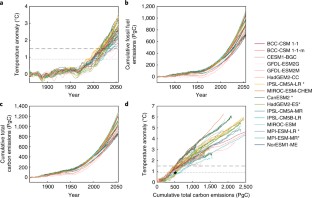
The alternative text for this image may have been generated using AI.
Fig. 2: Cumulative total carbon budgets consistent with 1.5 °C warming (for RCP 4.5 and 8.5 scenarios) as a function of simulated cumulative fossil fuel carbon emissions at present warming.

The alternative text for this image may have been generated using AI.
Fig. 3: Cumulative frequency distribution of carbon budgets consistent with staying below 1.5 °C global warming.

The alternative text for this image may have been generated using AI.
Fig. 4: Cumulative frequency distribution of carbon budgets consistent with staying below 1.5 °C global warming based on all CMIP5 models considered here for two different base periods and five different observational data sets.

The alternative text for this image may have been generated using AI.
References
- Adoption of the Paris Agreement FCCC/CP/2015/L.9/Rev.1 (UNFCCC, 2015); https://unfccc.int/resource/docs/2015/cop21/eng/l09r01.pdf.
- IPCC Climate Change 2013: The Physical Science Basis (eds Stocker, T. F. et al.) 1029–1136 (Cambridge Univ. Press, 2013).
- Allen, M. R. et al. Warming caused by cumulative carbon emissions towards the trillionth tonne. Nature 458, 1163–1166 (2009).
Article CAS Google Scholar - Matthews, H. D., Gillett, N. P., Stott, P. A. & Zickfeld, K. The proportionality of global warming to cumulative carbon emissions. Nature 459, 829–832 (2009).
Article CAS Google Scholar - Zickfeld, K. et al. Setting cumulative emissions targets to reduce the risk of dangerous climate change. Proc. Natl Acad. Sci. USA 106, 16129–16134 (2009).
Article CAS Google Scholar - Rogelj, J. et al. Differences between carbon budget estimates unravelled. Nat. Clim. Change 6, 245–252 (2016).
Article Google Scholar - Taylor, K. E., Stouffer, R. J. & Meehl, G. An overview of CMIP5 and the experiment design. Bull. Am. Meteorol. Soc. 93, 485–498 (2012).
Article Google Scholar - IPCC Summary for Policymakers. In Climate Change 2013: The Physical Science Basis (eds Stocker, T. F. et al.) (Cambridge Univ. Press, 2013).
- Millar, R. J. et al. Emission budgets and pathways consistent with limiting warming to 1.5 °C. Nat. Geosci. 10, 741–747 (2017).
Article CAS Google Scholar - IPCC Climate Change 2014: Synthesis Report (eds Pachauri R. K. & Meyer L. A.) (Cambridge Univ. Press, 2014).
- Le Quéré, C. et al. Global carbon budget 2015. Earth Syst. Sci. Data 7, 349–396 (2015).
Article Google Scholar - Le Quéré, C. et al. Global carbon budget 2013. Earth Syst. Sci. Data 6, 235–263 (2014).
Article Google Scholar - Morice, C. P., Kennedy, J. J., Rayner, N. A. & Jones, P. D. Quantifying uncertainties in global and regional temperature change using an ensemble of observational estimates: The HadCRUT4 data set. J. Geophys. Res. Atmos. 117, 1–22 (2012).
Article Google Scholar - Vose, R. S. et al. NOAA’s merged land-ocean surface temperature analysis. Bull. Am. Meteorol. Soc. 93, 1677–1685 (2012).
Article Google Scholar - GISTEMP Team GISS Surface Temperature Analysis (GISTEMP) (NASA Goddard Institute for Space Studies, 2018); http://data.giss.nasa.gov/gistemp/.
- Hansen, J., Ruedy, R., Sato, M. & Lo, K. Global surface temperature change. Rev. Geophys. 48, RG4004 (2010).
Article Google Scholar - Cowtan, K. & Way, R. G. Coverage bias in the HadCRUT4 temperature series and its impact on recent temperature trends. Q. J. R. Meteorol. Soc. 140, 1935–1944 (2014).
Article Google Scholar - Rohde, R. et al. A new estimate of the average earth surface land temperature spanning 1753 to 2011. Geoinform. Geostat. Overview 1, https://doi.org/10.4172/2327-4581.1000101 (2013).
- Rogelj, J. et al. Energy system transformations for limiting end-of-century warming to below 1.5 °C. Nat. Clim. Change 5, 519–528 (2015).
Article Google Scholar - Sanderson, B. M., O’Neill, B. & Tebaldi, C. What would it take to achieve the Paris temperature targets? Geophys. Res. Lett. 43, 7133–7142 (2016).
Article Google Scholar - Schleussner, C.-F. et al. Science and policy characteristics of the Paris Agreement temperature goal. Nat. Clim. Change 6, 827–835 (2016).
Article Google Scholar - Van Vuuren, D. P. et al. The representative concentration pathways: an overview. Climatic Change 109, 5–31 (2011).
Article Google Scholar - Gillett, N. P. Weighting climate model projections using observational constraints. Phil. Trans. R. Soc. A 373, 20140425 (2015).
Article Google Scholar - Ehlert, D. & Zickfeld, K. What determines the warming commitment after cessation of CO2 emissions? Environ. Res. Lett. 12, 15002 (2017).
Article Google Scholar - MacDougall, A. H., Avis, C. A. & Weaver, A. J. Significant contribution to climate warming from the permafrost carbon feedback. Nat. Geosci. 5, 719–721 (2012).
Article CAS Google Scholar - Schuur, E. A. G. et al. Climate change and the permafrost carbon feedback. Nature 520, 171–179 (2015).
Article CAS Google Scholar - MacDougall, A. H., Zickfeld, K., Knutti, R. & Matthews, H. D. Sensitivity of carbon budgets to permafrost carbon feedbacks and non-CO2 forcings. Environ. Res. Lett. 10, 125003 (2015).
Article Google Scholar - Schaphoff, S. et al. Contribution of permafrost soils to the global carbon budget. Environ. Res. Lett. 8, 014026 (2013).
Article Google Scholar - Schurer, A. P. et al. Importance of the pre-industrial baseline for likelihood of exceeding Paris goals. Nat. Clim. Change 7, 563–567 (2017).
Article Google Scholar - Rogelj, J. et al. Impact of short-lived non-CO2 mitigation on carbon budgets for stabilizing global warming. Environ. Res. Lett. 10, 75001 (2015).
Article Google Scholar - Forster, P. M. et al. Evaluating adjusted forcing and model spread for historical and future scenarios in the CMIP5 generation of climate models. J. Geophys. Res. Atmos. 118, 1139–1150 (2013).
- Stocker, T. F. et al. in Climate Change 2013: The Physical Science Basis (eds Stocker, T. F. et al.) 33–115 (IPCC, Cambridge Univ. Press, 2013).
Acknowledgements
The authors thank M. Berkley for assistance with data acquisition, V. K. Arora and V. Kharin for providing comments on the initial version of the manuscript, and M. Eby, A. P. Schurer and A. R. Friedman for helpful discussions. The authors acknowledge support from the Natural Sciences and Engineering Research Council of Canada (NSERC) Discovery Grant Program and the UK Natural Environment Research Council SMURPHS project (grant no. NE/N006143/1). The authors acknowledge the World Climate Research Programme’s Working Group on Coupled Modelling, which is responsible for CMIP, and thank the climate modelling groups for producing and making available their model output. For CMIP the US Department of Energy’s Program for Climate Model Diagnosis and Intercomparison provides coordinating support and led development of software infrastructure in partnership with the Global Organization for Earth System Science Portals. The authors acknowledge Met Office Hadley Centre for providing observational HadCRUT4 data sets, K. Cowtan and R. Way for the filled-in HadCRUT4 data set, the Berkeley Earth Surface Temperature data set, NOAA/OAR/ESRL PSD for providing the NASA(GISS/GISTEMP and NOAAGlobalTemp) global surface temperature data.
Author information
Authors and Affiliations
- School of Earth and Ocean Sciences, University of Victoria, Victoria, British Columbia, Canada
Katarzyna B. Tokarska - School of Geosciences, University of Edinburgh, Edinburgh, UK
Katarzyna B. Tokarska - Canadian Centre for Climate Modelling and Analysis, Environment and Climate Change Canada, University of Victoria, Victoria, British Columbia, Canada
Nathan P. Gillett
Authors
- Katarzyna B. Tokarska
- Nathan P. Gillett
Contributions
N.P.G. designed the study. K.B.T. collected and analysed data. K.B.T. and N.P.G. interpreted the data and wrote the manuscript.
Corresponding author
Correspondence toKatarzyna B. Tokarska.
Ethics declarations
Competing interests
The authors declare no competing interests.
Additional information
Publisher’s note: Springer Nature remains neutral with regard to jurisdictional claims in published maps and institutional affiliations.
Supplementary information
Rights and permissions
About this article
Cite this article
Tokarska, K.B., Gillett, N.P. Cumulative carbon emissions budgets consistent with 1.5 °C global warming.Nature Clim Change 8, 296–299 (2018). https://doi.org/10.1038/s41558-018-0118-9
- Received: 29 September 2016
- Accepted: 23 February 2018
- Published: 02 April 2018
- Version of record: 02 April 2018
- Issue date: April 2018
- DOI: https://doi.org/10.1038/s41558-018-0118-9