19 Best Books on Discipline & Self-Control (original) (raw)
Key Insights
- Books on self-discipline & self-control provide practical strategies for setting goals, managing impulses & fostering long-term success.
- Effective self-discipline involves understanding triggers & implementing habits that align with personal values & objectives.
- Cultivating self-control enhances resilience, helps overcome procrastination & leads to improved personal & professional outcomes.
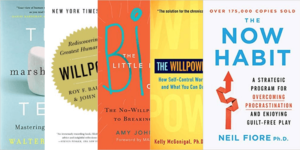 Self-discipline goes by many names – willpower, self-control, and self-regulation, to name a few.
It helps us stay focused, deal adaptively with distractions, and accomplish what we intend to do, among many other things.
Some researchers have linked self-discipline with accomplishment, others with well-being, and still others argue that it’s a precious finite resource.
If you’re interested in learning more about what self-regulation looks like and how you can improve it, this article includes some of the best books on self-discipline and self-control to help you make your own informed decision. Some fall into the “personal development” category, while others give a slightly more academic coverage of the concepts involved.
Read on to find something that tickles your fancy, and let us know of any personal recommendations you might have in the comments below.
Before you continue, we thought you might like to download our five positive psychology tools for free. These detailed, science-based exercises will help you or your clients become more productive and efficient.
This Article Contains
- 4 Best Books on Self-Discipline and Self-Control
- 5 Best Books on Self-Regulation
- A List of Top Audiobook Recommendations
- Other Good Recommendations
- Tools From PositivePsychology.com
- A Take-Home Message
- Frequently Asked Questions
- References
4 Best Books on Self-Discipline and Self-Control
Since Mischel’s Marshmallow Test in the late sixties, we’ve learned a lot more about how willpower works and what it looks like. It’s created a very bustling market of evermore (and more) self-help books designed to equip readers with useful tactics, motivation, and insight into their habits.
In this section, a combination of popular self-help books on the topics of self-discipline and control is provided. We’ve made these recommendations with the average ‘you and I’ in mind, and they are not overly academic in any way unless specified otherwise.
Perfect for a summer read or a less tedious morning commute. In addition, after selecting a great book, head on over to Self-Discipline Exercises for even more inspiration and encouragement.
1. Discipline Is Destiny: The Power of Self-Control – Ryan Holiday

Discipline Is Destiny makes a compelling case that self-discipline is a foundational virtue. The book’s central argument is simple: to be good at anything, whether it’s a hobby, a relationship, or a job, you have to first be good at controlling your thoughts, feelings, and actions.
The book explores three areas of self-mastery – the body, the mind, and the soul. Using the lives of historical figures who lived disciplined lives, such as Lou Gehrig, Queen Elizabeth II, Marcus Aurelius, and Toni Morrison, and contrasting them with cautionary tales, Holiday shows what discipline looks like in all areas of life.
What sets this book apart from other self-discipline books is its philosophical depth and insistence that discipline isn’t about working harder or denying yourself pleasure, but about finding the right balance, which the ancients called temperance.
Holiday doesn’t preach impossible ideals; instead, he talks about how self-control can be a way to show respect for yourself and be free.
Find the book on Amazon.
2. The Now Habit: A Strategic Program for Overcoming Procrastination and Enjoying Guilt-Free Play – Neil Fiore

This book is full of techniques to help anyone who tends to procrastinate – and perfectionists who want to improve their productivity. It’s a clear and straightforward read and offers plenty of help for people who – let’s be open here – can’t understand why they are procrastinating.
By delving into root causes, Dr. Neil Fiore invites his readers to get a better grasp of their unique difficulties and deal with them in the most appropriate way.
By offering to help you do things ‘Now,’ make a positive habit out of it, and break old, unhelpful ones, this is a powerful book. Perhaps not compelling enough for some very intense procrastinators, but a highly recommended read for anyone who wants to get things done and move on, minus the anxiety.
Find the book on Amazon.
3. No Excuses!: The Power of Self-Discipline – Brian Tracy
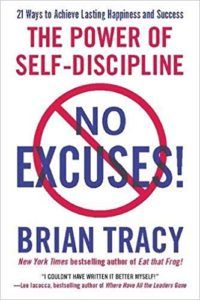 Brian Tracy is the author of several popular books on goal-setting, so his work on self-regulation is quite extensive. This book is roughly 300 pages long and spans 21 chapters, each of which contains tactical exercises to help you apply the concepts he’s discussed.
It is divided into three main areas: financial and business goals, personal goals, and general well-being, and these, in turn, are broken down further into domains such as leadership, relationships, friendship, personal excellence, responsibility, health, and time-management.
Concerning specific approaches, he emphasizes nine disciplines in particular, such as daily goal-setting, hard work, persistence, and similar. The ‘tone and flavor’ of this book is best described as motivational – it’s not a heavy read at all, and it’s easy to jump back and forth between chapters as you feel like covering certain topics.
Find the book on Amazon.
4. The Power of Habit: Why We Do What We Do, and How to Change – Charles Duhigg

Charles Duhigg is a business reporter for the New York Times, who wrote this book on habits after observing collective habits at play in rioting mobs overseas.
He became intrigued by human behavior and began digging further into the research on the “loops” that our brain gets into to conserve effort.
It is an insightful look into the deep-seated way in which habitual behaviors often sabotage the best intentions, and how they guide our behaviors in more ways than we may realize.
Duhigg considers some of the findings on how habits work at the brain level and discuss the 3-stages of cue, habit, and reward that can shape our actions. Throughout the book and more so toward the latter parts, he introduces specific strategies for changing habits and regaining self-control.
Find the book on Amazon.
5 Best Books on Self-Regulation
The terms self-regulation, self-control, and self-discipline are often interchangeably used in everyday conversations. The first, however, is the term most commonly used by behavioral psychologists to refer to a specific set of mechanisms.
The books in this particular section are either:
- Written by professional psychologists or therapists;
- Based mainly on psychological research; or
- Strongly recommended by/for therapists.
They also make great reads for anyone who’s looking for a slightly different, perhaps more scientific take on self-control. If you’re interested in reading more about the psychology of emotional and behavioral self-regulation, our article What is Self-Regulation? (+9 Skills and Strategies) also looks much closer at the topic.
In this article, we’ve put together a list of some of the best books on the topic.
1. Willpower: Rediscovering Our Greatest Strength – Roy F. Baumeister and John Tierney
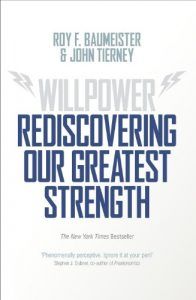
One of this book’s fundamental premises is that willpower is a finite resource. Along with IQ, the authors argue, it is one of life’s most important determinants of whether we succeed or not.
This book lays out how willpower is linked very strongly with happiness, emotional well-being, social support, physical health, and more.
At least in part, then, self-control is about consciously managing how we channel our energy – what depletes our willpower, replenishes it, and even when we should leave things (like critical tasks) until another time.
Cited over and over by myriad other self-development authors, Willpower is probably one of the seminal texts on self-discipline and self-control. It’s a 316-page read and professionally written by psychologists, so it touches on some fascinating experiments to make its strong and convincing arguments.
Find the book on Amazon.
2. The Little Book of Big Change: The No-Willpower Approach to Breaking Any Habit – Amy Johnson and Mark Howard
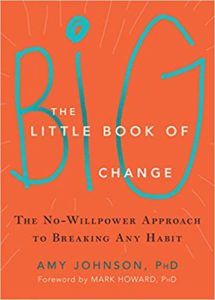 In this fascinating book, psychologists Dr. Amy Johnson discusses the neuroscience of addiction and habits to argue that changing them is very much possible.
Popular with counselors, therapists, and other helping professionals, it’s heavily focused on recovery but also touches on how we can reverse our tendency to think in certain ways.
There are useful insights for those struggling with anxiety or anxiety-related disorders, and may at times be a little heavy for reluctant readers.
Some highlights include Dr. Johnson’s approach to breaking down habitual behaviors to get a better grip on them, and tuning into your internal narrative. Psychologists will find it useful for its potential relevance in Cognitive Behavioral Therapy.
Find the book on Amazon.
3. The Marshmallow Test: Mastering Self-Control – Walter Mischel
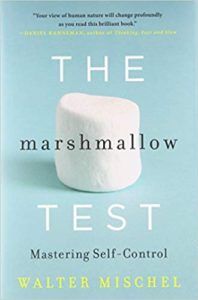 Walter Mischel was the acclaimed self-control psychologist behind the famous Marshmallow Test, which looked at the intricacies of delayed and instant gratification in kids.
During the second half of the ‘60s, he conducted his first studies with preschoolers – offering them either “a single marshmallow now or two marshmallows in ten minutes.”
He followed up these children’s later development to look at their academic performance, obesity rates, and other variables, paving the way for many more researchers to build on his findings.
This book is more than a useful overview of how to enhance your self-control; it also gives the reader an absorbing look at one of the most eye-opening experiments in modern psychological history.
Find the book on Amazon.
4. The Willpower Instinct: How Self-Control Works, Why It Matters, and What You Can Do to Get More of It – Kelly McGonigal
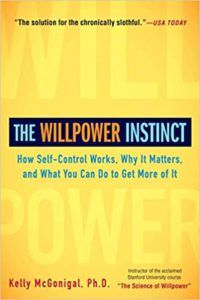 In this book, Dr. Kelly McGonigal introduces readers to the what, how, and why of willpower from numerous perspectives. She draws not just on psychological research, but on medical and neuroscientific insights to consider the up and downsides of self-control.
Readers who are curious about the impacts of willpower on our physical health, cognitive capabilities, and emotions will enjoy this informative read, in which McGonigal consistently references relevant studies.
It considers the roles of mindfulness, nutrition, mindset, and self-compassion in self-discipline, and includes practical advice regarding productivity, habits, and procrastination.
Find the book on Amazon.
5. Good Habits, Bad Habits: The Science of Making Positive Changes That Stick – Wendy Wood
 This book by Professor and habit expert Wendy Wood argues a counterintuitive idea: willpower is the wrong tool for lasting behavioral change.
Wood highlights that approximately 43% of what we do every day is habitual. Thus, the key to changing behavior is not to exert more self-control, but to change the situations and places that trigger our habits in the first place.
She presents pragmatic strategies, including habit stacking, friction reduction, and context design, to illustrate how our environment can facilitate or hinder self-regulation. Drawing heavily on the latest science, this book is widely considered a rigorous update to the willpower and self-regulation literature since Baumeister’s work.
Find the book on Amazon.
A List of Top Audiobook Recommendations
Audiobooks are a great way to stay up to date with the best reads. Here we have a couple of great suggestions.
1. Eat That Frog! 21 Great Ways to Stop Procrastinating and Get More Done in Less Time – Brian Tracy
 Another Brian Tracy book, this time with 21 practical techniques for those who would like to get things done efficiently and stop putting things off.
This runs for approximately 2 and a half hours, and focuses predominantly on workplace productivity, introducing logical (some might argue rather commonsense) tactics for improving the aforementioned.
Examples include:
- The Pareto efficiency concept – prioritizing and focusing on the 20% of tasks which yield the most valuable outcome;
- Breaking down seemingly overwhelming items into manageable steps;
- Setting time limits – creating personal deadlines for achieving your goals; and
- Making a conscious effort to reduce distractions.
Tracy digs slightly into the fact that as individuals, we have different reasons for procrastinating. In this sense, there’s a technique for everyone in this audiobook.
Get Eat That Frog! in audio format from Audible.
2. Smart but Scattered Teens: The “Executive Skills” Program for Helping Teens Reach Their Potential – Richard Guare, Peg Dawson and Colin Guare
 Written by two experts, Drs. Richard Guare and Peg Dawson, along with young adult Colin Guare, this book is predominantly aimed at parents.
It draws on psychological research to provide practical, science-based strategies for helping teenagers deal productively with issues such as procrastination, lack of focus, and impulse control.
It offers an executive skills-based approach for adults to tackle common difficulties which youths experience – such as lack of organization and forgetfulness – in a more effective way than micromanagement or punishment. In this sense, it considers concepts such as working memory, self-control, and how these can be developed with the right approaches.
Two points to note: the print copy comes with more resources, such as quizzes, worksheets, and activities, and it may be slightly tricky for educators to implement, as it’s geared specifically at parents.
Smart but Scattered Teens is available from Audible.
3. Drive: The Surprising Truth About What Motivates Us – Daniel H. Pink
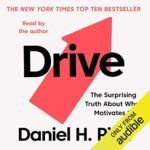 This is a highly, highly popular book with leaders, managers, and Organizational Development practitioners.
Its central premise is that three things underpin intrinsic motivation: a sense of purpose, autonomy to go about achieving our goals a certain way, and mastery – we are driven to get increasingly better at things.
Self-discipline doesn’t need to be about struggling tenaciously against the odds for the sake of it; when we are intrinsically motivated, we move toward achieving our goals much more naturally in spite of the odds.
At least, this is Pink’s premise, and he provides copious amounts of scientific research to support it. It’s approximately six hours long and peppered with plenty of corporate and scientific examples to keep the listener entertained.
Get Daniel Pink’s Drive from Audible.
Self discipline the neuroscience by Ray Clear - Great AudioBooks
Other Good Recommendations
Teaching children self-control is important. As any parent or early childhood educator knows, it can be just as much of an exercise in emotional self-regulation for the grown-up involved. It’s why we’ve also included some recommendations in this last little section – for kids.
Books for Children
Here are a few suggestions that will hopefully make things a little easier and keep those little ones entertained at the same time.
- My Mouth Is A Volcano! by Julia Cook (Amazon) – Louis is a boy who has a hard time not interrupting others. In this colorful book for 5 – 8-year-olds, he learns about the good things that happen when he tries listening and being patient instead.
- Executive Functioning Workbook for Kids: 40 Fun Activities to Build Memory, Flexible Thinking, and Self-Control Skills at Home, in School, and Beyond by Sharon Grand (Amazon) – A hands-on activity book for ages 6 – 9 that helps children build the memory, flexible thinking, and self-control skills that underpin executive functioning. Reviewers note it works best when used together with a parent or teacher.
- Katie Loves the Kittens by John Himmelmann (Amazon) – Katie the dog’s overwhelming enthusiasm about some cute little kittens, makes them scared, and she can’t understand why. She learns to control herself in this beautiful, relateable picture book for 3 – 8-year-olds.
- What Were You Thinking? by Bryan Smith (Amazon) – playful Brayden makes a few suboptimal jokes and ends up regretting his actions in this storybook for 4 – 8-year-olds. His teachers and mother try to help him learn how to make better decisions and control himself.
Related Concepts
There are also a few more great books that touch on self-control but which – because they aren’t exclusively focused on it – we’ve put in this section.
1. Stumbling on Happiness – Daniel Gilbert
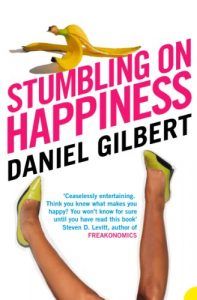
Professor Daniel Gilbert has won multiple awards both for his psychological teachings and as a researcher, including the 2007 Royal Society of Science Prize for this best-selling book.
His look at habitual behaviors, thought patterns, and happiness makes it a good read for those curious about cognitive biases and mental patterns, and how we might start controlling them.
Find the book on Amazon.
2. Grit: The Power of Passion and Perseverance – Angela Duckworth
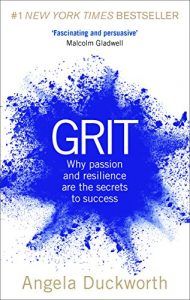
Angela Duckworth argues for the learnability of valuable psychological assets – that through hard work and self-discipline, we can accomplish what we set out to achieve despite not being ‘born’ with particular talents.
She credits her success in large part to passion, deliberate practice, and grit.
For those curious about how grit and self-control differ – despite being positively correlated – Duckworth and Gross (2004) have written a lovely paper on the topic entitled: Self-Control and Grit: Related but Separable Determinants of Success.
Find the book on Amazon.
3. Thinking, Fast and Slow – Daniel Kahneman, Patrick Egan and Random House Audio
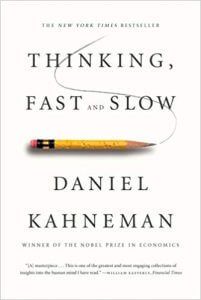 Daniel Kahneman’s bestselling Thinking Fast and Slow already enjoys its place in our Emotional Intelligence section, but is still worth a mention here.
The Nobel Prize Winner’s core argument is that we can think in two separate ‘modes’ – a rapid, emotionally-driven mode, and one which is more rational and controlled.
This is something which anyone struggling with emotional self-regulation will likely find valuable, and some would argue quite profound. This and other EQ books have been reviewed more thoroughly in our article: 26 Best Emotional Intelligence Books (Reviews + Summaries).
The book’s central thesis is a dichotomy between two modes of thought: System 1 is fast, instinctive and emotional; System 2 is slower, more deliberative, and more logical. The book delineates cognitive biases associated with each type of thinking, starting with Kahneman’s research on loss aversion.
Find the book on Amazon.
Looking to learn more about the science and practice of self-control? Check out the following articles throughout our blog:
- What Is Self-Control Theory in Psychology?
Self-control is a complex topic that different schools of psychological thought approach in various ways. This article explores several perspectives, including strengths-based, social, and cognitive approaches. - 40+ Benefits of Self-Control and Self-Discipline
Self-control can benefit you in almost every domain of life. This article explores several of these benefits and provides 22 strategies you can use to increase your discipline today. - 21 Tools to Maximize Self-Control and Self-Regulation
Strengthening self-control takes discipline and practice. This article provides a range of useful self-reflection questions, tools, and techniques for both children and adults to support your efforts. - How to Practice Delayed Gratification: Activities & Exercises
Resisting short-term temptation is key to achieving long-term goals. This article explores practical ways to strengthen self-control through mindfulness, goal setting, and replacement behaviors. It includes many worksheets and activities to help you put delayed gratification into practice.
If you’re looking for more science-based ways to help others become more productive and efficient, check out this collection of 17 validated productivity and work efficiency exercises. Use them to help others prioritize better, eliminate time wasters, maximize their personal energy, and more.
A Take-Home Message
The market is chock-full of self-development texts that claim to help you improve your focus, productivity, and happiness, and they are a dime a dozen. To dismiss them all as fluff would be frankly imprudent because you never know where your next great inspiration might come from – so we’ve included some popular self-help titles in this article.
Hopefully, you will also find some of these science-based reads as enjoyable as we have. To improve and enhance our abilities at anything – self-control included – expert help is never a bad idea!
What books have we missed, in your opinion? Do you have more suggestions or recommendations that we can include? Let us know in the comments, and happy reading!
We hope you enjoyed reading this article. Don’t forget to download our five positive psychology tools for free.
Frequently Asked Questions
Developing self-discipline can lead to better time management, increased productivity, and the ability to make healthier choices. It helps in setting and achieving personal and professional goals.
Yes, self-discipline is a skill that can be developed over time with practice and dedication. Starting with small, manageable tasks and gradually increasing their complexity can help build this skill.
Strong self-discipline can reduce stress and anxiety by promoting healthier habits and routines. It also enhances self-esteem and confidence as individuals see progress toward their goals.
- Bandura, A. (1991). Social cognitive theory of self-regulation. Organizational Behavior and Human Decision Processes, 50(2), 248-287. https://doi.org/10.1016/0749-5978(91)90022-L
- Duckworth, A., & Gross, J. J. (2014). Self-control and grit: Related but separable determinants of success. Current Directions in Psychological Science, 23(5), 319-325. https://doi.org/10.1177%2F0963721414541462
- Duckworth, A. L., & Seligman, M. E. (2005). Self-discipline outdoes IQ in predicting academic performance of adolescents. Psychological Science, 16(12), 939-944. https://doi.org/10.1111/j.1467-9280.2005.01641.x
- Hagger, M. S., Wood, C., Stiff, C., & Chatzisarantis, N. L. D. (2010). Ego depletion and the strength model of self-control: A meta-analysis. Psychological Bulletin, 136(4), 495-525. https://doi.org/10.1037/a0019486
- Hofmann, W., Schmeichel, B. J., & Baddeley, A. D. (2012). Executive functions and self-regulation. Trends in Cognitive Sciences, 16(3), 174-180. https://doi.org/10.1016/j.tics.2012.01.006
Catherine Moore has a BSc in Psychology from the University of Melbourne. She enjoys researching and using her HR knowledge to write about Positive and Organizational psychology. When she isn’t getting super ‘psyched’ about her favorite topics of creativity, motivation, engagement, learning, and happiness, she loves to surf and travel.

Read other articles by their category
- Body & Brain (70)
- Boundaries (14)
- Coaching & Application (42)
- Compassion (26)
- Counseling (41)
- Emotional Intelligence (22)
- Gratitude (18)
- Grief & Bereavement (18)
- Happiness & SWB (40)
- Meaning & Values (27)
- Meditation (16)
- Mindfulness (47)
- Motivation & Goals (41)
- Optimism & Mindset (36)
- Positive CBT (28)
- Positive Communication (29)
- Positive Education (39)
- Positive Emotions (34)
- Positive Leadership (17)
- Positive Parenting (18)
- Positive Psychology (27)
- Positive Workplace (41)
- Productivity (17)
- Relationships (56)
- Resilience & Coping (45)
- Self Awareness (25)
- Self Esteem (38)
- Strengths & Virtues (34)
- Stress & Burnout Prevention (39)
- Theory & Books (44)
- Therapy Exercises (43)
- Types of Therapy (64)