12+ Career Coaching Questions, Tools & Exercises (original) (raw)
Key Insights
- Career coaching empowers individuals to identify strengths & set goals, enhancing job satisfaction & career advancement.
- Coaches provide guidance in navigating career transitions & developing skills, fostering personal & professional growth.
- Engaging with a career coach can clarify career paths, boost confidence & align work with personal values.
 Throughout our working lives, most of us will reflect at some point on where our career is heading.
We may ask ourselves, “_Have I chosen the right path?_” and “_How do I earn a good living, yet remain true to my values?_”
These are big questions — and not easily answered.
Whether we are embarking on a first career or feeling stuck in a long-term job, a career coach can help, adding value by bringing “the advantage of insight, information and planned action to the pursuit of goals” (Cox, 2018, p. 412).
Let’s learn more about what a client can expect from career coaching and look at tools, questions, and templates to help.
Before you continue, we thought you might like to download our five positive psychology tools for free. These detailed, science-based exercises will help you or your clients identify opportunities for professional growth and create a more meaningful career.
This Article Contains
- What Is Career Coaching? 2 Models
- 9 Benefits of Career Coaching
- 4 Career Coaching Skills & Techniques
- How to Plan Your Sessions: 5 Templates
- Topics for Career Coaches: Best Tips and Advice
- 12 Questions to Ask Your Coaching Clients
- 3 Helpful Exercises, Tools, and Worksheets
- A Note on Using Online Platforms and Apps
- Best Resources From PositivePsychology.com
- A Take-Home Message
- Frequently Asked Questions
- References
What Is Career Coaching? 2 Models
“The boundaries between work life and home life, and career and family are increasingly blurred, and the two parts of life inevitably influence and impact on each other.”
Yates, 2021, p. 282
While career coaching typically focuses on supporting choices and making transformations associated with moving between jobs, it can also help us find a balance between multiple life domains (Yates, 2021).
A career coach supports clients in defining their career goals and devising strategies to meet them while balancing other aspects of their lives (Kauffeld et al., 2022).
The following two models are helpful when considering and delivering change. These specific models can be transformational in career coaching.
GROW Model
John Whitmore’s (2009) model is a powerful tool for setting and working toward career goals.
Key elements of the GROW coaching model include:
- Goal – Clients establish their goals.
- Reality – They examine their reality.
- Options – They explore the options for meeting their goals.
- Will – They affirm their commitment, or will, to do what is needed to move forward.
OSCAR
This solution-focused model breaks down the process into a series of steps to understand the goal and context before capturing and finding a path toward the client’s career aspirations (Gilbert & Whittleworth, 2009).
- Outcome – Understand the desired outcome and the individual’s long-term goals.
- Situation – Help the client become aware of their skills, abilities, level of knowledge, and how they feel.
- Choices – What are the options for reaching the desired outcome?
- Actions – Identify the improvements and how best to make them.
- Review – Hold regular check-ins to ensure the client is on track.
These and other coaching models are further described in our article 12 Effective Coaching Models to Help Your Clients Grow.
Career coaching vs. career counseling
Career coaching and career counseling inevitably overlap, covering similar challenges, setting comparable goals, and relying on one-on-one conversations (Passmore, 2021).
However, counseling “involves a significant amount of time exploring issues in the past and present,” while coaching “encourages a stronger focus on the present and future” (Passmore, 2021, p. 5).
Executive vs. career coaching
Executive coaching is typically a subset of career coaching (Passmore, 2021).
“At its simplest, executive coaching could be defined as coaching for senior, or C-suite, managers” (Passmore, 2021, p. 8).
And yet, it can be more than that. Executive coaches support leadership development through a series of one-to-one reflective conversations, requiring significant trust, safety, and support (Passmore, 2021).
3 Goals of career coaches
Career coaches supporting individuals facing an evolving career often focus on three goals (Kauffeld et al., 2022):
- Assessing the client’s potential for development in terms of their present career situation, goals, and competencies
- Increasing the client’s “awareness of opportunities for professional development, challenges, and obstacles” (Kauffeld et al., 2022, p. 138)
- Developing the knowledge and skills required to take the appropriate next steps
Most clients seeking a career coach’s support are either considering starting a new career or facing a forthcoming career transition — potentially outside their control (Kauffeld et al., 2022).
9 Benefits of Career Coaching
 While there are many benefits to working with a career coach, the following positives are nine of our favorites (Kauffeld et al., 2022).
- Clarity: Uncovering professional goals to ignite passion and creativity
- Adaptation: Shaping and realigning careers to fit evolving aspirations and needs
- Insight: Supporting confident, informed career decisions
- Strategy: Crafting a strategic roadmap for the next career chapter
- Harmony: Achieving a more manageable balance between work and personal life
- Empowerment: Recognizing and honing career-relevant skills and strengths
- Impact: Mastering self-marketing to showcase talents and ambitions
- Fulfillment: Creating more fulfilling, value-led roles
- Thriving: Unleashing potential by connecting values and career pursuits
4 Career Coaching Skills & Techniques
Career coaching draws practical techniques from several theoretical approaches, including Cognitive-Behavioral Therapy, Narrative Therapy, positive psychology, and Person-Centered Therapy (Cox, 2018).
While each session may vary, the following are four typical coaching techniques that the career coach should be skilled at (Cox, 2018).
Conducting assessments
The coach must identify and help the client realize (and understand) their needs, values, and life domains.
It can help to understand the following:
What is the client’s personal and family history of work?
What values and life domains are most important to the client?
Planning
It is vital to identify the client’s current and goal (target) state. For example:
“I am in sales but wish to move into marketing.”
Also, consider other commitments, such as timing and finances.
Defining the exit criteria
Career coaching should have a clear end goal.
Consider the following:
How will the client know when they are successful?
Address skill deficits
The client will probably require different or additional skills to perform a new role.
Identifying what is needed and taking action to address any deficits are vital.
How to Plan Your Sessions: 5 Templates
 The role of the career coach involves planning and implementing the changes required for the client to reach their career goals.
They must plan their approach and continually re-assess whether they are meeting the client’s needs (Cox, 2018).
Structuring the program and the sessions
There are many ways to design a coaching program. Use this Checklist for Building a Coaching Program to consider every aspect of your business and client offering.
Use our Coaching Program Blueprint to help structure sessions and include all the necessary learning points and activities.
Best intake forms for career coaches
Intake forms are vital for identifying the client’s needs and situation.
- Adult Psychotherapy Intake Form
While targeting clients in psychotherapy, this template can be tailored to the needs of a client entering career coaching. - New Client Intake Form
This useful form is meant to be completed before the first session, helping the career coach understand the client’s background and goals. - Employee Intake Form
This valuable form is for dealing with multiple clients in a workplace setting.
Topics for Career Coaches: Best Tips and Advice
“Good career coaching makes use of a non-judgmental, non-directive approach, a structured conversation, as well as listening, questioning and challenging where appropriate” (Yates, 2021, p. 284).
Support for clients is imperative when faced with the following decisions (Yates, 2021).
Initial career choice
A limited experience of the world can hold clients back from making an informed choice about potential careers.
The coach can help clients identify their values and strengths and begin to link their individual characteristics to potential jobs.
After all, awareness and use of strengths is linked to “a range of positive outcomes, including work engagement and job satisfaction” (Yates, 2021, p. 284).
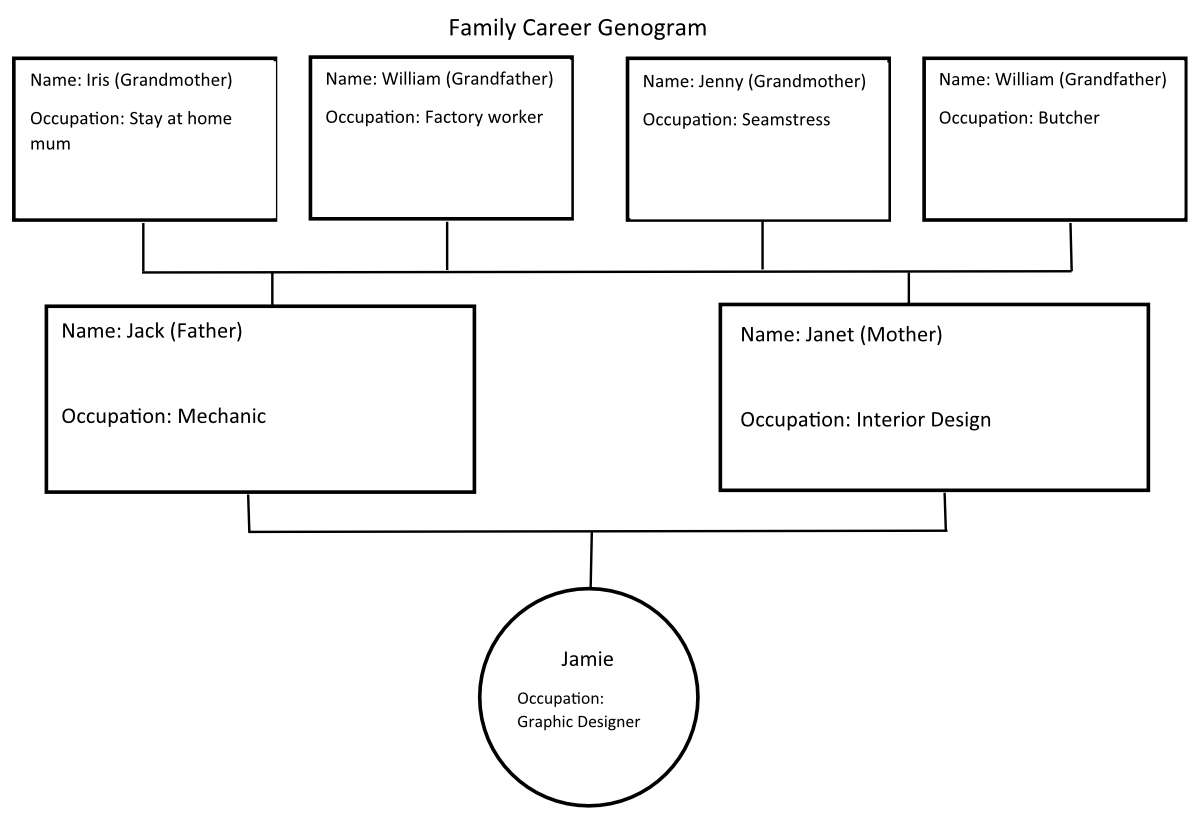
A career genogram offers a visual tool for understanding a client’s family’s impact on their career decisions.
The following diagram captures the occupations of key family members and offers insight into the “values that are manifest and the family’s conceptualization of career success” (Yates, 2021, p. 285).
Career change
Career changes typically involve moving between jobs but can also include job crafting, where individuals shape their existing roles to make them more satisfying (Yates, 2021).
Either way, career changing may require costly training and may briefly leave the individual feeling like they are professionally regressing.
For those experiencing layoffs, this can be particularly true. Along with facing their fears, they may experience a loss of confidence.
Career coaches help clients see such changes as opportunities with the potential to surface the other side happier and more engaged (Yates, 2021).
Return to work
This group often includes parents returning to their career and seeking help from a coach as they reach the end of a career break.
“Family dynamics tend to be quite entrenched by this point, which often means that the stay-at-home parent expects to be the children’s primary carer, even after their return to work” (Yates, 2021, p. 284).
Career conversations often involve identifying priorities and are likely to include consideration of working hours, location, and flexibility.
Retirement
Reaching the end of a career can feel scary, heading into uncharted territories where the individual must choose whether to stop and fully retire or do something they’ve always wished for (Yates, 2021).
The career coach will help the individual maintain or regain their self-confidence and consider what they wish to do next while considering their financial situation.
12 Questions to Ask Your Coaching Clients
 Here are several questions exploring values, identifying personal resources, and generating job ideas (Yates, 2021).
1. Questions to explore values
- What causes or issues are you most passionate about, and why?
- What impact or legacy would you like to leave behind?
- What are your top priorities in life, and how do they align with your career goals?
- What kind of work environment or company culture brings out the best in you?
2. Questions to help identify personal resources
- What skills or abilities do you possess that others often recognize and appreciate?
- Think of a time when you faced a significant challenge. How did you overcome it, and what personal strengths did you rely on?
- What activities or tasks do you enjoy that make you lose track of time? What does that tell you about your natural talents?
- In what ways do your personality traits contribute to your success in certain areas?
3. Questions to generate job ideas
- What job would you choose if there were no limits, and why?
- What are your hobbies or interests outside of work?
- What entrepreneurial venture or business would you start if you had unlimited resources and support?
- Reflect on times when you have felt the most excited and energized. Are there any job roles or industries that evoke similar feelings?
There are several considerations when choosing a career. The following exercises, tools, and worksheets can help.
Assessment of Life and Career ‘Wants’
This assessment of life and career wants asks five questions to help clients consider their sense of purpose as they assess career opportunities.
- How do your life experiences connect with and shape your career development?
- What makes your life meaningful?
- What sort of life would you like to build (for example, work–life balance, time spent traveling, etc.)?
- What would you like to express through your work?
- What aspects of work or ways of working allow you to come closest to expressing who you are?
Career Visualization
Before choosing a career direction, it’s helpful to consider our future selves.
How might it look, feel, and be like if we took the path we have been thinking about and had the career of our dreams (Yates, 2021)?
Use the Career Visualization worksheet with your clients to explore those dreams.
FIRST Framework Questions
Use the FIRST framework to understand the client’s current developmental stage.
- Focus: How far have you narrowed down your career options?
- Information: How well informed are you about the career options you have in mind?
- Realism: How realistic do you think you are regarding your abilities and external constraints (for example, the job market)?
- Scope: How aware are you of the range of options available?
- Tactics: How far have you worked out the practical steps to reach your career objective(s)?
The answers will help the career coach assess where the client is on their career path.
A Note on Using Online Platforms and Apps
 To avoid spending too much time on administrative tasks and taking focus away from clients, using digitization can create the opportunity to automate and scale up your career coaching business.
While there are other coaching platforms available, Quenza has been developed by psychologists, therapists, and coaches to provide a powerful and easy-to-use tool to:
- Increase engagement with clients through sending online exercises, activities, and meditations
- Inspire clients with automatically timed motivational content, including videos, podcast links, and articles
- Track activity completion and identify where extra focus is required
- Automatically collect feedback to improve and refine the service offering
Crucially, services can be turned into products for increased reach and profitability.
Best Resources From PositivePsychology.com
We have many resources available to support those entering, leaving, or moving within the workplace, which you can apply with clients in both individual or group coaching contexts.
Let’s start with a resource aspiring career coaches would find most useful:
Our free resources include the following:
- Career Counseling Evaluation
By asking the client to rate each of the statements, the career coach can improve existing and future interventions. - Career Action Plan
When moving toward career aspirations, it is helpful to break larger goals into smaller tasks and actions.
More extensive versions of the following tools are available with a subscription to the Positive Psychology Toolkit©, but they are briefly described below.
- Priority Dartboard
Our working life can be hectic. Being busy does not always mean being productive, especially if we focus on the wrong tasks.
Try out the following four steps to improve performance in the workplace:
- Step one – List all the tasks on your to-do list.
- Step two – Prioritize each one. How urgent and how important is it?
- Step three – Draw an outline of a dartboard and add the tasks. Put the most urgent and important ones near the center.
- Step four – Plan your day, week, and month around those tasks nearest the center of the dartboard.
- The Five Ps of Job Preference
When we make career changes, we must clearly understand what we are looking for.
Considering the five Ps can help:
- People – Who would you like to work with (if anyone)?
- Place – Where would you like to work?
- Projects – What projects and tasks do you prefer?
- Process – What are your desired ways of working?
- Powers – What strengths and skills do you like to use at work?
Reflect on the answers to the coaching questions and consider what insights they offer regarding career choice.
A Take-Home Message
Whether preparing for a first job, feeling stuck in a current role, or facing layoffs or retirement, a career coach can help.
Unlike counselors, career coaches typically focus on present and future goals and how to achieve them.
In doing so, they consider the values and life domains critical to the client and support them in finding the right work–life balance and a role that fosters engagement and interest.
There are plenty of tools to help career coaches and their clients, including the GROW and the OSCAR models, which help break down important, daunting goals into more manageable chunks.
As a result, clients find new ways to balance their work and personal life, reconnect their work with their values, and create clarity and direction for their careers.
Why not try some of the tools discussed in the article? Create a path of interventions that help clients visualize potential careers and identify values and strengths that can support their professional transformation.
We hope you enjoyed reading this article. Don’t forget to download our five positive psychology tools for free.
Frequently Asked Questions
Career coaching is a professional service that helps individuals identify their career goals, develop strategies to achieve them, and navigate career transitions, focusing on present and future aspirations.
Career coaches employ models like GROW and OSCAR to break down goals into manageable steps, helping clients balance work and personal life while fostering engagement and interest.
To find a career coach, consider seeking recommendations, researching professionals with expertise in positive psychology, and ensuring they align with your specific career development needs.
- Cox, E. (2018). The complete handbook of coaching. SAGE.
- Gilbert, A., & Whittleworth, K. (2009). The OSCAR coaching model: Simplifying workplace coaching. Worth Consulting.
- Kauffeld, S., Güntner, A. V., & Ebner, K. (2022). Career coaching_._ In S. Greif, H. Möller, W. Scholl, J. Passmore, & F. Müller (Eds.), International handbook of evidence-based coaching (pp. 137–149). Springer.
- Passmore, J. (2021). Coaching defined and explored. In J. Passmore (Ed.), The coaches’ handbook: The complete practitioner guide for professional coaches (pp. 3–12). Routledge.
- Whitmore, J. (2009). Coaching for performance. Nicholas Brealey.
- Yates, J. (2021). Career coaching. In J. Passmore (Ed.), The coaches’ handbook: The complete practitioner guide for professional coaches (pp. 280–290). Routledge.
Jeremy Sutton, Ph.D., is an experienced psychologist, coach, consultant, and psychology lecturer. He works with individuals and groups to promote resilience, mental toughness, strength-based coaching, emotional intelligence, wellbeing, and flourishing. Alongside teaching psychology at the University of Liverpool, he is an amateur endurance athlete who has completed numerous ultra-marathons and is an Ironman.

Read other articles by their category
- Body & Brain (69)
- Boundaries (14)
- Coaching & Application (42)
- Compassion (26)
- Counseling (41)
- Emotional Intelligence (22)
- Gratitude (18)
- Grief & Bereavement (18)
- Happiness & SWB (40)
- Meaning & Values (27)
- Meditation (16)
- Mindfulness (47)
- Motivation & Goals (41)
- Optimism & Mindset (36)
- Positive CBT (28)
- Positive Communication (29)
- Positive Education (39)
- Positive Emotions (34)
- Positive Leadership (17)
- Positive Parenting (18)
- Positive Psychology (27)
- Positive Workplace (41)
- Productivity (17)
- Relationships (56)
- Resilience & Coping (45)
- Self Awareness (25)
- Self Esteem (38)
- Strengths & Virtues (34)
- Stress & Burnout Prevention (39)
- Theory & Books (44)
- Therapy Exercises (43)
- Types of Therapy (64)