Community Psychology: 20+ Theories & Interventions (original) (raw)
Key Insights
- Community psychology focuses on understanding the individual within their social & community contexts to promote wellbeing.
- It prioritizes social justice & empowerment, addressing systemic issues that affect mental health.
- Collaborative efforts with communities foster resilience & sustainable change through shared resources & support.
 A crisis is often a time of great suffering, disagreement, and confusion; yet, it can also be an opportunity for positive social transformation.
To achieve constructive change in a community, it is vital to see the links between individual needs and global politics, economics, and cultural development (Riemer, Reich, Evans, Nelson, & Prilleltensky, 2020).
Community psychology theories and models help understand the environment’s potential and interventions to improve people’s health and wellbeing through a series of coordinated changes.
This article looks at the values, research findings, and goals of community psychology and its capacity to change lives individually and on a much larger scale.
Before you continue, we thought you might like to download our five positive psychology tools for free. These science-based exercises explore fundamental aspects of positive psychology, including strengths, values, and self-compassion, and will give you the tools to enhance your clients’ or community’s wellbeing.
This Article Contains
- What Is Community Psychology?
- Core Values and Popular Topics
- 4 Real-Life Examples
- 5 Evidence-Based Theories and Models
- A Look at 3 Research Findings
- Helpful Interventions and Skills for Community Psychologists
- 4 Valuable Resources and Tools
- Training Opportunities: 4 Programs and Master’s Options
- 3 Books on the Topic
- Resources From PositivePsychology.com
- A Take-Home Message
- Frequently Asked Questions
- References
Community psychology is a complex, interdisciplinary field – more a perspective than a fixed entity. Its goals are easier to define, and they are both bold and admirable. Community psychology aims to have:
“a strong, global impact on enhancing wellbeing and promoting social justice for all people by fostering collaboration where there is division, and empowerment where there is oppression.”
(What is SCRA?)
Building such a prosocial community relies on everyone’s commitment to work toward their own and each other’s wellbeing – at the community, society, and global level. Attention is focused less on the individual and more on how people feel and think as they work together toward a better world (Burton, Boyle, Harris, & Kagan, 2007).
While connected to psychology, community psychology is less formal. It is a way of thinking that brings people from many backgrounds and disciplines together via a shared set of values (Riemer et al., 2020). And it is more easily understood when we consider some of the issues it attempts to address, such as immigration, homelessness, and environmental stability.
Community psychology acts as a lens through which challenges can be viewed. It tries to understand the broader context rather than the situation of the individual in isolation. For example, typical questions to address complex issues include (modified from Riemer et al., 2020):
Immigration
- What challenges will an immigrant face in a new country?
- How can they be supported?
- How will the community respond to the arrival of immigrants?
Homelessness
- What sorts of problems, issues, and situations lead to homelessness?
- What should the focus of an intervention be?
- Is there a way to prevent homelessness?
- How can the community support people in this situation?
Environmental sustainability
- How can we support communities campaigning for environmental issues?
- What are the environmental issues that affect local communities (often at the margins of society; for example, racialized, low-income, and indigenous communities)?
Community psychology is very often action oriented. And it needs to be; the need for change in each of the above issues is typically high.
Community psychologists must continually reassess the boundaries of the discipline and consider new, sometimes radical ways of thinking.
Core Values and Popular Topics
 Community psychology is value driven and closely tied to its vision (Riemer et al., 2020).
Therefore, it is valuable to begin by asking questions regarding how society might look if we were to create it from scratch without interference from existing people, politics, or prejudice.
Ask yourself:
- What might the ideal society look like?
- Who would make decisions, and how would the decision-makers be chosen?
- How would basic needs be met (housing, food, and healthcare)?
It is both an insightful and creative exercise that can lead us to question the injustices in the world.
As we delve deeper, it soon becomes clear that solutions to societal-level problems are complex and interdisciplinary. Solving them typically requires consideration beyond borders, race, religion, gender, sexuality, and other arbitrary divisions.
So, what are the enduring beliefs and values that underpin community psychology?
Community psychology’s values are drawn from the guiding principles that led to its development: to work toward justice, wellbeing, and equality within society by addressing injustice and oppression.
Rather than being objective, values are subjective and rely on the individuals and wellbeing of the communities they serve. Positive wellbeing can only truly be created by synergy and the balance between addressing personal, relational, and collective needs (Riemer et al., 2020).
Let’s take each in turn.
Values for personal wellbeing
The following values and objectives promote the needs of the individual’s wellbeing.
- Self-determination: the opportunity to pursue personal goals
- Caring and compassion: the expression of care for the wellbeing of the self and others
- Health: the protection of our own and others’ wellbeing through physical and emotional health
For personal wellbeing, all three values must be present in the individual and the communities that support them.
Values for relational wellbeing
It isn’t easy to imagine purely personal happiness; after all, it is intertwined with others’ wellbeing (Riemer et al., 2020).
The following relational values and objectives are, therefore, crucial:
- Respect for diversity: the freedom for people to define themselves and be respected for doing so
- Participation and collaboration: the meaningful engagement of both adults and children in decisions that impact their lives
Diversity and identity must be respected and recognized as human needs. Where conflicts arise, ways must be found to resolve the differences.
Values for collective wellbeing
Social resources are crucial for satisfying the above individual aims and may be met by the following collective values and objectives (Riemer et al., 2020):
- Support for community structure: sufficient support for personal and community goals
- Social justice and accountability: resources and bargaining power for all, including the oppressed
Good health is not possible without resources. Hence, social justice – the equality of rights, opportunities, and equity in living conditions – is essential (Bales, 2017). Indeed, justice is broader than the law or the economy and must consider the healthy relationships between groups and society.
Community psychology is clear about the importance of the values it serves, as they shape the interaction with the community. As a result, the values shape how we see the world and the actions we take to address the issues we identify.
4 Real-Life Examples
 The following case studies show the potential for community psychology to provide support for valuable change within communities.
Fairweather Lodge
In the 1960s, psychologist George Fairweather recognized that patients often struggled when they left psychiatric facilities. In response, he created the Fairweather Lodge to encourage personal wellbeing by allowing patients to live in the community rather than in a psychiatric institution.
Patients were each given roles to fulfill in their new home, and with appropriate support, they successfully took on community jobs, formed social connections, and became part of their community (Fairweather, Sanders, Maynard, & Cressler, 1969; Riemer et al., 2020).
Partners in Policy Making
Partners in Policy Making provides training for family members of those with disabilities to better understand disability issues and become successful advocates for change at a local and government level.
Through an ecological model of disability advocacy, Partners in Policy Making considers the experiences of the person (and others within the community) with a disability and the local and national policies that need to change (Jimenez, Hoffman, & Grant, 2019).
Mini-grants
A community program provided small grants to residents to improve local neighborhoods, including cleaning up parks, fixing broken windows, repairing schools, etc. The results extended beyond aesthetic and physical benefits and led to increased community communication and the building of relationships (Jimenez et al., 2019).
Community gardening
Gardening and time spent in nature have well-known benefits for psychological and physiological wellbeing. Indeed, community gardening and other similar programs encourage educational skills and opportunities for positive engagement between community members. The resource requirements are relatively low, and it is sustainable and leads to healthy food production.
When local volunteers planted fruit trees as part of a project in Guatemala, strong links were seen between the value of community service work, connectedness to community, and increased future participation (Hoffman, 2019).
5 Evidence-Based Theories and Models
Community psychology theories help us analyze social problems and develop community interventions by thinking of the individual within the context of their environment and community.
Their goal is to promote a social justice agenda by focusing on how individuals can shape, and be shaped by, the environment. They offer a powerful and practical way to understand marginalized populations’ needs and social issues (Jimenez et al., 2019).
The following theories provide a lens through which we can better understand (and change) the relationships between the individual and the ecological factors that affect them.
A recent survey suggested there are over 30 theories in community psychology. We have included a brief description of some of the more prominent ones below (Jimenez et al., 2019; Jason et al., 2016).
Behavior setting theory
Each ecological environment has differing influences on how behaviors evolve (Barker, 1968). Behavior settings explain the relationship between an individual’s dynamic behavior within a stable social structure.
The theory illustrates why specific settings have similar adverse outcomes (e.g., prisons).
Ecological theory
This theory describes how environmental factors play a vital role in how people interact (Kelly, 1966). The four principles of the theory guide the development and evaluation of preventative community interventions.
- Interdependence – is the interrelatedness of all aspects of the system. Changing one aspect impacts all others.
- Adaptation – explains why behavior is effective in one environment but not others.
- Cycling of resources – describes the process of developing and using resources (skills, expertise, equipment, social support, etc.) that impact the advancement of a community.
- Succession – relates to the state of constant change within communities and its impact on adaptation requirements.
Sense of community theory
This theory captures the feeling of being part of a large and dependable group or community and the sense of belonging it offers (Sarason, 1974). Four factors measure it:
- Membership – who is inside the community
- Influence – the individual’s sense of being able to influence the practices of the community
- Integration and fulfillment of needs – feeling of shared values, exchanged resources, and needs met within the community
- Shared emotional connection – involvement in rituals, ceremonies, and celebrations as part of the wider group
Social climate theory
This theory explores the two-way adaptation between people and their social environment (Moos, 2003; Jimenez et al., 2019). It is valuable for understanding the experiences of people in a setting by focusing on how:
- The setting organizes peoples’ perceptions of social relationships
- It supports maintaining norms and change processes
- People feel supported in their personal development
Social climate assessment scores are strong indicators of individual wellbeing.
Liberation psychology
Developed in Latin America during the 1970s to understand wellbeing in oppressed and impoverished societies, its focus is on assisting people to gain control over their lives, particularly where an individual or group has power over another (Jimenez et al., 2019). Core components include:
- Praxis – a tool for making a theory more grounded by integrating with practice
- Dialectics – developing knowledge of the world while bringing about change
Ultimately a change to the status quo can only happen through dialogue between the oppressed and those who hold power.
A Look at 3 Research Findings
We look at the research findings of various community projects.
Colombian Peace Process
The Colombian Peace Process victim assistance program measured what it was like to be part of a community suffering from post-traumatic stress (Maya-Jariego, De La Peña-Leiva, Arenas-Rivera, & Alieva, 2019).
Interviews with 143 community leaders suggested strong, positive relationships between the density of people’s networks and their psychological sense of community. They concluded that housing policies that led to segregation within communities were an obstacle to reintegrating armed conflict victims and ex-military into community life.
Homelessness and vulnerability to climate change
 People experiencing homelessness are one of several marginalized groups vulnerable to climate change as they are less able to cope with exposure to weather extremes.
In a 2010 study by Wandel et al. that included team members with experiences of homelessness, one individual told of how they cut their arms to be admitted to a psychiatric hospital as a way of getting out of the cold. Their research raised awareness of the challenges of homelessness in confronting the effects of climatic change and subsequently influenced decision-making at all levels.
Supported housing programs for homelessness
Tsemberis, Gulcur, and Nakae, (2004) explored the complex challenges faced by people experiencing homelessness and mental illness, finding that while providing psychiatric help is essential, so is offering choice regarding the accommodation provided.
It is essential to see people experiencing homelessness as people with needs and choices, rather than as statistics.
Christine Robinson - Community psychology
Helpful Interventions and Skills for Community Psychologists
Community psychologists fulfill a vital role, and we offer guidance to assist with the important work being done.
Interventions
To create a positive impact, community psychologists push for changes from both within an organization and from outside in the forms of amelioration, where support is given within the existing structure, and transformation, which is more extreme and goes to the source of the problem (Riemer et al., 2020).
Ultimately community psychology interventions aim to transform the circumstances of individuals, groups, and communities and improve their wellbeing. This is achieved by satisfying both the subjective needs (for example, a sense of control and being valued) and objective needs (food and shelter, etc.) of the individual and community.
There are several different types of intervention (Riemer et al., 2020):
- Social intervention
Changes to systems, policies, resource distribution, allocation of power, etc. to positively improve the community’s wellbeing. Community psychologists often work within governments and NGOs. - Organizational and community interventions
Many of the efforts for wellbeing and liberation occur in organizations and communities, so it is essential to build appropriate coalitions for ameliorative and transformative interventions. - Individual and small group interventions
Individuals and small groups (possibly emotionally and socially damaged) can be connected to larger groups to effect social transformation.
Skills for the community psychologist
The community psychologist is less of an expert and more of a trained professional with a collection of skills and competencies. They must combine values, expertise, research, and theoretical skills to collaborate successfully with community groups and ensure appropriate interventions.
The Society for Community Research and Action, part of the American Psychological Association, provides a full list of 18 competencies involved in community psychology practice. Here are just a few:
- Empowerment
Empower marginalized communities attempting to access and participate in community decision making. - Program development, implementation, and management
Partner with appropriate stakeholders in the community to plan, develop, and implement sustainable programs. - Community leadership and mentoring
Help community members lead and develop their strengths. - Consultation and organizational development
Support an organization’s growth to reach its goals. - Community development
Develop a vision to direct the actions needed to become a healthy community.
 Several websites offer useful insights into community psychology and provide valuable tools for assessment and interventions.
- Introduction to Community Psychology – an insightful discussion of community psychology theories
- Society for Community Research and Action, part of the American Psychological Association (APA) – includes its vision, mission statement, and guiding concepts
- Community Advocacy: A psychologist’s toolkit for state and local advocacy – science-based advocacy toolkit created by the APA for intervention by grassroots psychologists
- Sense of Community Index – commonly used by social sciences to measure the sense of community
Training Opportunities: 4 Programs and Master’s Options
There are several degrees and master’s courses that include community psychology; here are a few:
- Public Health and Community Psychology, MA – Georgia State University, US
- Community Counseling, MA – Loyola University Chicago, US
- Community Psychology, MA – Russell Sage College, US
- Community Psychology, MA – Brighton University, UK
3 Books on the Topic
To know more about the topic, the following books are all focused on community psychology.
1. Community Psychology: In Pursuit of Liberation and Well-Being – Manuel Riemer, Stephanie M. Reich, Scotney D. Evans, Geoffrey Nelson, and Isaac Prilleltensky
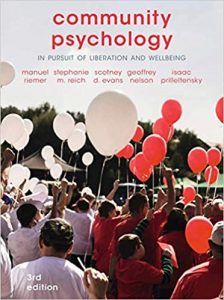
This book offers a valuable introduction to the field of community psychology.
The authors use vital issues such as climate change, affordable housing, homelessness, and immigration to explain the available theories and interventions.
This is an essential read for anyone interested in or studying community psychology.
Find the book on Amazon.
2. Community Psychology – John Moritsugu, Elizabeth Vera, Frank Y. Wong, and Karen Grover Duffy
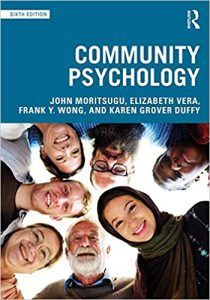
An easy-to-navigate yet comprehensive review of the field of community psychology.
Split into three parts, this book includes the concepts, interventions, and application behind the key theories.
It also describes the latest insights into current issues such as grit and life success, technology, social movements, and justice.
Find the book on Amazon.
3. Community Psychology: Linking Individuals and Communities – Bret Kloos, Jean Hill, Elizabeth Thomas, Andrew D. Case, Victoria C. Scott, and Abraham Wandersman
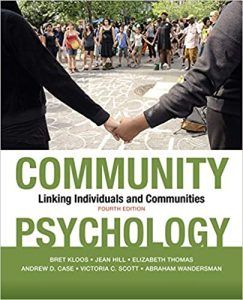
A fascinating overview of community psychology, including research, methodologies, theory, and how to promote change within communities.
The chapter summaries are excellent, referencing videos and other resources, and the marginal glossary highlights the key concepts.
Find the book on Amazon.
Resources From PositivePsychology.com
We have many articles and useful resources throughout our website to support the development of psychologically healthy communities.
To start, take a look at the following further reading:
- What Is Social Wellbeing? 12+ Activities for Social Wellness
In this article, social wellbeing is defined across relationships and wider systems, then translated into measures and practical activities that strengthen belonging, support, and collective functioning. - Hope Circles: How to Build Hope Within a Community
Here, we introduce hope circles as structured gatherings that cultivate collective resilience and possibility. The article covers the psychology behind shared hope, practical facilitation steps, and how to implement hope circles across a range of settings. - 10 Characteristics: What Makes a Positive Community
In this article, you’ll learn the core traits and practices that make communities thrive. These include shared goals, inclusive norms, clear communication, fair governance, and frequent, trust-building interaction.
For some surprising and counterintuitive ideas about community psychology, you may also enjoy our articles on positive deviance and positive gossip, as well as our two-part series on positive peer pressure and positive peer pressure examples.
For a useful tool to spark positive change, check out our free worksheet, Nudge Interventions in Groups. This worksheet helps community leaders apply subtle, indirect “nudges” that can sometimes spur positive behavior more effectively than strictly enforced regulations.
More extensive versions of the following tools are available with a subscription to the Positive Psychology Toolkit©, but they are described briefly below:
- Asking For Feedback: Keep, Stop, Start
When leading a community, it is important to solicit feedback from community members about your leadership. The Keep, Stop, Start approach is a simple and organized method to gather this feedback, involving just three questions: - Keep – As a leader, what do I do that you like and want me to keep doing?
- Stop – As a leader, what do I do that you don’t like and want me to stop doing?
- Start – As a leader, what am I not doing that you want me to start doing?
- Celebrating Team Accomplishments with a ‘Win Wall’
Research consistently shows that recognizing small wins can have a significant psychological and cultural benefit among groups of individuals. A physical (or virtual) ‘win wall’ for acknowledging such wins ensures that appreciation is not limited to formal awards or high-profile achievements, but is democratized and peer-led.
Examples of ‘wins’ community members might post upon the wall could include:
- ”Brought my reusable cup every day this week—no disposables.”
- ”Improved my running mile time by 20 seconds!”
- ”Came out to a close friend this week even though I was nervous.”
If you’re looking for more science-based ways to help others build healthy relationships, this collection contains 17 validated positive relationships tools for practitioners. Use them to help others form healthier, more nurturing, and life-enriching relationships.
A Take-Home Message
Community psychology is a large, complex, interdisciplinary field of study with far-reaching and positive effects on communities. One of its most exciting aspects and critical strengths is its field-based approach of working with communities within the context of their environment.
Community psychology is vital for tackling crises that impact groups of people and offers a practical approach for exploring ongoing growth and communities’ overall wellbeing through supporting mental health.
To create sustainable social change and address society’s many social inequalities, community psychology and its values must enter public awareness and our professional practices.
Success will be based on the ability of those working in the field of community psychology and beyond to recognize the unique experiences of marginalized people and promote social justice and social transformation.
While this article serves only as a brief introduction, the field is fascinating, vast, and worthy of further attention.
We hope you enjoyed exploring this challenging topic. Don’t forget to download our five positive psychology tools for free.
Frequently Asked Questions
Community psychology emphasizes social justice, empowerment, prevention, and collaboration to enhance the quality of life for individuals and communities.
Unlike traditional psychology, which often centers on individual behavior, community psychology focuses on the interplay between individuals and their communities, aiming to address social issues and promote systemic change.
Interventions include primary prevention programs, empowerment strategies, mutual support groups, and social action initiatives like community organizing and advocacy.
- Bales, S. (2017). Social justice and library work. Chandos Publishing.
- Barker, R. G. (1968). Ecological psychology: Concepts and methods for studying the environment of human behavior. Stanford University Press.
- Burton, M., Boyle, S., Harris, C., & Kagan, C. (2007). Community psychology in Britain. International Community Psychology, 219–237. https://doi.org/10.1007/978-0-387-49500-2_11
- Fairweather, G. W., Sanders, D. H., Maynard, H., & Cressler, D. L. (1969). Community life for the mentally ill: An alternative to institutional care. Aldine Publishing Company.
- Hoffman, A. J. (2019). Creating a culture of transformation in Guatemala: One fruit tree at a time. Electronic Green Journal, 1(40). https://doi.org/10.5070/G314031453
- Jason, L. A., Stevens, E., Ram, D., Miller, S. A., Beasley, C. R., & Gleason, K. (2016). Theories in the field of community psychology. Global Journal of Community Psychology, 7(2), 1–27.
- Jimenez, T. R., Hoffman, A., & Grant, J. (2019). Theories. Rebus Community. Retrieved October 28, 2020, from https://press.rebus.community/introductiontocommunitypsychology/chapter/theories/
- Kelly, J. G. (1966). Ecological constraints on mental health services. American Psychologist, 21, 535–539. https://doi.org/10.1037/h0023598
- Kloos, B., Hill, J., Thomas, E., Case, A. D., Scott, V. C., & Wandersman, A. (2020). Community psychology: Linking individuals and communities (4th ed.). American Psychological Association.
- Maya‐Jariego, I., De La Peña-Leiva, A., Arenas-Rivera, C., & Alieva, D. (2019). Personal networks, social media, and community cohesion in the strategies of peace‐building agents in Colombia to counteract the segregation of displaced populations. Journal of Community Psychology, 47(6) 1300–1312. https://doi.org/10.1002/jcop.22173
- Moos, R. H. (2003). Social contexts: Transcending their power and their fragility. American Journal of Community Psychology, 31, 1–13. https://doi.org/10.1023/A:1023041101850
- Moritsugu, J., Vera, E., Wong, F. Y., & Grover Duffy, K. (2019). Community psychology (6th ed.). Routledge.
- Riemer, M., Reich, S. M., Evans, S. D., Nelson, G., & Prilleltensky, I. (Eds.) (2020). Community psychology: In pursuit of liberation and wellbeing (3rd ed). Springer.
- Sarason, S. B. (1974). The Psychological sense of community: Prospects for a community psychology. Brookline Books.
- Tsemberis, S., Gulcur, L., & Nakae, M. (2004). Housing first, consumer choice, and harm reduction for homeless individuals with a dual diagnosis. American Journal of Public Health, 94(4), 651–656. https://doi.org/10.2105/AJPH.94.4.651
- Wandel, J., Riemer, M., de Gomez, W., Klein, K., De Schutter, J., & Singleton, C. (2010). A report from the study on the vulnerability to global climate change of people experiencing homelessness in Waterloo Region. Waterloo, ON.
- What is SCRA? (n.d.). Community Psychology. Retrieved October 28, 2020, from https://www.communitypsychology.com/who-is-the-society-for-psychology-research-and-action/
Jeremy Sutton, Ph.D., is an experienced psychologist, coach, consultant, and psychology lecturer. He works with individuals and groups to promote resilience, mental toughness, strength-based coaching, emotional intelligence, wellbeing, and flourishing. Alongside teaching psychology at the University of Liverpool, he is an amateur endurance athlete who has completed numerous ultra-marathons and is an Ironman.

Read other articles by their category
- Body & Brain (69)
- Boundaries (14)
- Coaching & Application (42)
- Compassion (26)
- Counseling (41)
- Emotional Intelligence (22)
- Gratitude (18)
- Grief & Bereavement (18)
- Happiness & SWB (40)
- Meaning & Values (27)
- Meditation (16)
- Mindfulness (47)
- Motivation & Goals (41)
- Optimism & Mindset (36)
- Positive CBT (28)
- Positive Communication (29)
- Positive Education (39)
- Positive Emotions (34)
- Positive Leadership (17)
- Positive Parenting (18)
- Positive Psychology (27)
- Positive Workplace (41)
- Productivity (17)
- Relationships (56)
- Resilience & Coping (45)
- Self Awareness (25)
- Self Esteem (38)
- Strengths & Virtues (34)
- Stress & Burnout Prevention (39)
- Theory & Books (44)
- Therapy Exercises (43)
- Types of Therapy (64)