How to Improve Emotional Intelligence in the Workplace (original) (raw)
Key Insights
- Developing emotional intelligence in the workplace enhances communication, teamwork & conflict resolution, boosting overall productivity & morale.
- Key components of emotional intelligence include self-awareness, self-regulation, empathy & social skills, each contributing to better workplace interactions.
- Training programs & ongoing practice can strengthen emotional intelligence, fostering a positive work environment & improving employee wellbeing.
 If you’ve heard a lot about emotional intelligence but you’re not sure what the hype is, or if you know what it is but doesn’t see how it really applies in the workplace, you’ve come to the right place.
In this piece, we’ll define emotional intelligence in the context of the workplace, describe its components, explore its correlates in the workplace, and look at how to improve it for both individual employees (including yourself) and the organization as a whole.
Before you read on, we thought you might like to download our five positive psychology tools for free. These science-based exercises will not only enhance your ability to understand and work with your emotions but will also give you the tools to foster the emotional intelligence of your clients, students, or employees.
This Article Contains
- What is Emotional Intelligence in the Workplace? (Definition + Concept)
- 7 Examples of High and Low EQ at Work
- 5 Benefits and Advantages of Using EQ in Business
- Are There Disadvantages and Limitations to Using EQ in the Workplace?
- What Happens When There is a Lack of EQ in the Workplace?
- How EQ Can be Used to Manage and Address Problems in the Workplace
- Workplace Training in Emotional Intelligence
- Can We Measure Emotional Intelligence in the Workplace?
- How to Implement Emotional Intelligence in the Workplace
- Using EI in HR (Human Resources)
- HBR and Emotional Intelligence
- Recommended Books
- A Take-Home Message
- Frequently Asked Questions
- References
What is Emotional Intelligence in the Workplace? (Definition + Concept)
First, let’s get a baseline on what emotional intelligence is. Emotional intelligence (shortened to EI or EQ for emotional quotient) can be defined as:
“EQ refers to someone’s ability to perceive, understand and manage their own feelings and emotions”
(Chignell, 2018).
Further, there are five distinct components of EI:
- Self-awareness
- Self-regulation
- Internal (or intrinsic) motivation
- Empathy
- Social skills
From a glance at these components, it’s easy to see how EI applies in the workplace! Clearly workers with higher in self-regulation, intrinsic motivation, and social skills have a leg up on those with less. We’ll go over some of the reasons why this is so later in this piece.
Daniel Goleman on EI in the Workplace
EI was first defined and established as a construct in psychology back in the 1990s, but interest in it has grown exponentially since then-especially in its application in the workplace. Emotional intelligence expert Daniel Goleman shares his view on why there is so much interest on EI/EQ in the workplace:
“The interest in emotional intelligence in the workplace stems from the widespread recognition that these abilities – self-awareness, self-management, empathy and social skill – separate the most successful workers and leaders from the average. This is especially true in roles like the professions and higher level executives, where everyone is about as smart as everyone else, and how people manage themselves and their relationships gives the best and edge.”
(Goleman, 2012).
Why is Developing EQ Important in the Workplace?
Emotional intelligence is a vital consideration in the workplace for many reasons, but there are two that really stick out:
- It is linked to higher job satisfaction for those with high EI/EQ as well as employees who work with or are managed by those with high EI/EQ.
- It is strongly associated with job performance.
A Look at Emotional Intelligence and Job Satisfaction
It’s well-known that emotional intelligence is related to job satisfaction. Employees who are high in EI/EQ also tend to be higher in job satisfaction, as many studies have shown:
- Çekmecelioğlu and colleagues studied nearly 150 call center employees in Istanbul and found a significant positive relationship between EI/EQ and internal job satisfaction (2012).
- Similarly, high EI/EQ (specifically high self-awareness) is negatively related to burnout and positively related to job satisfaction in people who work in the public sector (Lee, 2017).
- Ghanian nurses who were higher in emotional intelligence also enjoyed higher job satisfaction (Tagoe & Quarshie, 2017).
How can Emotional Intelligence Improve Job Performance?
In addition to contributing to greater happiness and satisfaction in employees, higher emotional intelligence also contributes to better job performance.
- Researchers found that emotional intelligence training boosted employee productivity and resulted in better evaluations from management (Hosseinian et al., 2008).
- Teachers with higher emotional intelligence also generally perform better in their jobs (Mohamad & Jais, 2016).
- A 2017 study by Pekaar and colleagues showed that emotional intelligence is significantly correlated with job performance, particularly the EI/EQ components of recognizing and managing the emotions of the self and others.
You might be thinking, “How does emotional intelligence have such an impact on job performance?” Through these seven traits and characteristics:
- Emotional stability (greater ability to manage their own emotions and tolerate stress)
- Conscientiousness (tendency to be diligent, hardworking, control impulses)
- Extraversion (personality trait that makes people more open and better at establishing relationships with others)
- Ability EI (individuals’ ability to perform emotion-related behaviors, like expressing emotions, empathizing with others, and combine emotion with reasoning)
- Cognitive ability (IQ; studies suggest there is at least some overlap between the IQ and EQ)
- General self-efficacy (confidence in the ability to cope with the demands of our job)
- Self-rated job performance (Bailey, 2015).
To get a better handle on understanding the importance of emotional intelligence, let’s move on to some examples of emotional intelligence.
7 Examples of High and Low EQ at Work
We know that high EI/EQ in the workplace is an advantage, but how do we know it when we see it? What does it look like?
Here are some good examples of high vs. low EI/EQ at work from emotional intelligence coach Ush Dhanak:
1. An Upset Employee Finds a Compassionate Ear
We all get moody sometimes, even at work. How a person deals with her coworkers or employees when they are having a bad day is a good indication about her EI/EQ level.
If she doesn’t even notice the moodiness, ignores the employee, exacerbates the bad mood, or criticizes the employee and tells them to “snap out of it,” she probably has low EI/EQ. If, on the other hand, she notices that something’s up, offers her employee compassion and understanding, and tries to cheer the employee up or distract them from their woes, that’s a great indicator that she has high EI/EQ.
2. People Listen to Each Other in Meetings
Unfortunately, not all meetings are positive and productive; sometimes meetings can devolve into everyone talking at once, no one offering any input at all, or-worst of all-shouting and heated arguments.
If an employee contributes to any of the above in a meeting, he is displaying low emotional intelligence. If he allows others to have their say, listens attentively and refrains from interrupting others, and gently but effectively keeps everyone on task, he is probably high in EI/EQ.
3. People Express Themselves Openly
A person who is comfortable speaking up about things that are important, and is just as comfortable listening to others talk about their own opinions, is showing high workplace EI/EQ. She is probably also adept at expressing her own emotions in an appropriate way and accepting of others who express their own emotions.
A person who keeps things bottled up or gets upset when others disagree with her at work is likely low in emotional intelligence. She might spar with her coworkers about their opinions or-conversely-expect everyone to simply keep all emotions and opinions to themselves.
4. Most Change Initiatives Work
If a workplace is generally high in emotional intelligence, it likely handles change well. Change initiatives are probably taken seriously and carried out in earnest.
On the flip side, workplaces with low emotional intelligence are resistant to change, fail to put in the effort necessary to make change initiatives succeed, or even actively sabotage them. Additionally, poorly though-out initiatives indicate that the management team is low in EI/EQ and does not understand how their proposed changes will affect their employees.
5. Flexibility
A workplace that offers flexibility and understanding of the complex, busy lives of organization members is one that is probably high in EI/EQ. Managers and executives who accept that people have differing needs and offer ways to work smarter are displaying a good sense of emotional intelligence.
Managers and executives who refuse to allow their employees flexibility and hold strictly to the way things have always been done (when there is no need to do so) are showing signs of low emotional intelligence.
6. People Have the Freedom to Be Creative
Similarly, workplaces that allow their employees the opportunity to be creative and innovative are high in EI/EQ. Giving people the chance to practice their creativity and think outside the box is not only a welcome gesture for employees, it’s also a smart move for the workplace.
Workplaces that make their employees stick to strict policies and procedures (again, when there is no need for such strictness) are low in EI/EQ. Not understanding the value of creativity and the need employees have to be imaginative and invested in their work is a hallmark of low EI/EQ.
7. People Meet Out of Work Time
Finally, a good sign of emotional intelligence in the workplace is when organization members meet outside of the workplace. Organizations where employees enjoy happy hours, having lunch together, or other social activities indicates that there is a high level of EI/EQ present.
Workplaces that don’t feature such strong bonds and those in which employees do not spend any non-working time together are likely low in EI/EQ. When people are emotionally intelligent, they tend to get along and see the value in investing their time and energy into workplace relationships, but people low in EI/EQ are generally not interested in building quality relationships with their peers (Dhanak, n.d.).
5 Benefits and Advantages of Using EQ in Business
If you’re not already convinced about the benefits of using EI/EQ in the workplace, here are a few more reasons you should pay attention to it!
- Motivation-high EI/EQ translates to better control of our motivation, and perhaps even more motivation for our coworkers!
- Common vision-those high in EI/EQ are able to more effectively understand and communicate with others, which makes it easier to develop and maintain a common team vision.
- Change-highly emotionally intelligent people can handle the stress, uncertainty, and anxiety that comes with working in business.
- Communication-clear communication is a telltale sign of emotional intelligence, and it contributes to better relationships, an easier time getting help from others, and more effective persuasion and influence of others.
- Leadership-self-leadership, leading others, influencing others-all of these are vital for those in business; more on this later (Elite World Hotels, 2018).
Emotional intelligence at work: Why IQ isn't everything
Are There Disadvantages and Limitations to Using EQ in the Workplace?
There are absolutely advantages to using EI/EQ in the workplace, as the examples and associations above show. So far, there are virtually no disadvantages to it.
However, there are some limitations-emotional intelligence can be enhanced, but as with other traits and skills, there is an upper limit to it that is likely determined at least in part by genetics. Not everyone can be a master of emotional intelligence.
In addition, there is some concern that too much emotional intelligence can encourage manipulation and other unethical or bad behavior. If unscrupulous employees have extremely high EI/EQ, they may be tempted to use their emotional intelligence to manipulate, deceive, and take advantage of their coworkers, subordinates, and perhaps even their management.
Generally, having excess EI/EQ is not something anyone should be too concerned about; it’s much more common to have too little than too much!
What Happens When There is a Lack of EQ in the Workplace?
 Speaking of too little EI/EQ, you might be wondering what a lack of emotional intelligence in the workplace looks like. There are two main ways that a lack of EI/EQ can negatively impact the workplace:
- Communication
- Decision Making
How EQ Impacts Communication in the Workplace
A lack of EI/EQ can negatively impact communication in the workplace through several mechanisms:
- Less understanding of one’s own emotions
- Less understanding of the emotions of others
- Less effective communication of ideas and emotions to others
- Inappropriate communication-related behavior, such as outbursts of emotion, oversharing or failing to communicate important information.
It’s easy to see how these mechanisms impact overall communication and, through less effective communication, lower productivity and efficiency in the workplace.
How Emotional Intelligence Affects Decision Making in the Workplace
Similarly, EI/EQ can have a significant impact on decision-making in the workplace. When emotional intelligence is high, organization members can understand the cause and effect relationship between emotions and events and plan effectively (Côté & Yip, 2013).
When EI/EQ is low, organization members may experience “incidental emotions” surrounding decision-making. For example, anxiety is a common emotion involved in decision-making, especially for big decisions that will have a significant impact.
Those low in EI/EQ may not understand the source of their anxiety or how to effectively manage it, leading to too much risk-taking, not enough risk-taking, or judgment clouded by bias (Côté & Yip, 2013).
How EQ Can be Used to Manage and Address Problems in the Workplace
So we know what a lack or surplus of EI/EQ can do to a workplace, but we still need to consider how emotional intelligence can actually be applied in the workplace.
There are many applications for EI/EQ at work, but there are three interesting areas where emotional intelligence interventions can be especially effective:
- Leadership and management
- Project management
- Social work
Leading with Emotional Intelligence in Management
Emotional intelligence is perhaps most effective and impactful when applied to leadership and management; higher EI/EQ in leadership has a funny way of starting a trickle-down effect of positivity and efficiency in an organization.
A leader who embodies and practices high EI/EQ can:
- Communicate their vision more effectively.
- Improve their persuasion and inspirational speaking abilities.
- Ensure appropriate responses to stressful and confusing situations at work.
- Manage their own emotions and the emotions of their employees (to an extent).
All of this leads directly (and indirectly) to a more efficient, effective, and productive workplace.
To learn more about emotional intelligence in leadership and management, see the EI/EQ training resources towards the end of this piece.
Emotional Intelligence for Project Managers
Emotional intelligence is clearly important for leaders and managers, but don’t underestimate its importance in more peer-heavy projects and interactions. Project managers have good reason to pay attention to their EI/EQ levels, and improve them if possible.
To be successful, project managers must be able to…
- Perceive emotion: ability to recognize, attend to, and understand one’s own emotions and others’ emotions.
- Manage emotion: ability to effectively manage, control, and express emotions.
- Decision-making: ability to appropriately apply emotion to manage and solve problems.
- Achieve: the best motivation to achieve is inner or intrinsic motivation.
- Influence: ability to recognize, manage, and evoke emotions in others (Davey-Winter, n.d.).
As you might have guessed, higher emotional intelligence is characterized by these five abilities! High EI/EQ is a must-have for project managers!
To learn more about emotional intelligence in leadership and management, see the EI/EQ training resources towards the end of this piece.
Using Emotional Intelligence in Social Work
Emotional intelligence is especially important to apply in social work. Social workers have some of the most difficult situations, challenging interactions, and heavy emotional labor of all professions.
EI/EQ can be applied to improve one’s skills and abilities in five core social work tasks:
- Engagement of users/clients
- Assessment and observation
- Decision making
- Collaboration and cooperation
- Dealing with stress (Morrison, 2007)
Improvements in these five tasks will not only allow the social worker to work more effectively, but will also improve their clients’ experience and help the social worker feel more positive, fulfilled, and satisfied with their job (Morrison, 2007).
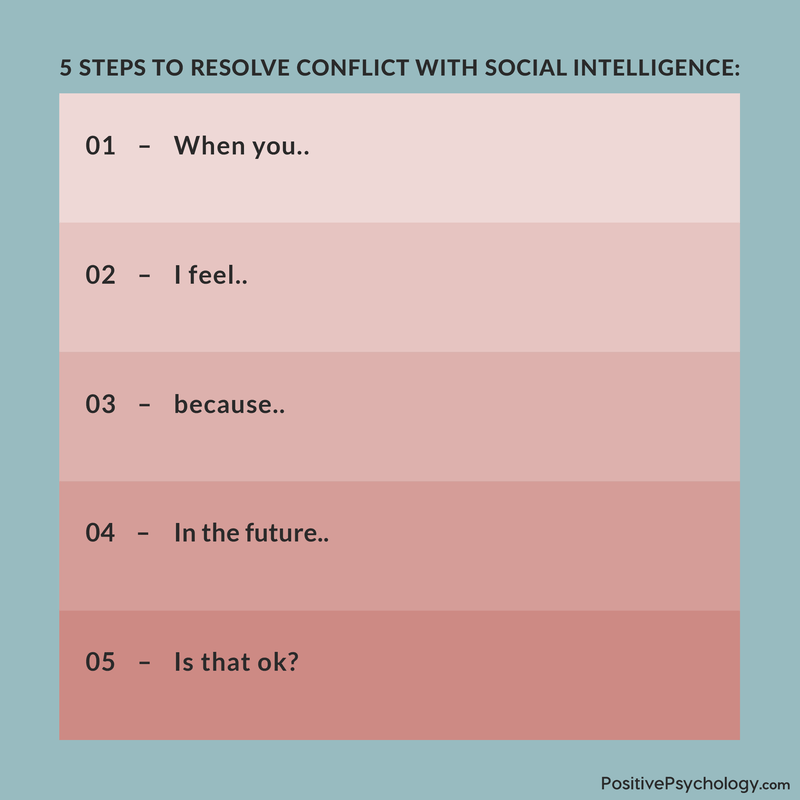
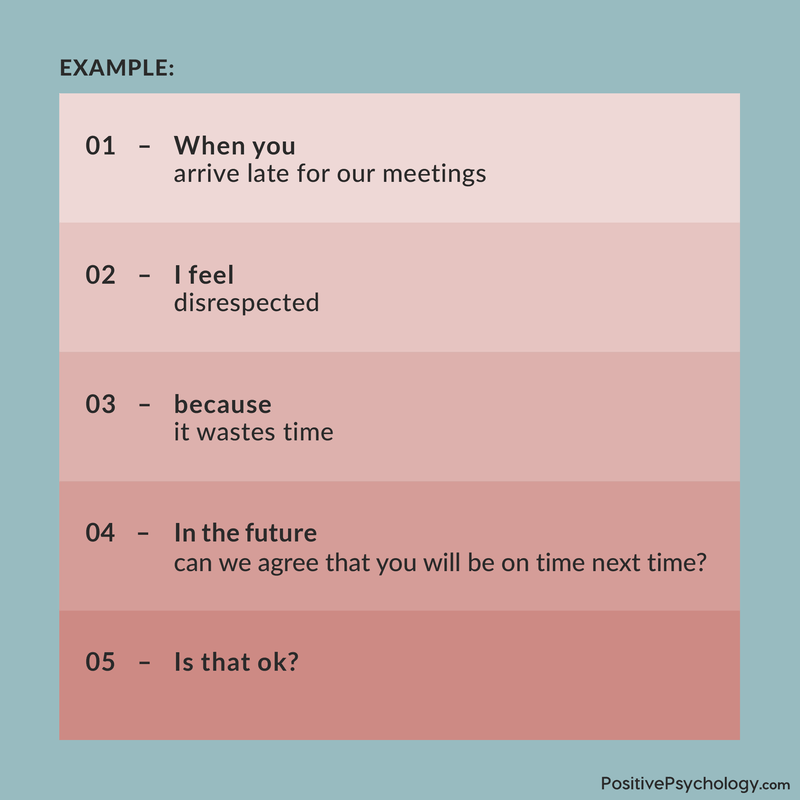
5 Steps to Resolve Conflict
The importance of emotional intelligence is ever growing in the current world and is critical in work, social, and romantic relationships.
Social intelligence is an essential component of emotional intelligence and captures how we engage with and connect to those around us (Goleman, 2005). It relies on us understanding the perspectives of others and also on asserting our own. It is also critical when overcoming interpersonal conflicts.
Despite this, developing one’s social intelligence in the face of conflict is a difficult task. This is where our 5-Point Tool for Social Intelligence comes in. Each step represents the critical components of a socially intelligent conversation in response to a conflict.
Remembering these steps and incorporating them into your conversations can help build your social intelligence and improve your relationships and skills across different situations.
Workplace Training in Emotional Intelligence
Clearly, EI/EQ is worth spending some time on to understand and enhance. Luckily, there are ways to better understand and enhance our EI/EQ skills and abilities!
There are training courses and programs available for improving emotional intelligence in the workplace, some of which have impressive outcomes.
If you’re interested in learning more about the types of training out there and which one might be right for you, check out these resources:
Emotional Intelligence Matters Workshop
This workshop from the Careerstone Group is designed to help you and your organization learn how to improve their emotion recognition, emotion management, and social skills. It focuses on teaching participants to:
- Recognize how emotional intelligence impacts workplace interactions.
- Increase self-awareness, self-management, and develop a clear understanding of interpersonal dynamics.
- Use strategies to manage counterproductive tendencies.
- Communicate professionally and effectively in all situations.
- Identify and apply key emotional skills to a broad variety of workplace situations-regardless of emotional stress.
- Improve sensitivity to organizational and social cues.
- Avoid behaviors that will derail success in the workplace.
- Practice effective engagement skills for organizational success.
To learn more about this one-day training opportunity, click here.
Emotional Intelligence Courses from Skillsoft
If you’re a leader or aspiring leader and you are committed to enhancing your emotional intelligence, Skillsoft’s resources are a great place to start.
They offer courses in:
- Leadership Essentials: Leading with Emotional Intelligence
- The Emotionally Intelligent Leader
- How High Is Your EQ?
- Emotional Intelligence at Work
- Emotional Intelligence: Owning Your Emotions
- Emotional Intelligence: Building Self-Management Skills
- Emotional Intelligence: Applying EI at Work
- Emotional Intelligence: Being Aware of the Emotions of Others
They also list some books and videos that you can use to work on increasing your EI/EQ on your own. Click here to learn more.
Can We Measure Emotional Intelligence in the Workplace?
Yes! Fortunately, there are many valid, reliable measures of emotional intelligence out there. Some are even geared towards teams and workplaces.
These two tools are some of the best measures available for getting a good indicator of EI/EQ in your workplace.
Multidimensional Emotional Intelligence Assessment – Workplace (MEIA-W)
This measure from Tett, Wang, and Fox (2006) takes only 20 minutes to complete and can provide you with a personality-based measure of the emotional intelligence of your workforce.
According to the experts, this measure is best for:
- Qualified professionals looking to select leaders and employees with emotional intelligence (EI) and exceptional interpersonal skills
- Psychologists seeking a brief, comprehensive, personality-based measure of EI
- Employees and leaders who want to develop critical people skills
- Users seeking convenient online administration and a simple, brief, easy to interpret report
The MEIA-W is composed of 144 short items that assess 10 distinct facets of emotional intelligence:
- Recognition of Emotion in the Self
- Regulation of Emotion in the Self
- Recognition of Emotion in Others
- Regulation of Emotion in Others
- Nonverbal Emotional Expression
- Empathy
- Intuition versus Reason
- Creative Thinking
- Mood Redirected Attention
- Motivating Emotions
To learn more about the MEIA-W, click here.
Related reading: Emotional intelligence assessments
Work Group Emotional Intelligence Profile (WEIP)
This scale was developed by emotional intelligence researcher Adeyemo in 2008 and offers a measure of emotional intelligence in team members. It is a self-report measure containing 30 items rated on a scale from 1 (strongly disagree) to 7 (strongly agree).
Two scales (made up of their own subscales) comprise the WEIP:
- Ability to Deal with Own Emotions
- Ability to Recognize Own Emotions
- Ability to Discuss Own Emotions
- Ability to Manage Own Emotions
- Ability to Deal with Others’ Emotions
- Ability to Recognize Others’ Emotions
- Ability to Manage Others’ Emotions
To learn more about this scale and how to use it, click here.
How to Implement Emotional Intelligence in the Workplace

If you want to learn more about how to apply and enhance emotional intelligence in the workplace, this excellent guide from emotional intelligence experts Cherniss, Goleman, Emmerling, Cowan, and Adler (1998) is what you need.
It describes best practices for implementing emotional intelligence training and overall culture in four phases:
- Preparation
- Training
- Transfer
- Evaluation
Phase One is where you should be:
- Assessing the organization’s needs
- Assessing personal strengths and limitations
- Providing feedback with care
- Maximizing learner choice
- Encouraging participation-not requiring it
- Linking learning goals to personal values
- Adjusting expectations
- Gauging readiness
Once you have your plans in place, Phase Two is where you start training. You should plan on:
- Fostering a positive relationship between the trainer and the learner
- Maximizing self-directed change
- Setting clear goal
- Breaking those goals into manageable steps
- Maximizing opportunities to practice emotional intelligence
- Providing frequent feedback on that practice
- Relying on experiential, hands-on methods
- Building in support for your staff
- Using models of desirable behavior
- Enhancing insight into emotions and thought patterns
- Preventing relapse by preparing people for mental slips
Phase Three is all about transferring and maintaining the skills learned. Make sure you build in opportunities for:
- Encouraging use of the skills learned on the job
- Providing an organizational culture that supports learning
Finally, Phase Four is focused on evaluating the change that has come about from training. In this phase, you should be:
- Conducting ongoing evaluation research (Cherniss, Goleman, Emmerling, Cowan, & Adler, 1998).
Follow these guidelines to maximize your chances of spearheading a successful emotional intelligence training program in your organization. You can read the full report here.
18 Tips for Teaching and Applying EQ in the Workplace
Kendra Cherry at Very Well Mind has some great practical tips for boosting your own emotional intelligence and teaching your staff to boost their as well. She suggests:
- Becoming more self-aware
Pay attention to how you are feeling throughout your day and noticing how your emotions contribute to your decisions and actions.
Identify and understanding your emotional strengths and weaknesses.
Understand that emotions can be fleeting and easily changed. - Practicing self-regulation
Find techniques that help you deal with your work-related stress, like hobbies, exercise, meditation, etc.
Try to accept reality and keep a cool head when work gets crazy.
Give yourself time to think and plan before making decisions-especially big decisions. - Improving your social skills
Listen actively and attentively to your managers, coworkers, and peers.
Keep an eye out for nonverbal communication.
Work on your persuasion and influencing skills.
gossip, but step in to handle conflict when appropriate and necessary. - Becoming more empathetic
Put yourself in their shoes-at work and in your personal life.
Pay attention to your own responses to others. - Working on your motivation
Focus on what you love about your job rather than what you hate about it.
Try to maintain a positive, optimistic attitude (Cherry, 2018).
5 Emotional Intelligence Icebreakers for Team Building
Meeting new people can often be awkward and uncomfortable, but icebreakers help! If you’re looking for a way to get the EI/EQ flowing in a group of strangers or just hoping to loosen up your team before training, these five icebreakers can do the trick.
Emotional Intelligence Test
This test is not a carefully constructed and validated measure of emotional intelligence, but the questions are simple, it’s quick to complete, and it makes it easy for everyone to understand emotional intelligence-all of which makes it a great icebreaker activity!
It’s only 20 questions, and they’re all short and easy to understand. You’ll see questions like:
- When criticized, I:
a. Ignore the criticism
b. Listen and learn
c. Become defensive
d. Get angry - I maintain a sense of humor at appropriate times and in appropriate places, without using sarcasm or hurting the feelings of others.
a. Strongly disagree
b. Disagree
c. Neither agree nor disagree
d. Agree - In stressful situations, I do not get irritated easily and I am able to contain my emotions.
a. Never
b. Sometimes
c. Often
d. Always
See below for the interpretation of your score based on range, directly from the editor at icebreakerideas.com.
| Score | Interpretation |
|---|---|
| 68-80 | You have extremely high emotional intelligence. You are skilled at understanding, interpreting, and acting appropriately upon your emotions and those of others. You deal effectively with emotional and social situations and conflicts, and express your feelings without hurting the feeling of others. |
| 60-68 | Although you score relatively high, you do have room for improvement. Watch the reactions of others to determine when you are using your emotional intelligence effectively and when you are not. Objectively looking at social and personal situations where emotions run high and analyzing your success will help you improve your already high emotional intelligence even more. |
| 48-60 | You fall in the middle range when it comes to your emotional intelligence. Although you are responding appropriately in most situations, your still find yourself losing it sometimes. You also get impatient with others and are sometimes uncomfortable in emotional situations. Don’t worry. Our section on developing your emotional intelligence will help you reach a high level. |
| 40-48 | Your emotional intelligence is a bit low. You probably struggle to manage your emotions in high-pressure situations or when you get angry. You have some work to do to improve. Begin by trying to express your emotions after you are calm. Our section on developing your emotional intelligence will help you a great deal. |
| Under 40 | Your emotional intelligence is extremely low. You are probably experiencing anxiety and stress on a daily basis. Additionally, you are probably having difficulty in school or at work, not making the progress you wish to. Read carefully through our section on developing your emotional intelligence and follow our advice to improve your EI and have a happier, more meaningful and successful life. |
Take this test with your team and see how you all do. If you feel comfortable, share out about your answers, your scores, and your impressions or insights.
Click here to see the test.
My Colored Hat
This easy and engaging game is a fun way to get participants thinking about emotional awareness. It is probably best suited for children and teens, but it could easily be scaled up in terms of maturity to work for an organization. (For more on this, see: Is Emotional Intelligence Relevant for Kids?)
First, do your prep work; grab some colored paper and make some paper hats! Alternatively, you could simply buy paper hats of different colors. You should have at least four different colors of hats, and enough hats for each of your participant to wear one.
Next, decide which colors represent which emotions and share these with your participants.
For the activity itself, have each participant pick out a hat that represents how they are feeling or that they’d simply like to work with for the activity and tell them to stand in a circle wearing the hat. Now, have each participant do one of the following based on their hat:
- If their hat represents a positive emotion, have them share that emotion with the group, describe it, and give themselves permission to feel it and enjoy it.
- If their hat represents a negative emotion, have them acknowledge it but decide to put it aside (“bag” it or “bracket” it) for the moment. Once everyone has shared, remind them to take out that emotion and deal with it-whether that involves neutralizing it or replacing it with something positive.
To see this icebreaker at the source, click here.
The “I Am” Circle
This is a great icebreaker to help people figure out what they have in common.
Have your participants stand in a circle with one person in the middle. The person in the middle should say something that’s true about themselves.
If it’s true for any of the other participants, then he or she must quickly switch places with the person in the middle (think musical chairs). Whoever doesn’t find a spot in the circle quick enough goes in the middle, and the cycle repeats.
Anita Hossain, the leader of First Round’s Knowledge program, notes that this activity usually starts off light, with people sharing things like, “I’m the youngest,” or “I have two kids.” However, it can get much deeper surprisingly quickly. Hossain says she’s heard things like, “I have impostor syndrome,” and “I grew up poor and have always felt less than.”
The movement from outside to inside is more than just to get the blood pumping; according to Hossain, it’s “kinetic” and promotes a sense of empathy among the participants.
Tell Your Story Redux
Hossain also outlines another helpful icebreaker activity she learned from the consultancy Innerspace that’s all about telling your story-but telling it in a new and possibly more authentic way.
To begin, have your participants turn to their neighbor and tell their life stories in just two minutes. Next, have each participant do it again; however, this time, have them share their story in a way that’s totally different from the way they normally do.
Hossain says that people usually go straight to their work lives: “People tell each other where they went to college and their paths through various jobs that got them to this moment. When forced to do something different, they immediately start sharing things they usually never would in a professional setting-and they get really into it.” (Hossain, as quoted in First Round Review, 2018).
In the second round, they open up quite a bit. They’ll talk about their real reasons for leaving a job and transitioning to another, why they moved, and what drives them. It’s a sort of “behind the scenes” peek at the real, more complex, and vastly more interesting story.
Once each participant has told both versions of their story, get the whole group together again and have them share out about their partner’s story. Encourage them to note what changed and what was most interesting about those changes. The participants will likely find that they got to know each other far better than they thought they would in just two minutes of talking!
Empathy Cards
The coaching firm Reboot taught Hossain this last icebreaker activity. It’s a great choice when you hope your participants will be vulnerable, open, and make meaningful connections.
Before the official icebreaker-perhaps during a breakfast, cocktail hour, or whenever else you can fit it in.
Give participants an index card and have each of them write down one work-related thing that worries them or causes them anxiety, preferably one that they don’t usually share with others. These cards should remain anonymous, so make sure they don’t write their names down on them.
Gather them up and shuffle them, then place a card at each seat or space at the table. The idea is that each participant receives someone else’s card, and each participant can see that they’re not alone-we all have fears, anxieties, worries, and concerns hanging over us.
This icebreaker reinforces that we are all vulnerable and we’re not alone, which is a great place to start an open and empathic dialogue between participants (First Round Review, 2018).
Click here to see the last three activities described on the Fast Company website.
3 Group Activities to Help Develop EQ
Once you’ve successfully broken the ice, give this group activity a try. It has three separate levels with a range of time commitments, so you’re bound to find at least one level that works for you and your team.
Compass Points Activity: Level One
This group activity was designed off of work by the National School Reform Faculty, a non-profit professional development site for educators, and it works well with both teens and adults.
Before the activity, you have a bit of preparation to do:
- Create the four signs: North, South, East and West.
- Post them on the walls of the room before your participants arrive.
- Bring large pieces of paper or flip-boards and markers for four groups.
- Under each sign, list the traits associated, as directed by the Compass Points game:
North: Acting – “Let’s do it;” Likes to act, try things, plunge in.
East: Speculating – likes to look at the big picture and the possibilities before acting.
South: Caring – likes to know that everyone’s feelings have been taken into consideration and that their voices have been heard before acting.
West: Paying attention to detail -likes to know the who, what, when, where and why before acting.
Now you’re ready to begin the activity. The Level One activity only takes about 20 minutes.
Begin by pointing out the four compass points posted around the room to your participants, and ask them to read the information posted under each point. Next, they should gather under the point that most accurately captures how they work with others on teams.
Once everyone has chosen their point, have your participants look around and see who has ended up in each group and think about whether that makes sense to them or gives them any new insights about their coworkers and peers.
Direct each group to select three individuals for three team member roles:
- Recorder – records responses of the group
- Timekeeper – keeps the group members on task
- Spokesperson — shares out on behalf of the group when time is called
Once the teams are set up and ready to get started, give the groups 5 to 10 minutes to respond to these questions:
- What are the strengths of your style? (3-4 adjectives)
- What are the limitations of your style? (3-4 adjectives)
- What style do you find most difficult to work with and why?
- What do people from other “directions” or styles need to know about you so you can work together effectively?
- What’s one thing you value about each of the other three styles?
When time is up and each team has answered all five questions, give them time to share out their responses.
You’ll probably hear some things like:
- North gets impatient with West’s need for details
- West gets frustrated by North’s tendency to act before planning
- South group members crave personal connections and get uncomfortable when team members’ emotional needs aren’t met
- East group members get bored when West gets mired in details.
- East gets frustrated when North dives in before agreeing on big goals
As you wrap up the activity, give everyone at least 2 minutes to share their insights and key takeaways. If this takeaway doesn’t come up on its own, be sure to include it as part of the activity conclusion:
This activity increases our awareness of our own and others’ preferences and styles, and helps us to better understand, communicate with, and work with people who have different preferences and styles. Ultimately, this diversity almost always leads to better results (Allen, 2015).
Compass Points Activity: Level Two
To get a little deeper into this activity, you can go for Level Two.
It adds about 10 minutes to the first level by including a component that makes the activity more personally relevant: after participants have chosen a preference compass point, have them think of a past team experience they’ve had that was either very positive or very negative. For now, tell them to think of it but just keep it in mind; it will come into play later.
Encourage them to think of one they feel comfortable sharing, since they’ll be asked to report out to the group.
After the participants have completed the first level activities and shared out some of their thoughts, ask them to think about their personal positive or negative team experience again. Tell them to spend a few moments reflecting on what they learned from this exercise and how it applies to their team experience; does it help them better understand why this past team experience was a very good one or a very bad one?
The point of this extra portion of the activity is to get them thinking about what they’ve learned and how it applies in their real life. They may have some “a-ha” moments or insights that wouldn’t have come up without this exercise to get them thinking about it. Give them at least a few minutes to share the personal lessons they’ve learned, then shift into the key takeaways described earlier (Allen, 2015).
Compass Points Activity: Level Three
To get really deep into the exercise and drive the point about emotional intelligence home, try the third level. You’ll need about 45 minutes to complete the whole thing.
The pieces added to Level Three include a warm-up at the beginning and some preferences background information before moving into the Level Two portion described above.
Here’s how to do the warm-up:
“Begin by projecting an image of team members working together to achieve a goal. For example, there’s a terrific image of Universal Picture’s minions working together to screw in a light bulb. Ask participants to pair up and discuss what they notice about the team – their interactions, their facial expressions, and their progress. This can be a lighthearted yet focused way to kick off the exercise.”
Once participants are all warmed up and ready to get started, you can move them into the preferences background information.
Spend some time describing preferences and emphasizing exactly what they are-our natural inclinations or inherent tendencies. Emphasize that they are not things that we have chosen about ourselves, but pretty permanent features of our personality.
For this exercise, the relevant preferences are those related to how we tend to behave in teams. Make sure to also outline what they are not (e.g., ways to label, categorize, or judge ourselves or others). They are also not good or bad; each type has its strengths and weaknesses. To help them understand, you can talk a little bit about famed psychologist Carl Jung’s research into personality types, including extraversion and introversion.
Once your participants have a good grasp of what these preferences and personality features are and why they are not “good” or “bad,” you can shift into the activity itself. Allow participants enough time to come up with their personal team experience and share out on it.
After each group shares their responses and participants have an opportunity to share some of their reflections on personal team experiences, make sure you have a few minutes left for the key takeaways discussion (Allen, 2015).
For even more tools to develop EQ, be sure to check out our dedicated article featuring 13 hand-picked exercises, activities, and worksheets.
Using EI in HR (Human Resources)
 HR is one of the most effective places to apply what we know about emotional intelligence.
Besides contributing to better communication, relationships, and problem-solving among current employees, emotional intelligence can also help you to identify the best candidates for positions within the organization.
Read on to learn how.
Using Emotional Intelligence Interview Questions
Emotional intelligence interview questions can be extremely helpful in narrowing down your pool of applicants, especially if you have a lot of applicants with similarly impressive qualifications.
However, make sure you don’t just jump in and come up with your own ways to assess emotional intelligence; follow these guidelines to make sure you’re doing it the right way.
Don’t:
- Use personality tests as a proxy for EI; many of the EI/EQ measures are designed to measure emotional intelligence as a facet of personality rather than an indicator of work habits, competencies, and skills. They may not measure specific components of emotional intelligence such as self-awareness, positive outlook, achievement orientation, empathy, or inspirational leadership.
- Use a self-report test (i.e., a test in which your candidates answer questions and report on their own emotional intelligence. This doesn’t really work for two reasons: (1) if a person is not self-aware, they possibly aren’t going to be able to accurately assess their own emotional intelligence, and (2) if they are self-aware, you could be giving them the opportunity to exaggerate their skills or abilities and make themselves seem like a better candidate than they really are.
- Use a 360-degree feedback instrument-even if it is a good measure of EI competencies. A tool like 360-degree feedback is best used for development and improvement in current employees rather than evaluation and hiring. When these instruments are used to evaluate, some people “game” them by carefully selecting the respondents and even instructing them how to answer the questions.
Do:
- Get references for the candidate-and actually call them! Letters of reference don’t cut it when it comes to gauging a candidate’s EI/EQ, because they are carefully prepared, static, and usually pretty general. When you get the chance to speak with a candidate’s references, you can ask them questions that really get to the heart of EI/EQ and its subcomponents and competencies. Get as many examples as you can and press for details. Above all, be sure to ask for examples of how your candidate treats other people.
- Interview for emotional intelligence. This might sound easy or like it’s something you are already doing, but chances are you aren’t actually assessing EI/EQ. In interviews that aren’t strictly structured, we usually let people be vague in their responses-even to the point of not really answering the question-and we often fail to ask good follow-up questions. Even when we ask candidates directly about emotional intelligence or EI-related competencies, they generally provide us with a picture of an idealized version of themselves rather than an accurate portrait of their real selves. To overcome these obstacles to getting a good handle on your candidates’ EI/EQ, behavioral event interviewing is the way to go (McKee, 2016).
Behavioral event interviewing is a method that allows you to see their EI/EQ competencies almost firsthand.
Annie McKee from the Harvard Business Review explains how to do it:
- Start the interview off on the right foot; make it as warm, friendly, and comfortable as possible. This will help you get the candidate in a frame of mind conducive to sharing the information you want to get.
- Ask a few traditional questions about the candidate’s experience, background, and education.
- Next, ask the candidate about a recent situation where she and some of her peers (coworkers, teammates, etc.) faced a difficult challenge that needed solving, and encourage her to pick one where she’s the “protagonist” of the story and one where she was ultimately successful and/or proud of her solution.
- Ask her to tell the story in a few brief sentences first. Once you have the outline, have her go over the story in detail and ask her specific, detailed questions about it (e.g., what she thought at a certain point, how she felt about what happened, what she did about it).
- Ask her to share a similar story except this time it should be about a time when she failed and learned a valuable lesson. Again, have her give a brief overview then go more in-depth, and ask detailed questions.
- Finally, end on a positive note-ask for another positive story.
This technique will give you insight into your candidate’s thought processes, her awareness of her own emotions, how she thinks and feels about others, what she does during a conflict, and how she handles disagreements and challenges with other people (McKee, 2016).
You may not be great at this method right away, but practice makes perfect!
25 Emotional Intelligence Interview Questions
There are tons of good questions you can ask to gauge emotional intelligence. These six were identified by Karla Cook, editor and team manager at HubSpot Marketing, as some of the best ones to get an indicator of EI/EQ:
- Can you tell me about a time you tried to do something and failed?
- Tell me about a time you received negative feedback from your boss. How did that make you feel?
- Can you tell me about a conflict at work that made you feel frustrated?
- Tell me about a hobby you like to do outside of work. Can you teach me about it?
- What would your co-workers say is the most rewarding thing about working with you? What about the most challenging thing?
- Can you tell me about a time you needed to ask for help on a project? (Cook, 2017).
These six questions offer you some great opportunities to learn about your candidates EI/EQ, but if you need even more suggestions, check out the list below from Alison Doyle at The Balance Careers:
- What is one of your weaknesses? How do you overcome that weakness?
- What motivates you to do your work?
- Describe a stressful work situation you’ve had. How did you resolve that situation?
- What are one or two things that make you angry or frustrated at work? What do you do when you get angry or frustrated at work?
- Tell me about a time when you received feedback on your performance, and you disagreed with the feedback. How did you handle the situation?
- Tell me about a setback you had at work. How did you handle it?
- Describe a time when you made a big mistake at work. How did you handle the situation?
- Tell me about a time when you had to handle multiple work assignments at once. How did you feel? How did you handle the situation?
- Tell me about a time when you took on a task at work that was new to you. How did you feel doing it?
- How would you handle a coworker who consistently does not pull his weight on group assignments?
- How do your colleagues benefit from working with you?
- Tell me about a time when you did or said something that had a positive impact on an employee, coworker, or customer.
- Have you ever noticed that someone at work was having a bad day? How did you know? What did you do?
- Tell me about a time when you had a dispute with a colleague. What did you do to deal with the situation?
- Describe a time when a colleague came to you with a problem. How did you respond?
- Tell me about a time when understanding someone else’s perspective helped you accomplish a task or resolve an issue.
- Tell me about a time when you motivated someone to accomplish a task. How did you motivate him or her?
- Why is it important to develop a rapport with your colleagues?
- How do you build a rapport with your colleagues? (Doyle, 2018).
HBR and Emotional Intelligence
As you may have noticed from the citations, the Harvard Business Review is at the forefront of sharing information about and applications of emotional intelligence in the workplace. To dive a little deeper into the finer points of this topic, check out these two resources from HBR:
Harvard Business Review Everyday Emotional Intelligence: Big Ideas and Practical Advice on How to Be Human at Work
This double-volume will give you a broad understanding of emotional intelligence, with HBR’s top 10 “must-reads” on the subject along with information and advice from HBR on how to actually apply this knowledge.
The book description promises that you’ll learn how to:
- Recognize your own EQ strengths and weaknesses
- Regulate your emotions in tough situations
- Manage difficult people
- Build the social awareness of your team
- Motivate yourself through ups and downs
- Write forceful emails people won’t misinterpret
- Make better, less emotionally biased decisions
- Help an employee develop emotional intelligence
- Handle specific situations like crying at work and tense communications across different cultures
Click here to check it out.
HBR Guides to Emotional Intelligence at Work (5 Books from the HBR Guide Series)
This is a five-volume set of books that dive into the topic of emotional intelligence at work. It includes valuable information on emotional intelligence in general, office politics, dealing with conflict, managing stress at work, and managing “up and across.”
Through this set, you’ll learn how to:
- Monitor and channel your moods and reactions
- Determine your emotional intelligence strengths and weaknesses
- Deal with difficult people
- Understand when to resolve a conflict head-on–and when to let it go
- Influence others across the organization
- Build supportive alliances with coworkers and colleagues
- Handle workplace stress in productive ways
You can find this set for sale or learn more about it on Amazon.
Recommended Books
If you’ve already taken a peek at the HBR resources-or if you just want an entire shelf of books on the subject-not to worry! There are other emotional intelligence books that can give you a succinct overview, an in-depth exploration, or an understanding that is somewhere in between the two. Check out these seven books to get started:
- Emotional Intelligence at Work: The Untapped Edge for Success by Hendrie Weisinger (Amazon)
- How to Improve Your Emotional Intelligence at Work & in Relationships by Shawn Kent Hayashi (Amazon)
- Put Emotional Intelligence to Work: Equip Yourself for Success by Jeff Feldman and Karl Mulle (Amazon)
- Emotional Intelligence at Work: 18-Year Journey of a Researcher by Chi-Sum Wong (Amazon)
- Emotion at Work: Unleashing the Secret Power of Emotional Intelligence by Roberta Ann Moore (Amazon)
- Emotional Intelligence: The Emotional Intelligence Book – Emotional Intelligence at Work and Emotional Intelligence Leadership by John C. Allen (Amazon)
- The Emotionally Intelligent Workplace: How to Select for, Measure, and Improve Emotional Intelligence in Individuals, Groups, and Organizations by Cary Cherniss and Daniel Goleman (Amazon)
- 26 Best Emotional Intelligence Books
A Take-Home Message
I hope you enjoyed this dive into emotional intelligence at work! It’s a vital topic to understand for managers, HR professionals, and leadership at all levels.
However, even if you don’t fall into any of the categories above, understanding your own emotions and working on your emotion recognition and management skills is still a good idea!
What are your thoughts on emotional intelligence? Do you think it’s really as important as they say? How do you get an estimate of someone’s emotional intelligence without using validated tests or scales? How do you think it can be improved? Let us know in the comments section!
Thanks for reading!
For further reading:
- Emotional Intelligence Frameworks, Charts, Diagrams & Graphs
- Emotional Intelligence Theories & Components Explained
We hope you enjoyed reading this article. Don’t forget to download our five positive psychology tools for free.
Frequently Asked Questions
High EI fosters better communication, empathy, and conflict resolution, leading to more effective teamwork and a positive work environment.
Leaders with high EI can inspire and motivate their teams, build trust, and navigate complex interpersonal dynamics, resulting in higher performance and lower turnover.
Practices like mindfulness, journaling, and seeking feedback can enhance self-awareness and emotional regulation, improving your EI over time.
- Allen, G. (2015). A simple exercise to strengthen emotional intelligence in teams. Mind Shift. Retrieved by https://www.kqed.org/mindshift/40880/a-simple-exercise-to-strengthen-emotional-intelligence-in-teams
- Bailey, S. (2015). Emotional intelligence predicts job performance: The 7 traits that help managers relate. Forbes. Retrieved from https://www.forbes.com/sites/sebastianbailey/2015/03/05/emotional-intelligence-predicts-job-performance-the-7-traits-that-help-managers-relate/#7058eee34124
- Brin, D. W. (2013). What is emotional intelligence? Society for Human Resource Management: Leadership & Navigation. Retrieved from https://www.shrm.org/resourcesandtools/hr-topics/behavioral-competencies/leadership-and-navigation/pages/what-is-emotional-intelligence.aspx
- Çekmecelioğlu, H. G., Günsel, A., & Ulutaş, T. (2012). Effects of emotional intelligence on job satisfaction: An empirical study on call center employees. Procedia – Social and Behavioral Sciences, 58, 363-369. https://doi.org/10.1016/j.sbspro.2012.09.1012
- Cherniss, C., Goleman, D., Emmerling, R., Cowan, K., & Adler, M. (1998). Bringing emotional intelligence to the workplace: A technical report issues by the Consortium for Research on Emotional Intelligence in Organizations. EI Consortium. Retrieved from http://www.eiconsortium.org/reports/technical_report.html
- Cherry, K. (2018). Utilizing emotional intelligence in the workplace. Very Well Mind. Retrieved from https://www.verywellmind.com/utilizing-emotional-intelligence-in-the-workplace-4164713
- Chignell, B. (2018). The importance of emotional intelligence in the workplace. Center for Innovative Public Health Research. Retrieved from https://www.ciphr.com/features/emotional-intelligence/
- Cook, K. (2017). 6 interview questions to assess emotional intelligence. HubSpot Blog. Retrieved from https://blog.hubspot.com/marketing/5-interview-questions-to-assess-emotional-intelligence
- Côté, S., & Yip, J. (2013). Decision-making with emotional intelligence. Ideas for Leaders. Retrieved from https://www.ideasforleaders.com/ideas/decision-making-with-emotional-intelligence
- Davey-Winter, K. (n.d.). Emotional intelligence for project managers-Nice to have or necessity? Project Management Institute of Washington, DC. Retrieved from https://www.pmiwdc.org/article/karen-davey-winter/emotional-intelligence-project-managers-%E2%80%93-nice-have-or-necessity
- DeLeon, M. (2015). The importance of emotional intelligence at work. Entrepreneur. Retrieved from https://www.entrepreneur.com/article/245755
- Dhanak, U. (n.d.). 7 great examples of emotional intelligence in the workplace. Magazines Today. Retrieved from http://www.magazinestoday.co.nz/7-great-examples-emotional-intelligence-workplace/
- Doyle, A. (2018). Interview questions about your emotional intelligence. The Balance Careers. Retrieved from https://www.thebalancecareers.com/interview-questions-about-your-emotional-intelligence-2059962
- Ealias, A., & George, J. (2012). Emotional intelligence and job satisfaction: A correlational study. The International Journal’s Research Journal of Commerce & Behavioural Science, 1, 37-42.
- http://www.eiconsortium.org/measures/weip.htm
- Elite World Hotels. (2018). 5 advantages of emotional intelligence in business life. Elite World Hotels Blog. Retrieved from https://www.eliteworldhotels.com.tr/blog-en/5-advantages-of-emotional-intelligence-in-business-life.1241.aspx
- First Round Review. (2018). 3 icebreakers to build empathy among strangers within 10 minutes. Fast Company. Retrieved from https://www.fastcompany.com/40557322/3-icebreakers-to-build-empathy-among-strangers-within-10-minutes
- Goleman, D. (2005). Emotional Intelligence: Why It Can Matter More Than IQ. Bantam Books.
- Goleman, D. (2012). EQ in the workplace. Daniel Goleman: Q & A. Retrieved from http://www.danielgoleman.info/eq-in-the-workplace/
- Hosseinian, S., Yazdi, S., Zahraie, S., & Fathi-Ashtiani, A. (2008). Emotional intelligence and job satisfaction. Journal of Applied Sciences, 8, 903-906. https://doi.org/10.3923/jas.2008.903.906
- Lee, H. J. (2017). How emotional intelligence relates to job satisfaction and burnout in public service jobs. International Review of Administrative Sciences [Advance Online Publication].
- McKee, A. (2016). How to hire for emotional intelligence. Harvard Business Review. Retrieved from https://hbr.org/2016/02/how-to-hire-for-emotional-intelligence
- Mohamad, M., & Jais, J. (2016). Emotional intelligence and job performance: A study among Malaysian teachers. Procedia Economics and Finance, 35, 674-682. https://doi.org/10.1016/S2212-5671(16)00083-6
- Morrison, T. (2006). Emotional intelligence, emotion and social work: Context, characteristics, complications and contribution. The British Journal of Social Work, 37, 245-263. https://doi.org/10.1093/bjsw/bcl016
- Nair, M. (2016). The importance of emotional intelligence in human resources. LinkedIn. Retrieved from https://www.linkedin.com/pulse/importance-emotional-intelligence-human-resources-mahesh-nair/
- Pekaar, K. A., van der Linden, D., Bakker, A. B., & Born, M. P. (2017). Emotional intelligence and job performance: The enactment and focus on others’ emotions. Human Performance, 30, 135-153. https://doi.org/10.1080/08959285.2017.1332630
- Tagoe, T., & Quarshie, E. N. (2017). The relationship between emotional intelligence and job satisfaction among nurses in Accra. Nursing Open, 4, 84-89. https://doi.org/10.1002/nop2.70
Courtney E. Ackerman, works as a mental health policy researcher for the state of California, focusing on population mental health and wellbeing, peer support, and violence prevention. She is passionate about fostering transformational change in California's mental health system. She also works as a research consultant with individuals and organizations on a freelance basis, generating insights and identifying actionable solutions. Courtney is guided by her curiosity and a commitment to authentic connections.

Read other articles by their category
- Body & Brain (70)
- Boundaries (14)
- Coaching & Application (42)
- Compassion (26)
- Counseling (41)
- Emotional Intelligence (22)
- Gratitude (18)
- Grief & Bereavement (18)
- Happiness & SWB (40)
- Meaning & Values (27)
- Meditation (16)
- Mindfulness (47)
- Motivation & Goals (41)
- Optimism & Mindset (36)
- Positive CBT (28)
- Positive Communication (29)
- Positive Education (39)
- Positive Emotions (34)
- Positive Leadership (17)
- Positive Parenting (18)
- Positive Psychology (27)
- Positive Workplace (41)
- Productivity (17)
- Relationships (56)
- Resilience & Coping (45)
- Self Awareness (25)
- Self Esteem (38)
- Strengths & Virtues (34)
- Stress & Burnout Prevention (39)
- Theory & Books (44)
- Therapy Exercises (43)
- Types of Therapy (64)