How to Develop Empathy: 10 Best Exercises for Adults (original) (raw)
Key Insights
- Empathy worksheets are practical tools designed to enhance understanding & emotional connection by fostering empathy skills.
- These worksheets encourage reflection on different perspectives & feelings, promoting compassionate interactions & relationships.
- Creating a habit of empathy through structured exercises supports emotional intelligence & personal growth.
 We have all met people who appear to lack empathy.
When they see someone upset or having a hard time, they appear baffled, unclear how to respond.
Why are they like that, and can it be changed?
Genetics provide part of the story (Horsburgh, Schermer, Veselka, & Vernon, 2009). The rest of who we are is explained by our environment, how we grew up, and what we are learning right now.
We have the potential to change. Our empathy is not fixed; it can be developed.
This article looks at how empathy grows throughout our formative years and offers a set of exercises that can be used with clients to develop it further.
Before you continue, we thought you might like to download our five positive psychology tools for free. These science-based exercises will not only enhance your ability to understand and work with your emotions but will also give you the tools to foster the emotional intelligence of your clients, students, or employees.
This Article Contains
- How Is Empathy Developed? 5 Stages and 5 Factors
- Why Work on Your Empathy Skills?
- 8 Strategies to Develop Empathy
- Fostering Empathy in Students and Kids: 4 Games and Activities
- 4 Helpful Activities and Exercises
- 24 Questions and Statements to Use With Your Clients
- 7 Worksheets and Tools
- PositivePsychology.com’s Resources
- A Take-Home Message
- Frequently Asked Questions
- References
How Is Empathy Developed? 5 Stages and 5 Factors
Empathy is an integral part of emotional and social development and an essential motivator for helping those in distress. In a very literal sense, it is the “_ability to feel or imagine another person’s emotional experience_” (McDonald & Messinger, 2011).
While initially it was thought that empathy did not develop in young children, research into their response to others’ distress has shown otherwise.
Below we discuss some of the development stages and factors that influence empathy, drawing on research performed at the University of Miami (McDonald & Messinger, 2011).
Stages of empathy development
Newborns: when newborns hear other infants crying, they frequently exhibit signs of distress, known as reflexive crying or emotional contagion.
Their behavior suggests a precursor to empathy and a predisposition to others’ negative emotions, rather than an unthinking reaction to noise.
Infants: infants exhibit concern for others. However, as any parent knows, they have difficulty regulating their emotions and often become overwhelmed by others’ feelings.
Toddlers: between the ages of 14 and 36 months, children begin to show clear signs of the emotional components of empathy, including apologizing, showing concern for others, and offering help. In a very real way, they begin to ‘try on’ others’ experiences, whether seen on TV, with friends, or in a family situation.
Early childhood: as children begin their early school years, they not only experience others’ emotional states but also start to imagine their experiences. Referred to by psychologists and philosophers as the theory of mind, they begin to see themselves and others in terms of emotions, feelings, and desires (Wellman, Cross, & Watson, 2001).
Middle childhood into adulthood: significant developments in empathy are seen from middle childhood to adulthood that form part of a broader prosocial personality trait. Indeed, the development of early prosocial behavior, such as empathic concern and perspective taking, motivates helping behavior (McDonald & Messinger, 2011).
Factors of empathy development
There are many factors involved in the early and rapid development of empathy.
Genetic: twin research has consistently implicated the importance of heredity in the development of empathy, accounting for between one third and one half of the variation found in children (Knafo, Zahn-Waxler, Van Hulle, Robinson, & Rhee, 2008).
Neurodevelopmental factors: mirror neurons in the animal and human brain, which reflect other people’s emotions, may provide a neurological basis for connecting others’ experiences with our own. Check out Vilayanur Ramachandran’s excellent TED Talk for an overview (Ramachandran, 2009).
The neurons that shaped civilization - Vilayanur Ramachandran
Temperament: our personality is an essential factor in how we develop empathy. For example, fearful and shy children appear less likely to engage in empathic behavior in unfamiliar situations.
Mimicry and imitation: facial mimicry begins in early infancy and appears to be linked to internalizing others’ emotional experiences.
Parenting: the socializing influence of parents and caregivers on young children is considerable and further impacts empathy. Feldman (2007) found that increased matching behaviors during play in infancy led to more empathy displays in later life.
Other research has confirmed the importance of parent–child relationships in promoting the development of empathy, most likely based around feelings of trust and a sense of a loving relationship.
While the above list is not exhaustive, it does provide crucial insights into the complexity and importance of empathy.
Why Work on Your Empathy Skills?
 In the book Emotional Intelligence, science reporter for the New York Times Daniel Goleman (2006) describes empathy as a capacity to “know how another feels_” coming “_into play in a vast array of life arenas, from sales and management to romance and parenting, to compassion and political action.”
To intuit another’s feelings, we must read nonverbal cues: facial expressions, tone of voice, and behavior. And the benefits are profound.
Indeed, it isn’t easy to find any part of our life unaffected by our ability to empathize. Some of which we identify below:
- How we and others see ourselves:
According to research by Robert Rosenthal and colleagues at Harvard University, our capacity to read the feelings of others makes us more outgoing and popular in childhood and adulthood (Goleman, 2006). - Positive impact on work relationships:
Research confirms that increased empathy impacts our work effectiveness, thereby improving our skills as workers and managers (McKee, David, Chaskalson, & Chussil, 2017). - Successful marriages:
Plopa, Kaźmierczak, and Karasiewicz (2016) found that partners’ empathy was a strong predictor of their chances of a successful relationship. - Better parenting:
Empathy makes parents more resilient and better able to face the challenges associated with raising children (Geiger, Piel, Lietz, & Julien-Chinn, 2016). - Averting global disaster:
Psychologist Robert Ornstein and biologist Paul Ehrlich, in Humanity on a Tightrope (2012), point out that while we are hardwired to empathize with those closest to us, by extending humanity’s compassion, we will be able to tackle the challenges ahead, from global warming to pandemics and war.
8 Strategies to Develop Empathy
Our ability to be empathic to others is not fixed; it can be developed.
Making changes, often small ones, in our daily lives can significantly impact our ability to empathize with individuals and groups (Miller, 2019).
We should encourage ourselves and our clients to experience the lives of others by learning to:
1. Cultivate curiosity
Develop an insatiable curiosity about the particulars of those you meet (Eyal, Steffel, & Epley, 2018; Krznaric, 2012):
- Spend time with people you know less well, and ask them about themselves, how they are, and what their life is like.
- Follow people from many different backgrounds – religious, ethnic, political – on social media and listen to what they have to say.
- Be present with people when you talk to them. Recognize the subjects that make them passionate, happy, or sad.
- Visit new places, meeting local people while immersing yourself in their way of life.
2. Step out of your comfort zone
Learn something new or travel, and see how it feels to be out of your comfort zone:
- Experience what it is like to be unable to do something or not know how to interact with where you are.
- Reach out for support.
- Accept how helpless you may feel at times, and let it humble you.
- Humility can be a useful path to empathy.
3. Receive feedback
Ask for feedback from friends, family, and colleagues regarding your active listening and relationships skills:
- How could you improve?
- What opportunities did you miss?
4. Examine your biases
We all have biases, and they impact our capacity for empathy. Often without knowing, we judge others on the way they look and how they live (Miller, 2019):
- Find opportunities to mix with people from other backgrounds.
- Talk to people about the important things in their lives.
- While recognizing the similarities we share, be interested, without judgment, in the differences.
- Donate to charities that provide support to other communities.
5. Walk in the shoes of others
- Understand what it is like for people in other situations. How do they live, work, and share?
- Spend time with others, and understand their worries. What gives them happiness? What are their dreams?
- Build relationships with people you see but don’t usually connect with.
6. Difficult, respectful conversations
While it can be hard to challenge or be challenged by alternative points of view, a few simple lessons can help (Miller, 2019):
- Listen and don’t interrupt.
- Be open to new and different ideas.
- Apologize if you have hurt someone’s feelings by what you have said.
- Research the issue. Understand where a point of view has come from and how it affects the people involved.
7. Join a shared cause
Research has shown that working together on community projects can help heal differences and divisions and remove biases (Halpern & Weinstein, 2004):
- Find a community project, locally or in another country.
- Join others who have been through similar life experiences.
- Join a group from different backgrounds and help out at school, political, or church events.
8. Read widely
Reading fiction, nonfiction, newspapers, journals, and online content that captures people’s lives from different backgrounds increases our emotional intelligence and our capacity to empathize (Kidd & Castano, 2013):
- Find writers with unique stories to tell.
- Enter the lives of their characters, their feelings, and thoughts.
Fostering Empathy in Students and Kids: 4 Games and Activities
 Children can learn empathy in their daily lives through play, interaction with others, reading, and caregivers’ behavior.
1. Teach children how to empathize
Imaginative play and reading can offer incredible opportunities for children to learn empathy (Miller, 2019):
- Teach children the names of their emotions.
- Ask children what emotions the characters might be feeling in their stories and imaginative play.
- Let children see your concern for others’ wellbeing.
- Read stories to them with characters from different backgrounds, and discuss why someone might feel the way they do.
2. Empathy scavenger hunts
Bring a youth group or school class together and give them a set of clues that take them to multiple locations (possibly classrooms). At each one, they will find a different teacher or leader.
- Once there, give them a clue about the person they have found and instructions on how to ‘interview’ them.
- Ask them to listen carefully, with compassion. Their goal is to understand the person’s hopes and dreams, and what is important to them.
3. Identifying emotions
Write out various emotions on small pieces of paper and place them in a container in front of a group of children.
- Ask a child to choose one piece of paper and either read it themselves or (if too young) read it to them, without the rest of the group hearing.
- Ask the child to make a face or perform an action to enact the emotion to the rest of the group.
- Ask the group to watch and guess the emotion. If correct, ask them why they choose that emotion.
4. Feeling collage
This art-based activity works well with any age group. The messier, the better for younger children.
- Ask children to cut out faces from newspapers and magazines and stick them on to a large piece of paper or lay them on the floor.
- Ask them to think about what the displayed emotion might be and place pictures in groups.
- Discuss each picture with the broader group.
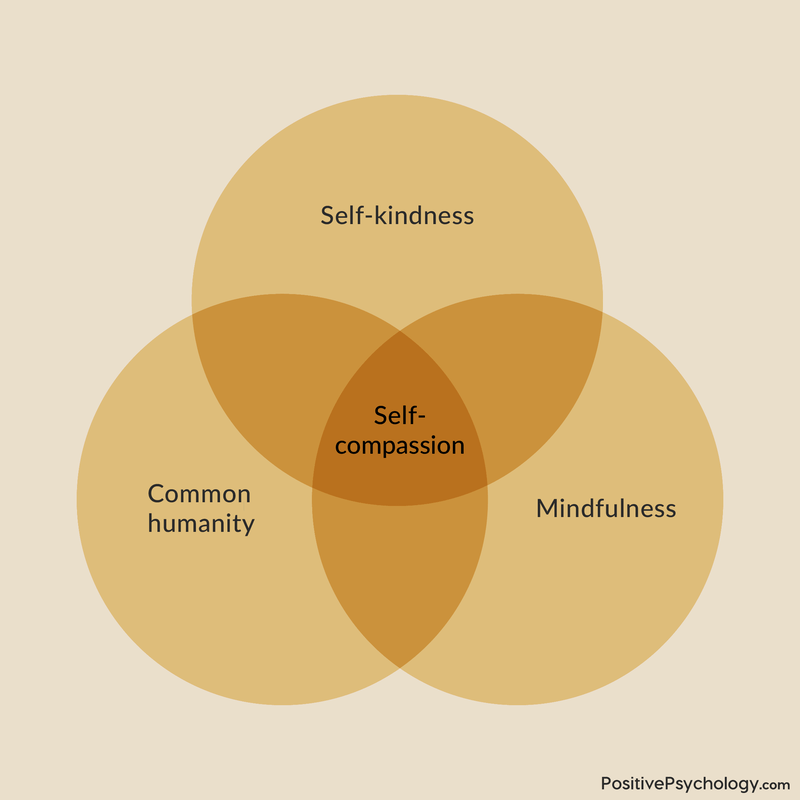
When moving from empathy to compassion, consider compassion for yourself as well.
Dr. Kristin Neff is a world-renowned expert on self-compassion, and suggests that self-compassion has three essential components (Neff, 2003):
1. Self-Kindness vs. Self-Judgment:
Self-kindness refers to the tendency to be caring and understanding of the self instead of critical. Rather than attacking and criticizing the self for personal shortcomings, warmth and unconditional acceptance are offered.
2. Common Humanity vs. Isolation:
Common humanity involves recognizing that humans are imperfect; all people fail, make mistakes, and have serious life challenges. It is the recognition that we all go through these adversities at times, rather than something that happens to “me” alone.
3. Mindfulness vs. Over-Identification:
Mindfulness involves being aware of one’s painful experiences in a way that neither ignores nor amplifies painful thoughts and emotions. Awareness of–without over-identifying with–personal sufferings is necessary to extend compassion toward the self.
4 Helpful Activities and Exercises
Try out these exercises to help develop and improve empathy.
Mindfulness and empathy
One of the many strengths of mindfulness is its ability to “_shift perspective from our personal subjectivity to impersonal objectivity_” (Shapiro, 2020). This move away from an egocentric perspective allows us to experience another’s feelings.
Try out the following worksheets:
Role-play
Role-play can offer a safe, comfortable way for people to tackle difficult issues and practice putting themselves in others’ shoes.
Try out the following worksheet:
Random acts of kindness
Notice when others perform a kind act for you and expect nothing in return. It could be as simple as keeping a door open for you while you are running to get out of the rain or helping you lift a heavy load to the trunk of your car.
As you go through your day and opportunities arise, see what simple acts you can perform to benefit someone else, perhaps without them knowing.
At the end of each day, consider the acts of kindness you have received and how you have improved other people’s day.
24 Questions and Statements to Use With Your Clients
 Empathic listening is vital to developing relationships.
When successful, it forms a deeper connection with the client, friend, family member, or colleague both emotionally and intellectually.
To listen well, you must learn to be patient and not interrupt, even if you disagree with what is being said.
Empathic questions can be helpful but should not dominate sessions.
Try out a few of the following, tailoring as appropriate:
- When has your personal bias led to a wrong choice?
- What decisions make you feel uncomfortable?
- When have your instincts let you down?
- How do you balance looking after yourself and the needs of others?
- How do you comfort others?
- What about an experience makes it meaningful?
- When were you most challenged to be your best self?
- Does your curiosity ever create difficulty?
- Do you use silence during your conversations? If so, when?
- What should others understand about you?
- How do you deal with negative emotions?
- When are you most present?
Empathetic statements and responses can show that you understand your client’s feelings:
- I am sorry that this happened to you.
- That would upset me too.
- I want to thank you for being so open and honest with me.
- This sort of challenge is never easy.
- It is clear that this has impacted you deeply.
- What else would you like to share?
- It sounds like you had a very stressful time.
- Yes, what has happened makes no sense at all.
- I am on your side.
- It’s no surprise you are upset.
- That sounds frightening.
- You are making complete sense.
Concepts, feelings, and emotions can often become clearer by working through real or imagined situations.
Try out the following worksheets with clients as a way to develop their empathic skills:
Also, the following two tools provide support for teaching children and adults about empathy:
The next two worksheets help grow listening skills that foster empathy in communication:
PositivePsychology.com’s Resources
If you’re looking for more tools to help your clients improve their empathy and strengthen their relationships, be sure to check out our Positive Psychology Toolkit©.
To develop empathy in children, the first stop would be to develop emotional intelligence, and our article Is Emotional Intelligence Relevant for Kids? provides guidance on exactly that.
For more science-based ways to help others develop emotional intelligence, this collection contains 17 validated EI tools for practitioners. Use them to help others understand and use their emotions to their advantage.
A Take-Home Message
While a large part of who we are is defined by our genetic make-up, our childhood and the life we lead as an adult can change many aspects of how we behave and the way we respond to our environment.
If we are to solve problems at an individual level and gain a greater understanding of the issues humanity faces, we must develop compassion and empathy to make decisions that meet the needs of everyone, not just ourselves.
After all, we are all humans, sharing both a time and a location, with a psychological need to connect. Building empathy allows us to form an authentic, deep relationship with the people we meet and society at large, making decisions that solve our problems and those of others.
Try out some of the worksheets with your clients to help them implement empathy-building strategies daily and develop the empathy needed for stronger relationships, while avoiding disagreements that arise from not being able to see another’s point of view.
We hope you enjoyed reading this article. Don’t forget to download our five positive psychology tools for free.
Frequently Asked Questions
Empathy worksheets help individuals recognize and understand others’ emotions by practicing perspective-taking, emotional recognition, and active listening. These exercises can improve emotional intelligence and enhance relationships.
Anyone, including children, adults, and professionals like teachers and therapists, can benefit from empathy worksheets. They are particularly useful for people looking to improve communication skills or foster stronger social connections.
Exercises in empathy worksheets may include role-playing scenarios, identifying emotions in facial expressions, and practicing reflective listening to better understand others’ feelings.
- Ehrlich, P. R., & Ornstein, R. E. (2012). Humanity on a tightrope: Thoughts on empathy, family, and big changes for a viable future. Lanham, MD: Rowman & Littlefield.
- Eyal, T., Steffel, M., & Epley, N. (2018). Research: Perspective-taking doesn’t help you understand what others want. Harvard Business Review. Retrieved September 2, 2020, from https://hbr.org/2018/10/research-perspective-taking-doesnt-help-you-understand-what-others-want
- Feldman, R. (2007). Mother-infant synchrony and the development of moral orientation in childhood and adolescence: Direct and indirect mechanisms of developmental continuity. American Journal of Orthopsychiatry, 77, 582–597. https://doi.org/10.1037/0002-9432.77.4.582
- Geiger, J. M., Piel, M. H., Lietz, C. A., & Julien-Chinn, F. J. (2016). Empathy as an essential foundation to successful foster parenting. Journal of Child and Family Studies, 25(12), 3771–3779. https://doi.org/10.1007/s10826-016-0529-z
- Goleman, D. (2006). Emotional intelligence. New York: Bantam Books.
- Halpern, J., & Weinstein, H. M. (2004). Rehumanizing the other: Empathy and reconciliation. Human Rights Quarterly, 26(3), 561–583. https://doi.org/10.1353/hrq.2004.0036
- Horsburgh, V. A., Schermer, J. A., Veselka, L., & Vernon, P.A. (2009). A behavioural genetic study of mental toughness and personality. Personality and Individual Differences, 46, 100–105. https://doi.org/10.1016/j.paid.2008.09.009
- Kidd, D. C., & Castano, E. (2013). Reading literary fiction improves theory of mind. Science, 342(6156), 377–380. https://doi.org/10.1126/science.1239918
- Knafo, A., Zahn-Waxler, C., Van Hulle, C., Robinson, J. L., & Rhee, S. H. (2008). The developmental origins of a disposition toward empathy: Genetic and environmental contributions. Emotion, 8, 737–752. https://doi.org/10.1037/a0014179
- Krznaric, R. (2012, November 27). Six habits of highly empathic people. Greater Good Magazine. Retrieved September 2, 2020, from https://greatergood.berkeley.edu/article/item/six_habits_of_highly_empathic_people1
- McDonald, N. M., & Messinger, D. S. (2011). The development of empathy: How, when, and why. Retrieved September 1, 2020, from https://www.researchgate.net/publication/267426505_The_Development_of_Empathy_How_When_and_Why
- McKee, A., David, S., Chaskalson, M., & Chussil, M. (2017, May 3). If you can’t empathize with your employees, you’d better learn to. Harvard Business Review. Retrieved September 2, 2020, from https://hbr.org/2016/11/if-you-cant-empathize-with-your-employees-youd-better-learn-to
- Miller, C. (2019). How to be more empathetic. The New York Times. Retrieved September 2, 2020, from https://www.nytimes.com/guides/year-of-living-better/how-to-be-more-empathetic
- Neff, K. D. (2003). Self-compassion: An alternative conceptualization of a healthy attitude toward oneself. Self and Identity, 2, 85-102. https://doi.org/10.1080/15298860309032
- Plopa, M., Kaźmierczak, M., & Karasiewicz, K. (2016). The quality of parental relationships and dispositional empathy as predictors of satisfaction during the transition to marriage. Journal of Family Studies, 25(2), 170-183. https://doi.org/10.1080/13229400.2016.1211550
- Ramachandran, V. (2009). The neurons that shaped civilization. TED. Retrieved September 2, 2020, from https://www.ted.com/talks/vilayanur_ramachandran_the_neurons_that_shaped_civilization?language=en
- Wellman, H. M., Cross, D., & Watson, J. (2001). Meta-analysis of theory-of-mind development: The truth about false belief. Child Development, 72, 655–684. https://doi.org/10.1111/1467-8624.00304
- Shapiro, S. L. (2020). Rewire your mind: Discover the science + practice of mindfulness. London: Aster.
Jeremy Sutton, Ph.D., is an experienced psychologist, coach, consultant, and psychology lecturer. He works with individuals and groups to promote resilience, mental toughness, strength-based coaching, emotional intelligence, wellbeing, and flourishing. Alongside teaching psychology at the University of Liverpool, he is an amateur endurance athlete who has completed numerous ultra-marathons and is an Ironman.

Read other articles by their category
- Body & Brain (69)
- Boundaries (14)
- Coaching & Application (42)
- Compassion (26)
- Counseling (41)
- Emotional Intelligence (22)
- Gratitude (18)
- Grief & Bereavement (18)
- Happiness & SWB (40)
- Meaning & Values (27)
- Meditation (16)
- Mindfulness (47)
- Motivation & Goals (41)
- Optimism & Mindset (36)
- Positive CBT (28)
- Positive Communication (29)
- Positive Education (39)
- Positive Emotions (34)
- Positive Leadership (17)
- Positive Parenting (18)
- Positive Psychology (27)
- Positive Workplace (41)
- Productivity (17)
- Relationships (56)
- Resilience & Coping (45)
- Self Awareness (25)
- Self Esteem (38)
- Strengths & Virtues (34)
- Stress & Burnout Prevention (39)
- Theory & Books (44)
- Therapy Exercises (43)
- Types of Therapy (64)