How to Overcome Perfectionism: 15 Worksheets & Resources (original) (raw)
Key Insights
- Overcoming perfectionism involves recognizing unrealistic standards & fostering self-compassion.
- Embracing mistakes as learning opportunities can help reduce the pressure to be perfect & enhance personal growth.
- Setting realistic goals & celebrating progress, not just outcomes, encourages a healthier mindset.
 While difficult to define, perfectionism can drive impossibly high standards and have dangerous consequences.
Maintaining that flawless veneer can put your mental and physical wellbeing at risk as you search for that perfect life (Thomson, 2019).
The number of people experiencing perfectionism is rising dramatically, especially among the young (Curran & Hill, 2019).
So, how do we manage the exceedingly high expectations we have for ourselves and others while addressing our concerns over making mistakes and handling criticism (Stoeber, 2018)?
This article introduces techniques and therapeutic approaches to combat perfectionism and understand when good is good enough.
Before you continue, we thought you might like to download our five positive psychology tools for free. These detailed, science-based exercises will help you or your clients become more productive and efficient.
This Article Contains
- How to Overcome Perfectionism
- Helping Perfectionists With CBT
- 3 Interventions, Activities, and Exercises
- 3 Counseling Worksheets and Workbooks
- Perfectionism Questionnaires
- Measuring Perfectionism: Scales & Tests
- Can Meditation Help With Perfectionism?
- 4 Fascinating Books & Podcasts
- Resources From PositivePsychology.com
- A Take-Home Message
- Frequently Asked Questions
- References
How to Overcome Perfectionism
In their review of perfectionism in college students over a 27-year period, Curran and Hill (2019, p. 410) uncovered a concerning trend: “Recent generations of young people perceive that others are more demanding of them, are demanding of others, and are more demanding of themselves.”
As a result, young people – and other age groups too – are finding themselves subject to excessively high personal standards and increasingly critical self-evaluation. They are experiencing perfectionism.
Haven’t we all at times felt the desire to be more perfect: getting an A, a high-performance job, and having the best dinner date? Researchers and therapists are now finding increasing numbers of people unable to meet the high standards they are setting themselves (Stoeber, 2018; Thomson, 2019).
So, how do we overcome perfectionism?
With social media, parents, academia, an unpredictable economy, high-pressure workplaces, and demanding educational policies all guilty of pushing unrealistic targets for people of all ages, how do we manage the need to always do better?
There are ways to combat our desire for perfection. For some, depending on how they are feeling and acting, self-help books may be sufficient. Others may need talking therapies or Cognitive-Behavioral Therapy (CBT) to break out of negative thinking patterns (Thomson, 2019).
Former clinical psychologist Alice Boyes (2020) suggests focusing on aspects of perfectionism and their potential solutions on a day-to-day basis. By doing so, we can recognize what is essential and what is not, and develop heuristics to manage our daily tasks without becoming derailed by perfectionist ideals.
The following three approaches can help you overcome perfectionism in the workplace (and outside) and ultimately get what is really needed done (modified from Boyes, 2020):
- Re-assign tasks
Perfectionists can find it difficult to let go of control; they don’t want to hand over work for fear that it will not be done properly.
Learn to enjoy handing over tasks to other people and being relieved of the decision-making burden. Ask yourself: Am I best placed to do this? Would my time be better spent elsewhere? Could someone else step up and be accountable for this task?
- Stop over-delivering
It can be tempting to think, “If I’m not over-delivering, I’m under-delivering.” This is unlikely. If given time, resources, and payment to complete a piece of work, perform it well, but your standards and time investment should not be disproportionate to its value.
Recognize that a client may not expect you to reply within two hours. And if you are paid for a day’s work, it should not be extended into the remainder of the week. Depending on the task, try to focus on areas where you can add the most value according to the time and resources agreed.
- 100% consistency is unlikely
You may find you avoid starting a new habit unless you know you can achieve perfection in it every day. This can lead to procrastination and avoidance coping strategies.
Be flexible. Recognize you can take time off from working toward your goals, especially if you are starting to feel burned out.
The three approaches above are practical ways to keep perfectionism from impeding high performance and task completion. Essentially, they are about balance. High standards are required in almost all jobs, but they have to be realistic, and you need to be aware that mistakes can lead to development and growth.
The following interventions and exercises go deeper, exploring how we can change the beliefs associated with avoiding setting impossible-to-maintain standards.
Helping Perfectionists With CBT
 Cognitive-Behavioral Therapy has proven helpful in treating clients with issues surrounding perfectionism.
While traditionally focusing on clinical perfectionism – defined as being overly dependent on achieving “personally demanding, self-employed standards” – therapists can use it to challenge all aspects of perfectionist thinking and behavior (Stoeber, 2018, p. 284).
At its heart, CBT can help clients recognize that their self-worth does not depend on their striving or achieving.
Behavioral experiments are a core aspect of CBT treatment and are highly effective.
Joachim Stoeber (2018) takes us through an example of such a technique with a teacher with perfectionist tendencies that are affecting her work and life. Emmy worries that unless she spends excessive time on students’ yearly reports, parents will complain.
The following provides a working example of the key steps involved in this powerful CBT technique (modified from Stoeber, 2018):
- Identify the belief
According to Emmy, “Unless I spend at least five hours preparing each child’s report, their parents will complain.” - Experiment
Emmy was asked to write half of her reports using the ‘five-hour method’ and the remainder assigning a maximum of 30 minutes to each. - Specific predictions
Emmy predicted with 95% certainty that she would receive a lot of complaints in the 30-minute group and very few from reports where she used her original strategy. - Results
Despite feeling anxious regarding the experiment, Emmy received no complaints from either report group. - Re-rate
Emmy reduced her self-rating from a 95% expectation that her original belief was true to 60% when she re-rated her belief. - Conclusions
Emmy realized that her attempts to be perfect meant that she was spending too much time on each report and could do a good job in less time, and still keep parents happy.
Behavioral experiments are valuable in challenging perfectionism beliefs and, crucially, starting a change in the associated behavior (Stoeber, 2018).
3 Interventions, Activities, and Exercises
Challenging and changing our beliefs is not always straightforward. Understanding and becoming more aware of our thinking can help us set goals and transform our lives, breaking free of perfectionism.
The self-assessment, identification of perfectionist triggers, and goal-setting activities and exercises below do just that.
Perfectionist Beliefs ‘Flexibility’ Self-Assessment
Assessing the flexibility of your perfectionist thinking is a valuable activity. The less rigid and more flexible your thought patterns, the easier it is to change unwanted or incorrect beliefs.
Use the Perfectionist Beliefs ‘Flexibility’ Self-Assessment worksheet to identify where your thinking is rigid and where you may need to focus further attention going forward (modified from Antony & Swinson, 2009).
Ask yourself the following questions:
- Do you find it difficult to recognize when you are being a perfectionist? Give examples.
- Do you find it difficult to relax your high standards? Give examples.
- Are you typically unwilling to consider someone’s suggestion that you are being a perfectionist? Give examples.
- Do you typically disagree when someone says your standards are too high? Give examples.
- Do you get upset when you can’t meet your own standards?
- Do you get upset when others can’t meet your standards?
If you are inflexible regarding your perfectionist thinking, you may find breaking free of it more difficult. Yet, in time, you can learn to ease up on yourself and others.
Identifying Perfectionist Triggers
There are most likely recurring themes or triggers behind your perfectionist thinking and behavior.
The Identifying Perfectionist Triggers worksheet will help you build a picture of and reflect on activities that trigger your perfectionism.
Review the form regularly. Add more lines and look for patterns in your perfectionist thinking and behavior. Identify where you need to cut yourself some slack and recognize areas in your life where perfectionism could do harm.
Goal Setting to Manage Perfectionism
Goal setting can help you define the problem you wish to overcome, the general goals you would like to set (in a non-perfectionist way), and the tasks involved in reaching them.
Use the Goal Setting to Manage Perfectionism worksheet to capture what you would like to change and the goals you can set to complete the challenge.
It can be helpful to re-write the list regularly in priority order and remove those items you feel you have addressed. Let this become a working list of the changes you would like to make to ensure your perfectionist tendencies are managed and do not get in the way of living your life.
3 Counseling Worksheets and Workbooks
 The following three worksheets support counselors in helping their clients manage perfectionism through better awareness and understanding of the situations, people, and standards involved.
Perfectionism Diary
In therapy and counseling, the process of helping an individual with a particular problem typically begins with an assessment (Antony & Swinson, 2009).
The Perfectionism Diary provides a valuable template to diarize perfectionist thinking when it happens. Its completion and later review can help identify triggers and patterns involved in thought processes.
Keep copies of the completed forms and review them once a week to see where expectations are set too high and standards are impossible to maintain.
Expecting Perfectionism From Others
Often our focus for perfectionism is not on ourselves, but on others in our lives. Unfairly and with impossibly high expectations, we may be setting them up to fail and risk harming our relationships with them (Stoeber, 2018).
The Expecting Perfectionism From Others worksheet identifies the people with whom you tend to be overly perfectionistic and why (modified from Antony & Swinson, 2009).
Reevaluating Your Perfectionist Standards
The previous worksheets are useful to understand where, when, and with whom perfectionism is typically triggered.
Awareness of perfectionist triggers is crucial, and so is an understanding of how unrealistic expectations impact lives.
Use the Reevaluating Your Perfectionist Standards worksheet to understand the effect of these perfectionist standards on others’ lives.
Working through these questions can help you gain perspective regarding the effect of your perfectionist standards on your life.
Why perfectionism isn't perfect and how to overcome it
Perfectionism Questionnaires
There are several less formal self-assessment questionnaires for perfectionism, many of which are available for free online:
- Self-Assessment Perfectionism Screening Test – 15 questions, answered yes or no, that provide a simple screening test for perfectionism.
- Perfectionist Quiz – Answer each of the 22 items with never, sometimes, frequently, or always to gain insight into your perfectionist tendencies.
Measuring Perfectionism: Scales & Tests
 According to Stoeber (2018), much of the research on perfectionism is based on the following two academic measures:
- Frost Multidimensional Perfectionism Scale – a well-validated, 35 question self-report measure
- Hewitt-Flett Multidimensional Perfectionism Scale – a well-validated, 45-question self-report measure taking approximately 15 minutes to complete
Each contains subscales capturing perfectionistic strivings and concerns that combine to form the standard two-factor model of perfectionism.
Can Meditation Help With Perfectionism?
There are significant links between the use of meditation and mindfulness and a decline in perfectionist thoughts.
A seven-week mindfulness relaxation course increased students’ resilience and self-efficacy, while reducing stress levels and perfectionism scores (Burns, Lee, & Brown, 2011).
4 Fascinating Books & Podcasts
There are many valuable books and podcasts on perfectionism, its impact, and how we can learn to cope with such challenging tendencies. We have selected four of our favorites below.
When Perfect Isn’t Good Enough: Strategies for Coping with Perfectionism – Martin Antony and Richard Swinson
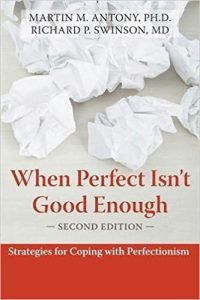
The fully revised second edition of this immensely valuable text provides powerful and practical methods for understanding the root causes of perfectionism and introduces coping skills to help overcome its hold on your life.
This is an essential text for practitioners working with clients with perfectionist tendencies.
Find the book on Amazon.
The Psychology of Perfectionism: Theory, Research, Applications – Joachim Stoeber
 This essential text provides an overview of perfectionism theory, research, and treatments.
It is invaluable reading for students, academics, and professionals in clinical and counseling psychology.
Find the book on Amazon.
The Sport Psych Show – Perfectionism in Sport
Although this podcast focuses on sports, this fascinating episode featuring Dr. Andy Hill is just as relevant to other areas of our lives.
Andy introduces the listener to valuable insights into the consequences of perfectionism and how coaches can help athletes overcome such tendencies.
Access this podcast episode here.
Psychologists Off the Clock – Perfectionism With Sharon Martin
In this insightful and valuable episode, Diana Hill interviews psychotherapist and author Sharon Martin about her knowledge of perfectionism.
Sharon helps listeners understand how perfectionists can find themselves disconnected from their values and are often left fearing the judgment of others.
Access this podcast episode here.
Resources From PositivePsychology.com
We have many resources that will help you or your clients handle perfectionism and discover self-acceptance through increased awareness of emotional and psychological needs and effective coping mechanisms.
- What Makes a Perfect Day?
It’s essential to understand the difference between experiencing a perfect day and using perfectionism to drive ourselves and others too far. - Stress Decision Framework
Use this tool to place decision-making into context and accept that sometimes we must aim for good enough, not perfect, decisions.
If you’re looking for more science-based ways to help others become more productive and efficient, this collection contains 17 validated productivity and work efficiency exercises. Use them to help others prioritize better, eliminate time wasters, maximize their personal energy, and more.
A Take-Home Message
Setting high standards is not unhealthy; indeed, it will probably lead to exceptional performance in multiple areas of your life. However, working toward impossible-to-reach levels of performance can be damaging, especially when it is constant.
Similarly, it is vital to recognize that all of us will fail and make mistakes at some point. But that’s okay. If we accept that this is a necessary aspect of human growth, we can learn, improve, and strengthen our relationships with ourselves and those around us.
It can help to accept that being human means that we are not 100% consistent all the time and that our fallibility and vulnerability make us human, capable of unlearning and relearning.
CBT, along with other talking therapies, can help to challenge our beliefs. We can learn to identify our triggers and harmful thinking patterns, creating new realistic goals, and learning to accept how good enough looks.
Why not try out some of the exercises, techniques, and assessments and see the benefits of moving away from impossible-to-maintain perfectionist tendencies?
We hope you enjoyed reading this article. Don’t forget to download our five positive psychology tools for free.
Frequently Asked Questions
To overcome perfectionism, set realistic goals, embrace mistakes as learning opportunities, and practice self-compassion.
Effective strategies include breaking tasks into smaller steps, focusing on progress rather than perfection, and challenging negative self-talk.
Yes, therapy can assist in identifying underlying beliefs, setting achievable goals, and developing healthier coping mechanisms to manage perfectionism.
- Antony, M. M., & Swinson, R. P. (2009). When perfect isn’t good enough: Strategies for coping with perfectionism. New Harbinger Publications.
- Boyes, A. (2020, March 3). Don’t let perfection be the enemy of productivity. Harvard Business Review. Retrieved August 24, 2021, from https://hbr.org/2020/03/dont-let-perfection-be-the-enemy-of-productivity
- Burns, J. L., Lee, R. M., & Brown, L. J. (2011). The effect of meditation on self-reported measures of stress, anxiety, depression, and perfectionism in a college population. Journal of College Student Psychotherapy, 25(2), 132–144. https://doi.org/10.1080/87568225.2011.556947
- Curran, T., & Hill, A. P. (2019). Perfectionism is increasing over time: A meta-analysis of birth cohort differences from 1989 to 2016. Psychological Bulletin, 145(4), 410–429. https://doi.org/10.1037/bul0000138
- Stoeber, J. (2018). The psychology of perfectionism: Theory, research, applications. Routledge, Taylor & Francis Group.
- Thomson, H. (2019, August 14). The misunderstood personality trait that is causing anxiety and stress. New Scientist. Retrieved August 24, 2021, from https://www.newscientist.com/article/mg24332430-600-the-misunderstood-personality-trait-that-is-causing-anxiety-and-stress/
Jeremy Sutton, Ph.D., is an experienced psychologist, coach, consultant, and psychology lecturer. He works with individuals and groups to promote resilience, mental toughness, strength-based coaching, emotional intelligence, wellbeing, and flourishing. Alongside teaching psychology at the University of Liverpool, he is an amateur endurance athlete who has completed numerous ultra-marathons and is an Ironman.

Read other articles by their category
- Body & Brain (70)
- Boundaries (14)
- Coaching & Application (42)
- Compassion (26)
- Counseling (41)
- Emotional Intelligence (22)
- Gratitude (18)
- Grief & Bereavement (18)
- Happiness & SWB (40)
- Meaning & Values (27)
- Meditation (16)
- Mindfulness (47)
- Motivation & Goals (41)
- Optimism & Mindset (36)
- Positive CBT (28)
- Positive Communication (29)
- Positive Education (39)
- Positive Emotions (34)
- Positive Leadership (17)
- Positive Parenting (18)
- Positive Psychology (27)
- Positive Workplace (41)
- Productivity (17)
- Relationships (56)
- Resilience & Coping (45)
- Self Awareness (25)
- Self Esteem (38)
- Strengths & Virtues (34)
- Stress & Burnout Prevention (39)
- Theory & Books (44)
- Therapy Exercises (43)
- Types of Therapy (64)