25 Self-Reflection Questions: Why Introspection Is Important (original) (raw)
Key Insights
- Introspection boosts self-awareness, emotional regulation, resilience & personal growth.
- Effective self-reflection uses mindfulness to identify feelings, align actions with values & manage discomfort.
- Self-reflection questions should explore values, experiences & patterns to foster self-discovery and growth.
 Contrary to what people might think, introspection is not a form of self-absorbed navel gazing.
Introspection is a type of self-reflection that is the foundation of self-awareness. It’s an important aspect of inner work, whether in psychotherapy, counselling, coaching, or meditation.
Self-reflection questions and skills are the foundation of inner growth, behavior change, and psychological healing.
This article explores why introspection is important, which self-reflection questions to ask, and how to deal with any discomfort that arises. We also explore whether looking within can be dysfunctional before providing numerous tools and worksheets to help guide the self-reflection process so it remains productive.
Before you continue, we thought you might like to download our five positive psychology tools for free. These detailed, science-based exercises will help you increase the compassion and kindness you show yourself and will also give you the tools to help your clients, students, or employees show more compassion to themselves.
This Article Contains
- 7 Reasons Introspection Is Important
- How to Self-Reflect in 6 Steps
- 20 Self-Reflection Questions to Ask Yourself
- Can Self-Reflection Be Dysfunctional?
- 10 Introspection Worksheets & Tools
- 5 Introspective Questions for Clients
- 4 Inspiring Quotes on Self-Reflection
- PositivePsychology.com’s Helpful Resources
- A Take-Home Message
- Frequently Asked Questions
- References
7 Reasons Introspection Is Important
Introspection involves the examination of our thoughts, feelings, and behavior and helps develop the self-awareness required to support personal growth and wellbeing.
Here are science-based reasons introspection is important, supported by research.
1. Development of self-awareness
Introspection increases self-awareness, which is necessary to identify personal values, strengths, and challenges. Recognizing these characteristics is required to promote growth and make informed decisions (Carden et al., 2022).
2. Emotional regulation
Reflecting on our emotions and recognizing triggers and glimmers helps us manage our responses to stressors and challenging situations. Taking responsibility for our emotions and their expression is the hallmark of a mature adult (London et al., 2023).
3. Improved relationships
Introspection is an important self-exploration skill for understanding relationship patterns, setting boundaries, resolving misunderstandings, and building healthier connections (Morales, 2024).
4. Increased resilience
Understanding our unique responses to life events helps us recognize problems and identify solutions at an early stage. This builds coping skills and enhances resilience (Carden et al., 2022).
5. Clarification of goals and values
Introspection supports us aligning our actions with our core values and long-term goals. This is especially important for managing stress and overcoming life challenges that might result in reactive behaviors that undermine our values (London et al., 2023).
6. Encouragement of growth and change
Introspection is an important aspect of self-discovery that can uncover areas of stagnation and help to motivate change. Self-reflection questions are required to leave our comfort zone and seize opportunities for growth (Carden et al., 2022).
7. Enhanced problem-solving and creativity
Introspection fuels creativity by allowing people to process experiences and learn from them. Self-reflection questions, followed by writing about experiences, can generate new perspectives and solutions, especially when used as support for psychotherapy (Ruini & Mortara, 2022).
By regularly practicing introspection, we can develop a deeper understanding of ourselves, leading to greater fulfilment, improved relationships, and the capacity to navigate life’s complexities with resilience and confidence.
How to Self-Reflect in 6 Steps
 This exercise has been designed to explore your feelings, identify unmet personal needs, and align your actions with your values. The exercise integrates mindfulness and values-based self-reflection, helping you nurture self-awareness and personal growth.
- Find a quiet, comfortable place where you won’t be disturbed. Bring a notebook or device to record your reflections.
- Begin with a mindful body scan.
Close your eyes and take a few deep breaths.
– What are you feeling right now?
– Where do you notice these feelings in your body?
Note your observations. - Identify the source.
– What events, thoughts, or situations might be contributing to these feelings?
– Are these feelings aligned with your values or external pressures? - Explore your needs.
– What do you need most right now (e.g., rest, connection, adventure, achievement)?
– Are there unmet needs or boundaries you need to address? - Consider acting.
Can you take a small step to address your needs or align more closely with your values today? For example:
– If you feel stressed, commit to a short relaxation activity.
– If you feel disconnected, reach out to someone important to you. - Review your experience.
– How do you feel now compared to when you started?
– What did you learn about yourself?
How to deal with discomfort when reflecting
For the more extroverted among us especially, looking inward may not be a natural tendency and can be challenging and uncomfortable.
For example, when practicing the inner observation of mindfulness for the first time, people are often shocked to find out how random and chaotic their thought processes are. They may also be negative, critical, or bullying. This can create anxiety if we hold on to these thoughts and believe in them (Hanckmann, 2021).
However, this recognition of the often chaotic nature of thoughts is normal and an important stage of mindfulness practice. It is believing in them that is problematic and creates anxiety (Hanckmann, 2021). As your mindfulness skills improve, you begin to see thoughts as temporary and fleeting.
When reflecting, if you begin to feel stressed, remember that you can step back and “defuse” from your thoughts rather than identifying with them (Assaz et al., 2023). We have a free worksheet of cognitive defusion exercises based on acceptance and commitment therapy that can help.
In short, it is quite normal to feel uncomfortable when doing introspection, but there are skills you can use to manage and even dissolve any discomfort.
20 Self-Reflection Questions to Ask Yourself
Self-reflection questions can be explored in a journal, during meditation, or in deep conversation with a coach, counselor, or mentor. Self-reflection can help you live a more intentional, fulfilling life.
Self-discovery questions
Self-discovery questions can be used to clarify your values and check whether your behavior is aligned with your principles. Sometimes, we can discover that we are still acting in line with outmoded beliefs or have internalized values that are not our own.
Behaving and living in line with your values is the foundation of self-respect and a fulfilling life (Neller et al., 2023).
- What are my guiding principles or values in life?
- What makes life meaningful for me?
- What do I stand for, even when it’s uncomfortable or unpopular?
- How do my actions reflect what I stand for?
- Are there any beliefs I’ve outgrown but still hold onto out of habit?
Daily self-reflection
Conducting daily self-reflection can deepen your self-awareness, highlight areas for growth, and encourage a more intentional approach to life (Carden et al., 2022). Here are five prompts to ask yourself at the end of each day to support a growth mindset.
- What went well today, and what am I grateful for?
- Were there any challenges, and how did I handle them?
- What emotions did I experience most strongly today, and why?
- Did my actions align with my values and goals today?
- Is there anything I would do differently tomorrow to grow or improve?
Deep questions to ask yourself
These five deeper questions are designed to help self-exploration in coaching, counseling, or therapy to facilitate insight and personal growth.
- Are there any patterns in my life that keep repeating, and if so, what is triggering them?
- How do I usually respond to stress and pressure, and what does this reveal about my coping mechanisms?
- What are my core fears, and how do they influence my life choices?
- Who am I when I’m not fulfilling my roles in my family, work, and community?
- Is there anything I need to forgive, either in myself or others, to release resentment, guilt, or shame?
Self-reflection journaling prompts
Naikan therapy is a Japanese introspection technique that focuses on maintaining positive relationships in all life domains as the foundation of mental health and wellbeing (Schuh, 2023).
It consists of three core questions that are useful foundations for self-reflection journaling. They can be asked daily or weekly and shared with a trusted mentor or supporter for further self-exploration.
- What have I received from others?
This question cultivates gratitude. - What have I given to others?
This focuses on enhancing self-respect. - What troubles or difficulties have I caused others?
This question encourages accountability, humility, and self-awareness.
Self-awareness questions
The following self-reflection questions have been designed to facilitate the growth of self-awareness, which is an essential component of personal growth.
- What have been my successes and failures in life, and what have they taught me about my strengths and difficulties?
- Is there anything I am avoiding in life, and what might happen if I faced it directly?
Can Self-Reflection Be Dysfunctional?
 As mentioned previously, it may be uncomfortable as we start to recognize that our inner world of thoughts is often chaotic and disorganized.
In this video below, Sadhguru, the Indian yogi and meditation teacher who leads the global Isha Foundation, discusses the idea of introspection and advocates for less introspection to improve mental health. He argues that excessive introspection, akin to driving while staring into the rearview mirror, can lead to mental illness.
Crucially, there are no disciplinary distinctions made between psychology, philosophy, and spiritual practice in traditional Indian thought or yogic science. Inner work, which includes meditation and self-reflection, teaches practitioners how to take some distance from their psychological processes and observe their experiences with detachment.
This is a controversial argument that seems to rest on the idea that introspection necessarily leads to an identification with thoughts and thinking. Watch this short talk, The Negative Impact of Introspection, here:
The negative impact of introspection - Sadhguru
The counterargument regards introspection as a necessary practice for developing self-awareness. It does not preclude the cultivation of the kind of nonjudgmental clarity of observation that Sadhguru recommends but is, in fact, the foundation of mindfulness.
We need to go within and explore our chaotic inner to distinguish what is and isn’t useful and to separate the kernels of insight from the chaff of useless noise. The latter is often based on the internalization of values and ideas we have not chosen for ourselves, as we live in a world flooded with information.
It is true that introspection is based on the ancient Greek maxim of “know thyself” and therefore Eurocentric in origin. However, this analysis of psychological processes does not necessarily lead to increased neuroticism. Rather, it can provide the insight and self-awareness required to develop into a mature, functioning adult with sound and healthy boundaries.
Introspection in more individualistic, Western societies is foundational to interpersonal problem-solving and positive relationship building.
In this School of Life talk, In Praise of Introspective People, a different view of introspection is presented that aligns it with a depth of processing that is often intrinsically pleasurable for more introverted people.
In praise of introspective people - The School of Life
The following free downloadable worksheets contain exercises and tools that can be used to support introspection and deepen self-awareness.
- Basic Needs Satisfaction in General Scale
The Basic Needs Scale is a tool that invites you to reflect on different areas of your life and identify those in need of attention and exploration. - The Self-Esteem Checkup
This tool further explores how you really feel about yourself in terms of your self-worth. It can help focus on areas of future growth to enhance self-esteem and self-respect. - My Personal Beliefs
Most people have deeply held personal beliefs. This Personal Beliefs worksheet offers 10 self-reflection questions on the things we believe about ourselves to help determine their truth, reality, and value. - Your Core Values Worksheet
Going deeper, the Core Values worksheet provides a checklist of values to help you select those that resonate most with you. Knowing our core values can provide useful inner guidance during challenging and difficult times. - Exploring Past Resilience
This worksheet invites clients to reflect on their approach to overcoming past challenges and identify coping skills and strengths they can draw upon in the future. - Nurturing vs. Depleting Activities
To enhance self-awareness in support of better self-care, this worksheet encourages reflection on how much time is spent on nurturing versus depleting activities. - Changing Physical Habits
Taking care of our physical health is key to managing stress and emotions. This habit-tracking worksheet connects behavior to wellbeing. - Focus on the Little Things
This worksheet refers to the Japanese concept of ikigai and invites your client to reflect on the little things that they enjoy throughout the day. By paying attention to simple pleasures and reflecting deeply, gratitude can be cultivated to help offset stress. - Writing Your Mission Statement
Capturing self-reflection thoughts on paper is made easier with this worksheet, which supports your client in identifying what they stand for to help define their direction in life. - Emotional Footprint Exercise
The Emotional Footprint Exercise invites the client to reflect on their emotional reactions and responses to various life events as a first step to regulating emotions. It helps identify our emotional impact on society, the ripple effects, and their ideal emotional footprint.
We hope this selection of carefully curated worksheets helps consolidate a client’s self-reflection skills by demonstrating the direct benefits of introspection and enhanced self-awareness.
5 Introspective Questions for Clients
Asking coaching and counseling clients questions that explore their thoughts and feelings promotes introspection and identifies issues in need of attention to further their personal growth.
In addition to all the self-reflection questions mentioned above and the selection of self-reflection worksheets, try these five questions to prompt a broader exploration of a client’s aspirations, inspirations, sources of joy and contentment, and blockages to expressing their authentic sense of self.
These questions are open ended to encourage dialogue.
- When do you feel most fulfilled, and what contributes to that feeling?
- Who or what inspires you, and how can you include that in your daily life?
- What does success look like to you, and how aligned are you with that vision?
- What would you do if you knew you couldn’t fail?
- What would your life look like if it reflected your true self?
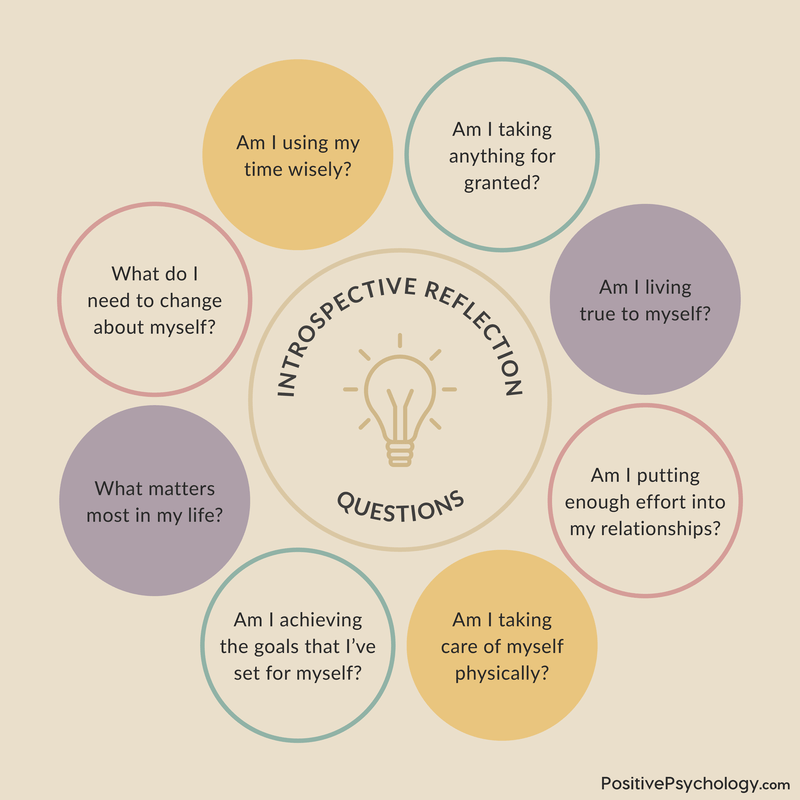
Introspective Reflection Questions
The average human has more than 50,000 thoughts per day; more than half of them are negative, and more than 90% are just a repetition from the day before (Wood, 2013).
This means refocusing your mind on positive thoughts through introspection is essential for personal ascendance and growth. Most people take the end of the year as an opportunity to reflect on the past and set goals for the following year. However, reflections and introspection are critical at any point in time and enable your clients to grow.
Wilhelm Wundt developed the concept of introspection in the late 1800s (McLeod, 2008). According to him, introspection is focused on thoughts, images, and feelings. Introspective questions are often used in the field of cognitive psychology.
Understanding your clients allows you to learn more about their values, internal thoughts, and feelings. Furthermore, it takes the focus away from fast-paced lives and allows your client to be in the present moment and refocus on fulfillment (Wood, 2013).
Besides asking your client reflective questions, another tip is to practice active listening. Being able to stay entirely in the present moment without interruption or projecting your own story onto someone is key to helping your clients flourish. When the urge to share your story arises, pause and take the time to listen.
4 Inspiring Quotes on Self-Reflection
Here are five inspiring quotes to ponder when you need reminding of the benefits of self-reflection for self-actualization.
Knowing yourself is the beginning of all wisdom.
Aristotle
Your vision will become clear only when you look into your heart. Who looks outside, dreams; who looks inside, awakens.
C. G. Jung (1912)
Man, know thyself, and you shall know the Universe and God.
Inscription at the Temple of Apollo in Delphi
Knowing others is intelligence; knowing yourself is true wisdom. Mastering others is strength; mastering yourself is true power.
Lao Tzu, Tao Te Ching
These quotes reflect the timeless wisdom of introspection and its importance for self-awareness, self-knowledge, and personal growth.
PositivePsychology.com’s Helpful Resources
In addition to all the resources mentioned above, we have a series of articles packed with resources to support your clients’ next step in their self-reflection practice.
Many clients will discover they need to pay more attention to self-care, self-compassion, and setting healthy boundaries. Check out the following articles for guidance.
- What is Self-Worth & How Do We Build it? (Incl. Worksheets)
- 20 Creative Self-Care Activities for Groups
- What is Mindful Self-Compassion? (Incl. Exercises + PDF)
- The Self-Compassion Scale and Test (Incl. PDF)
- How to Set Healthy Boundaries & Build Positive Relationships
- 14 Worksheets for Setting Healthy Boundaries
The Science of Self-Acceptance Masterclass© is the next step in self-compassion. The search for self-esteem can hold us to impossible standards and become unhealthy. The positive psychology science indicates that rather than self-esteem, self-acceptance is the foundation of wellbeing, a sense of being “good enough” in the face of life challenges and obstacles, with all our vulnerabilities to loss, change, and the unknown.
If you want to guide others in cultivating self-compassion and emotional wellbeing, our Self-Compassion X© training program is the right tool for you. Designed for practitioners to use anywhere, it is filled with ready-to-use practices.
Lastly, if you want to invest further, then take a look at our store. We have plenty of tools and masterclasses to support self-reflection, including 17 Self-Compassion Exercises to help create a kinder and more nurturing relationship with the self, supported by science from the field of positive psychology.
A Take-Home Message
Self-reflection is an important skill for building self-awareness, which is key to personal development and growth.
While an excessive focus on introspection could be counterproductive if it drives an identification with psychological processes like thoughts and feelings, self-reflection questions are required to cultivate mindfulness and detached observation.
If we avoid looking within, the danger is we will remain unaware of what we think, feel, and value in life. Self-knowledge is an essential component of adult human development and the cornerstone of optimal functioning and flourishing.
We hope you enjoyed reading this article. Don’t forget to download our five positive psychology tools for free.
ED: Rewrite Jan 2025
Frequently Asked Questions
Deep questions entail going underneath the surface of your mind and everyday attention to external things. Deep questions often entail going within but can also involve broader, more philosophical questions about the meaning of life and our place in the world.
To do introspection means to engage in self-examination and reflect on your thoughts, feelings, and behaviors. It involves looking inward to understand your motivations, emotions, and reactions, often with the goal of gaining deeper self-awareness and personal insight.
Being introspective can be a good thing as it promotes self-awareness and personal growth. It helps individuals understand their emotions and behaviors, leading to better decision-making and emotional regulation. However, excessive introspection can lead to overthinking and self-criticism, so it’s important to balance it with action and perspective.
Self-reflection can be as simple as checking in with yourself about how you’re thinking and feeling to enhance self-awareness.
- Aristotle. (2000). Nicomachean ethics. Cambridge University Press.
- Assaz, D. A., Tyndall, I., Oshiro, C. K., & Roche, B. (2023). A process-based analysis of cognitive defusion in acceptance and commitment therapy. Behavior Therapy, 54(6), 1020–1035. https://doi.org/10.1016/j.beth.2022.06.003
- Carden, J., Jones, R. J., & Passmore, J. (2022). Defining self-awareness in the context of adult development: A systematic literature review. Journal of Management Education, 46(1), 140–177. https://doi.org/10.1177/1052562921990065
- Hanckmann, H. (2021). Discomfort as a pathway to well-being: How befriending and mindfulness contrast in coping with discomfort (Master’s thesis, University of Twente). https://essay.utwente.nl/87935/
- Jung, C. G. (2024). Collected works of C.G. Jung, Volume 11: Psychology and religion: West and East. Princeton University Press.
- London, M., Sessa, V. I., & Shelley, L. A. (2023). Developing self-awareness: Learning processes for self-and interpersonal growth. Annual Review of Organizational Psychology and Organizational Behavior, 10(1), 261–288. https://doi.org/10.1146/annurev-orgpsych-120920-044531
- Morales, J. (2024). Introspection is signal detection. The British Journal for the Philosophy of Science, 75(1), 99–126.
- Neller, S. A., Cloyes, K. G., Edelman, L. S., Wong, B., Baines, B., & Towsley, G. L. (2023). Preparing for the future while living in the present: Older adults’ experiences creating a legacy of values. The Gerontologist, 63(9), 1488–1496. https://doi.org/10.1093/geront/gnad019
- Ruini, C., & Mortara, C. C. (2022). Writing technique across psychotherapies—from traditional expressive writing to new positive psychology interventions: A narrative review. Journal of Contemporary Psychotherapy, 52, 23–34. https://doi.org/10.1007/s10879-021-09520-9
- Schuh, J. (2023). Naikan-the world of introspection: Finding inner peace and discovering yourself. Tredition.
- Tzu, L. (1993). Tao Te Ching. Hackett Publishing Company.
Jo Nash, Ph.D., began her career in mental health nursing before working in mental health advocacy and policy research. After earning her Ph.D. in Psychotherapy Studies, she became a lecturer in mental health at the University of Sheffield for over a decade before moving to India to study and practice Buddhism. Today, Jo works as an accredited transpersonal coach, combining IFS-based parts work, ACT, and positive psychology interventions in her work with neurodivergent and highly sensitive adults.

Read other articles by their category
- Body & Brain (69)
- Boundaries (14)
- Coaching & Application (42)
- Compassion (26)
- Counseling (41)
- Emotional Intelligence (22)
- Gratitude (18)
- Grief & Bereavement (18)
- Happiness & SWB (40)
- Meaning & Values (27)
- Meditation (16)
- Mindfulness (47)
- Motivation & Goals (41)
- Optimism & Mindset (36)
- Positive CBT (28)
- Positive Communication (29)
- Positive Education (39)
- Positive Emotions (34)
- Positive Leadership (17)
- Positive Parenting (18)
- Positive Psychology (27)
- Positive Workplace (41)
- Productivity (17)
- Relationships (56)
- Resilience & Coping (45)
- Self Awareness (25)
- Self Esteem (38)
- Strengths & Virtues (34)
- Stress & Burnout Prevention (39)
- Theory & Books (44)
- Therapy Exercises (43)
- Types of Therapy (64)