Therapy Intake: Questions Every Therapist Should Ask (original) (raw)
Key Insights
- Thoughtful therapy questions promote self-reflection, deeper understanding & meaningful conversations in counseling sessions.
- Questions can focus on emotions, relationships & personal goals, guiding individuals toward insight & growth.
- Using open-ended & empathetic questions creates a supportive environment, facilitating therapeutic progress & self-discovery.
 Healing conversations are an art form in peril of being lost to our busy lives.
The ultimate goal of talk therapy is to enable the process of psychological and emotional healing along the continuum from the problematic toward a sense of greater mental wellbeing.
Although we often come to therapy with a problem, we also come as people who want to be heard and understood, feel like we matter, wish to learn self-compassion, and want to find partnership in helping us heal and see ourselves and our life situation in a different light.
I would rather have questions that can’t be answered than answers that can’t be questioned.
Richard Feynman
Progress in a therapeutic relationship cannot be made unless the client feels safe to speak their mind, and it is on the practitioner to create that climate of openness and transparency.
The process also often requires the clinician’s willingness to work diligently to help clients understand what they want, the patience to help them learn to own all aspects of themselves, including contradictory feelings, and the ability to create a safe space to allow for transformation to occur.
Most of what happens in talk therapy is accomplished through the skillful use of questions, but only second to a lot of active listening.
This article surveys different approaches to asking therapeutic questions meant for both practitioners and their clients and gives examples of how the quality of questions we ask can improve our lives. For more common therapy questions, see our related post: Classic Therapy Questions Therapists Tend to Ask.
Before you continue, we thought you might like to download our five positive psychology tools for free. These science-based exercises will provide you with detailed insight into Positive CBT and give you the tools to apply it in your therapy or coaching.
This Article Contains
- 7 Questions Designed for the First Therapy Session
- Therapy Intake Questions to Ask Patients
- 15 Useful Therapy Questions to Ask Yourself
- 20 Couples Therapy Questions Designed to Improve Relationships
- 30 Family Therapy Assessment Questions
- The Family Therapy Questions Game
- Therapeutic Questions for Youth
- 15 Therapeutic Questions for Group Therapy Discussions
- Resources From PositivePsychology.com
- A Take-Home Message
- Frequently Asked Questions
- References
7 Questions Designed for the First Therapy Session
The first therapy session must focus on relationship building and creating rapport, which are necessary to establish an effective foundation for a practitioner–client relationship, often referred to as the therapeutic alliance. The outcomes of therapy are heavily dependent on the quality of this relationship (Lambert & Barley, 2001).
Ideally, the first therapy session should be a form of positive inception so the practitioner can set the stage for future interactions. Carl Rogers (1961) used to say that the therapist must create an environment where everyone can be themselves.
Courage doesn’t happen when you have all the answers. It happens when you are ready to face the questions you have been avoiding your whole life.
Shannon L. Alder
The very first question in therapy is usually about the presenting problem or the chief complaint for which the client comes to therapy, often followed by an exploration of the client’s past experience with therapy, if any, and their expectations of future outcomes of therapy.
1. What brings you here today?
For clients who need encouragement to open up, it may be helpful to remark on their bravery in seeking therapy.
For those who are at the other extreme and go into a lengthy and detailed explanation of their issues, perhaps having been in therapy before, it is best to listen empathically first before offering validation or complimenting them on their self-knowledge and how they have thought a lot about what they would like to address in therapy.
2. Have you ever seen a counselor before?
For those who are in therapy for the first time, observing how comfortable and confident they are in talking about the challenges in their life can help set the stage for further disclosure.
It may be helpful to set some expectation of what is going to happen in the therapeutic process by explaining how asking questions is at the core of the process and reassuring the client that they should feel free to interrupt at any time and to steer the conversation to where they need it to go.
If the client has seen a counselor before, it can prove very valuable to inquire further about their previous experience in therapy by asking about frequency, duration, and issues discussed during their previous engagements, as well as one thing they remember most that a former counselor told them.
An important aspect for gauging clients’ engagement in the process of therapy is asking them about what went right or didn’t turn out the way they would have liked in their previous therapeutic engagement, as this can point to where they place the sense of responsibility for their situation.
Inquiring if the client achieved the results they sought and if they have been successful in maintaining them outside of the therapeutic relationship can also provide valuable insight into their motivation to change their behavior.
3. What do you expect from the counseling process?
Establishing a mutual agreement and setting expectations for the engagement is crucial to making progress. Clients’ goals and preferences for the format and level of interaction need to be taken into consideration.
Some clients like to vent and have the counselor listen silently; others want a high level of interaction and a spirited back-and-forth. To aid with providing psychoeducation, it is also important to inquire how the client learns best and if they like to receive homework.
For a range of useful worksheets, resources, and exercises you might include as part of your client’s psychoeducation plan, be sure to check out the following articles:
- 17 Therapy Worksheets for Teens, Adults, and Couples (+PDFs)
- 17+ Free Therapy Resources For Your Practice
- 17+ Powerful Therapeutic Activities & Therapy Exercises
Other examples of questions that can point to the tone and flow of future communications can include the following:
- How many meetings do you think it will take to achieve your goals?
- How might you undermine achieving your own goals?
- How do you feel about using good advice to grow from?
- How will we know when we have been successful in achieving your goals for therapy?
Therapy Intake Questions to Ask Patients
 Levy et al. (2018) analyzed records from healthcare providers and found that:
- 45.7% of adults avoided telling their providers that they disagreed with their care recommendations.
- 81.8% of adults withheld information because they didn’t want to be lectured or judged.
Many aspects of clients’ lives can influence their engagement and progress in therapy.
Indeed, questions about preexisting medical conditions, current and past treatments, medications, and family history are essential to the effective assessment of needs and the successful provision of therapeutic treatment. Therefore, having a clear picture of these details is a critical part of the initial intake process.
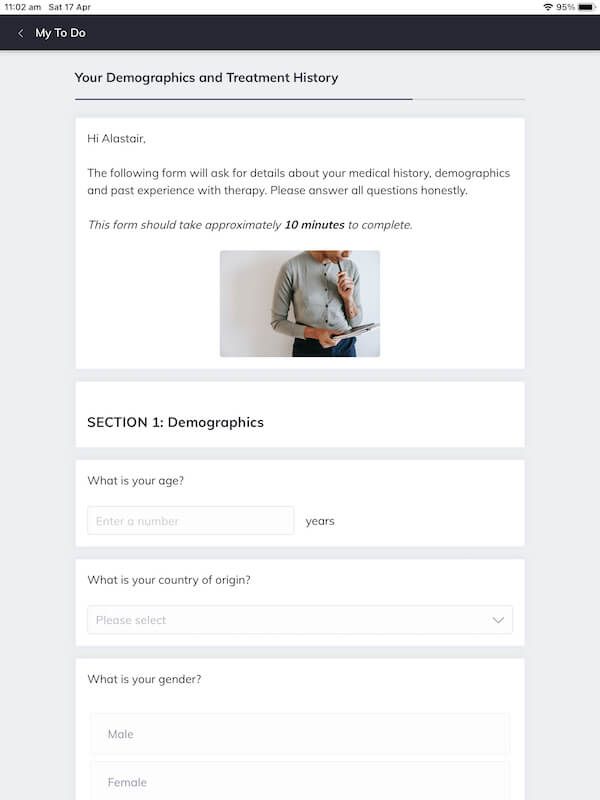
In order to gather this information securely and efficiently, therapists are increasingly drawing on digital technologies. For instance, using a blended care platform such as Quenza (pictured here), therapists can design and distribute standardized sets of intake materials, such as forms and agreements, that clients can complete on their own devices and at a time that suits them.
The benefits of providing intake forms digitally is that they can facilitate better documentation and record keeping for practitioners. Additionally, and unlike paper forms, they can be programmed to ensure no critical questions are accidentally missed.
It is important to note that while most therapists do not prescribe medication, many often partner with other medical professionals by making recommendations, particularly in instances when clients have been referred for therapy.
An intake form is attached and can be a useful guide for some of the issues that may require further exploration.
15 Useful Therapy Questions to Ask Yourself
We get into thinking ruts and routines and often function on autopilot without giving much consideration to the way we go about our day or spend our time and energy.
We can break this mindless cycle by asking meaningful questions of ourselves and reflecting deeply on our thoughts, emotions, and behavior. Many self-help therapy books have popularized a way of doing just that.
One such approach can be found in vastly popular notebooks that provide inspirational therapy quotes or reflective writing prompts that get our cognitive wheels spinning.
The most important questions in life can never be answered by anyone except oneself.
John Fowles, The Magus
Another important form of self-inquiry is to ask yourself questions that we can’t answer honestly in the presence of anyone else, probing and burning questions that we can often only answer for ourselves. They may require some reflection, examination of values, and perhaps writing, if only to organize our thoughts.
Here is a list of important questions we should revisit periodically:
- Assessing our life satisfaction – Tools like the Wheel of Life (accessible via the linked post) or one of the many Happiness Assessments are a great place to start.
- Exploring meaning in our lives – Our masterclass in Meaning and Valued Living is a great place to start.
- Defining our values – value exploration exercises
- Finding character strengths – VIA Strengths Assessment
- Visualizing goals – SMART goal setting, tracking how we invest our time with experience sampling method or Miracle Question (included below)
- Cultivating gratitude – Three good things exercise
- Practicing forgiveness – Empty chair technique
- Making bucket lists
Other useful questions are those that we can use to motivate ourselves. For example, appreciative inquiry questions focus on strengths and the propelling power our past successes can have on self-efficacy and motivation toward goal pursuit.
Here are a few examples of questions and prompts based on appreciative inquiry:
- Think back through your career. Locate a moment that was a high point, when you felt most productive and engaged. Describe how you felt and what made the situation possible.
- Without being humble, describe what you value most about yourself and your work.
- Describe your three concrete wishes for your future.
- Describe the most energizing moment, a real “high” from your professional life. What made it happen?
- How do you stay professionally affirmed, renewed, enthusiastic, and inspired?
Sometimes, self-therapy can feel like chasing our tail, particularly for those who already live in their heads a bit too much and may feel a bit stuck.
The most important questions to ask ourselves at this point are those that allow us to evaluate whether we should be reaching for help and if our situation warrants considering therapy.
- Have I struggled to be myself lately?
- Has daily life felt harder lately?
- Do I have a confidante who I can trust to be impartial?
- Is there a big choice in my life I have been struggling with?
- Is my worry increasing, and are my thoughts less logical?
- Have I lost interest in things I used to love lately?
- Have friends been avoiding me or saying they have been worried about me?
- Am I just not bouncing back from something?
- Do I have a habit that I keep secret from others that causes me ongoing shame and life problems?
- Do I spend most of my time feeling worthless compared to others?
20 Couples Therapy Questions Designed to Improve Relationships
 Dr. John Gottman, an expert marriage therapist who has observed couples for over 40 years, tells us that we have a very high chance for miscommunication in close relationships (Gottman & Silver, 2015).
How do we cope with those unfavorable odds? Through acceptance, the practice of active listening, and the realization that relational conflict is an opportunity for growth.
Lack of acceptance is often an important component of relationship gridlock, as it causes both people to feel criticized or rejected (Gottman & Silver, 2015). There are always two points of view, both valid and right, from within each perception.
The need to be right prevents us from actively listening to each other. Communicating fundamental acceptance instead of rejection of the other person’s personality is therefore basic to all effective problem solving.
Active listening requires practice and comes down to moving from self-informed certainty to curiosity about the other person. It helps to adopt an “and stance,” where both stories are valid, the world is complex, both partners can get angry, both contribute to the situation, and both are doing their best.
Couples can improve their odds of having a productive talk by (Gottman & Silver, 2015):
- Finding things in common (Gottman and Silver recommend having good Love Maps of each other)
- Getting to know each other’s flexible and inflexible areas for negotiations
- Offering to help meet the core needs of another person
- If gridlock seems unavoidable, figuring out if we need a temporary compromise
What often happens in couples therapy is an equivalent of the two people getting to know each other in a different way, improving communications, and learning that conflict can be an opportunity for growth.
Some of the most common questions explored in couples therapy include:
- Why choose today?
- How did you decide to come to therapy?
- What brought you together in the first place?
- How does your relationship affect your levels of joy?
- What do you wish your partner would do more?
- How do you cultivate trust in your relationship?
- Describe your level of satisfaction with intimacy in your relationship.
- How would you rate your communication skills: negative, neutral, or positive?
- What positive relationship rules do you follow?
- In the recent past, what did you do when your partner disappointed you?
- How much can you recall about what your partner did last week?
- How would you describe your other relationships, like those with family and friends?
- What family conflicts have you been embroiled in recently?
- What relationship have you been in that you judged to be a failure?
- Who do you call upon when your heart is hurting?
- What is your most significant vulnerability or Achilles heel in relationships?
- What is your relationship forecast for both now and in the future?
- What counseling questions do you hope aren’t asked?
10 Therapy questions to get to the root of the problem
30 Family Therapy Assessment Questions
Some of the most important relationships in our lives can be both a source of happiness and the greatest struggle at the same time. The closest people in our lives influence in no small degree who we become as a person and shape our view of the world around us in significant ways we often underestimate.
Some approaches to family therapy employ systemic interpretations; for example, depression may be viewed as a symptom of a problem in the larger family.
When a family seeks counseling, the questions focus on the relationship’s dynamics, everyone’s met and unmet needs, and goals for the relationships. Assessing these factors, while it may seem complicated at first, is nevertheless worth the time.
Dysfunctional communication patterns within the family can be identified and corrected through teaching family members how to listen, ask questions, and respond non-defensively.
The genogram is one such tool used in family therapy. It’s mostly a family tree that provides a visual representation of three to four generations and explores how patterns or themes within families influence their current behavior and identifies whether relationships in the family have been close, distant, or ridden with conflicts.
It asks about values, beliefs, traditions, characteristics, and habits of family members, including health issues, alcohol and drug use, physical and mental health, violence, crime and trouble with the law, employment, and education. See Simple Guide to Genograms.
Some of the questions about relationships between family members include:
- Who are you closest to?
- What is/was your relationship like with… ?
- How often do you see… ?
- Where does … live now?
- Is there anyone here that you really don’t get along with?
- Is there anyone else who is very close in the family? Or who really don’t get along?
When exploring patterns and themes, good questions are:
- Who are you most like?
- What is … like? Who else is like them?
- Did anyone else leave home early?
- Is anyone else interested in art/science/etc.?
The following questions may also help explore the family background and family dynamics:
- Who is important to you in your life? Why are these particular people important?
- Who provides the most support in your life?
- How have members of your family reacted to the problems that you are currently experiencing?
- Are members of your extended family aware of what you have been experiencing?
- What was it like growing up in your family?
- Perhaps you could talk about some of the memories, both good and not so good.
- What is it like for you right now living in your family?
- How do you think your family might describe you? What qualities or strengths might they say you have?
- Are there members of your extended family who you feel close to or feel that you have something in common with?
- Did you feel safe in your family?
- How does your family handle disagreements?
- Is it okay to express your emotions in your family? To feel happy, sad, frustrated, angry, content, etc.?
- Tell me about your different family members and how they express their emotions.
- Were there times when you were worried about any of your family members? Why were you worried? How were these concerns handled?
- What qualities do you bring to your family that are special or unique?
- Were there any special activities that you did together?
- Did your family mix with other families?
- What other information would you like me to know about your family that will be helpful during our time together?
The Family Therapy Questions Game
One of the most effective ways to address family dynamics, particularly when it involves children, is by playing therapy games. It removes the formality and allows for interaction to unfold in a nonthreatening way that often brings out the best in all participants.
While it is fun for the children, it also allows the adults to regress for a moment and get down to the level of being playful and spontaneous. In the end, we find out that we don’t know as much as we thought we did about the most important people in our lives.
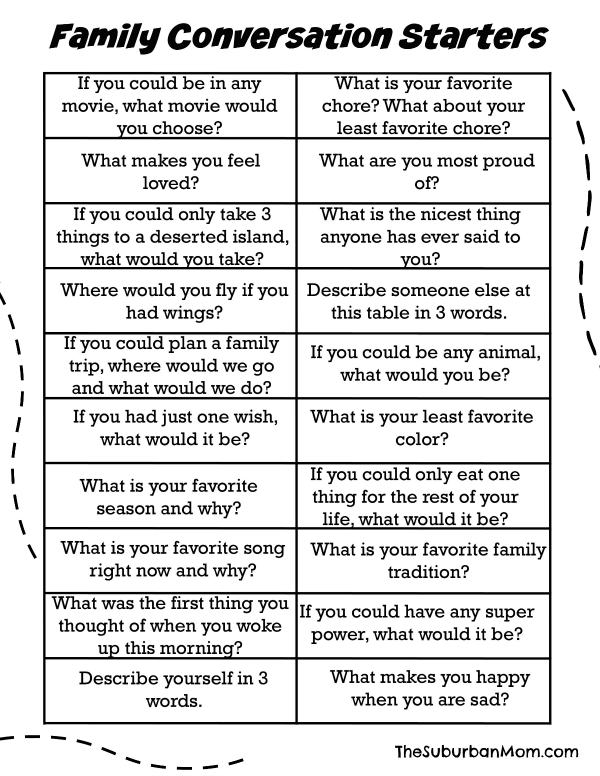
The family conversation starters below can be used in a family therapy session as well as at home. They can and should be personalized in a way that is age appropriate and has a specific goal in mind: to bring family members together, help them communicate effectively, express their emotions, or move toward constructive problem solving.
Another great activity known as ‘_What will they say?_‘ encourages family members to guess what another family member will say in response to a question (Lowenstein, 2010).
It allows family members not only to get to know each other better, but also to develop skills in asking each other questions, understanding that there are things that are similar between family members and things that are different. Finally, it helps make the point that family members, especially parents, may not know as much about each other as they think they do.
Create at least 20 questions, such as:
- What is your favorite color?
- What is your favorite dessert?
- Who do you think gets angry the most in the family?
- Who cries the most in the family?
- Who laughs the most in the family?
- Who watches TV the most in the family?
- Who gives the most support to you?
- Who gives Mom/Dad the most support?
- What would the family member on your left like to get for their birthday?
- Who is the best at following the rules?
- Who sets the most rules?
To use these games effectively, it helps to make sure the questions connect to a family goal. The game can move reasonably quickly, giving everyone a turn and ending the session on a high note. Finally, many existing games, especially games and activities the family is already familiar with, can be adapted to provide an opportunity for a meaningful conversation.
Therapeutic Questions for Youth
 There is no time more ridden with unanswered questions and throbbing with urgency as in our youth.
As teens grapple with discovering their identities and setting directions for their lives, it is an excellent opportunity to set standards for a self-reflective and inquisitive mind that is open to honest discussions and not afraid to ask questions.
As the saying goes, if we ask good questions, we get better answers. Below is a list of questions most frequently used in therapy with pre-teens to young adults and that anyone might find interesting.
- What is the best compliment you have received?
- In your opinion, what is the best song ever written?
- If you could know one thing about the future, what would it be?
- What is something you feel nervous about right now?
- What is your happiest memory?
- What is something that you did that you are proud of?
- If someone’s underwear were showing, would you tell them?
- I get mad when…
- What calms you down when you get angry or upset?
- What is your favorite animal and why?
- My favorite sound is…
- What is your favorite green thing?
- If you could travel anywhere in the world, where would you go and why?
- If your house was burning down, what one item would you grab and why?
- Name two anger management techniques.
- Name two positive values.
- Name two ways you can show self-control in the school setting.
- What would be the title of your autobiography?
- Do you think people talk differently online than they do in person? Why?
- What is one item you can’t live without?
- What would you do if you were hungry and a lunchbox was left open and unattended?
- What is better, giving your money or giving your time?
- If you could add, change, or cancel one rule in your school, what would it be?
- What does “habit” mean, and why is it hard to change?
- Who do you trust the most and why?
- Where do you feel the safest and why?
- If you could change one rule that your family has, what would it be and why?
- What is one word you would use to describe your family and why?
- How do you think others view you and why?
- If you could travel back in time to years ago and visit your younger self, what advice would you give yourself?
- What five words best describe you?
- If you could make one rule that everyone in the world had to follow, what would it be and why?
- What does respect mean to you? Give an example.
- What do you like the most about yourself?
- If you could give one gift to every child in the world, what would it be and why?
- What do you think is the most important job in the world? Why?
- Tell us about a time when you felt sad. What helped get you through it?
- What is the first symptom you notice when you feel mad?
- Give two examples of acts of kindness.
- Who is someone you consider a real-life hero and why?
- Where do you see yourself in 10 years?
- Who do you wish you had a better relationship with, and what would make it better?
- Share a time where you sought attention in an appropriate way. And in a negative way?
- Choose one person in this room and compliment them.
- Give two examples of communication with a teacher who accuses you of something you didn’t do.
- Talk about a time when you witnessed someone being teased. What effect did the teasing have on that person?
One assessment tool that is particularly useful in work with young people with complex needs is the ecomap. It is a visual representation of current family relationships and also community and social networks where clients are encouraged to identify whether their relationships with their peers, school, social clubs, professionals, are strong, weak, or stressful. See these templates.
15 Therapeutic Questions for Group Therapy Discussions
Group therapy serves two distinct goals. While it addresses exploration of issues very much in the same way that individual therapy does, it also serves the purpose of finding ourselves in the environment where we feel less isolated from other people because many of those in the room share similar struggles.
Just as in individual therapy, clients often enact the same tendencies they bring to all their other relationships, and the client interaction within a group can often be a good reflection of how they show up in the relationships with other people in their lives (Yalom, 1983).
While the therapist is trained in delivering structure for the discussion and guiding the questions, the biggest benefit lies in the exchange between participants. Leaders within the group are usually appointed and tasked with looking for commonalities among members and encouraging everyone to be supportive of each other.
Most group therapies are done in a round-robin discussion format. Rules of conduct are established and adhered to, roles assigned for leaders of the group, and the room set up usually in a circle to encourage collaboration and everyone having a voice. Questions used in group therapy often focus on very much the same themes as individual therapy and include the reasons for being there and the expectations for the future.
- Let’s start by spending a few minutes talking about the benefits of group therapy and what positive psychology groups are about.
- Let’s go around and have each member tell us what you expect to get out of the group
- Where else might you have been at this moment if you hadn’t come to this group session today?
- What might you have chosen to do?
- Is it your own decision to come here, or did someone else encourage you to do so?
- How do you feel about coming here each week?
- What do you like best about this session?
- Is there something you don’t enjoy about this group session?
- Are you particularly looking forward to anything?
Depending on the purpose of the group, be it anger management, bereavement, substance abuse, etc., the content and the topics of discussion may vary. Although in a typical session, several topics and questions are provided, group leaders need not ask all questions or address all topics; instead, questions and topics should be selected as they relate to what is happening in the group. Some general questions could include:
- What brought each of you into the group?
- Tell us two or three words that best describe you.
- Now, thinking about those words, how do they relate to why you are here?
- What is your favorite thing about yourself, something that makes you feel positive and proud to be you?
- Is there something new that has happened in your life recently?
Homework assignments and progress logs can be used between sessions, and educational material and handouts may be distributed. Many sessions start with reviews of progress and end with a recap of the activities.
Resources From PositivePsychology.com
At PositivePsychology.com, we have many tools you can use to support your clients’ diverse therapeutic aims.
If you’d like to learn what effective questioning looks like across some different therapy subtypes, check out the following articles:
- 10 Best Reality Therapy Techniques, Worksheets, & Exercises
Reality therapy centers on present-focused questions that explore what clients want, what they’re doing, and whether those actions are working. This article offers a clear, practical overview of the approach and shows how these questions can guide clients toward more effective choices. - How to Perform Hope Therapy: 4 Best Techniques
Hope therapy applies questions that help clients clarify meaningful goals and build the agency needed to pursue them. This article offers an overview of the approach and shows how these hopeful, future-oriented questions can boost motivation and support change. - Reparenting: Seeking Healing for Your Inner Child
Reparenting-focused work uses gentle questions to help clients notice when their “younger parts” are activated and name unmet childhood needs. This article offers a trauma-informed overview of reparenting and inner child work, as well as concrete exercises you can use in session or as homework. - How Does Paradoxical Intention Really Work in Therapy?
Paradoxical intention invites clients to experiment with questions like, “What if you tried to make the symptom worse on purpose?” to break the cycle of fear-of-fear. This article explores such paradoxical intentions in cases like insomnia, anxiety, and phobias, with practical guidance for safely applying the technique.
For even more therapy interventions beyond questioning, you might also check out our dedicated articles on using thought records, role play scripts, or behavior change interventions.
A more extensive version of the following tool is available with a paid subscription to the Positive Psychology Toolkit©, but it is described briefly below.
- Daily Exceptions Journal
This exercise combines traditional CBT with positive psychology by encouraging clients to ask questions focusing on what is right, rather than wrong, in their lives.
The technique enables the client and therapist to better understand the problems the client faces and the contexts in which they occur.
Complete a daily exceptions journal by answering a series of questions, including:
What has improved today, even if just a little bit?
What did I do differently to improve things?
When didn’t I experience the problem today?
When was the problem less of a problem?
What could I continue to do to make improvements?
For a ready-to-use collection of evidence-based worksheets covering behavioral change and other core therapeutic domains, explore our article on the PracticeLab Worksheet Series Volume 2.
Lastly, if you’re looking for more science-based ways to help others enhance their wellbeing, this signature collection contains 17 validated positive psychology tools for practitioners. Use them to help others flourish and thrive.
A Take-Home Message
The value of deep, probing questions need not be reserved for the therapy session. There is no reason why we can’t have more of these healing conversations in our lives, but it is both an art and science and requires some practice. We can all get better at asking questions we want answers to, and applying the therapeutic approach to the process of self-discovery can prove a worthwhile endeavor.
The scientist is not a person who gives the right answers, he’s one who asks the right questions.
Claude Levi-Strauss
What questions do you think are important to ask, in therapy or not?
We hope you enjoyed reading this article. For more information, don’t forget to download our five positive psychology tools for free.
Frequently Asked Questions
The first question a therapist asks may vary depending on the situation and the therapist’s style. Typically, a therapist will begin by asking the client about the reason for seeking therapy and what they hope to achieve through therapy.
Here are some examples of open-ended questions on mental health:
- How has your mental health been impacting your daily life?
- What are some ways you cope with stress?
- Can you tell me more about what brings you here today?
- What are some challenges you are facing right now?
- How do you feel about your current support system?
- Can you describe some of your current emotions and how they are affecting you?
- What would you like to be different in your life?
- How do you think therapy can help you?
- What has been helpful for you in the past when you faced similar challenges?
- Can you share more about your background and experiences that may be relevant to your mental health?
Open-ended questions in therapy are designed to encourage clients to explore their thoughts, feelings, and experiences more deeply. These questions do not have a specific answer and allow the client to provide a more detailed response.
- Gottman, J. M., & Silver, N. (2015). The seven principles for making marriage work: A practical guide from the country’s foremost relationship expert. Harmony. https://www.amazon.com/dp/0553447718/
- Lambert, M., & Barley, D. E. (2001). Research summary on the therapeutic relationship and psychotherapy outcome. Psychotherapy: Theory, Research, Practice, Training, 38(4), 357–361.
- Levy, A. G., Scherer, A. M., Zikmund-Fisher, B. J., Larkin, K., Barnes, G. D., & Fagerlin, A. (2018). Prevalence of and factors associated with patient nondisclosure of medically relevant information to clinicians. JAMA Network Open, 1(7). https://doi.org/10.1001%2Fjamanetworkopen.2018.5293
- Lowenstein, L. (2010). Creative family therapy techniques: Play, art, and expressive activities to engage children in family sessions. Champion Press. https://www.amazon.com/dp/0968519962/
- Rogers, C. (1961). On becoming a person: A therapist’s view of psychotherapy. https://www.amazon.com/dp/039575531X/
- Yalom, I. D. (1983). Inpatient group psychotherapy. Basic Books. https://www.amazon.com/dp/0465032982/
Beata Souders is currently pursuing her Ph.D. in Psychology at CalSouth and MA in Creative Writing at SNHU, she holds a Master's degree in Positive Psychology from Life University. An ICF certified coach and a Gottman Institute Certified Educator, Beata is on the Executive Committee for the Student Division of the International Positive Psychology Associations and has published and presented on subjects ranging the Flow Theory to learned helplessness.

Read other articles by their category
- Body & Brain (69)
- Boundaries (14)
- Coaching & Application (42)
- Compassion (26)
- Counseling (41)
- Emotional Intelligence (22)
- Gratitude (18)
- Grief & Bereavement (18)
- Happiness & SWB (40)
- Meaning & Values (27)
- Meditation (16)
- Mindfulness (47)
- Motivation & Goals (41)
- Optimism & Mindset (36)
- Positive CBT (28)
- Positive Communication (29)
- Positive Education (39)
- Positive Emotions (34)
- Positive Leadership (17)
- Positive Parenting (18)
- Positive Psychology (27)
- Positive Workplace (41)
- Productivity (17)
- Relationships (56)
- Resilience & Coping (45)
- Self Awareness (25)
- Self Esteem (38)
- Strengths & Virtues (34)
- Stress & Burnout Prevention (39)
- Theory & Books (44)
- Therapy Exercises (43)
- Types of Therapy (64)