Difference Between Apogamy and Apospory (original) (raw)
Last Updated : 21 Aug, 2025
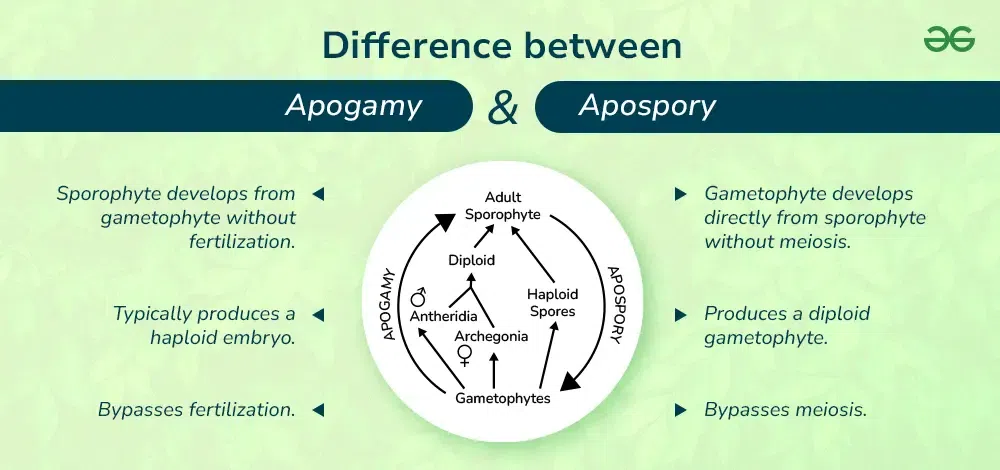
The **difference between apogamy and apospory lies in their reproductive processes. Apogamy involves the development of a sporophyte without fertilization, while apospory involves the development of a gametophyte from a somatic cell without meiosis. In both the apogamy and apospory process the formation of gametes does not take place.
In this article, we will cover the **difference between apogamy and apospory along with some similarities in detail.
Difference Between Apogamy and Apospory
Table of Content
- Apogamy Meaning
- Apospory Meaning
- Difference Between Apogamy and Apospory
- Similarities Between Apogamy and Apospory
- Conclusion - Difference Between Apogamy and Apospory
- Other Difference Related Articles
- FAQs on Difference Between Apogamy and Apospory
Apogamy Meaning
Apogamy is a type of asexual reproduction in plants where an embryo develops without fertilization. This process bypasses the fusion of sperm and egg, resulting in offspring genetically identical to the parent plant. In some cases, apogamy can lead to the formation of a haploid embryo (like in some ferns), but more commonly, it results in a diploid embryo because mitotic cell division occurs without meiosis. Apogamy can occur in both flowering and non-flowering plants. Farlow first discovered this process in 1874.
Apogamy Examples
Examples of apogamy include certain ferns, where sporophytes develop from gametophytes without fertilization, and some plants like dandelions, where seeds germinate into new plants without the need for pollination or fertilization.
Apospory Meaning
Apospory is another asexual reproductive strategy in plants. Here, a diploid gametophyte develops directly from a sporophyte cell, bypassing meiosis (the cell division that halves the chromosome number to create spores). Since the gametophyte develops from the sporophyte tissue, both generations share the same ploidy level (diploid). This process is primarily observed in bryophytes but can also occur in some ferns. Druery first documented apospory in 1884.
Apospory Examples
Examples of apospory include the formation of gametophytes in ferns from somatic cells, and the development of embryo sacs in flowering plants from nucellar cells.
Difference Between Apogamy and Apospory
The differences between Apogamy and Apospory are as follows:
| Parameter | Apogamy | Apospory |
|---|---|---|
| Definition | Apogamy is defined as a process of asexual reproduction that takes place in plants sporophyte is developed from gametophyte without the process of fertilization | Apospory is defined as an asexual reproduction in plants where 2n gametophyte is developed directly from the cell of sporophyte without the process of meiosis. |
| Significance | In Apogamy the embryo is formed without the process of fertilization. | In Apospory gametophyte is formed without the process of formation of spores. |
| Ploidy | The process of Apogamy produces a haploid embryo. | The process of Apospory produces a diploid gametophyte. |
| Occurrence | Apogamy occurs in Funaria | Apospory occurs in Anthoceros |
| Factors Affecting | Far-red light intensity Very low concentration of carbohydrates | Low light intensity Young cells such as the tip of the leaf and shoot apex. |
| Discovered by | This process of Apogamy was discovered by Farlow in the year 1874. | The process of Apospory was first discovered by Druery in the year 1884. |
| Types | Types of Apogamy: Obligate Apogamy Induced Apogamy | Types of Apospory: Soral Apospory Apical Apospory |
Similarities Between Apogamy and Apospory
Following are the similarities between Apogamy and Apospory:
- Apogamy and Apospory both are asexual reproduction processes.
- Apogamy and Apospory both take place in the plant kingdom.
- The process of formation of gametes does not take place in both types.
- In both Apogamy and Apospory, different types of reproduction units are produced by sporophytes.
- In both Apogamy and Apospory, the same ploidy level is shared by gametophyte and sporophyte.
Conclusion - Difference Between Apogamy and Apospory
In conclusion, apogamy and apospory are unique asexual reproductive processes in plants. The difference between apogamy and apospory lies mainly in their mechanisms and outcomes. Apogamy involves the development of a sporophyte from a gametophyte without fertilization, often producing a haploid embryo. Apospory, on the other hand, involves the direct development of a diploid gametophyte from sporophyte cells without meiosis. Both processes bypass traditional sexual reproduction, allowing plants to reproduce under specific conditions, and highlight the diversity and adaptability of plant reproductive strategies.