Kingdom Protista (original) (raw)
Last Updated : 10 Feb, 2026
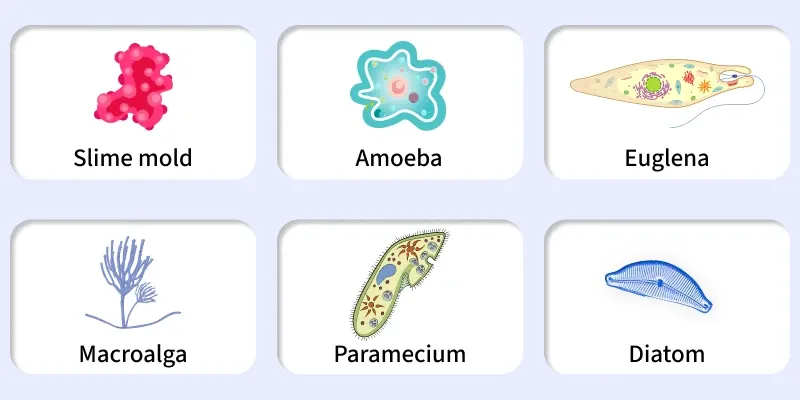
Protists are primarily unicellular eukaryotes and are considered an important evolutionary link between plants, animals, and fungi. The term Protista derives from the Greek word “protistos,” meaning “the very first,” highlighting their early evolutionary origin. Protists play vital roles in ecosystems as decomposers, primary producers, and parasites, making them essential to both ecological balance and biological diversity.
**Characteristics of Protista
Protists are a diverse group of eukaryotic organisms, meaning their cells have a well-defined nucleus enclosed within a membrane, along with other membrane-bound organelles such as mitochondria and endoplasmic reticulum. They exhibit a wide range of forms and functions, bridging the gap between simple unicellular organisms and more complex multicellular life.
The key characteristics of Protists are as follows:
**1. Eukaryotic cells: All protists are eukaryotic, meaning their cells contain a nucleus and membrane-bound organelles.
**2. Cellularity: While the majority of protists are unicellular, some, like kelp (a type of seaweed), are multicellular. They lack specialized tissues and organs.
**3. Locomotion: It exhibit diverse modes of locomotion using specialized structures such Pseudopodia, Flagella and Cilia.
**4. Nutrition: Protists may be autotrophic, producing their own food through photosynthesis (e.g., algae), or heterotrophic, obtaining nutrients by consuming other organisms (e.g., protozoa). Some are saprobic, absorbing nutrients from decaying matter, while others are parasitic, living on or inside hosts and causing disease.
**5. Reproduction: Protists primarily reproduce asexually(binary fission, budding, spores), though sexual reproduction occurs in some species, usually under stressful conditions.
**6. Habitat: Most protists are aquatic, living in freshwater or marine environments, but they can also be found in soil or other moist regions.
**Classification of Protista
Based on their nutrition, cellular structure, and mode of reproduction, organisms in Kingdom Protista are classified into five main groups:
**1. Protozoans
These organisms are considered the primitive relatives of animals. They are heterotrophic in nature and may live freely as predators or survive as parasites. Based on their structure and mode of locomotion, protozoans are grouped into four major categories:
- **Amoeboid protozoans: Found in freshwater or marine environments. They move and capture food using pseudopodia (false feet).Example: _Amoeba
- **Flagellated protozoans: These organisms possess flagella and may be free-living or parasitic. Example: _Trypanosoma
- **Ciliated protozoans: Covered with cilia that help in movement and feeding. They are mostly aquatic. Example: _Paramecium
- **Sporozoans: Named because a stage in their life cycle resembles a spore. Many are parasitic. Example: _Plasmodium (causes malaria)
**2. Slime Mould
Slime moulds are saprophytic protists that feed on decaying organic matter. They exhibit fungus-like characteristics and play an important role in decomposition. Their key features include:
- They creep over rotting leaves and twigs, engulfing organic material as they move.
- Under favourable conditions, they form a large, multinucleate, creeping mass called a _plasmodium, which can spread over several feet.
- During unfavourable conditions, the plasmodium develops fruiting bodies that produce spores at their tips.
- The spores have thick, resistant walls and are easily dispersed by air currents.
**3. Chrysophytes
Chrysophytes mainly include diatoms and golden algae and play a significant role in aquatic ecosystems. Their key features include:
- They inhabit both freshwater and marine environments, making them widely distributed.
- Diatoms possess a unique cell wall made of two thin, overlapping halves that fit together like a soapbox.
- Their cell wall is highly durable due to the presence of silica embedded within it.
- Diatoms act as the primary producers in oceans, forming the base of aquatic food chains and supporting a vast range of marine life.
**4. Dinoflagellates
Dinoflagellates are mostly marine, photosynthetic protists known for their distinctive pigments and unique cell structure. Their key features include:
- They are predominantly found in marine habitats and are capable of photosynthesis.
- Their colour varies depending on the dominant pigment, appearing red, brown, green, yellow, or blue.
- The outer cell wall contains cellulose and supports two flagella—one running longitudinally and the other transversely within a groove on the cell surface.
- A well-known example is the red dinoflagellate _Gonyaulax.
**5. Euglenoids
Euglenoids are flexible, freshwater protists commonly found in stagnant water bodies. Their key features include:
- They lack a true cell wall and instead possess a protein-rich pellicle, which provides flexibility.
- They exhibit mixotrophic nutrition, acting as both autotrophs (photosynthetic) and heterotrophs (feeding on smaller organisms).
- Their photosynthetic pigments are similar to those found in higher plants.
- A well-known example of this group is _Euglena.
**Economic Importance
**1. Form the base of the food chain: Protozoa and other protists serve as primary producers or primary consumers, forming the foundation of aquatic food webs and helping maintain ecological balance.
**2. Enhance soil fertility: Many protozoa help decompose organic matter, releasing nutrients back into the soil and improving its fertility.
**3. Symbiotic relationships: Protists often form beneficial associations with other organisms, helping them survive and contributing to ecosystem stability.
**4. Oxygen production and biofuel: Photosynthetic protists, especially algae, release large amounts of oxygen and are being explored as sources of eco-friendly biofuels.
**5. Food source for animals: Protists such as phytoplankton and zooplankton are a major food source for many aquatic animals.
**6. Human use in food and industry: Some protists, particularly algae like seaweed, are harvested by humans for food, cosmetics, and other industrial applications.
**7. Essential for large marine animals: Phytoplankton is one of the main food sources for huge animals like whales.
**8. Support marine food chains: Zooplankton, which includes protists, is eaten by various marine creatures such as shrimp and crab larvae, sustaining marine ecosystems.