Class 11 Biology NCERT Notes Chapter 18 Neural Control and Coordination (original) (raw)
Last Updated : 23 Jul, 2025
**NCERT Notes for Class 11 Biology Chapter 18 - Neural Control and Coordination: The neural system controls and coordinates various functions, and homeostatic and metabolic activities of all the organs in the body. **Neurons are the functional unit of the neural system. The human nervous system is divided into two parts: The central nervous system (CNS) and the Peripheral nervous system (PNS). You will find neural control and coordination class 11 notes self-study here. Also, see the solutions of NCERT Class 11 Biology Chapter 18: Neural Control and Coordination.
Table of Content
- Neural System
- Human Nervous System
- Neurons
- Generation and Conduction of Nerve Impulse
- Transmission of Nerve Impulses
- Central Nervous System
- FAQs on Neural Control and Coordination
Neural System
The neural system of all animals is composed of **neurons, which can detect, receive and transmit different types of stimuli. In the lower invertebrates, the neural system is very simple, composed of a network of neurons. The vertebrates have a more developed neural system.
Human Nervous System
The human nervous system is divided into two parts :
- The **Central Neural System (CNS): Site of information processing and control. It includes:
- Brain
- Spinal cord
- The **Peripheral Neural System (PNS): Consists of all the nerves associated with CNS. The nerve fibers of PNS are of two types
- **Afferent fibers (transmit impulses from tissues/organs to the CNS)
- **Efferent fibers (transmit regulatory impulses from the CNS to the concerned peripheral tissues/organs)
**The PNS is divided into:
- **Somatic Nervous Systemrelays(transmits impulses from the CNS to skeletal muscles)
- **Autonomic Nervous System(transmits impulses from the CNS to the involuntary organs and smooth muscles) It is further divided into the **sympathetic neural system and parasympathetic neural system.
**Visceral Nervous System
Part of PNS consists of a whole complex of nerves, fibers, ganglia, and plexuses by which impulses travel from the CNS to the viscera and from the viscera to the CNS.
Neurons
A neuron is a specialized cell that transmits information throughout the nervous system through electrical and chemical signals.
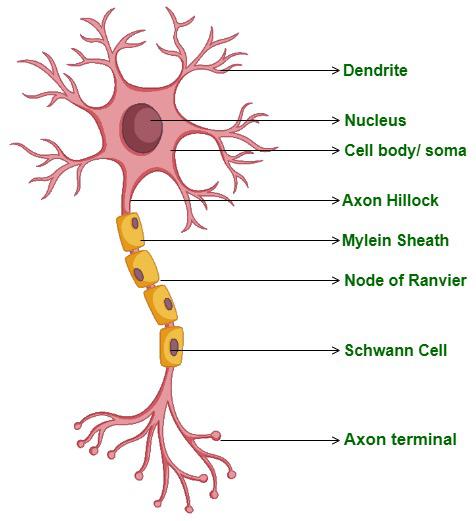
Diagram of Neuron
- A neuron is composed of three parts: cell body, dendrites, and axon.
- The cell body contains cytoplasm along with cell organelle and granules known as **Nissl's granules.
- Dendrites are small fibers that project out of the cell body. They also contain Nissl's granules. Its function is to transmit impulses toward the cell body.
- Axon is a long fiber, branched at the distal end. The axons transmit nerve impulses away from the cell body to synapse or to a neuro-muscular junction.
- Neurotransmitters are present in the synoptic knob present at the end of the axon.
- Axons are divided into three types based on the number of axons and dendrites.
There are two types of axons, namely, **myelinated and non-myelinated.

- The myelinated nerve fibers are enveloped with **Schwann cells. It forms a myelin sheath around the axon. For example, Spinal and cranial nerves.
- **Non-myelinated fiber is enclosed by a Schwann cell that does not form a myelin sheath around the axon. Example: Autonomous and somatic neural systems. Nodes of Ranvier are the gaps between two adjacent myelin sheaths.
Generation and Conduction of Nerve Impulse
First, let's discuss why the membrane of the nerve is polarized. Neural membrane contains different types of ion channels, that are selectively permeable to different ions.
**At the resting phase (when the neuron is not conducting any impulse), the axonal membrane is permeable to potassium ions and impermeable to sodium ions, and also to negatively charged proteins present in the axoplasm. Therefore, inside the axon, there is a high concentration of potassium ions and negatively charged proteins and a low concentration of sodium ions. Outside the axon, there is a low concentration of potassium ions and a high concentration of sodium ions. Thereby, creating a **concentration gradient.
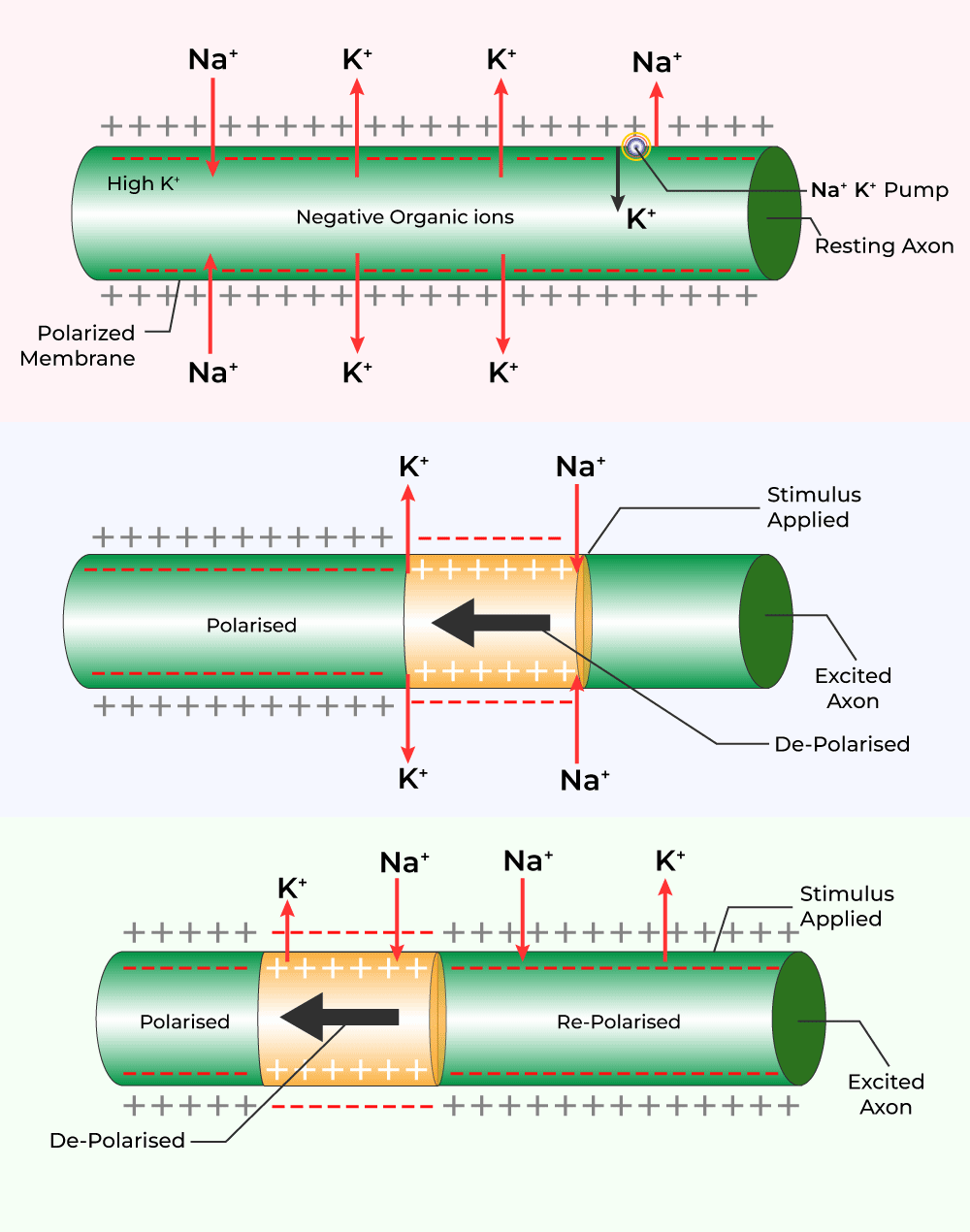
This ionic gradient is maintained by the **sodium-potassium pump, which transports 3 Na+ outwards for 2 K+ into the cell. Hence, the axonal membrane's outer surface possesses a positive charge, and the inner surface negative charge, therefore is polarized. The electrical potential difference across the resting plasma membrane is called **the resting potential. Now let's discuss the mechanism of conduction of impulse.
**Mechanism of Generation and Conduction of Impulse
When the polarized membrane is stimulated, the membrane at site A becomes permeable to sodium ions, leading to a rapid influx of sodium ions, that results in the reversal of polarity at site A. Now, the outer surface of the membrane is negatively charged and the inner surface is positively charged. This reversal of polarity is known as **depolarization. This difference in electrical potential across the membrane at site A is called a **nerve impulse.

At site B, the outer surface of the membrane is positively charged, and the inner surface is negatively charged, therefore the current flows on the inner surface from site A to site B and on the outer surface from site B to site A, thus completing the circuit of current flow. The action potential is generated at site B, and the impulse generated at site A arrives at site B. The cycle is repeated along the length of the axon and an impulse is conducted.
Transmission of Nerve Impulses
Transmission of impulses from one neuron to another takes place through **synapses.A synapse is formed by the membranes of a pre-synaptic neuron and a post-synaptic neuron, that may or may not be separated by a gap called synaptic cleft. Two types of synapses are:
**Electrical synapses
The membrane of pre and post-synaptic neurons is very close. Current flows directly from one neuron to another in this synapse. This type of synapse is very rare in humans and is similar to the transmission in a single axon.

**Chemical Synapses
The membranes of the pre and post-synaptic neurons are separated by a fluid-filled space called synaptic cleft. Neurotransmitters at the axonal ends are involved in the transmission of impulses at these synapses.
Neurotransmitter released at the synaptic cleft binds with the specific receptor, present on the post-synaptic membrane. New potential ( either excitatory or inhibitory) is generated at the postsynaptic neuron by opening ion channels.
Central Nervous System
The brain is present inside the skull and is covered by a membrane known as **cranial meninges. Meninges is divided into three parts, the outer layer called the dura mater, the middle layer called the arachnoid, and the inner layer called pia mater. The brain performs various functions like balancing of body, thermoregulation, hearing, vision, voluntary movements, etc. The brain is divided into three parts, that is forebrain, midbrain, and hindbrain.
**Also Read: Difference Between Brain and Spinal Cord Meninges
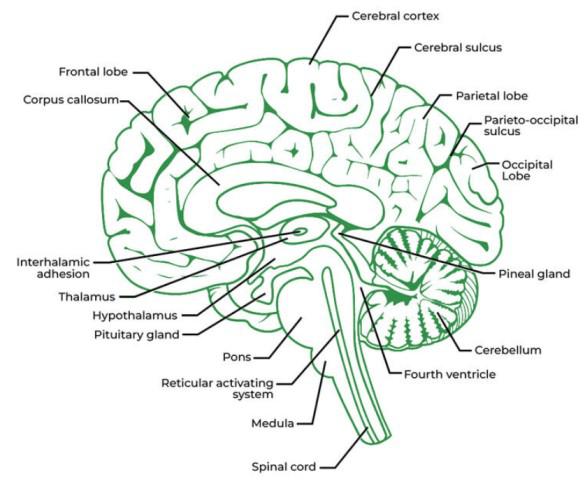
Forebrain
The forebrain consists of the **cerebrum, thalamus, and hypothalamus.
- **Cerebrum
- The cerebrum consists of left and right cerebral hemispheres connected by nerve fibers called the corpus callosum.
- The outer layer covering the cerebral hemispheres is called the Cerebral cortex or Grey matter.
- Within the cerebral cortex are motor areas, sensory areas, and large association areas.
- Beneath the cerebral cortex lies the white matter, consisting of fibers covered with a myelin sheath.
- **Thalamus helps in the coordination of sensory and motor signals.
- **Hypothalamus controls body temperature, urges for drinking and eating, and secret hypothalamic hormones.
**Also Read: Difference Between Cerebellum And Cerebrum

Human Brain Diagram
Midbrain
Located between the thalamus/Hypothalamus of the forebrain and the pons of the hindbrain. The four lobes present at the dorsal portion of the midbrain are known as **corpora quadrigemina.
Hindbrain
Consists of the **pons, cerebellum, and medulla oblongata.
- **Pons connects different regions of the brain through fiber tracts.
- **Cerebellum provides space for more neurons through its convoluted surface.
- **Medulla oblongata controls cardiovascular reflex, respiration, and gastric secretion.
Midbrain, pons, and medulla oblongata together form the **brain stem. The brain stem connects the brain and spinal cord.
**Also Read: