Plant Hormones (original) (raw)
Last Updated : 9 Apr, 2026
Plant hormones, commonly known as phytohormones, are chemical substances that oversee and coordinate a variety of growth and developmental functions in plants. They are crucial in processes such as cell division, elongation, flowering, fruit set, and responses to environmental changes. These hormones are produced in specific parts of the plant and moved to various locations.
Types of Plant Hormones
They are derived from multiple sources, including gases such as ethylene, carotenoid compounds like abscisic acid, terpenes such as gibberellins, and indole derivatives like auxins. It is divided into two categories based on their functions:
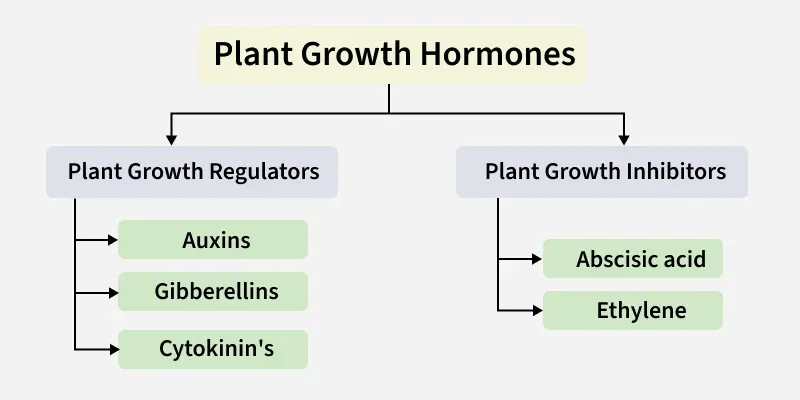
Plant Growth Promoters
Plant growth promoters are the hormones that promote the growth and development of plants. There are three types of hormones:
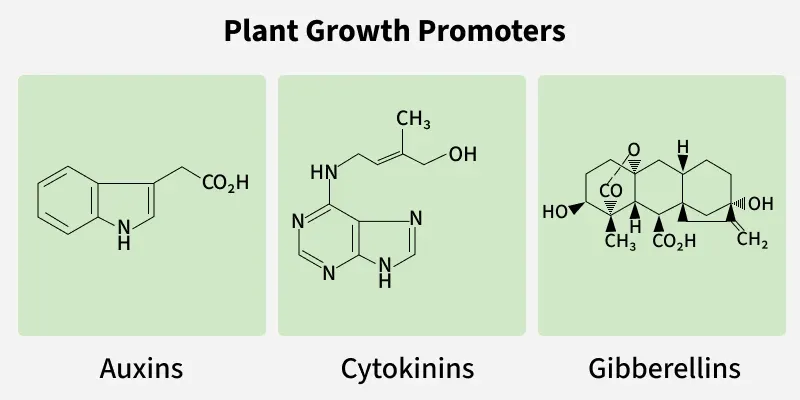
1. Auxins
- It is discovered by F.W. Went and produced in shoot tips and young leaves.
- Promoting cell elongation and regulating plant growth are the main functions of this hormone.
- Other functions of this hormone are to promote root formation, stimulate elongation of the stem, Control phototropism and geotropism, prevent premature leaf and fruit drop, and to be used to produce parthenocarpy in tomato and cucumber.
**Examples: Indole-3-acetic acid (IAA), Indole-3-butyric acid (IBA), Naphthalene acetic acid (NAA).
2. Gibberellins
- It is found in the fungus _Gibberella fujikuroi and produced in young leaves, seeds, and shoot tips.
- Stimulating cell elongation and breaking dormancy are the main functions of this hormone.
- Other functions of this hormone are to promote stem elongation, break seed dormancy, stimulate flowering in long-day plants, increase fruit sizes in grapes and apples, and stimulate flowering in long-day plants.
**Example: Gibberellic acid (GA₃).
3. Cytokinins
- It is discovered by Miller and Letham and produced in root tips, developing fruits, and seeds.
- Promoting cell division is the main function of this hormone.
- Other functions of this hormone are to promote the formation of lateral buds and shoots, delay senescence, stimulate cell division, promote growth, and work with auxins to control tissue culture growth.
**Example: Kinetin and Zeatin.
Plant Growth Inhibitors
Plant growth inhibitors are the hormones that slow down or stop the growth and development of plants. There are two types of hormones:
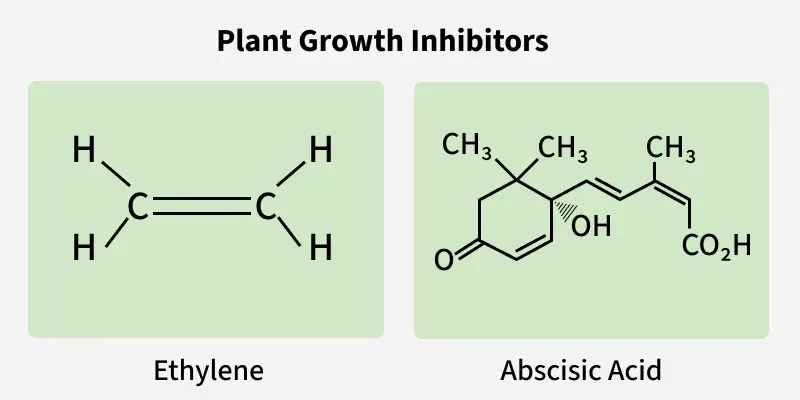
1. Abscisic Acid (ABA)
- It is also known as a Stress hormoneand is produced in mature leaves, stems, green fruits, and seeds.
- Inhibiting growth and promoting dormancy are the main functions of this hormone.
- Other functions of this hormone are to inhibit cell division and elongation, prepare plants for stress conditions, promote the falling of leaves, flowers, and fruits during unfavourable conditions, induce dormancy in seeds and buds, and close stomata to reduce water loss.
**Example: Abscisic Acid (ABA).
2. Ethylene
- It is the only gaseous plant hormone and is produced in ripening fruits, ageing leaves, and nodes of stems.
- Promoting ripening of fruits and ageing (senescence) are the main functions of this hormone.
- Other functions of this hormone are to affect growth at high concentrations, stimulating flowering in pineapple, inducing leaf and flower senescence, and promoting fruit ripening in banana, mango, and tomato.
**Example: Ethylene gas (C₂H₄).