Ethylene Hormone (original) (raw)
Last Updated : 3 Jun, 2026
Ethylene is a gaseous plant hormone that regulates many important processes related to plant growth, development, and ageing. It is chemically represented by the formula C₂H₄ and is unique among plant hormones because it exists in gaseous form, allowing rapid diffusion through plant tissues. Ethylene plays a major role in fruit ripening, leaf fall, flowering, senescence, and stress responses in plants. Due to its important function in the ripening of fruits, it is commonly known as the “ripening hormone” of plants.
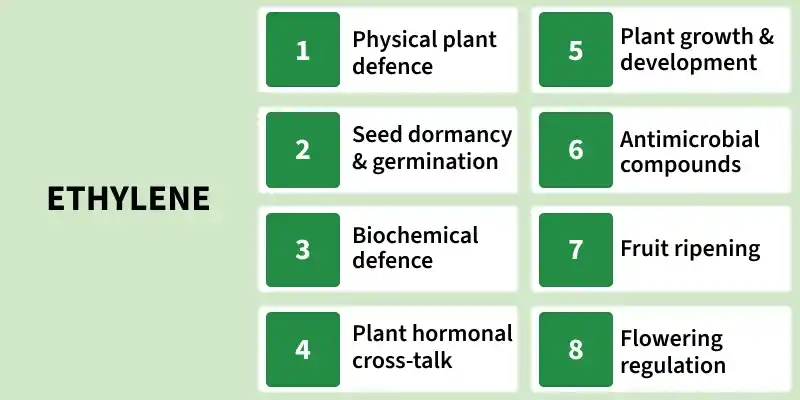
Discovery and Nature of Ethylene Hormone
- The discovery of ethylene as a plant hormone occurred through observations made during the nineteenth century.
- Scientists noticed that plants growing near street lamps that used illuminating gas showed unusual growth patterns.
- These plants exhibited symptoms such as reduced stem elongation, thickened stems, premature leaf fall, and abnormal bending of shoots.
- Later, researchers identified ethylene gas present in the illuminating gas as the substance responsible for these effects.
- Further investigations confirmed that ethylene is naturally produced by plants themselves and functions as a plant hormone regulating growth and developmental activities.
- This discovery marked an important milestone in plant physiology and led to extensive studies on the role of ethylene in plants.

Biosynthesis of Ethylene
Ethylene is produced in plants through a metabolic pathway involving the amino acid methionine. Methionine is converted into S-adenosyl methionine (SAM), which is then transformed into ACC (1-aminocyclopropane-1-carboxylic acid). Finally, ACC is converted into ethylene by the enzyme ACC oxidase. The synthesis of ethylene increases under various conditions such as:
- Fruit ripening
- Senescence and ageing
- Mechanical injury
- Drought and flooding
- Pathogen infection
- High temperature and stress
Characteristics of Ethylene Hormone
Ethylene possesses several unique characteristics that distinguish it from other plant hormones:
- It is the only gaseous plant hormone.
- It can diffuse rapidly through plant tissues and the atmosphere.
- It is produced in almost all plant parts.
- It regulates both growth-promoting and growth-inhibiting activities.
- It is highly active even in very small concentrations.
- It plays a major role in fruit ripening and senescence.
Functions of Ethylene Hormone
Ethylene performs a wide range of physiological functions in plants and influences various stages of plant growth and development.
1. Promotes Fruit Ripening
- One of the most important functions of ethylene is the acceleration of fruit ripening.
- Ethylene stimulates several biochemical and physiological changes in fruits, including softening, colour development, starch conversion into sugars, and development of aroma and flavour.
- During ripening, chlorophyll breaks down and pigments such as carotenoids and anthocyanins become visible, giving fruits their characteristic colours.
- Ethylene also increases enzyme activity responsible for cell wall breakdown, making fruits softer and sweeter.
- Fruits such as banana, mango, apple, papaya, tomato, and pear show rapid ripening in the presence of ethylene.
2. Promotes Seed Germination
- Ethylene helps in breaking seed dormancy and promotes seed germination in certain plant species.
- It stimulates metabolic activities and enhances enzyme action necessary for the emergence of the seedling.
- In some plants, ethylene helps seeds germinate even under stressful environmental conditions.
3. Induces Flowering
- Ethylene induces flowering in certain plants such as pineapple.
- Commercially, ethylene-releasing compounds are used to synchronise flowering in pineapple cultivation, ensuring uniform fruit production.
- The hormone helps stimulate floral initiation and improves crop management practices.
4. Influences Sex Expression in Flowers
- Ethylene affects the development of male and female flowers in some plants.
- In cucurbits such as cucumber and pumpkin, ethylene promotes the formation of female flowers, which increases fruit production and agricultural yield.
- This property is especially useful in crop improvement and horticultural practices.
5. Stimulates Root Initiation and Growth
- Ethylene promotes the formation of adventitious roots and root hairs in plants.
- Root hairs increase the surface area for water and mineral absorption from the soil.
- Under flooded conditions, ethylene stimulates root growth adaptations that help plants survive in low-oxygen environments.
6. Causes Epinasty
- Ethylene induces epinasty, which refers to the downward bending or curling of leaves and petioles.
- This occurs because ethylene causes faster growth on the upper side of the leaf stalk compared to the lower side.
- Epinasty is often observed in plants under stress conditions such as flooding and waterlogging.
7. Regulates Plant Responses Under Stress
- Ethylene plays an important role in helping plants respond to environmental stresses such as drought, salinity, flooding, mechanical injury, and pathogen attack.
- The hormone activates defence mechanisms and adaptive responses that improve the survival of plants under unfavourable conditions.
8. Inhibits Longitudinal Growth and Promotes Horizontal Growth
- Ethylene inhibits vertical or longitudinal growth of stems while promoting lateral or horizontal expansion. As a result, stems become shorter, thicker, and more robust.
- This effect is commonly referred to as the “triple response” in seedlings, which includes reduced elongation, increased stem thickness, and horizontal growth.
9. Promotes Senescence and Abscission
- Ethylene accelerates the ageing process, known as senescence, in leaves, flowers, and fruits.
- It promotes the breakdown of chlorophyll, proteins, and other cellular components, leading to yellowing and ageing of tissues.
- The hormone also stimulates abscission, which is the shedding of leaves, flowers, and fruits from the plant.
Commercial Uses of Ethylene Hormone
Ethylene has several important commercial applications in agriculture and horticulture due to its ability to regulate ripening and flowering.
- **Artificial Fruit Ripening: Ethylene is widely used for artificial ripening of fruits such as bananas, mangoes, tomatoes, and apples during storage and transportation. Controlled ripening ensures uniform colour, texture, flavour, and market quality.
- **Degreening of Fruits: Ethylene helps remove green colour from fruits such as oranges and lemons by promoting chlorophyll breakdown. This process improves the appearance and market value of fruits.
- **Induction of Flowering: Ethylene is used commercially to induce flowering in pineapple plants, leading to uniform flowering and synchronized fruit production.
- **Thinning of Flowers and Fruits: Ethylene helps remove excess flowers and fruits in certain crops, improving fruit size and quality.
- **Enhancement of Latex Flow: In rubber plants, ethylene-releasing compounds are used to stimulate latex production and increase yield.
Advantages of Ethylene Hormone
- Ethylene ensures even ripening of fruits, improving their quality, taste, colour, and market value.
- The hormone is widely used for controlling flowering, ripening, and crop management practices.
- Ethylene helps plants adapt to environmental stresses such as flooding, drought, and mechanical injury.
- By regulating flowering and fruit ripening, ethylene contributes to increased crop yield and better harvest management.
Disadvantages of Ethylene Hormone
- Overproduction of ethylene may lead to early senescence and ageing of leaves, flowers, and fruits.
- Excess ethylene during storage may accelerate ripening and cause fruits to spoil quickly.
- High concentrations of ethylene can reduce stem elongation and negatively affect normal plant growth.
- Ethylene accelerates wilting and ageing in cut flowers, reducing their shelf life and commercial value.