How to Become a Data Engineering and Retrieval (original) (raw)
Last Updated : 23 Mar, 2026
Data and Retrieval Engineers build the data infrastructure and search systems that allow AI models to access reliable knowledge. This role combines data engineering, search technology and LLM systems to ensure that AI applications retrieve accurate and relevant information from large datasets.
The overall workflow of a Data and Retrieval Engineer typically includes:
- **Building Data Pipelines: Designing pipelines that collect, process and prepare datasets used by AI systems.
- **Improving Search Relevance: Developing retrieval systems that return the most accurate and useful information for a given query.
- **Managing Knowledge Sources: Organizing documents, databases and external data sources that AI models rely on for information.
- **Optimizing Retrieval Systems: Improving how information is indexed, searched, ranked and delivered to AI models.
Skills Required
1. Python Programming
Python is widely used by data and retrieval engineers for building data pipelines and processing datasets.
- Introduction
- Variables
- Data Types
- Conditional Statements
- Loops
- Functions
- NumPy for Numerical Computing
- Pandas for Data Manipulation
2. Modern Data Stack
The modern data stack enables efficient data processing, storage and management required for large scale AI and retrieval systems.
3. Data Quality Management
Data quality management ensures that datasets used by AI and retrieval systems are accurate, consistent and reliable, helping improve retrieval results and system performance.
- **Data Validation and Constraints****:** Applying rules and checks to ensure data values follow expected formats, ranges and relationships.
- **Anomaly Detection****:** Identifying unusual patterns or unexpected values in data that may indicate errors or inconsistencies.
- **Schema Evolution****:** Managing changes in data structure over time while maintaining compatibility with existing data pipelines and systems.
4. Information Retrieval (IR) Techniques
Information retrieval techniques enable AI systems to search and retrieve relevant information from large document collections efficiently.
- **BM25 Ranking****:** A traditional keyword based ranking method that scores documents based on term frequency and relevance to the query.
- **Dense Retrieval****:** Uses vector embeddings to find semantically similar documents rather than relying only on keyword matching.
- **Hybrid Search Systems****:** Combines keyword based search and vector based retrieval to improve search accuracy.
- **Document Ranking****:** Ordering retrieved documents based on their relevance so the most useful results appear first.
5. Query Understanding
Query understanding helps retrieval systems interpret user queries more accurately, improving the relevance of search results.
- **Query Rewriting: Modifying or expanding a query to improve search results and better match relevant documents.
- **Query Decomposition: Breaking complex queries into smaller parts so each component can be searched more effectively.
- **Multi Hop Retrieval****:** Retrieving information from multiple sources or documents to answer complex queries that require several reasoning steps.
6. Unstructured Data Pipelines
AI systems often rely on large collections of unstructured data that must be processed and organized before retrieval.
- **Processing PDFs and Documents: Extracting and structuring text from documents so it can be indexed and searched.
- **Web Page Data Extraction: Collecting and processing information from web pages for use in retrieval systems.
- **Image Based Information Sources:Extracting useful information from images using techniques such as OCR or vision models.
RAG Corpus Engineering
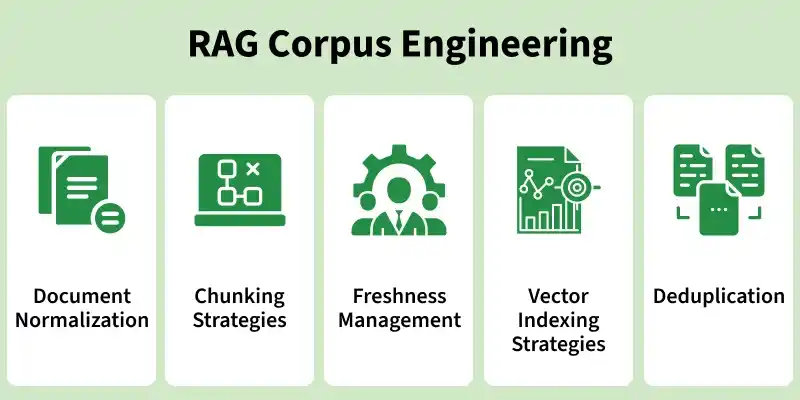
RAG corpus engineering focuses on creating and maintaining a well organized collection of documents that AI systems can retrieve from. These documents serve as the knowledge source that helps the model generate accurate and reliable answers.
RAG Corpus Engineering
Important topics include:
- **Document Normalization:Cleaning and standardizing documents so they can be processed and indexed consistently.
- **Chunking Strategies:Splitting large documents into smaller sections to improve retrieval accuracy.
- **Deduplication:Removing duplicate documents or repeated content to maintain data quality.
- **Freshness Management: Ensuring the document collection is regularly updated so retrieved information remains current and relevant.
Vector Indexing Strategies
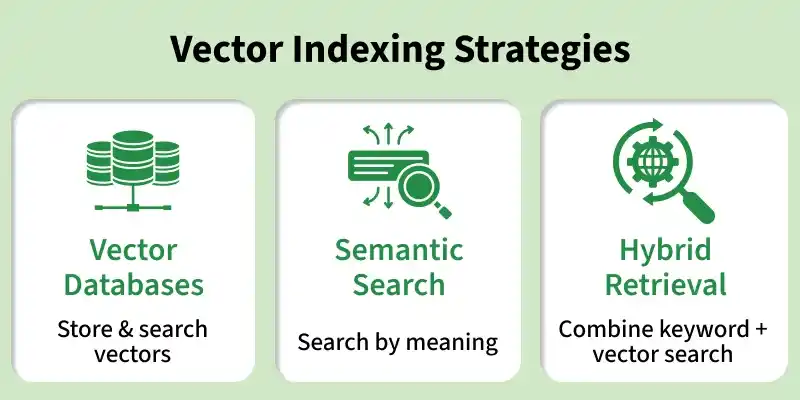
Vector indexing strategies focus on building efficient vector search systems that allow AI models to retrieve relevant information quickly.
Vector Indexing Strategies
Important topics include:
- **Vector Databases****:** Specialized databases designed to store and search high dimensional vector embeddings efficiently.
- **Semantic Search Systems: Retrieval methods that use vector embeddings to find documents based on meaning rather than exact keywords.
- **Hybrid Retrieval Pipelines: Systems that combine vector search with traditional keyword based search to improve retrieval accuracy.
Advance Retrieval Techniques
Advanced retrieval techniques help improve the accuracy, reliability and robustness of retrieval systems when dealing with complex queries and large knowledge sources.
1. Context Packing
Selecting the most relevant information from retrieved documents so it fits within the token limits of LLM context windows while preserving useful evidence.
2. Citation Verification
Ensuring retrieved information can be traced back to its original sources so generated responses include proper evidence and attribution.
3.Handling Hard Queries
Managing complex retrieval scenarios where standard search methods may struggle to return accurate results.
- **Ambiguous Queries: Queries with multiple possible interpretations requiring additional context.
- **Long Tail Queries: Rare or highly specific queries that may not match common search patterns.
- **Conflicting Information Sources: Situations where different documents provide inconsistent or contradictory information.
Fields in Data and Retrieval Engineering
Data and retrieval engineering is used across many industries to build systems that organize, search and retrieve information efficiently for AI applications.
- **Search and Information Retrieval Systems: Systems that help users find relevant information from large document collections or databases.
- **Enterprise Knowledge Systems: Platforms that allow organizations to search internal documents, reports and knowledge bases.
- **Recommendation and Discovery Systems: Retrieval systems that help users discover relevant content, products or information.
- **Document Intelligence Systems: Tools that process and retrieve information from documents such as PDFs, reports and web pages.
- **AI Powered Question Answering Systems: Systems that retrieve relevant information to generate accurate answers for user queries.