What is IP Routing? (original) (raw)
Last Updated : 23 Jul, 2025
IP routing is the process that defines the shortest path through which data travels to reach from source to destination. It determines the shortest path to send the data from one computer to another computer in the same or different network. Routing uses different protocols for the different networks to find the path that data follows. It defines the path through which data travel across multiple networks from one computer to others. Forwarding the packets from source to destination via different routers is called routing. The routing decision is taken by the routers.

IP Routing
Importance of IP Routing
IP routing is important because it helps data travel from one device to another across different networks, like from your home network to the internet. It makes sure the data takes the quickest and most efficient route, which helps everything work faster. If one path stops working, IP routing automatically finds another way to send the data, keeping things running smoothly. It also helps manage network traffic so things don't get too crowded, and it prioritizes important data like voice or video calls to keep them clear.
Types of Routing
There are three different types of routing:
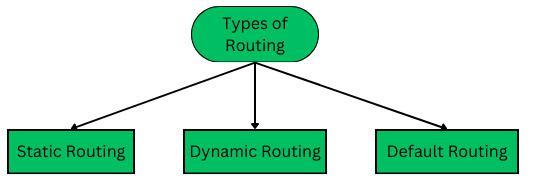
Types of Routing
- **Static Routing: It is also known as nonadaptive routing. In this type of routing the routing table is updated by the network administrator manually and routing decisions are not based on topology or condition of network.
- **Dynamic Routing: It is also known as **adaptive routing. In this type of routing the routing table is automatically updated using routing protocols. In response to changes in condition or topology of network, router adds a new route in the routing table.
- **Default Routing: In this type of routing the router is configured to send all the data towards a specific router. The default route is chosen only when specific route is not mentioned in the routing table. This routing is generally used with the stub routers.
Read in detail about Difference between Static and Dynamic Routing
How does IP Routing Work
When the data is sent from the source to the destination the TCP and other protocols of the source work and form an IP packet that is sent to the network. When an IP packet is sent to the network from the source it has to pass through multiple routers to reach the destination. The router in the network gets the destination address from the packet and through its routing table identifies the next router information to which the data packet has to be passed. The routing table of the router includes various information about the next router, its cost, and other necessary information. The router takes the routing decision with the help of routing protocols and a routing table to which next router the packet has to be sent to find the best route to reach the destination. Different packets can be sent through different paths but all the packets reach their intended destination. When the packets reach the destination through different routers it sends them to the TCP for further processing.
Types of Routing Protocols
For taking routing decisions router needs various routing protocols and a routing table. The routing protocols are divided into two domains:
- Interdomain Routing protocols
- Intradomain Routing protocols

**Interdomain Routing Protocols
This routing is used among autonomous networks and it includes **Path Vector Routing(PVR).
**Path Vector Routing
- Path vector routing uses path vectors for routing..
- These path vectors are dynamically updated
- Border Gateway Protocol(BGP) is used in PVR for making routing decisions.
Intra domain Routing Protocols
This routing is used within the autonomous networks and it includes two types of routing:Distance Vector Routing(DVR) and Link State Routing(LSR).
Distance Vector Routing
- Distance vector routing uses distance vectors for routing.
- Each router maintains a routing table that keeps the shortest distance to other routers.
- It uses the Bellman-Ford algorithm for the computation of various distances.
- Routing Information Protocol(RIP) is used in DVR for making routing decisions.
- DVR suffers from count to infinity problem which can be solved using split-horizon or route poisoning.
**Link State Routing
- Link State routing uses the state of the link for routing.
- It uses the Dijkstra algorithm for the computation of various distances.
- Open Shortest Path First(OSPF) is used in LSR for making routing decisions.
- LSR suffers from heavy traffic due to flooding which can be solved by the TTL field.
Read more about Differences between Intradomain and Interdomain Routing
Advantages of IP Routing
- **Scalable: IP routing lets networks grow easily. You can add more devices or networks without problems.
- **Flexible: If something changes, like a path breaking, IP routing can find a new way for the data to travel.
- **Efficient: It sends data along the fastest routes, making everything work faster.
- **Reliable: If one connection stops working, IP routing automatically finds another way to keep the network running.
- **Balanced Traffic: It spreads out data across different paths to avoid slowdowns or overloads on one connection.
- **Secure: IP routing can help block bad traffic and control access, keeping the network safer.
- **Cost-saving: It can choose the cheapest path for data, saving money on network costs.
- **Works with Different Networks: IP routing can connect different types of networks, whether they’re small or large.
- **Easy to Set Up: Modern tools can automatically configure IP routing, making it simple to manage.
Disadvantages of IP Routing
- **Complexity: Setting up IP routing in large networks with many devices and routes can be confusing.
- **Overhead: Routers need extra power and memory to process routes.
- **Routing Loops: If things are set up wrong, data can keep going in cycles without reaching its destination.
- **Vulnerable to Attacks: IP routing can be attacked by hackers and can cause disruptions or stealing of data.
- **Inconsistent Routing Decisions: Routers may make different decisions on the best path which can lead to inefficiency or slower speeds.
Application of IP Routing
- **Connecting Networks: IP routing is essential for network connectivity, allowing devices across different networks (home, office, etc.) to communicate by finding the fastest route for data.
- **Enabling Internet Access: IP routing ensures smooth internet access by directing data from local networks to the best path for connecting to websites and services.
- **Network Redundancy for Reliability: Network redundancy through IP routing ensures that if one route fails, another path is found.
- **High-Quality Voice Calls (VoIP): For VoIP (Voice over IP) services, IP routing directs voice data over the fastest route. It ensures **clear voice calls with minimal delay.
- **Improved Website and Video Loading (CDNs): Content Delivery Networks (CDNs) use IP routing to direct users to the closest server, improving website load speed and video streaming performance.
- **Traffic Prioritization and QoS: IP routing can prioritize important data (like live streaming or video calls) to ensure they perform well even during high traffic hence, improving Quality of Service (QoS).