Web Based Testing Software Testing (original) (raw)
Last Updated : 9 Jun, 2026
Web-Based Testing is the process of testing web applications or websites to identify defects and ensure they function correctly across different browsers, devices, and platforms. It helps verify functionality, performance, security, and user experience before the application is released to users.
- Ensures the web application works correctly under different environments and conditions.
- Identifies bugs, compatibility issues, and quality-related risks.
- Verifies performance, security, and usability of the website or web application.
**Example: An e-commerce website is tested on Chrome, Firefox, and Edge to ensure search, cart, and payment features work correctly.
Web Application Architecture
Web Application Architecture defines the structure and interaction of components that work together to deliver web-based services to users. It describes how data flows between the client, server, application logic, and database.
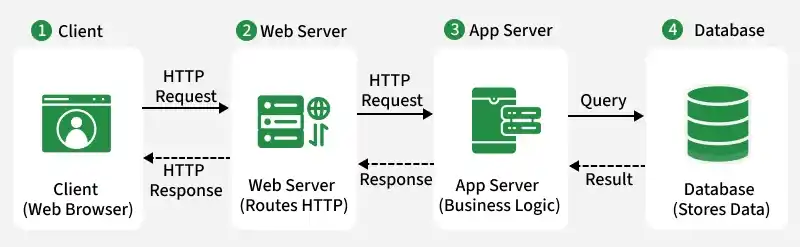
Web Application Architecture
Components
- **Client (Web Browser): The client is the user-facing interface that sends requests to the web server and displays the received web pages. Examples include Chrome, Firefox, Edge, and Safari.
- **Web Server: The web server receives requests from clients and serves static content such as HTML, CSS, and JavaScript files. It also forwards dynamic requests to the application server.
- **Application Server: The application server contains the business logic of the web application. It processes user requests, performs calculations, and communicates with the database.
- **Database Server: The database server stores, retrieves, and manages application data. It ensures data integrity and supports operations such as insert, update, delete, and query.
Types of Web Testing
1. Functional Testing
Verifies that the application works as expected.
- Unit Testing: Tests individual components/functions in isolation
- Integration Testing: Tests how modules interact with each other
- End-to-End (E2E) Testing: Simulates real user flows from start to finish
- Regression Testing: Ensures new changes don't break existing features
- Smoke Testing: Quick sanity checks after a new build
2. **UI / Front-End Testing
Focuses on the visual and interactive layer.
- Cross-browser Testing: Checks behavior across Chrome, Firefox, Safari, Edge, etc.
- Responsive/Layout Testing: Validates UI across screen sizes and devices
- Visual Regression Testing: Detects unintended visual changes using screenshots
3. Performance Testing
Measures speed, stability, and scalability.
- Load Testing: Behavior under expected traffic
- Stress Testing: Behavior under extreme/peak traffic
- Spike Testing: Response to sudden traffic surges
- Soak/Endurance Testing: Sustained load over a long period
4. **Security Testing
Identifies vulnerabilities in the application.
- Penetration Testing: Simulated attacks to find exploits
- OWASP Testing: Checks for common vulnerabilities (XSS, SQL injection, CSRF)
- Authentication/Authorization Testing: Validates access control
5. **API Testing
Tests the backend services independently of the UI.
- Validates request/response structure, status codes, and data integrity
- Tools: Postman, REST Assured, Insomnia
6. **Accessibility Testing
Ensures usability for people with disabilities.
- Checks compliance with WCAG standards
- Tools: Axe, Lighthouse, WAVE
Considerations in Web Application Testing
As a website consists of frontend, backend, and servers, testers must consider multiple factors like HTML pages, internet protocols, firewalls, and server-side applications during testing.
Key Considerations
- **Link Validation: All internal and external links should be checked to ensure they are working correctly without broken URLs.
- **Browser Compatibility: The application should function properly across different browsers like Chrome, Firefox, Edge, and Safari.
- **Device Compatibility: The website should work smoothly on desktops, tablets, and mobile devices with different screen sizes.
- **User Interface (UI): The layout, design, and responsiveness should be user-friendly and visually consistent.
- **Security Requirements: Proper security measures must be tested to protect data from unauthorized access and attacks.
- **Performance Considerations: The application should load quickly and handle expected and peak user loads efficiently.
- **Data Integrity: Data flow between frontend, backend, and database must be accurate and consistent.
- **Server and Network Configuration: Web servers, firewalls, and network protocols should function correctly without affecting performance.
- **Usability: The application should be easy to navigate and provide a smooth user experience.
- **Scalability: The system should be able to handle increasing users and traffic without performance degradation.
Steps in Web Testing
- **Requirement Analysis: Web testing starts by understanding the requirements, functionalities, and business goals of the web application.
- **Test Planning: A test plan is created, defining scope, objectives, resources, schedule, and testing approach.
- **Test Case Design: Test cases are prepared based on requirements to cover all functional and non-functional scenarios.
- **Test Environment Setup: The required browsers, devices, servers, and tools are configured for testing.
- **Test Execution: Test cases are executed manually or using automation tools to identify defects.
- **Defect Reporting: Bugs and issues are logged in defect tracking tools with proper details for developers to fix.
- **Test Re-Testing: Fixed defects are retested to ensure the issues are resolved correctly.
- **Regression Testing: Existing functionalities are tested again to ensure new changes have not affected them.
- **Test Closure: Testing activities are completed, and final reports and documentation are prepared.
- **Release & Maintenance: The application is released, and continuous testing is performed for updates and enhancements.
Web testing tools are software applications used to automate, manage, and execute testing activities for web applications. They help testers improve efficiency, accuracy, and test coverage while reducing manual effort.
- Selenium: It is an open-source automation tool used for testing web applications across different browsers.
- Cypress: It is a modern end-to-end testing framework for fast and reliable web application testing.
- Playwright: It is an automation framework used for cross-browser testing of modern web applications.
- Postman: It is a popular tool used for API testing and validation.
- Apache JMeter: It is a performance testing tool used to measure application speed and scalability.
- BrowserStack: It is a cloud-based platform for testing websites on real browsers and devices.
- TestNG: It is a testing framework used to organize, execute, and report test cases.
- Bugzilla: It is a defect tracking tool used to manage and monitor software bugs.
- JIRA: It is a project management and issue-tracking tool used for defect management.
- Lighthouse: It is an automated tool used to evaluate website performance, accessibility, and SEO.
Limitations of Web-Based Testing
- **Browser Compatibility Issues: Testing must be performed on multiple browsers to ensure consistent functionality and appearance.
- **Device Diversity: Different screen sizes, operating systems, and devices increase the complexity of testing.
- **Time-Consuming Process: Comprehensive testing across various environments and scenarios can require significant time and effort.
- **High Maintenance Cost: Automated test scripts often need updates whenever the web application changes.
- **Network Dependency: Application performance may vary depending on internet speed and network conditions.
- **Security Challenges: Identifying and addressing all potential security vulnerabilities can be difficult.
- **Frequent Updates: Continuous changes to web applications may require repeated testing and maintenance.
- **Complex Test Environments: Setting up and managing different browsers, devices, and configurations can be challenging.