ClientServer Architecture System Design (original) (raw)
Client-Server Architecture - System Design
Last Updated : 29 Apr, 2026
Client–server architecture is a widely used system design where multiple clients request services or resources from a central server. The server manages processing, data storage, and resources, while clients handle user interaction.
- Clients communicate with servers using protocols like HTTP/HTTPS or SQL to send requests and receive responses.
- Servers handle centralized data management, processing, and storage, ensuring efficient system operation.
- The architecture supports scalability (vertical and horizontal) and is widely used in web apps, databases, and email systems.
Real-World Examples of Client-Server Architecture
Some are some real-world examples of Client Server Architecture are:
- **Banking Systems: Online banking applications use client-server architecture to enable customers (clients) to interact securely with bank servers. Clients can perform transactions, check balances, and manage accounts through web or mobile applications.
- **Enterprise Applications: Large organizations use client-server architecture for various internal systems such as ERP (Enterprise Resource Planning), CRM (Customer Relationship Management), and document management systems. Clients (employees or users) access centralized servers to retrieve and update data related to business operations.
- **Telecommunications: Telecom networks rely heavily on client-server architecture for services like voice-over-IP (VoIP), video conferencing, and messaging applications. Clients (users' devices or applications) communicate through servers that manage call routing, signaling, and media streaming.
- **Internet of Things (IoT): IoT ecosystems often employ client-server architecture for managing devices and collecting sensor data. Devices act as clients that send data to servers for processing, storage, and analysis. Examples include smart home systems and industrial IoT applications.
- **Healthcare Systems: Electronic Health Record (EHR) systems and telemedicine platforms utilize client-server architecture to securely manage patient records, facilitate remote consultations, and exchange medical data between healthcare providers and patients.
Design Principles for Effective Client-Server Architecture
Designing an effective client-server architecture involves several key principles that ensure the system is robust, scalable, secure, and efficient. Here are the main design principles:
**1. Modularity:
Modularity is a design principle that structures a system into independent, well-defined components, each handling a specific responsibility.
- **Separation of Concerns: Divide the system into distinct modules, such as the client, server, and database, each responsible for specific tasks. This separation simplifies development, testing, and maintenance.
- **Reusability: Design components that can be reused across different parts of the system or in different projects.
**2. Scalability:
Scalability is the ability of a system to handle increasing workloads efficiently by adapting its resources.
- The system achieves horizontal scalability by handling increased load through adding more servers or instances.
- The system supports vertical scalability by upgrading server hardware such as CPU, memory, and storage.
**3. Reliability and Availability:
Reliability ensures that a system continues to operate correctly and efficiently even in the presence of failures or high load.
- The system improves reliability through redundancy by using multiple servers to remain operational during failures.
- The system enhances performance using load balancing by distributing client requests across servers to avoid bottlenecks.
**4. Performance Optimization:
Performance optimization focuses on improving system speed and efficiency by reducing delays and resource usage.
- **Efficient Communication: Optimize the communication protocols and data exchange formats to reduce latency and bandwidth usage.
- **Caching: Use caching mechanisms to store frequently accessed data closer to the client to improve response times.
**5. Security:
Security ensures that data and system resources are protected from unauthorized access and potential threats.
- **Authentication and Authorization: Ensure that only authorized clients and users can access the server and its resources.
- **Encryption: Use encryption protocols (e.g., SSL/TLS) to secure data transmission between clients and servers.
Steps for Client-Side Design and Server-Side Design
Designing a client-server architecture involves distinct steps for both the client-side and server-side development. Here are the steps for each:
1. Client-Side Design
Client-side design focuses on how the user interface is built and how it interacts with the server to request and display data.
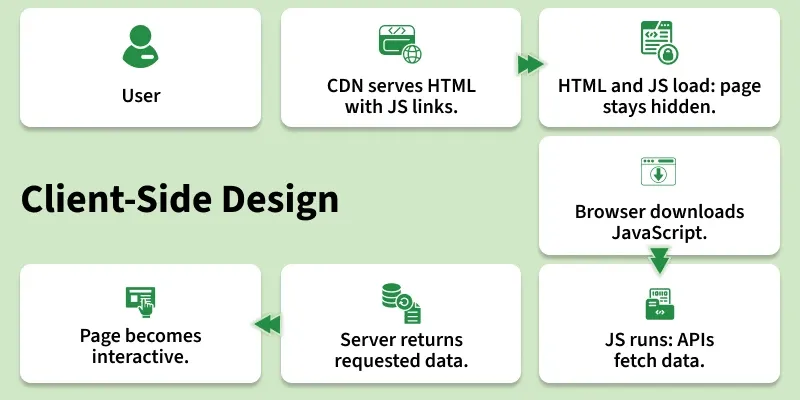
- **User Requests a Website: The process begins when a user requests a website by entering a URL in the browser or clicking a link.
- **CDN Serves HTML Files: A Content Delivery Network (CDN) quickly serves the HTML files, which contain links to the JavaScript files needed for the website.
- **Browser Downloads HTML and JavaScript: The browser first downloads the HTML file and then proceeds to download the linked JavaScript files. During this phase, the site may not be fully visible to the user, as it waits for the JavaScript to render the content.
- **Browser Downloads the JavaScripts: The browser continues to download the JavaScript files specified in the HTML.
- **JavaScript Execution and API Calls: Once downloaded, the JavaScript is executed. During execution, the JavaScript makes API calls to the server to fetch the necessary data. At this stage, placeholders may be visible to the user while the actual data is being fetched.
- **Server Responds with Data: The server responds to the API requests with the required data. This data is sent back to the client-side application.
- **Data Fills Placeholders: The data fetched from the APIs fills the placeholders in the client interface. The page becomes fully interactive and visible to the user.
2. Server-Side Design
Server-side design focuses on processing client requests, handling business logic, and managing data storage and responses.
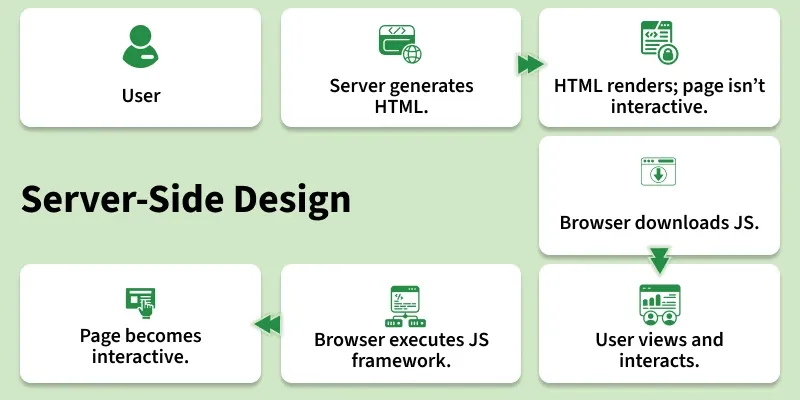
- **User Requests a Website: The process starts when a user requests a website.
- **Server Creates "Ready to Render" HTML Files: The server processes the request and generates HTML files that are ready to be rendered.
- **The Browser Can Quickly Render the HTML but the Site Isn't Interactive: The browser receives and renders the HTML quickly, allowing the user to see the content immediately, but the site is not yet interactive.
- **The Browser Downloads the JavaScript: The browser then downloads the necessary JavaScript files.
- **The User Can View Content and the Interactions Can Be Recorded: The user can view the content while the JavaScript is being downloaded. User interactions can be recorded even though the site is not fully interactive yet.
- **The Browser Executes the JS Framework: Once the JavaScript is downloaded, the browser executes the JavaScript framework (e.g., React, Angular).
- **The Recorded Interactions Can Be Executed and the Page Is Now Interactive: The recorded interactions are executed, and the page becomes fully interactive.
Networking and Communication in Client-Server Architecture
In system design, networking and communication in client-server architecture are fundamental concepts. Here's a breakdown:
- **Client-Server Model: This architecture involves two main components:
- **Client: Initiates requests to the server, typically in response to user actions or inputs.
- **Server: Responds to client requests, performing required processing and returning results.
- **Networking Protocols: These define rules and formats for communication between clients and servers. Examples include HTTP/HTTPS for web applications, TCP/IP for general network communication, and WebSocket for real-time applications.
Communication Patterns:
This section highlights how clients and servers interact while ensuring performance, security, and reliability.
- **Request-Response: Commonly used where a client sends a request to the server and waits for a response.
- **Scalability and Performance: Key considerations include load balancing (distributing client requests across multiple servers), caching (storing frequently accessed data), and optimizing network protocols to minimize latency.
- **Security: Ensuring data integrity, confidentiality, and authentication through measures like HTTPS (SSL/TLS), firewalls, and encryption protocols.
- **Fault Tolerance: The system ensures continuous service availability through fault tolerance by implementing redundancy and failover mechanisms to handle server failures or network issues.
Importance in System Design
Client-server architecture is critically important in system design for several reasons:
- **Centralized Management: Simplifies maintenance, monitoring, and security by managing resources from a single server.
- **Scalability: Supports growth by adding or upgrading servers without major changes to the system.
- **Resource Optimization: Efficiently distributes workload between clients (interaction) and servers (processing & storage).
- **Reliability and Availability: Ensures continuous service using redundancy, backups, and load balancing.
- **Enhanced Security: Improves data protection through centralized control, encryption, and authentication.
Key Components of Client Server Architecture
Client-server architecture in system design involves several key components that work together to ensure efficient communication, resource management, and service delivery.
- **Client: A device or application that requests services from the server, initiates communication, and processes the returned results.
- **Server: A system that provides services, handles requests, performs processing or data retrieval, and sends responses back to clients.
- **Network: Enables communication between clients and servers, ensuring reliable data exchange through protocols.
- **Middleware: Acts as an intermediary, offering services like authentication, logging, messaging, and transaction management.
- **Database: Stores and manages structured data on the server, ensuring consistency, integrity, and security.
- **User Interface (UI): The client-side interface that allows users to interact with the system by providing input and viewing results.
- **Application Logic: The core code and algorithms that process inputs, coordinate with the server, and manage data flow between components.