Are Intrusive Thoughts Normal? 6 Ways to Handle Them (original) (raw)
Key Insights
- Intrusive thoughts are normal, random, unwanted thoughts that everyone experiences.
- They can be distressing but do not reflect a person’s character or intentions.
- If intrusive thoughts become persistent, cause distress, or interfere, professional support is needed.
 Imagine this: You’re in the middle of an important meeting, and out of nowhere, a bizarre, totally uninvited thought pops into your head, something like, “_What if I kiss the person next to me?_”
That’s an intrusive thought: random, unwelcome — and completely normal.
These quirky mental visitors are part of the human experience, often harmless but occasionally unsettling. While they can spark curiosity or humor, they may also leave you questioning, “_Why did I think that?_”
The truth is, these thoughts reveal more about the brain’s quirks than your character. Exploring their origins and impact can turn mystery into understanding and anxiety into empowerment.
Before you continue, we thought you might like to download our five positive psychology tools for free. These science-based exercises will provide you with detailed insight into Positive CBT and give you the tools to apply it in your therapy or coaching.
This Article Contains
- What Are Intrusive Thoughts?
- What Causes Intrusive Thoughts?
- 3 Intrusive Thought Examples & Types
- How Unwanted Thoughts Affect Mental Health (Issues)
- 3 Ways of Treating Intrusive Thoughts
- How to Stop Intrusive Thoughts: 3 Tips & Techniques
- Recommendations From PositivePsychology.com
- A Take-Home Message
- Frequently Asked Questions
- References
What Are Intrusive Thoughts?
Intrusive thoughts are sudden, involuntary, and often distressing ideas or images that enter the mind without warning (Purdon & Clark, 1993).
These thoughts can range from harmless musings to unsettling scenarios that conflict with one’s values or beliefs. For most people, they are fleeting and easily dismissed, but for others, they can trigger different types of anxiety, shame, or self-doubt (Clark & Rhyno, 2005).
Importantly, the presence of intrusive thoughts does not reflect a person’s character or intentions; rather, they are a normal aspect of cognitive processing. Understanding their origins and how to manage them can help reduce their impact and foster mental wellbeing.
A definition of intrusive thoughts
Intrusive thoughts are thoughts that enter our consciousness, often without warning or prompting, with content that could be alarming, disturbing, or just flat-out weird. These thoughts are unwanted, distressing, and often incongruent with an individual’s values or intentions.
Rachman (1981, as cited in Purdon & Clark 1993, p. 714) defines an intrusive thought as “any thought, image or impulse that is repetitive, unacceptable and unwanted.”
What intrusive thoughts could mean
For most individuals, intrusive thoughts are simply a byproduct of how the brain works. Our minds generate random, spontaneous ideas or images, and these thoughts do not necessarily have a deeper meaning. Everyone experiences intrusive thoughts.
Intrusive thoughts, however, could be a common symptom of obsessive-compulsive disorder (OCD), post-traumatic stress disorder, or generalized anxiety disorder.
These thoughts may also be more likely to occur during periods of heightened stress or anxiety. Let’s dive deeper into the meanings.
OCD and intrusive thoughts
The main difference between intrusive thoughts and obsessive-compulsive disorder lies in the characteristics, persistence, and impact of the thought, as well as the associated behavioral responses (Abramowitz et al., 2014).
Intrusive thoughts, albeit unwanted, are normal experiences for most individuals. They are fleeting and do not typically interfere with daily life.
OCD is a mental health disorder that is characterized by recurrent, intrusive, and distressing thoughts (American Psychiatric Association, 2013). Unlike intrusive thoughts alone, OCD thoughts lead to compulsions intended to neutralize anxiety.
As a quick example, an individual experiencing an intrusive thought may have a fleeting thought to harm a loved one. An individual with OCD and intrusive thoughts may have the same thought over and over, have intense anxiety about the thought, avoid being near potential weapons, and constantly seek reassurance that they wouldn’t harm anyone.
What Causes Intrusive Thoughts?
 Intrusive thoughts are involuntary, distressing ideas or images that can disrupt daily functioning (Clark & Purdon, 1995). Their occurrence is influenced by a combination of psychological and neurological factors.
Research indicates that deficiencies in certain neurotransmitters, such as gamma-aminobutyric acid (GABA), may impair the brain’s ability to suppress unwanted thoughts (Schmitz et al., 2017).
A study at the University of Cambridge found that reduced GABA concentrations in the hippocampus are associated with difficulties in inhibiting intrusive thoughts, suggesting a neurochemical basis for the phenomenon (Schmitz et al., 2017).
Intrusive thoughts may also be more likely to occur in people who experience anxiety disorders. The persistent nature of these thoughts in such individuals may be attributed to heightened sensitivity to perceived threats and a tendency toward rumination.
A study published in the Journal of Anxiety Disorders found that ruminations can exacerbate the frequency and intensity of unwanted intrusive thoughts, which highlights the role of cognitive processes in their persistence (Kollarik et al., 2020).
Are intrusive thoughts normal or harmful?
Intrusive thoughts are a normal part of the human experience and are usually harmless, despite their unsettling nature. However, when they become persistent, distressing, or interfere with daily life, they may require professional support to manage effectively.
Generally, intrusive thoughts are not harmful, as they do not result in action. The types of undesired urges that result in action are called impulsive thoughts. More on this next.
Intrusive vs. impulsive thoughts
Although both are unwanted thoughts, urges, or ideas, intrusive and impulsive thoughts vary significantly.
Intrusive thoughts may bring about feelings of shame and anxiety; however, they are not typically acted upon. These thoughts may be associated with obsessive-compulsive disorder, post-traumatic stress disorder, and anxiety disorders (Gay et al., 2011).
Impulsive thoughts often lead to immediate, unplanned actions without consideration of consequences (Gay et al., 2011). These thoughts are associated with conditions such as attention deficit hyperactivity disorder (ADHD), bipolar disorder, or borderline personality disorder.
Unlike intrusive thoughts, these thoughts may result in actions, such as spontaneous purchases, risk-taking behaviors, or sudden emotional outbursts (Gay et al., 2011).
3 Intrusive Thought Examples & Types
Intrusive thoughts can take many forms. These thoughts often involve distressing themes like constant dark thoughts, sexual content, or irrational fears.
Though unwanted and unsettling, these thoughts are a common experience and do not reflect a person’s character or intentions. We will explore the different types of intrusive thoughts, such as constant dark thoughts, sexual intrusive thoughts, and more, with relatable examples to help normalize and understand these experiences.
1. Obsessive intrusive thoughts
Unlike general intrusive thoughts, obsessive intrusive thoughts are accompanied by a strong sense of urgency to neutralize or suppress them, often through repetitive behaviors or mental rituals (Abramowitz & Schweiger, 2009).
For example, someone without OCD might briefly imagine a harmful scenario and dismiss it, whereas someone with OCD might obsessively ruminate over the same thought, fear its implications, and engage in compulsions to alleviate the anxiety.
2. Constant dark intrusive thoughts
Constant dark intrusive thoughts are another subtype of obsessive intrusive thoughts often characterized by repetitive, distressing, and graphic mental images, such as fears of harm or violence.
These thoughts differ from general intrusive thoughts, which are typically fleeting and easily dismissed by individuals without significant emotional impact.
In contrast, obsessive intrusive thoughts, particularly in the context of OCD, are persistent, evoke high levels of anxiety, and often lead to compulsive behaviors aimed at neutralizing or avoiding perceived threats (Abramowitz & Schweiger, 2009).
Someone experiencing constant dark intrusive thoughts may engage in mental rituals or avoidance behaviors to cope with the overwhelming fear these thoughts provoke (Clark & Rhyno, 2005).
For example, a person may have intrusive thoughts of hurting a loved one. To prevent themselves from harming their loved one, the individual may go to extreme measures to ensure that they are never alone with their loved one. This person may also seek constant reassurance from others that they are a good person.
3. Sexually intrusive thoughts
Research highlights that sexually intrusive thoughts can trigger anxiety, shame, or guilt. The brain’s hyperactivation of fear and attention networks, such as the limbic system, can amplify these thoughts, causing a cycle of fixation and distress (Kühn et al., 2014).
Some of these thoughts may include less socially acceptable themes. More specific examples may involve a person who identifies as heterosexual but experiences a fleeting thought about same-gender attraction or a typically mild-mannered person getting an unexpected urge to engage in a violent sexual act.
How Unwanted Thoughts Affect Mental Health (Issues)
Unwanted thoughts can significantly impact mental health, often leading to increased anxiety, stress, and emotional distress. When these thoughts become persistent or overwhelming, they may contribute to mental health issues such as obsessive-compulsive disorder, depression, or generalized anxiety disorder.
ADHD intrusive thoughts
A hallmark symptom of ADHD is difficulty sustaining attention, even in the absence of clear distractions. While individuals with ADHD often face challenges with focus, many also contend with intrusive, repetitive, or distressing thoughts.
Research by Abramovitch and Schweiger (2009) revealed that individuals with ADHD report significantly higher levels of distressing and anxious thoughts compared to those without ADHD, along with increased worrying and rumination.
This overlap in symptoms creates substantial diagnostic challenges, as ADHD and OCD can share similar patterns of thought and behavior, making it difficult to differentiate between the two conditions (Anholt et al., 2009).
Anxiety and intrusive thoughts
Individuals with OCD often experience intrusive thoughts that are more graphic, violent, or socially inappropriate, while those with anxiety are more likely to grapple with unwanted thoughts that, though less intense, are equally persistent and distressing (Zainal & Newman, 2018).
For instance, people with generalized anxiety disorder may frequently worry about the safety of a loved one, while those with social anxiety might fixate on past moments when they felt embarrassed or made a mistake (Zainal & Newman, 2018).
When confronted with an intrusive thought, individuals with anxiety often respond by obsessing over it or trying to push it away entirely, actions that unintentionally amplify the thought’s significance and emotional impact (Lawrence et al., 2017).
3 Ways of Treating Intrusive Thoughts
We all experience intrusive thoughts at some point, but for some people, these thoughts get stuck and can cause severe distress (Brose et al., 2011). Here are a few research-based methods to help relieve intrusive thoughts.
1. Acceptance and commitment therapy
Acceptance and commitment therapy (ACT) is an evidence-based therapeutic approach that can effectively address intrusive thoughts by promoting psychological flexibility. ACT is a behavior change method based on relational frame theory (Assaz et al., 2023).
By focusing on mindfulness and value-driven actions, ACT helps individuals reframe intrusive thoughts as harmless mental events rather than threats, reducing their impact on daily functioning (Hayes et al., 2011).
2. Cognitive behavioral therapy
Cognitive behavioral therapy (CBT) is a widely recognized and effective treatment for managing intrusive thoughts, particularly when they are distressing or recurrent (Abramowitz et al., 2014). CBT helps individuals identify and challenge cognitive distortions, such as overestimating the significance of intrusive thoughts, and replacing them with more balanced, realistic perspectives (Clark & Beck, 2010).
3. Exposure and response prevention
Exposure and response prevention (ERP), a specialization of CBT, is a highly effective treatment for intrusive thoughts, especially those linked to OCD.
ERP involves gradually exposing individuals to situations or thoughts that trigger their anxiety while preventing the usual compulsive response, allowing them to habituate to the distress over time (Foa & McLean, 2016).
By directly addressing avoidance behaviors and challenging cognitive distortions, ERP aims to foster a healthier relationship with intrusive thoughts and diminish their control over daily life.
When to seek professional help
Although quite normal, intrusive thoughts, in some cases, may cause significant distress and interfere with daily life. Additionally, these thoughts may potentially accompany compulsive behaviors or intense anxiety. In these cases, seeking help from a mental health professional will be paramount.
How to Stop Intrusive Thoughts: 3 Tips & Techniques
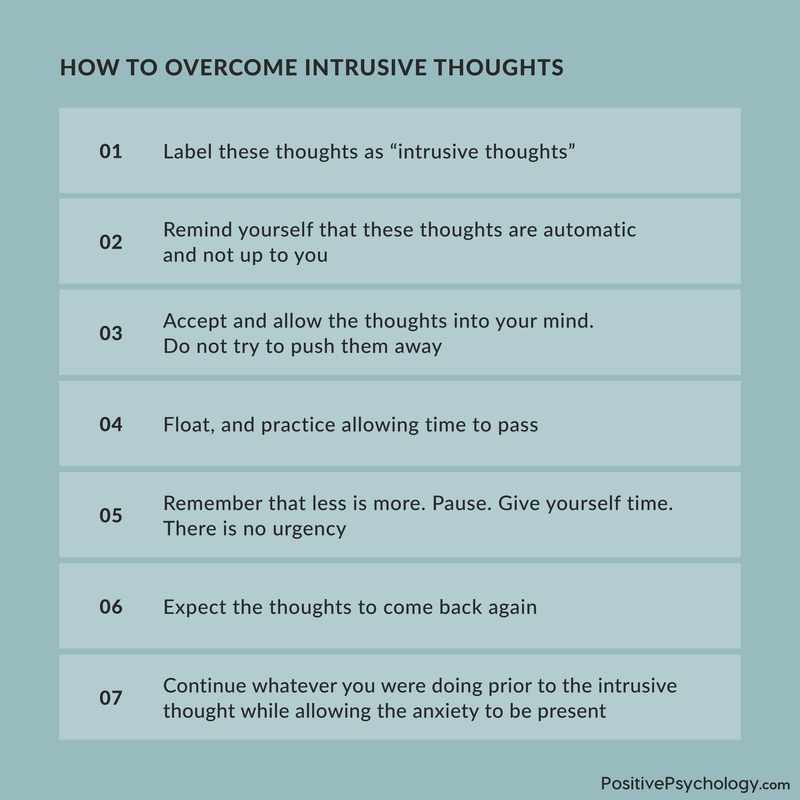
While you can’t technically bring all intrusive thoughts to a halt, you can mitigate their negative impact on your mental health and decrease the frequency and intensity of these intruders. Our article offering effective thought-stopping techniques will be a valuable resource for interrupting and blocking negative thoughts.
Here are a few additional tools to reduce anxiety and better manage intrusive thinking.
1. Cognitive reshuffling
Cognitive reshuffling is a mental strategy that involves consciously redirecting attention to alternate, neutral, or positive thoughts to disrupt the cycle of intrusive thinking. This technique works by engaging different cognitive pathways, reducing the emotional charge and recurrence of unwanted thoughts (Clark & Beck, 2010).
An example exercise may require an individual to think of a letter and then think of as many words as possible that begin with that letter.
2. Cognitive restructuring
Cognitive restructuring, a defining component in CBT, helps individuals identify, challenge, and reframe irrational or intrusive thoughts into more balanced and rational perspectives (Assaz et al., 2023; Beck, 2011).
An example exercise would involve the following steps (Levine & Warman, 2016; Najmi et al., 2009; Shipherd & Fordiani, 2015).
- Identify the intrusive thought.
- Examine the evidence. What evidence supports the thought? What evidence contradicts the thought?
- Reframe the thought.
- Replace negative self-talk with balanced statements.
3. Cognitive defusion
To understand cognitive defusion, it will be imperative to first understand cognitive fusion.
Cognitive fusion is the countless ideas your brain sends out and the idea that every thought has value. Our brain spits out so many thoughts, some of which are unconscious. Cognitive defusion is sifting through these thoughts to determine which to act on, a key component in acceptance and commitment therapy (Assaz et al., 2023).
Emma McAdam describes this strategy as the difference between having a thought and buying a thought. She reviews this concept in much more detail in her video.
Intrusive thoughts & overthinking: The skill of cognitive defusion
Recommendations From PositivePsychology.com
Whether it’s additional information on intrusive thoughts or methods to stop intrusive thoughts, PositivePsychology.com has got you covered.
Perhaps you’d like more strategies for challenging automatic thoughts or replacing them altogether with more positive thoughts. Our article Challenging Negative Automatic Thoughts will be an excellent resource, with worksheets and examples of positive and negative thoughts to promote change.
CBT was one method discussed to help treat intrusive thoughts. Our 17 Positive CBT & Cognitive Therapy Exercises will help you coach, teach, or implement the 17 highest-rated CBT tools in a therapeutic setting.
A Take-Home Message
As McAdam noted in her video above, you don’t have to buy all the thoughts that come your way. This simple yet profound wisdom reminds us that thoughts, much like window displays, often serve as passing distractions rather than truths about who we are.
Instead of fearing or fixating on them, we can approach our thoughts with curiosity and humor.
After all, isn’t it fascinating how the brain can conjure up scenarios ranging from utterly mundane to hilariously absurd or even unsettling?
By treating these mental moments as part of the human experience rather than personal flaws, we free ourselves to laugh, learn, and move forward without judgment.
So, enjoy the window displays and embrace the funny, weird, and sometimes downright disturbing thoughts that come your way.
We hope you enjoyed reading this article. For more information, don’t forget to download our five positive psychology tools for free.
ED: Rewrite Feb 2025
Frequently Asked Questions
Helping someone with intrusive thoughts requires a combination of understanding, support, evidence-based strategies such as encouraging professional help, and educating about and normalizing the experience.
A common example of an intrusive thought may include a fleeting thought of harming someone you care about, like punching them.
Intrusive thoughts are completely normal. They can also be brought about by emotional stress, fatigue, hormonal or neurological factors, suppression or hyperfocus, and unresolved trauma. In some cases, intrusive thoughts can indicate anxiety disorders, depression, or OCD.
- Abramowitz, J. S., Fabricant, L. E., Taylor, S., Deacon, B. J., McKay, D., & Storch, E. A. (2014). The relevance of analogue studies for understanding obsessions and compulsions. Clinical Psychology Review, 34(3), 206–217. https://doi.org/10.1016/j.cpr.2014.01.004
- Abramovitch, A., & Schweiger, A. (2009). Unwanted intrusive and worrisome thoughts in adults with Attention Deficit Hyperactivity Disorder. Psychiatry Research, 168(3), 230–233. https://doi.org/10.1016/j.psychres.2008.06.004
- American Psychiatric Association. (2013). Diagnostic and statistical manual of mental disorders (5th ed.). American Psychiatric Publishing.
- Anholt, G., Cath, D., Van Oppen, P., Eikelenboom, M., Smit, J., Van Megen, H., & Van Balkom, A. (2009). Autism and ADHD symptoms in patients with OCD: Are they associated with specific OC symptom dimensions or OC symptom severity? Journal of Autism and Developmental Disorders, 40, 580–589. https://doi.org/10.1007/s10803-009-0922-1
- Assaz, D. A., Tyndall, I., Oshiro, C. K., & Roche, B. (2023). A process-based analysis of cognitive defusion in acceptance and commitment therapy. Behavior Therapy, 54(6), 1020–1035. https://doi.org/10.1016/j.beth.2022.06.003
- Beck, J. S. (2011). Cognitive behavior therapy: Basics and beyond. Guilford Publications.
- Brose, A., Schmiedek, F., Lövdén, M., & Lindenberger, U. (2011). Normal aging dampens the link between intrusive thoughts and negative affect in reaction to daily stressors. Psychology and Aging, 26(2), 488–502. https://doi.org/10.1037/a0022287
- Clark, D. A., & Beck, A. T. (2010). Cognitive therapy of anxiety disorders: Science and practice. Guilford Press.
- Clark, D. A., & Purdon, C. L. (1995). The assessment of unwanted intrusive thoughts: A review and critique of the literature. Behaviour Research and Therapy, 33(8), 967–976. https://doi.org/10.1016/0005-7967(95)00030-2
- Clark, D. A., & Rhyno, S. (2005). Unwanted intrusive thoughts in nonclinical individuals: Implications for clinical disorders. Journal of Cognitive Psychotherapy, 19(2), 145–157.
- Foa, E. B., & McLean, C. P. (2016). The efficacy of exposure therapy for anxiety-related disorders and its underlying mechanisms: The case of OCD and PTSD. Annual Review of Clinical Psychology, 12(1), 1–28. https://doi.org/10.1146/annurev-clinpsy-021815-093533
- Gay, P., Schmidt, R. E., & Van der Linden, M. (2011). Impulsivity and intrusive thoughts: Related manifestations of self-control difficulties? Cognitive Therapy and Research, 35, 293–303. https://doi.org/10.1007/s10608-010-9317-z
- Hayes, S. C., Strosahl, K. D., & Wilson, K. G. (2011). Acceptance and commitment therapy: The process and practice of mindful change. Guilford Press.
- Kollarik, M., van den Hout, M., Heinzel, C. V., Hofer, P. D., Lieb, R., & Wahl, K. (2020). Effects of rumination on unwanted intrusive thoughts: A replication and extension. Journal of Experimental Psychopathology, 11(1), Article 2043808720912583. https://doi.org/10.1177/2043808720912583
- Kühn, S., Vanderhasselt, M., Raedt, R., & Gallinat, J. (2014). The neural basis of unwanted thoughts during resting state. Social Cognitive and Affective Neuroscience, 9(9), 1320–1324. https://doi.org/10.1093/scan/nst117
- Lawrence, P., Craske, M., Kempton, C., Stewart, A., & Stein, A. (2017). Intrusive thoughts and images of intentional harm to infants in the context of maternal postnatal depression, anxiety, and OCD. The British Journal of General Practice: The Journal of the Royal College of General Practitioners, 67(661), 376–377. https://doi.org/10.3399/bjgp17X692105
- Levine, A., & Warman, D. (2016). Appraisals of and recommendations for managing intrusive thoughts: An empirical investigation. Psychiatry Research, 245, 207–216. https://doi.org/10.1016/j.psychres.2016.08.040
- Najmi, S., Riemann, B., & Wegner, D. (2009). Managing unwanted intrusive thoughts in obsessive-compulsive disorder: Relative effectiveness of suppression, focused distraction, and acceptance. Behaviour Research and Therapy, 47(6), 494–503. https://doi.org/10.1016/j.brat.2009.02.015
- Purdon, C., & Clark, D. A. (1993). Obsessive intrusive thoughts in nonclinical subjects. Part I. Content and relation with depressive, anxious and obsessional symptoms. Behaviour Research and Therapy, 31(8), 713–720. https://doi.org/10.1016/0005-7967(93)90001-B
- Schmitz, T. W., Correia, M. M., Ferreira, C. S., Prescot, A. P., & Anderson, M. C. (2017). Hippocampal GABA enables inhibitory control over unwanted thoughts. Nature Communications, 8(1), Article 1311. https://doi.org/10.1038/s41467-017-00956-z
- Shipherd, J., & Fordiani, J. (2015). The application of mindfulness in coping with intrusive thoughts. Cognitive and Behavioral Practice, 22(4), 439–446. https://doi.org/10.1016/j.cbpra.2014.06.001
- Zainal, N., & Newman, M. (2018). Worry amplifies theory-of-mind reasoning for negatively valenced social stimuli in generalized anxiety disorder. Journal of Affective Disorders, 227, 824–833. https://doi.org/10.1016/j.jad.2017.11.084
Tiffany Sauber Millacci, Ph.D., is an educator who works with both university and elementary students. As a lifelong learner, she is driven by a passion for research and enjoys translating her findings into writing to share her knowledge with others.

Read other articles by their category
- Body & Brain (69)
- Boundaries (14)
- Coaching & Application (42)
- Compassion (26)
- Counseling (41)
- Emotional Intelligence (22)
- Gratitude (18)
- Grief & Bereavement (18)
- Happiness & SWB (40)
- Meaning & Values (27)
- Meditation (16)
- Mindfulness (47)
- Motivation & Goals (41)
- Optimism & Mindset (36)
- Positive CBT (28)
- Positive Communication (29)
- Positive Education (39)
- Positive Emotions (34)
- Positive Leadership (17)
- Positive Parenting (18)
- Positive Psychology (27)
- Positive Workplace (41)
- Productivity (17)
- Relationships (56)
- Resilience & Coping (45)
- Self Awareness (25)
- Self Esteem (38)
- Strengths & Virtues (34)
- Stress & Burnout Prevention (39)
- Theory & Books (44)
- Therapy Exercises (43)
- Types of Therapy (64)