What is Happiness? Understanding the Happiness Paradox (original) (raw)
Key Insights
- Happiness and strong relationships are vital for mental and physical health and key to wellbeing.
- Types of happiness include momentary joy (hedonic), which contrasts with deeper purpose (eudaimonic).
- Happiness varies with culture, values, and life stages.
 Before becoming a psychologist, I studied philosophy. At that time, I was fascinated by two equally vital yet frustratingly tricky questions: What is our purpose, and what is happiness?
Over the years, as part of my practical application of psychology, my focus has repeatedly been drawn to understanding and answering the latter. Despite chasing happiness personally and professionally, it seems as difficult to hold on to as running water.
Understanding happiness is equally essential to our clients, colleagues, family, and friends. It shapes the values they adopt, meaning they assign to what they do, and how they live their lives.
This article explores that question. What is happiness? How does it impact us, and how can we create an environment to help us foster more of it?
Before you continue, we thought you might like to download our five positive psychology tools for free. These detailed, science-based exercises will help you or your clients identify sources of authentic happiness and strategies to boost wellbeing.
This Article Contains
- What Is Happiness in Life?
- The Happiness Paradox
- The Neuroscience of Happiness
- 8 Signs & Types of Subjective Wellbeing
- Why Is Being Happy So Important?
- Happiness Throughout the Lifespan
- Defining Happiness Across Cultures
- 11+ Tools to Foster Subjective Wellbeing
- Helpful Resources From PositivePsychology.com
- A Take-Home Message
- Frequently Asked Questions
- References
What Is Happiness in Life?
The landmark Harvard Study of Adult Development that began over 80 years ago (and has since included multiple generations) confirms the importance of happiness to our ongoing psychological and physiological wellness (Waldinger & Schulz, 2023).
Robert Waldinger, the latest custodian of the research, confirms that happiness — along with its most significant contributing factor, good relationships — shapes our health, wellbeing, experiences in the workplace, and ability to recover from low points in our lives (Waldinger & Schulz, 2023).
But what is happiness?
A definition of happiness
Waldinger and Schulz (2023) argue that we must consider both the immediate and the long term when attempting to understand happiness.
Hedonic happiness is a moment-to-moment, temporary, and transient experience of joy. It concerns having a good time now and is firmly rooted in the present. On the other hand, eudaimonic happiness involves a “deep wellbeing in which a person feels that their life has meaning and purpose” (Waldinger & Schulz, 2023, p. 18).
Researcher and well-known author Brené Brown offers several valuable definitions that help us explore and answer the question “What is happiness?” Her research distinguishes the state of happiness from joy and contentment, describing the former as “feeling pleasure often related to the immediate environment or current circumstances” (Brown, 2021, p. 207).
What is happiness? - The Atlantic
The following video, “What Is Happiness?” further highlights the many ways of understanding this familiar yet complex way of feeling.
A definition of joy
Brown (2021, p. 205) defines joy as having a higher intensity than happiness: “an intense feeling of deep spiritual connection, pleasure, and appreciation.”
A definition of contentment
On the other hand, contentment contrasts our general degree of satisfaction with a constant desire for more.
Brown (2021, p. 205) defines contentment as the “feeling of completeness, appreciation, and ‘enoughness’ that we experience when our needs are satisfied.”
A definition of subjective wellbeing
Subjective wellbeing (SWB) is a term frequently used in psychological research, referring to how people appraise and evaluate their own lives.
Rather than a single concept, SWB encompasses reflective cognitive judgments regarding life satisfaction and positive and pleasant emotions. Studies recognize SWB as positively associated with better health, longevity, creativity, and work performance (Diener et al., 2018).
The following image pictures several factors influencing happiness, specifically genetics, circumstances, and thoughts. It recognizes the importance of our mindset, attitudes, and feelings to shape our positive connection with ourselves, our environment, and others.

In the following video, Arthur Brooks explores “The Art and Science of Happiness” and the steps to achieve more of it.
The art and science of happiness - Arthur Brooks
In this next, powerful talk by Katarina Blom, we hear more about how we can gain control of this vital feeling in “You Don’t Find Happiness, You Create It.”
You don't find happiness, you create it - Katarina Blom
The Happiness Paradox
Most, if not all, of your clients will be clear regarding their desire for happiness. It’s a basic psychological need and something most of us strive for.
Yet, there is an uncomfortable paradox.
Research suggests that endlessly pursuing happiness can cause frustration and dissatisfaction. It can mean we spend more time focusing on what we are trying to avoid (or don’t have) rather than on positive emotions such as joy and gratitude that boost our happiness (Ford et al., 2015).
As the following diagram suggests, searching for unrealistic happiness and continuously monitoring our progress can result in negative outcomes.

Happiness research suggests that we should also consider critical contextual factors.
A 2015 study concluded that “culturally bound meanings shape whether individuals’ pursuit of happiness is likely to result in more or — paradoxically — less actual happiness and wellbeing” (Ford et al., 2015, p. 8).
It means there is no one-size-fits-all approach to forming or solving the “what is happiness” equation.
The Neuroscience of Happiness
When reflecting on the question “What is happiness?” we typically account for our emotional states, actions, and who we are with. Yet, we also need to consider our brain’s hardware.
Cognitive psychologists recognize the importance of the prefrontal cortex for regulating emotions, the amygdala for managing stress and other emotional responses, and the hippocampus for storing positive memories (Eysenck & Keane, 2015).
Neurotransmitters, such as dopamine, serotonin, oxytocin, and endorphins, play a key role in pleasure, reward, motivation, and feelings of wellbeing and happiness (Eysenck & Keane, 2015).

8 Signs & Types of Subjective Wellbeing
Research into SWB continues to shed light on what happiness is and its key components (Diener et al., 2018; Waldinger & Schulz, 2023).
The following psychological factors point to what defines and categorizes SWB (Diener et al., 2018; Waldinger & Schulz, 2023; Seligman, 2011; Ryan & Deci, 2018):
- Life satisfaction
Positive self-evaluation considers the overall quality of individuals’ lives and how it aligns with their expectations and goals. - Positive emotions
A greater occurrence of positive emotions, such as joy, hope, awe, and gratitude, reflect a positive affective state. - Lower levels of negative emotions
Emotions such as anxiety, fear, stress, and anger don’t need to be absent but less frequent. - Fulfillment of basic and psychological needs
Individuals have their basic needs, such as safety, shelter, and food, met along with psychological ones, including competence, autonomy, and relatedness. - Supportive social relationships
Strong and lasting connections with friends, colleagues, partners, and family offer emotional support and a sense of belonging. - Meaning and purpose
Feeling close to and working toward personal values and goals creates a sense of fulfillment and purpose. - Resilience
Returning to or creating a new path following upheavals and challenging events is vital to psychological and physical wellness. - Engagement and flow
A deep involvement in tasks and activities contributes to wellbeing and provides meaningful rewards.
Why Is Being Happy So Important?
 As we begin to understand what happiness is, we next turn our attention to why it is so important.
Happiness matters because it is closely linked to psychological and physical wellbeing.
Feeling connected to others, which is a strong predictor of happiness, reduces the risk of dying at any age and improves the chances of living healthily (Waldinger & Schulz, 2023).
A 2018 study recognized that because happiness positively impacts health outcomes, it reduces the health care burden and enhances health care performance (See & Yen, 2018).
Happiness Throughout the Lifespan
Happiness is not static. Researchers recognize that it rises and falls throughout our lifespan (Galambos et al., 2020).
U-shaped happiness
Psychologists suggest that happiness levels are highest in our 20s, dip to their lowest point in midlife, and rise again in old age. This is often referred to as the U-shape of happiness and is confirmed by many cross-sectional studies (Galambos et al., 2020).
However, while popularized in the media and by economists in support of the term “midlife crisis,” it may not be that simple.
Longitudinal research studies attempting to answer the question “What is happiness?” have followed individuals throughout their lives (Galambos et al., 2020). Their findings suggest that happiness and the factors involved are highly complex and vary considerably between individuals. How we evaluate our life satisfaction and general wellbeing seems more important than our age.
Positive aging
The Harvard happiness study recognizes the importance of good relationships to happiness as we age. Its findings suggest that to achieve positive aging, we must prioritize our close friendships, family, and romantic relationships (Waldinger & Schulz, 2023).
Human connections reduce feelings of loneliness, increasing the likelihood of physical and psychological wellness and happier lives.
Multiple studies also recognize a general shift in our outlook as we age, which benefits our perception of happiness. Older adults seem to process and remember more positive events rather than negative information (Galambos et al., 2020).
Defining Happiness Across Cultures
 Culture is often invisible to those within it. Yet our nation and family values, traditions, and practices shape our values, goals, and how we answer the question “What is happiness?” (Waldinger & Schulz, 2023).
In individualistic Western cultures, we may strive for wealth and all that it brings. Meanwhile, those in more collectivistic cultures could prioritize family connections and working toward shared goals (Exton et al., 2015).
However, we should be wary of making culturally instilled value-based judgments. For example, while happiness can be linked to wealth, once a household has sufficient income to meet its needs, there is no clear relationship between money and joy, laughter, and fun (Waldinger & Schulz, 2023).
A 2015 study explored the impact of culture on wellbeing in over 150 countries and territories. Its findings suggest cultural values influence how people appraise, experience, and report happiness. Some of these can be explained by their religion and beliefs, social norms around emotional expression, cultural coping mechanisms, and expectations and aspirations (Exton et al., 2015).
Improving subjective wellbeing is a core component of positive psychology, and there are a multitude of tools available to enhance a client’s approach to happiness.
Mindfulness
Research recognizes the potential of mindfulness training to improve happiness and subjective wellbeing. Even brief interventions of three short sessions can have positive and lasting effects (Howells et al., 2014; Zarifsanaiey et al., 2020).
Work with your client to try out the following exercises:
- Being Present: Learn how to increase awareness of what is happening inside your head and body and what you are aware of in the environment.
- Funeral Meditation: This unlikely sounding mindfulness practice helps us focus on what truly matters and makes us happy.
- Workplace Mindfulness: The workplace can be fraught with stress. This exercise encourages a state of loving-kindness through a focus on personal values.
- Right Here, Right Now: Being in the moment can ground us and allow us to handle stress better by becoming more aware of positive emotions.
- Linking Feelings and Situations: Mindfully revisiting past situations can offer a safe and productive way to understand the connection between our thoughts and feelings.
Building relationships
Strong connections support enduring happiness. The following exercises help clients identify, foster, and focus on positive relationships (Waldinger & Schulz, 2023):
- Moving on to New Relationships: Building new relationships can involve letting go and moving on from old ones. This exercise focuses on what is essential and why.
- Understanding Siblings: Despite their importance, relationships with siblings can be complex. Understanding early family connections and responsibilities can help strengthen bonds.
- Understanding the Values You Want in a Relationship: Successful relationships require a clear understanding of what we want and the values we live by.
- Making and Strengthening Friendships: This helpful set of questions reflects on the positives of forming good relationships.
Positive emotions
Joy, awe, love, kindness, and gratitude are closely linked to subjective wellbeing (Seligman, 2011).
Try out the following exercises with clients to help them focus on positive feelings:
- Capitalizing Positive Emotions With Active Constructive Responding: Reconnecting to favorable events is a powerful way to bring awareness to positive emotions.
- Your Best Work Self: We can improve our emotional awareness by identifying and reaching a better understanding of the source of our feelings.
Happiness awareness
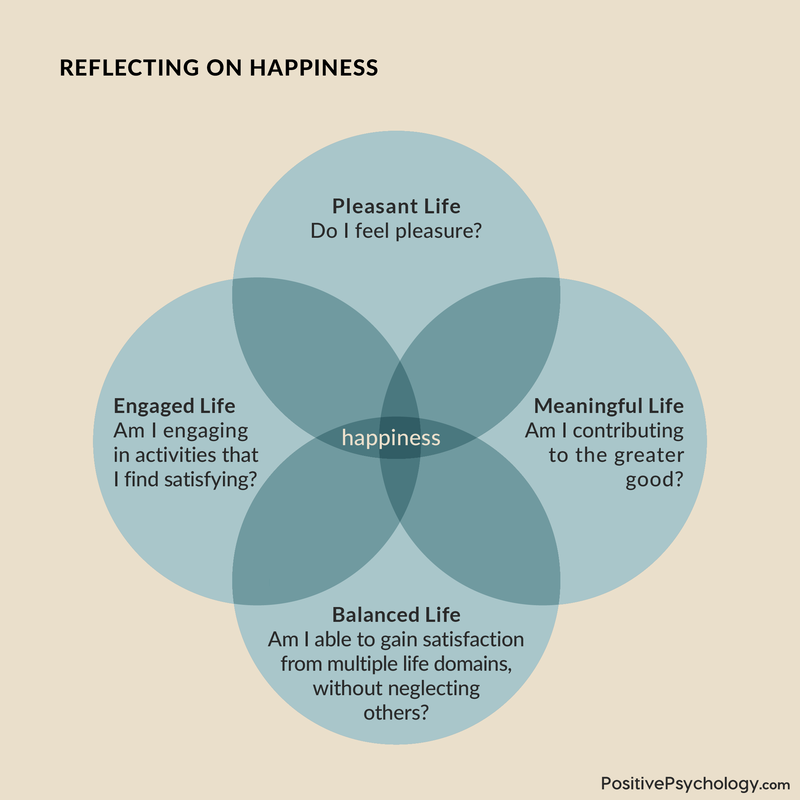
The following picture is a helpful way to become more aware of what happiness is.
Encourage clients to focus on each question and understand what the answers tell them about how they live.
The three dimensions of happiness
Happiness can be defined as an enduring state of mind consisting not only of feelings of joy, contentment, and other positive emotions, but also of a sense that one’s life is meaningful and valued (Lyubomirsky, 2001).
Happiness energizes us and is a highly sought after state of being. But, what components make up happiness?
Martin Seligman (2002) argued that happiness has three dimensions that can be cultivated:
- The regular experience of pleasantness (the pleasant life)
- The frequent engagement in satisfying activities (the engaged life)
- The experience of a sense of connectedness to a greater whole (the meaningful life)
Although each dimension is important, the happiest people tend to be those who pursue the full life— they infuse their life with pleasure, engagement, and meaning (Seligman et al., 2005).
Building on Seligman’s three dimensions of happiness, Sirgy and Wu (2009) added the balanced life dimension.
According to these authors, balance in life is another key factor contributing to happiness because the amount of satisfaction derived from a single life domain is limited. One needs to be involved in multiple domains to satisfy the broad spectrum of human needs. As a result, cultivating a sense of balance is crucial for juggling these life domains.
Helpful Resources From PositivePsychology.com
We have many resources available for therapists to support individuals and groups as they learn to connect to their positive emotions more readily, manage the negative ones, and reflect on the question “What is happiness?”
To start, check out the following further reading:
- The True Meaning of Hedonism: A Philosophical Perspective
- What Is The Good Life & How To Attain It
- Is Happiness More Important Than Success?
- What Is Cherophobia? How to Overcome a Fear of Happiness
Our positive psychology masterclass, Wellbeing X, provides tools, training, and techniques to support wellbeing in workplaces, schools, communities, faith-based organizations, health care settings, nonprofit groups, and one-on-one client coaching.
Other free resources include:
- Imagery-Based Exposure Worksheet
Learning to sit with difficult emotions before moving toward more positive ones is vital. - Radical Acceptance Worksheet
This powerful dialectical behavior therapy exercise helps clients deal with intense negative emotions and experiences. - Build an Emotions Portfolio
This valuable exercise aims to improve the awareness of and help clients focus on positive emotions.
More extensive versions of the following tools are available with a subscription to the Positive Psychology Toolkit©, but they are described briefly below:
- What makes me happy?
Focusing on positive emotions is crucial for overall wellbeing and a powerful way to build resilience.
This worksheet uses self-reflection, discussion, validation, and creativity to explore and express sources of happiness.
Ask clients to try out the following four steps:
- Step one: Working in groups, share what happiness means to you and capture your ideas on paper.
- Step two: Next, identify and reflect on associated feelings, such as joy, kindness, warmth, etc.
- Step three: Cut out magazine pictures and create a collage mapping happiness.
- Step four: Spot common feelings and activities associated with happiness in each group’s visual representation of happiness.
- A letter from your best day to your bad days
Mental time travel can be a surprisingly powerful intervention. In this exercise, clients write letters from their best days to inform their difficult days and create lasting reminders of their strength, resiliency, and inner resources.
Walk clients through the following steps:
- Step one: Choose a day and a time when you feel good about life and are happy, powerful, and motivated.
- Step two: Write yourself a letter answering the following prompts:
* On bad days, I would like you to keep in mind that …
* I want you to look back on this day and remember you …
* Before you finish reading this letter, remember what makes you feel hopeful. - Step three: Afterward, reflect on how it felt to write the letter and how it helps you appreciate better days and overcome challenges.
If you’re looking for more science-based ways to help others develop strategies to boost their wellbeing, this collection contains 17 validated happiness and wellbeing exercises. Use them to help others pursue authentic happiness and work toward a life filled with purpose and meaning.
A Take-Home Message
What is happiness? It’s a big question that has engrossed philosophers and, more recently psychologists, for hundreds of years.
It’s important to understand the question and know that the answers matter, because happiness impacts individual and group wellbeing, life satisfaction, and economic and policy-making decisions (Galambos et al., 2020).
Although happiness can be tricky to define, most would agree that it can be found in the present and over time by promoting a combination of positive feelings, satisfaction, joy, purpose, and meaningful relationships.
Interestingly enough, much of the happiness research confirms the importance of forming deep connections to our short- and long-term subjective wellbeing. The relationships we prioritize protect us from life’s challenges while allowing us to share positive emotions, such as gratitude, joy, and love.
As mental health professionals, we can work with clients to help them identify and savor the positives in their lives and shape their environment to increase their opportunities for happiness.
We can support improved life satisfaction, increased positive emotions, lower levels of negative emotions, meeting psychological needs, and building and sustaining a supportive social network.
We hope you enjoyed reading this article. Don’t forget to download our five positive psychology tools for free.
ED: Rewrite Dec 2024
Frequently Asked Questions
The true meaning of happiness involves a state of contentment and wellbeing, characterized by feelings of joy, satisfaction, and fulfillment. It is not merely the absence of negative emotions but a positive state of mind that includes a sense of purpose and connection with oneself and others.
Happiness can be defined as a subjective experience that includes positive emotions, life satisfaction, and a sense of wellbeing. It varies from person to person and can be influenced by external circumstances, personal values, and emotional resilience.
A happy person is generally characterized by a positive outlook, resilience in facing challenges, and a sense of satisfaction with their life. They often have strong social connections, engage in meaningful activities, and maintain a balanced perspective on life’s ups and downs.
- Brown, B. (2021). Atlas of the heart. Vermilion.
- Diener, E., Oishi, S., & Tay, L. (2018). Advances in subjective wellbeing research. Nature Human Behaviour, 2(4), 253–260. https://doi.org/10.1038/s41562-018-0307-6
- Exton, C., Smith, C., & Vandendriessche, D. (2015). Comparing happiness across the world. OECD Statistics Working Papers. https://doi.org/10.1787/5jrqppzd9bs2-en
- Eysenck, M. W., & Keane, M. T. (2015). Cognitive psychology: A student’s handbook. Psychology Press.
- Ford, B. Q., Dmitrieva, J. O., Heller, D., Chentsova-Dutton, Y., Grossmann, I., Tamir, M., Uchida, Y., Koopmann-Holm, B., Floerke, V. A., Uhrig, M., Bokhan, T., Mauss, I. B., & Gauthier, I. (2015). Culture shapes whether the pursuit of happiness predicts higher or lower well-being. Journal of Experimental Psychology: General, 144(6), 1053–1062. https://doi.org/10.1037/xge0000108
- Galambos, N. L., Krahn, H. J., Johnson, M. D., & Lachman, M. E. (2020). The U shape of happiness across the life course: Expanding the discussion. Perspectives on Psychological Science, 15(4), 898–912. https://doi.org/10.1177/1745691620902428
- Howells, A., Ivtzan, I., & Eiroa-Orosa, F. J. (2014). Putting the “app” in happiness: A randomised controlled trial of a smartphone-based mindfulness intervention to enhance wellbeing. Journal of Happiness Studies, 17(1), 163–185. https://doi.org/10.1007/s10902-014-9589-1
- Ryan, R. M., & Deci, E. L. (2018). Self-determination theory: Basic psychological needs in motivation, development, and wellness. The Guilford Press.
- See, K. F., & Yen, S. H. (2018). Does happiness matter to health system efficiency? A performance analysis. Health Economics Review, 8, Article 33. https://doi.org/10.1186/s13561-018-0214-6
- Seligman, M. (2011). Flourish: A new understanding of happiness and well-being and how to achieve them. Nicholas Brealey Publishing.
- Waldinger, R. J., & Schulz, M. S. (2023). The good life: Lessons from the world’s longest scientific study of happiness. Simon & Schuster.
- Zarifsanaiey, N., Jamalian, K., Bazrafcan, L., Keshavarzy, F., & Shahraki, H. R. (2020). The effects of mindfulness training on the level of happiness and blood sugar in diabetes patients. Journal of Diabetes & Metabolic Disorders, 19, 311–317. https://doi.org/10.1007/s40200-020-00510-7
Jeremy Sutton, Ph.D., is an experienced psychologist, coach, consultant, and psychology lecturer. He works with individuals and groups to promote resilience, mental toughness, strength-based coaching, emotional intelligence, wellbeing, and flourishing. Alongside teaching psychology at the University of Liverpool, he is an amateur endurance athlete who has completed numerous ultra-marathons and is an Ironman.

Read other articles by their category
- Body & Brain (69)
- Boundaries (14)
- Coaching & Application (42)
- Compassion (26)
- Counseling (41)
- Emotional Intelligence (22)
- Gratitude (18)
- Grief & Bereavement (18)
- Happiness & SWB (40)
- Meaning & Values (27)
- Meditation (16)
- Mindfulness (47)
- Motivation & Goals (41)
- Optimism & Mindset (36)
- Positive CBT (28)
- Positive Communication (29)
- Positive Education (39)
- Positive Emotions (34)
- Positive Leadership (17)
- Positive Parenting (18)
- Positive Psychology (27)
- Positive Workplace (41)
- Productivity (17)
- Relationships (56)
- Resilience & Coping (45)
- Self Awareness (25)
- Self Esteem (38)
- Strengths & Virtues (34)
- Stress & Burnout Prevention (39)
- Theory & Books (44)
- Therapy Exercises (43)
- Types of Therapy (64)