Centrioles (original) (raw)
Last Updated : 19 Dec, 2025
Centrioles are cylindrical or barrel-shaped cell organelles that help animal cells copy themselves. Centriole also plays a vital role in the cell cycle and other cell developmental processes. It plays a crucial role in several cellular processes, including cell division regulation and cytoskeletal organisation. Centriole structure is constituted by a protein known as tubulin.
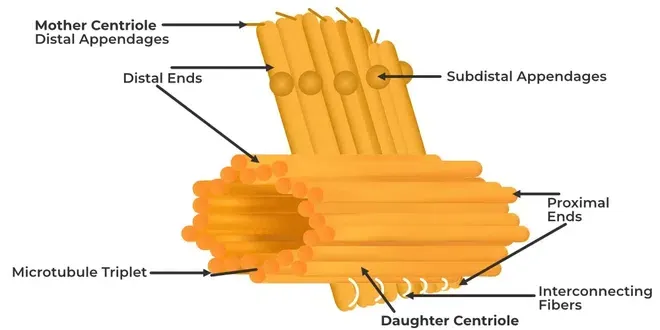
Structure of the Centriole
Centrioles are composed of nine sets of triplet microtubules. These microtubules are arranged in a circle, with each triplet consisting of three microtubules.
- These triplet microtubules are connected via connecting fibres.
- These fibres help maintain the structural integrity and stability of the centriole.
- These connecting fibres provide support and maintain the cylindrical shape of the centriole.
- Some organisms are exceptions to this conformation, for example, the embryos of Drosophila melanogaste**r and C. elegans.
- In Drosophila melanogaster, nine pairs of microtubules form instead of triplets, while the early embryos and sperm cells of C. elegans contain nine individual microtubules.
Characteristics of the Centriole
Characteristics of Centrioles are given below:
- Centrioles produce spindle fibres that bind to the centromeres of chromosomes, facilitating the separation of sister chromatids to opposite cell poles during the anaphase stage of mitosis.
- Centrioles are cylindrical or barrel-shaped**cell organelles that have essential roles in the formation of centrosomes, cilia, and flagella. A Belgian embryologist, Edouard van Beneden, discovered centrioles in the late 19th century. He was studying the eggs of marine invertebrates when he observed these structures.
- In animal cells, centrioles are usually present in pairs; this pair is located within a **centrosome. Within the centrosome, the centrioles are angled perpendicular to each other. The cells undergo division via mitosis, where the centrioles form areas that are responsible for the formation of the mitotic spindle.
Function of the Centriole
Centrioles play essential roles in various cellular processes. Some of the main functions of centrioles include:
- Centrioles aid in microtubule formation, vital for the cytoskeleton. Microtubules maintain cell shape and support intracellular transport.
- Centrioles play a crucial role in forming cilia and flagella. Cilia are short, hair-like structures on the cell surface, while flagella are longer, whip-like extensions.
- Centrioles assist in spindle fibre formation for cell division, separating chromosomes into daughter cells.
- In cells with cilia or flagella, centrioles serve as basal bodies, anchoring and supporting the growth of these structures.
- The centrosome, containing centrioles, organises cellular components by developing microtubules, crucial for intracellular transport and positioning.
Replication of the Centriole
Centriole replication occurs in the S-phase of cell division and helps in the formation of the mitotic spindle fibres. These fibres are an essential component of cell division as they help in the segregation of chromosomes.

The steps involved in centriole replication are:
- **Initiation: In the S phase of the cell cycle, DNA replication occurs. The duplication of the centriole is coordinated with DNA replication to make sure cell division occurs properly.
- **Duplication: In this phase, the centriole duplicates to form a new centriole adjacent to it. This results in the centrosome, which contains two centrioles.
- **Elongation: Certain proteins help in the assembly of centrioles, and the polymerisation of tubulin helps in the formation of microtubules. The centrioles elongate, resulting in a cylindrical shape.
- **Maturation: As the centrioles mature, they become capable of acting as MTOCs (Microtubule Organizing Centers).
- **Cell division: After maturation, the centrioles help in the proper arrangement of the mitotic spindle apparatus, thus enabling proper chromosome segregation during mitosis and meiosis. During cell division, centrioles in animal cells move to the opposite pole and help in the formation of spindles.
- **Regulation: This whole process of centriole replication is governed by certain checkpoints in the cell cycle and various regulatory proteins. Any disruption in centriole replication can lead to genomic instability, thus resulting in diseases like cancer.