Plastids (original) (raw)
Last Updated : 20 Dec, 2025
Plastids are membrane-bound organelles found in plant cells (and algae). They are mainly responsible for making and storing food and pigments. They are a diverse group of physiologically, phylogenetically, and genetically related eukaryotic organelles that play vital roles in plant metabolism.
They are involved in processes such as:
- Photosynthesis (chloroplasts)
- Imparting colours to fruits and flowers (chromoplasts)
- Storage of food like starch, oils, and proteins (leucoplasts)
- Nitrogen and sulfur assimilation
- Amino acid synthesis
Types of Plastids
Proplastids (undifferentiated plastids) may undergo differentiation into many forms, depending upon their specialised functions in the cell. Plastid may develop as the following variants:
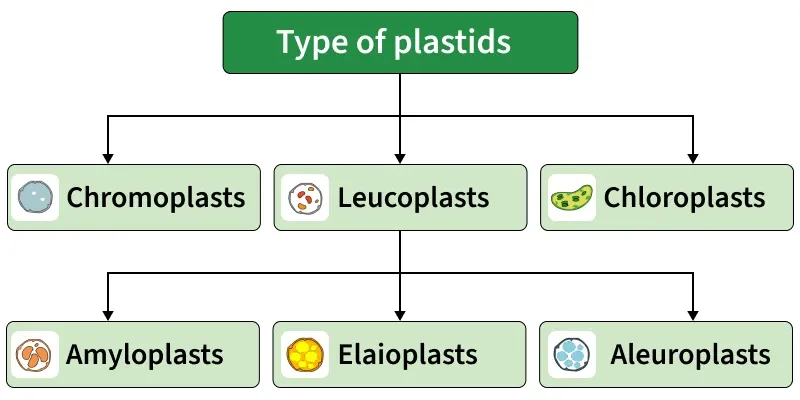
**1. Chloroplasts
Chloroplasts (green plastids) are 5 to 10 μm long organelles. They are surrounded by a double membrane known as the chloroplast envelope. In addition to the double membrane, chloroplasts have a third internal membrane system, known as the thylakoid membrane. They are located in the mesophyll of plant cells. They perform the process of photosynthesis and synthesise their food.
The Structure of the Chloroplast is described below:
- The majority of chloroplasts (green plastid) of green plants exist in the leaf mesophyll cells.
- Their shape resembles a lens and is discoid, oval, spherical, or ribbon-like. Their length varies from 5-10 µm, and their width varies from 2-4 µm.
- These organelles are encircled by a double membrane-like mitochondria.
- The inner membrane of the chloroplast is comparatively less permeable.
- Stroma is the space surrounded by the internal membrane of the chloroplast.
- This internal space is filled with fluid that surrounds the grana, thylakoids, and it also contains ribosomes, starch, and DNA.
- Other functions carried out by plant cells include: synthesis of fatty acids, synthesis of amino acids, and play an important role in regulating the immune response in plants.
**2. Chromoplasts
These are coloured plastids, which are responsible for pigment synthesis and storage. They can be found in a variety of plants, including flowering plants, fruit roots like carrots and sweet potatoes, and ageing leaves undergoing senescence. Other features of chromoplasts are given below:
- The unique colouration of these plastids is due to carotenoids.
- Chromoplasts are a type of plastid that synthesise and store pigments like xanthophylls (yellow), carotene (orange), and various red pigments.
- These vibrant colours help attract pollinators to the plants.
**3. Leucoplasts
These are unpigmented, i.e. colourless plastids. They are found in non-photosynthetic roots, bulbs, tubers, and seeds. Leucoplast exists in three types, that are given below:
- **Amyloplasts: These are double-enveloped organelles. For the plant, they store and synthesise starch through glucose polymerisation
- **Aleuroplasts: They are known as proteoplasts, proteinoplasts, or aleuronaplasts. They store proteins and exist in seeds (pulses).
- **Elaioplasts: Elaioplasts are also known as nucleosomes. They store fats and oils that are needed for the plant. They exist in seeds.
Characteristics of Plastids
Characteristics of plastids are given below:
- They are used as an important factor to differentiate between plant and animal cells.
- Plastid contains a double-stranded DNA molecule that is circular and resembles the circular chromosome of cells of prokaryotes and ribosomes for protein synthesis.
- The outer and inner membranes have an intermembrane space between them.
- The credit for the discovery of plastids goes to Ernst Haeckel; however, the proper definition of plastid was given by Schimper.
- Plastids are responsible for containing photosynthetic pigments, other colouring pigments, starch, proteins, fats, etc., substances.
**Inheritance of Plastids
In numerous green algae and land plants, plastid inheritance comes from only one parent. In species with oogamy, plastids are typically inherited from the maternal parent. If both parents contribute to plastid inheritance, the maternal plastids usually dominate. However, conifers have paternal plastid inheritance, despite the maternal influence being strong. Some species even shift from complete maternal inheritance to complete paternal inheritance.
Functions of Plastids
Plastids are responsible for many core functions of the plants, some of which are listed below:
- Due to the presence of DNA and ribosomes, the plastids can be used for phylogenetic studies of plants.
- The pigments contained in plastids are responsible for the different colouration of a plant's parts.
- They help store many important organic chemical compounds.
- Helps in photosynthesis.