Distributed Consensus in Distributed Systems (original) (raw)
Last Updated : 23 Jul, 2025
In distributed systems, achieving consensus among nodes is critical for maintaining coherence and reliability. This article explores the principles, algorithms, challenges, and applications of distributed consensus, which are essential for ensuring agreement across decentralized networks.
.webp)
Distributed Consensus in Distributed Systems
Important Topics for Distributed Consensus in Distributed Systems
- What is the Distributed Consensus in Distributed Systems?
- Importance of Distributed Consensus in Distributed Systems
- Challenges of Achieving Consensus
- Distributed Consensus Algorithms in Distributed Systems
- Practical Applications of Distributed Consensus in Distributed Systems
- Blockchain Distributed Consensus Mechanism
- Challenges and Considerations for Scalabilty, Fault Tolerance and Resilience
- Distributed Consensus in Distributed Systems FAQS
What is the Distributed Consensus in Distributed Systems?
Distributed consensus in distributed systems refers to the process by which multiple nodes or components in a network agree on a single value or a course of action despite potential failures or differences in their initial states or inputs. It is crucial for ensuring consistency and reliability in decentralized environments where nodes may operate independently and may experience delays or failures. Popular algorithms like Paxos and Raft are designed to achieve distributed consensus effectively.
Importance of Distributed Consensus in Distributed Systems
Below are the importance of distributed consensus in distributed systems:
- **Consistency and **Reliability:
- Distributed consensus ensures that all nodes in a distributed system agree on a common state or decision. This consistency is crucial for maintaining data integrity and preventing conflicting updates.
- **Fault Tolerance****:**
- Distributed consensus mechanisms enable systems to continue functioning correctly even if some nodes experience failures or network partitions. By agreeing on a consistent state, the system can recover and continue operations smoothly.
- **Decentralization:
- In decentralized networks, where nodes may operate autonomously, distributed consensus allows for coordinated actions and ensures that decisions are made collectively rather than centrally. This is essential for scalability and resilience.
- **Concurrency Control:
- Consensus protocols help manage concurrent access to shared resources or data across distributed nodes. By agreeing on the order of operations or transactions, consensus ensures that conflicts are avoided and data integrity is maintained.
- **Blockchain and Distributed Ledgers:
- In blockchain technology and distributed ledgers, consensus algorithms (e.g., Proof of Work, Proof of Stake) are fundamental. They enable participants to agree on the validity of transactions and maintain a decentralized, immutable record of transactions.
Challenges of Achieving Consensus
Achieving consensus in distributed systems presents several challenges due to the inherent complexities and potential uncertainties in networked environments. Some of the key challenges include:
- **Network Partitions:
- Network partitions can occur due to communication failures or delays between nodes. Consensus algorithms must ensure that even in the presence of partitions, nodes can eventually agree on a consistent state or outcome.
- **Node Failures:
- Nodes in a distributed system may fail or become unreachable, leading to potential inconsistencies in the system state. Consensus protocols need to handle these failures gracefully and ensure that the system remains operational.
- **Asynchronous Communication:
- Nodes in distributed systems may communicate asynchronously, meaning messages may be delayed, reordered, or lost. Consensus algorithms must account for such communication challenges to ensure accurate and timely decision-making.
- **Byzantine Faults:
- Byzantine faults occur when nodes exhibit arbitrary or malicious behavior, such as sending incorrect information or intentionally disrupting communication. Byzantine fault-tolerant consensus algorithms are needed to maintain correctness in the presence of such faults.
Distributed Consensus Algorithms in Distributed Systems
Distributed consensus algorithms are fundamental in ensuring that nodes in a distributed system can agree on a single value or decision despite potential failures, delays, or differences in their initial states. These algorithms play a crucial role in maintaining consistency, reliability, and coordination across decentralized networks. Here’s an in-depth explanation of key distributed consensus algorithms:
1. Paxos Algorithm
Paxos is a classic consensus algorithm which ensures that a distributed system can agree on a single value or sequence of values, even if some nodes may fail or messages may be delayed.Key concepts of paxos algorithm include:
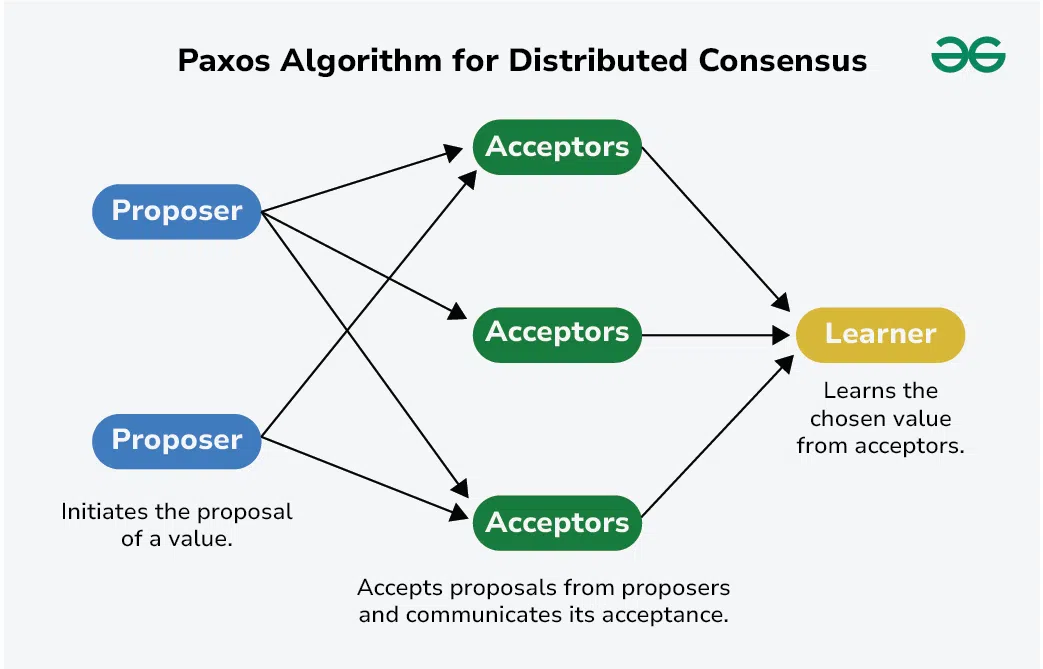
Paxos Algorithm
- **Roles:
- **Proposer: Initiates the proposal of a value.
- **Acceptor: Accepts proposals from proposers and communicates its acceptance.
- **Learner: Learns the chosen value from acceptors.
- **Phases:
- **Phase 1 (Prepare): Proposers send prepare requests to a majority of acceptors to prepare them to accept a proposal.
- **Phase 2 (Accept): Proposers send accept requests to acceptors with a proposal, which is accepted if a majority of acceptors agree.
- **Working:
- **Proposers: Proposers initiate the consensus process by proposing a value to be agreed upon.
- **Acceptors: Acceptors receive proposals from proposers and can either accept or reject them based on certain criteria.
- **Learners: Learners are entities that receive the agreed-upon value or decision once consensus is reached among the acceptors.
- **Safety and Liveness:
- Paxos ensures safety (only one value is chosen) and liveness (a value is eventually chosen) properties under normal operation assuming a majority of nodes are functioning correctly.
- **Use Cases:
- Paxos is used in distributed databases, replicated state machines, and other systems where achieving consensus among nodes is critical.
2. Raft Algorithm
The Raft algorithm is a consensus algorithm designed to achieve consensus among a cluster of nodes in a distributed system. It simplifies the complexities of traditional consensus algorithms like Paxos while providing similar guarantees. Raft operates by electing a leader among the nodes in a cluster, where the leader manages the replication of a log that contains commands or operations to be executed.
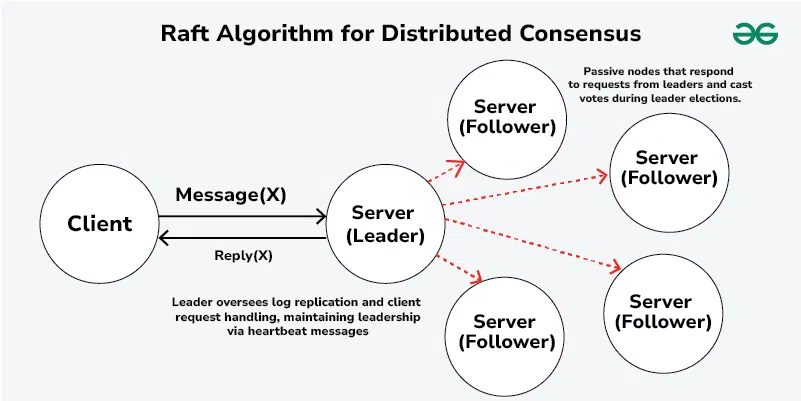
Raft Algorithm
- **Key Concepts:
- **Leader Election****:** Nodes elect a leader responsible for managing log replication and handling client requests.
- **Log Replication: Leader replicates its log entries to followers, ensuring consistency across the cluster.
- **Safety and Liveness: Raft guarantees safety (log entries are consistent) and liveness (a leader is elected and log entries are eventually committed) under normal operation.
- **Phases:
- **Leader Election: Nodes participate in leader election based on a term number and leader’s heartbeat.
- **Log Replication: Leader sends AppendEntries messages to followers to replicate log entries, ensuring consistency.
- **Use Cases:
- Raft is widely used in modern distributed systems such as key-value stores, consensus-based replicated databases, and systems requiring strong consistency guarantees.
3. Byzantine Fault Tolerance (BFT) Algorithm
Byzantine Fault Tolerance (BFT) algorithms are designed to address the challenges posed by Byzantine faults in distributed systems, where nodes may fail in arbitrary ways, including sending incorrect or conflicting information. These algorithms ensure that the system can continue to operate correctly and reach consensus even when some nodes behave maliciously or fail unexpectedly.
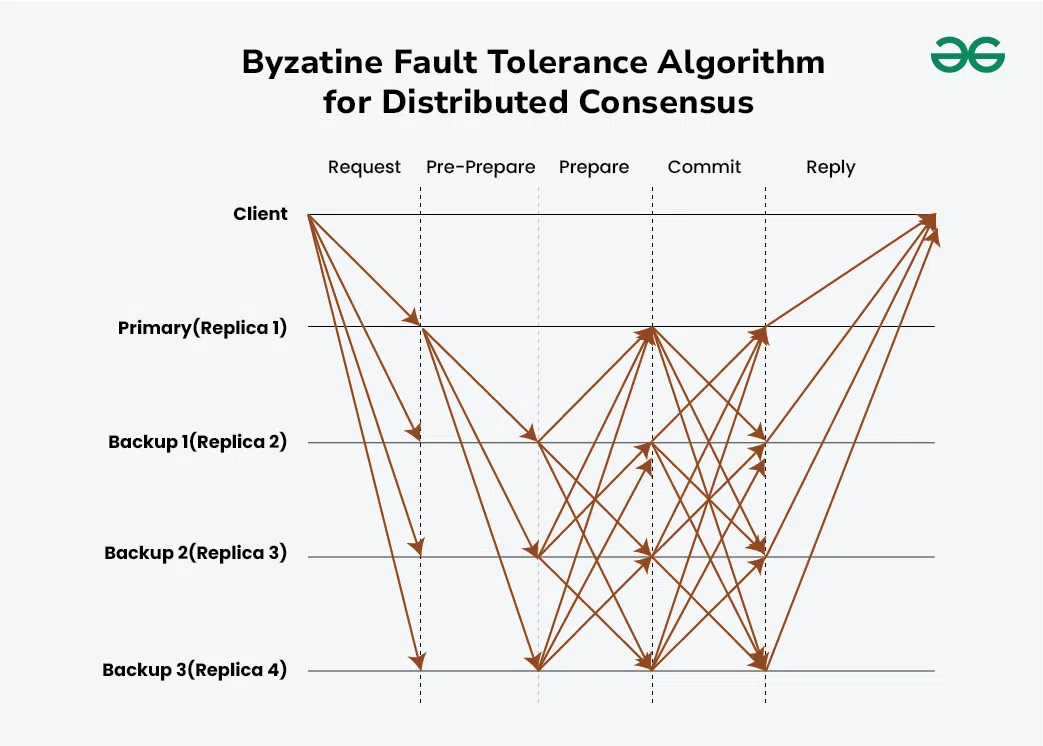
BFT Algorithm
- **Key Concepts:
- **Byzantine Faults: Nodes may behave arbitrarily, including sending conflicting messages or omitting messages.
- **Redundancy and Voting: BFT algorithms typically require a 2/3 or more agreement among nodes to determine the correct state or decision.
- **Examples:
- **Practical Byzantine Fault Tolerance (PBFT): Used in systems where safety and liveness are crucial, such as blockchain networks and distributed databases.
- **Simplified Byzantine Fault Tolerance (SBFT): Provides a simpler approach to achieving BFT with reduced complexity compared to PBFT.
- **Use Cases:
- BFT algorithms are essential in environments requiring high fault tolerance and security, where nodes may not be fully trusted or may exhibit malicious behavior.
A practical Byzantine Fault Tolerant system can function on the condition that the maximum number of malicious nodes must not be greater than or equal to one-third of all the nodes in the system. As the number of nodes increase, the system becomes more secure. pBFT consensus rounds are broken into 4 phases.
- The client sends a request to the primary(leader) node.
- The primary(leader) node broadcasts the request to the all the secondary(backup) nodes.
- The nodes(primary and secondaries) perform the service requested and then send back a reply to the client.
- The request is served successfully when the client receives ‘m+1’ replies from different nodes in the network with the same result, where m is the maximum number of faulty nodes allowed.
4. Challenges and Considerations:
- **Network Partitions and Delays: Algorithms must handle network partitions and communication delays, ensuring that nodes eventually reach consensus.
- **Scalability****:** As the number of nodes increases, achieving consensus becomes more challenging due to increased communication overhead.
- **Performance: Consensus algorithms should be efficient to minimize latency and maximize system throughput.
- **Understanding and Implementation: Many consensus algorithms, especially BFT variants, are complex and require careful implementation to ensure correctness and security.
In summary, distributed consensus algorithms are crucial for enabling cooperation and coordination among nodes in distributed systems. They ensure that all nodes agree on a consistent state or decision, providing reliability, fault tolerance, and consistency across decentralized networks in various applications from distributed databases to blockchain networks.
Each algorithm has its strengths and trade-offs, making them suitable for different use cases depending on the system's requirements for performance, fault tolerance, and security
Practical Applications of Distributed Consensus in Distributed Systems
Below are some practical applications of distributed consensus in distributed systems:
- **Blockchain Technology:
- **Use Case: Blockchain networks rely on distributed consensus to agree on the validity and order of transactions across a decentralized ledger.
- **Example: Bitcoin and Ethereum use consensus algorithms (like Proof of Work and Proof of Stake) to achieve decentralized agreement among nodes.
- **Distributed Databases:
- **Use Case: Consensus algorithms ensure that distributed databases maintain consistency across nodes, ensuring that updates and transactions are applied uniformly.
- **Example: Google Spanner uses a variant of Paxos to replicate data and ensure consistency across its globally distributed database.
- **Cloud Computing:
- **Use Case: Cloud providers use distributed consensus to manage resource allocation, load balancing, and fault tolerance across distributed data centers.
- **Example: Amazon DynamoDB uses quorum-based techniques for replication and consistency among its distributed database nodes.
Blockchain Distributed Consensus Mechanism
Blockchain uses a specific kind of distributed consensus to manage transactions and maintain a secure, decentralized record (ledger).Key mechanism include:
- **Proof of Work (PoW):
- **Concept: Computers (miners) solve difficult math puzzles to validate and add new blocks of transactions to the blockchain.
- **Consensus: The longest chain with the most computational effort is considered the valid chain, ensuring agreement on the transaction history.
- **Proof of Stake (PoS):
- **Concept: Validators are chosen based on the amount of cryptocurrency they hold and stake in the network.
- **Consensus: Validators are selected to propose and validate blocks of transactions based on their stake, promoting fairness and security.
- **Practical Byzantine Fault Tolerance (PBFT):
- **Concept: Nodes agree on the order of transactions through a voting process where two-thirds of the nodes must agree.
- **Consensus: Used in networks where participants are known and trusted, ensuring fast transaction confirmation and high throughput.
- **Delegated Proof of Stake (DPoS):
- **Concept: Token holders vote for delegates who are responsible for validating transactions and producing blocks.
- **Consensus: Delegates with the most votes perform block production, balancing decentralization with efficiency and governance.
Challenges and Considerations for Scalabilty, Fault Tolerance and Resilience
1. Scalability Issues:
Scalability refers to a system's ability to handle increasing amounts of work or users without compromising performance or efficiency.
- **Challenge: As the number of nodes (computers) in a distributed system grows, achieving consensus becomes more complex due to increased communication overhead and potential delays.
- **Considerations:
- **Sharding****:** Partitioning data into smaller subsets (shards) to distribute the workload and reduce the burden on individual nodes.
- **Optimized Protocols: Developing efficient communication protocols and algorithms to minimize message exchanges and latency.
- **Parallel Processing: Utilizing parallel processing techniques to handle multiple tasks simultaneously, improving overall throughput.
2. Fault Tolerance and Resilience:
Fault tolerance refers to a system's ability to continue operating in the presence of hardware or software failures, ensuring data integrity and availability.
- **Challenge: Nodes in a distributed system can fail unexpectedly or behave maliciously (Byzantine faults), disrupting consensus and potentially compromising the system's reliability.
- **Considerations:
- **Redundancy****:** Implementing redundant nodes or replicas to replicate data and tasks across multiple nodes, ensuring continuity even if some nodes fail.
- **Consensus Mechanisms: Using robust consensus algorithms (e.g., Practical Byzantine Fault Tolerance - PBFT) that can tolerate a certain percentage of faulty or malicious nodes.
- **Monitoring and Recovery: Implementing monitoring systems to detect failures promptly and automated recovery mechanisms to restore system integrity.