What Is Amazon EMR ? (original) (raw)
Last Updated : 23 Jul, 2025
Amazon Elastic MapReduce is an important cloud-based platform service that is designed for the effective scaling and processing of large-volume datasets. Its platform facilitates the users in quickly and easily setting up the cluster with Amazon EC2 Instances that are already pre-configured with big data frameworks. In this article, you will explore the easy setup and administration of EMR clusters in AWS.
Table of Content
- What Is Amazon EMR?
- How Does Amazon EMR Work?
- Amazon EMR Architecture
- How to Create a Cluster Using EMR? A Step-By-Step Guide
- Features of Amazon EMR
- Deployment Options of Amazon EMR
- Advantages Of Amazon EMR
- Disadvantages Of Amazon EMR
- Best Practices of Amazon EMR
- Use Cases Of Amazon EMR
What Is Amazon EMR?
Amazon EMR ( Elastic Map Reduce ) is an AWS-based platform service that processes large-volume datasets using shared computing frameworks such as Apache Hadoop and Apache Spark. It facilitates the users in quickly setting up, configuring, and scaling virtual server clusters for analyzing and processing vast amounts of data efficiently.
How Does Amazon EMR Work?
Amazon EMR functionalities simplify the complex processing of large datasets over the cloud. Users can create the clusters and can be utilized with elastic nature of Amazon EC2 instances. The natures of Amazon EC2 instances are configured with pre existing frameworks like Apache Hadoop and Apache Spark. By distributing the processing jobs across the several nodes these clusters effectively handle and guarantee the parallel executions with faster outcomes. It provides scalability by automatically adjusting the cluster size in accordance to workload needs. It optimizes the data storages on integrating with other AWS services making things easier. Users can find the things easily rather than going for complicated detailing of infrastructure and administration. It provides a simplified approach for big data analytics.

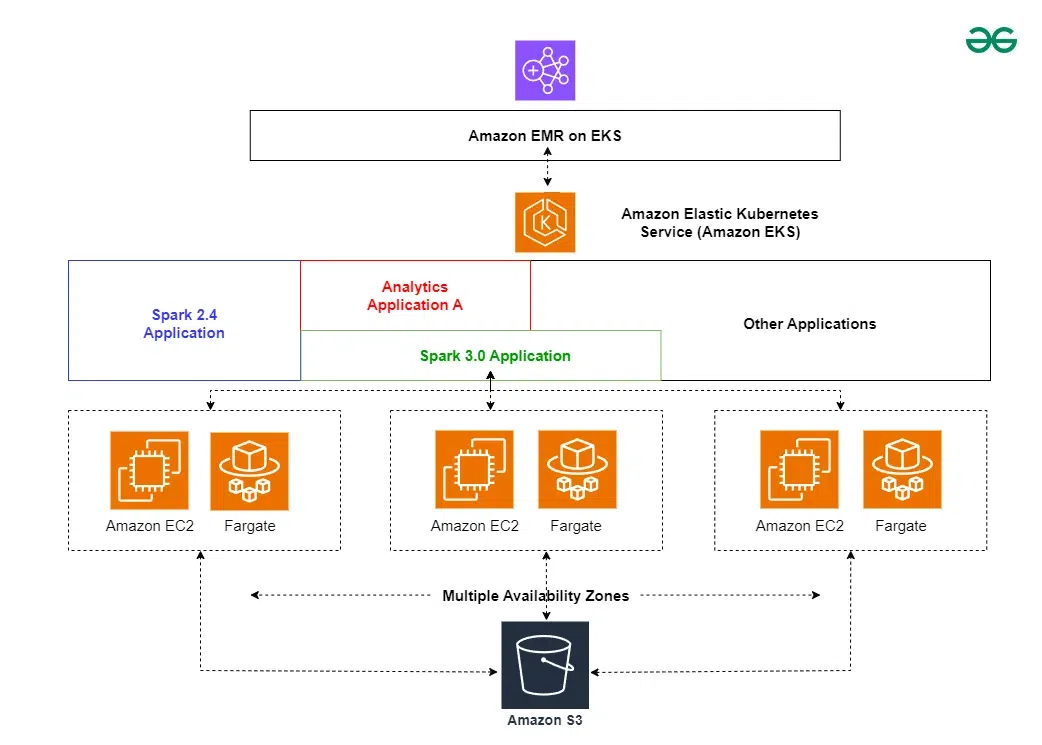
Amazon EMR Architecture
Amazon EMR (Elastic MapReduce) architecture is designed for efficient big data processing using a distributed computing framework.
- **Clusters: Consist of a master node (manages the cluster), core nodes (process data and store data in HDFS), and optional task nodes (handle additional processing).
- **Hadoop Ecosystem: Utilizes tools like Apache Spark, HBase, and Hive, pre-configured and optimized for big data analytics.
- **AWS Integration: Seamlessly integrates with AWS services like S3 (storage), IAM (security), CloudWatch (monitoring), and Amazon VPC (network isolation), enhancing functionality and security.
How to Create a Cluster Using EMR? A Step-By-Step Guide
**Step 1: First, login into your AWS account.
- Go to the AWS Management Console and select the EMR service.
- In a while, you will be redirected to the EMR console. Refer to the screenshot attached for a better understanding.
.png)
**Step 2: Click on the ****"Create Cluster"** button to create a new cluster. Following this, a complete form will be displayed.
- Add the configuration accordingly, and finally click ****"Create cluster"** again.
- Refer to the screenshot attached for a better understanding.
.png)
**Step 3: Post this process, and you will be redirected to a new screen as follows. Refer to the attached screenshot.
.png)
- Once the cluster is running, you can use the built-in web interfaces or connect to the cluster using SSH to run your data processing jobs.
Features of Amazon EMR
The following are the popular features of Amazon EMR:
- **Integration: It support integration with other AWS services that enhances the efficiency in data processing, making connections with Amazon S3 possible facilitating efficiency in workflow.
- **Salability: Amazon EMR providing scaling and handling of workloads dynamically. It support automatic adjustments in sizing of the cluster and optimizing the performance and minimizing costs.
- **Ease Of Use: Amazon EMR makes the deployments of big data easier by offering pre-configured environments for Apache Hadoop and Apache spark. Setuping and maintaining of clusters will be easier for users without requirement of complex setups on this Amazon ECR.
- **Cost Management: EMR facilitates with cost optimization through letting users to pay only for the resources during the processing of big data making analytics more affordable. Spot instances and Reserved Instances further minimizes the costs.
- **Security: EMR provides strong security features such as Data encryption, IAM roles and fine-grained access controls. It ensures data protection through the pipeline processing.
Deployment Options of Amazon EMR
Amazon EMR offers many different deployment options to fulfill the business needs and preferences. The following are a few development options:
- **On-Demand Instances: Without making any advanced commitments, users can easily create the EMR clusters utilizing on demand instances for they need and will pay for the resources on hourly basis. This will be as a flexible choice for shifting workloads well.
- **Reserved Instances: Reserved Instances are helpful for customers to commit for a specific instance for a duration of 1 or 3 years in a particular region. This option provides an appropriate steady workloads with predictable usage and less expensive than on-demand pricing.
- **Spot Instances: By using Amazon EC2 spot instances, users can create requests for EC2 capacity that are unused possibly saving a lot of money. Spot instances are best suited for workloads that are tolerant of faults and disrupts.
Advantages Of Amazon EMR
The following are the advantages of amazon EMR:
- **Scalability: EMR allows users to easily scale up or down the number of instances in a cluster to handle varying amounts of data processing and analysis tasks.
- **Cost Effectiveness: EMR allows users to pay for the resources they need, when they need them, making it a cost-effective solution for big data processing.
- **Integration With Other AWS Services: EMR can be easily integrated with other AWS services such as Amazon S3, Amazon DynamoDB, and Amazon Redshift for data storage and analysis.
- **Flexibility: EMR supports a wide range of open-source big data frameworks, including Hadoop, Spark, and Hive, giving users the flexibility to choose the tools that best fit their needs.
- **Easy To Use: EMR provides an easy-to-use web interface that allows users to launch and manage clusters, as well as monitor and troubleshoot performance issues.
**Disadvantages Of Amazon EMR
The following are the disadvantages of Amazon EMR:
- **Limited Customization: EMR is pre-configured with popular big data frameworks such as Hadoop and Spark, so users may have limited options for customizing their cluster.
- **Latency: The latency of data processing tasks may increase as the size of the data set increases.
- **Cost: EMR can be expensive for users with large amounts of data or high-performance requirements, as costs are based on the number of instances and the amount of storage used.
- **Limited Control Over The Infrastructure: EMR is a managed service, which means that users have limited control over the underlying infrastructure. This can be a disadvantage for users who need more control over their big data environments.
- **Limited Support For Certain Big Data Frameworks: EMR does not support some big data frameworks such as Flink, which may be a deal breaker for some organizations.
- **Limited Support For Certain Applications: EMR is not suitable for all types of applications, it mainly supports big data processes and analytics.
Best Practices of Amazon EMR
The following are the best practices of Amazon EMR:
- **Optimize Cluster Configuration: It helps in choosing the suitable instance types and using Spot Instances for cost savings, and enable auto-scaling.
- **Leverage S3 Storage: It helps in storing the data in Amazon S3 and uses EMRFS for data consistency, and enable consistent view.
- **Enhance Security: It helps in utilizing the IAM roles, encrypt data with AWS KMS, and configure security groups.
- **Monitor and Troubleshoot: It helps in enabling the CloudWatch logging, set up alarms, and regularly review logs for issues.
Use Cases Of Amazon EMR
The following are the use cases of Amazon EMR:
- **Big Data Processing: Amazon ECR is ideal for business Organizations where their is a dealing of distributed processing with large amounts of data. It is capable of managing large volumes of data conversions, data warehousing and analysis of logs efficiently.
- **Data Analysis: EMR is well known for performing complicated data analytics. It supports with big data frameworks like Apache spark. It facilitates the companies in making well informed decisions by letting them to extract insightful information from various types of datasets.
- **Genomic Analysis: EMR is used in bio informatics for analyzing genomic data. Large scaled genomic datasets are used for processing and analyzing to helps the researchers in enhancing the scalability and interoperabilities with genomic technologies in life sciences and healthcare.
- **Machine Learning: EMR supports integration with other AWS services such as Amazon SageMaker seamlessly. It facilitates the organizations to run distributed ML algorithms on large datasets. It usage is very beneficial for predictive analysis and model training.
Conclusion
In conclusion, Amazon EMR makes it easy to process large data sets using popular open-source frameworks such as Apache Hadoop, Apache Spark, and Apache Hive. With the step-by-step guide provided in this article, you can quickly and easily create an EMR cluster and start processing your data. Examples are provided to illustrate the potential uses of Amazon EMR in different industries.