Measures of Dispersion (original) (raw)
Last Updated : 3 Nov, 2025
Dispersion refers to the degree to which data values in a dataset are spread out or scattered around an average (such as the mean or median). It helps us understand the variability or consistency within the data — whether the values are closely grouped or widely spread.
In statistics, measures of dispersion are numerical values that describe the extent of variation among data points. They provide insight into how the data is distributed and help compare the reliability or uniformity of different datasets.
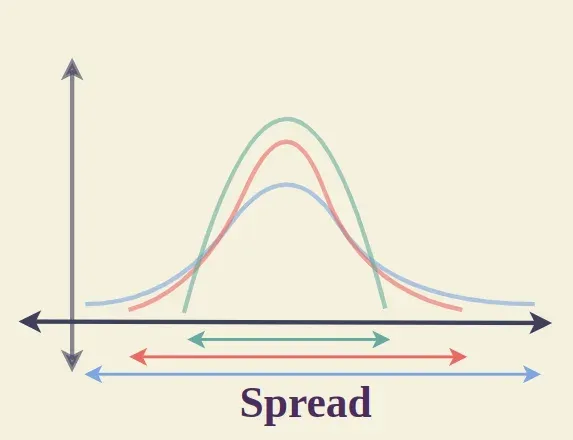
Different spreads show varying levels of data dispersion
The most common measures of dispersion include:
- **Range – the difference between the maximum and minimum values.
- **Variance – the average of the squared deviations from the mean.
- **Standard Deviation – the square root of the variance, showing dispersion in the same units as the data.
Types of Measures of Dispersion
Measures of dispersion can be classified into the following two types:
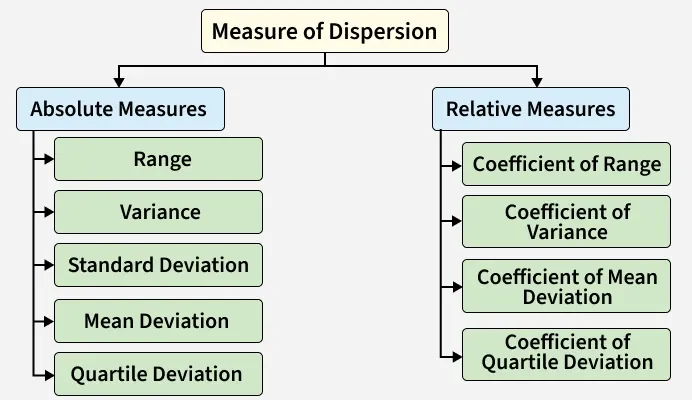
These measures of dispersion can be further divided into various categories. They have various parameters, and these parameters have the same unit.
**Absolute Measure of Dispersion
The measures of dispersion that are measured and expressed in the units of data themselves are called the Absolute Measure of Dispersion. **For example - Meters, Dollars, Kg, etc.
Some absolute measures of dispersion are:
- **Range: It is defined as the difference between the largest and the smallest value in the distribution. The measure of dispersion is used to variability of the data.
- **Mean deviation****:** It is the arithmetic mean of the differences between the values and their mean.
- **Standard Deviation: It is the square root of the arithmetic average of the squares of the deviations measured from the mean.
- **Variance: It is defined as the average of the square deviation from the mean of the given data set.
- **Quartile Deviation: It is defined as half of the difference between the third quartile and the first quartile in a given data set.
- **Interquartile Range****:** The difference between the upper(Q3) and lower(Q1) quartiles is called the Interquartile Range. Its formula is given as Q3 - Q1.
**Relative Measure of Dispersion
We use relative measures of dispersion to measure the two quantities that have different units to get a better idea of the scattering of the data.
Here are some of the relative measures of dispersion:
- **Coefficient of Range****:** It is defined as the ratio of the difference between the highest and lowest value in a data set to the sum of the highest and lowest value.
- **Coefficient of Variation****:** It is defined as the ratio of the standard deviation to the mean of the data set. We use percentages to express the coefficient of variation.
- **Coefficient of Mean Deviation****:** It is defined as the ratio of the mean deviation to the value of the central point of the data set.
- **Coefficient of Quartile Deviation****:** It is defined as the ratio of the difference between the third quartile and the first quartile to the sum of the third and first quartiles.
**Range of Data Set
The range is the difference between the largest and the smallest values in the distribution.
Thus, it can be written as
**R = L - S
where,
**L is the largest value in the Distribution
**S is the smallest value in the Distribution
- A higher value of range implies higher variation in the dataset.
- One drawback of this measure is that it only takes into account the maximum and the minimum value. They might not always be the proper indicator of how the values of the distribution are scattered.
**Example: Find the range of the data set 10, 20, 15, 0, 100.
**Solution:
- Smallest Value in the data = 0
- Largest Value in the data = 100
Thus, the range of the data set is,
R = 100 - 0
R = 100**Note: Range cannot be calculated for the open-ended frequency distributions. Open-ended frequency distributions are those distributions in which either the lower limit of the lowest class or the higher limit of the highest class is not defined.
**The range for Ungrouped Data
To find the range for the ungrouped data set, first, we have to find the smallest and the largest value of the data set by observing. The difference between them gives the range of ungrouped data.
**Example: Find out the range for the following observations: 20, 24, 31, 17, 45, 39, 51, 61.
**Solution:
- Largest Value = 61
- Smallest Value = 17
Thus, the range of the data set is
Range = 61 – 17 = 44
**The range for Grouped Data
The range of the grouped data set is found by studying the following example,
**Example: Find out the range for the following frequency distribution table for the marks scored by class 10 students.
| **Marks Intervals | **Number of Students |
|---|---|
| 0-10 | 5 |
| 10-20 | 8 |
| 20-30 | 15 |
| 30-40 | 9 |
**Solution:
- For Largest Value: Taking the higher limit of Highest Class = 40
- For Smallest Value: Taking the lower limit of Lowest Class = 0
Range = 40 – 0
Thus, the range of the given data set is,
Range = 40
Mean Deviation
Mean deviation measures the deviation of the observations from the mean of the distribution.
Since the average is the central value of the data, some deviations might be positive and some might be negative. If they are added like that, their sum will not reveal much as they tend to cancel each other's effect.
**For example, let us consider this set of data: -5, 10, 25
Mean = (-5 + 10 + 25)/3 = 10
Now, a deviation from the mean for different values is,
- (-5 -10) = -15
- (10 - 10) = 0
- (25 - 10) = 15
Now, adding the deviations shows that there is zero deviation from the mean, which is incorrect. Thus, to counter this problem, only the absolute values of the difference are taken while calculating the mean deviation.
**Mean Deviation Formula :
M.D. = \frac{\sum_{i=1}^{n} |x_i - \mu|}{n}
**Mean Deviation for Ungrouped Data
For calculating the mean deviation for ungrouped data, the following steps must be followed:
**Step 1: Calculate the arithmetic mean for all the values of the dataset.
**Step 2: Calculate the difference between each value of the dataset and the mean. Only absolute values of the differences will be considered. |d|
**Step 3: Calculate the arithmetic mean of these deviations using the formula, M.D =\frac{\sum|d|}{n}
This can be explained using the example.
**Example: Calculate the mean deviation for the given ungrouped data, 2, 4, 6, 8, 10
**Solution:
Mean(μ) = (2+4+6+8+10)/(5)
μ = 6
M. D = \frac{\sum|d|}{n}
⇒ M.D = \frac{|(2 - 6)| + |(4 - 6)| + |(6 - 6)| + |(8 - 6)| + |(10 - 6)|}{5}
⇒ M.D = (4+2+0+2+4)/(5)
⇒ M.D = 12/5 = 2.4
Measures of Dispersion Formula
Measures of Dispersion Formulas are used to tell us about the various parameters of the data. Various formulas related to the measures of dispersion are discussed in the table below.
| Absolute Measures of Dispersion | Related Formulas |
|---|---|
| Range | **H - Swhere H is the Largest Value and S is the Smallest Value |
| Variance | Population Variance, **σ 2 = Σ(x i *- μ) 2 /nSample Variance, S 2 = Σ(x i - x̄)* 2 **/(n-1)**where **μ isthemean and n is the number of observations |
| Standard Deviation | **S.D. = √(σ 2 ) |
| Mean Deviation | M.D. = ∑∣xi − x̄∣/nwhere, a is the central value(mean, median, mode)and **n is the number of observation |
| Quartile Deviation | ****(Q** 3 **- Q 1 )/2where,**Q 3 = Third Quartile and Q 1 = First Quartile |
Coefficient of Dispersion
Coefficients of dispersion are calculated when two series are compared, which have great differences in their average. We also use the coefficient of dispersion for comparing two series that have different measurements. It is denoted using the letters C.D.
| Relative Measures of Dispersion | Related Formulas |
|---|---|
| Coefficient of Range | (H - S)/(H + S) |
| Coefficient of Variation | C.V. = S/x̄ × 100 or C.V. = σ/μ × 100 |
| Coefficient of Mean Deviation | (Mean Deviation)/x̄where,μ is the central point for which the mean is calculated |
| Coefficient of Quartile Deviation | (Q3 - Q1)/(Q3 + Q1) |
Measures of Dispersion vs Central Tendency
Both Measures of Dispersion and Central Tendency are numbers that are used to describe various parameters of the data. Let's see the differences between Measures of Dispersion and Central Tendency.
| Central Tendency | Measure of Dispersion |
|---|---|
| Central Tendency is a term used for the numbers that quantify the properties of the data set. | The measure of Dispersion is used to quantify the variability of the data of dispersion. |
| The measure of Central tendency includes,MeanMedianMode | Various parameters included for the measure of dispersion are,RangeVarianceStandard DeviationMean DeviationQuartile Deviation |
Solved Exampleson Measures of Dispersion
Let's solve some questions on the Measures of Dispersion.
**Example 1: Find out the range for the following observations. {20, 42, 13, 71, 54, 93, 15, 16}?
**Solution:
Given,
- Largest Value of Observation = 93
- Smallest Value of Observation = 13
Thus, the range of the data set is,
Range = 93 - 13
Range = 80
**Example 2: Find out the range for the following frequency distribution table for the marks scored by class 10 students?
| **Marks Intervals | **Number of Students |
|---|---|
| 10-20 | 8 |
| 20-30 | 25 |
| 30-40 | 9 |
**Solution:
Given,
- Largest Value: Take the Higher Limit of the Highest Class = 40
- Smallest Value: Take the Lower Limit of the Lowest Class = 10
Range = 40 - 10
Range = 30
Thus, the range of the data set is 30.
**Example 3: Calculate the mean deviation for the given ungrouped data {-5, -4, 0, 4, 5}?
**Solution:
Mean(μ) = {(-5)+(-4)+(0)+(4)+(5)}/5
μ = 0/5 = 0
M. D = \frac{\sum|d|}{n}
⇒ M.D = \frac{|(-5 - 0)| + |(-4 - 0)| + |(0 - 0)| + |(4 - 0)| + |(5 - 0)|}{5}
⇒ M.D = (5+4+0+4+5)/5
⇒ M.D = 18/5
⇒ M.D = 3.6