Software Testing Techniques (original) (raw)
Last Updated : 1 Jun, 2026
Software testing techniques are methods used to evaluate an application against functional and non-functional requirements. Each technique focuses on identifying specific types of defects in the system. Using multiple techniques helps ensure better software quality and reliability.
- Different techniques target different types of defects (functional, structural, performance, etc.).
- No single technique can find all bugs; multiple methods are required.
- They help ensure the software meets business and technical requirements effectively.
Principles of Software Testing
Before diving into techniques, it helps to understand the guiding principles that apply across all of them:
- Tests should always be traceable to customer requirements.
- Exhaustive testing is not possible; the right amount of testing is determined by risk assessment.
- Testing should be planned before it is executed.
- Testing should begin with small, isolated components and progressively extend to larger, integrated ones.
- The Pareto principle applies: roughly 80% of defects tend to originate in 20% of the codebase.
- Testing shows the presence of defects, never their complete absence — the goal is to find the most critical bugs with the most efficient set of tests.
- For objectivity, testing is best performed by a party independent from the developers who wrote the code.
Categories of Testing Techniques
All software testing techniques fall into one of two broad categories: static and dynamic.
**Static Testing Techniques
find defects without executing the code. They are applied early in the development lifecycle — during requirements, design, and code review — which makes them among the most cost-effective defect-detection methods available.
Static Testing Techniques are divided into two major categories:
1. Reviews
Reviews examine artifacts — requirements documents, design specifications, test cases, or source code — before they are executed or released.
- **Peer reviews: are informal, conducted between two developers or testers who examine each other's work without a formal process or facilitator.
- **Walkthroughs: are led by the author of the artifact, who presents the work and the reasoning behind it to stakeholders. The primary goal is shared understanding and early feedback.
- **Technical reviews: focus on technical correctness and consensus among experts such as architects or lead designers. They range from informal to semi-formal depending on the organisation.
- **Inspections: are the most rigorous form of review. The document is prepared in advance, defects found during the meeting are logged in a tracking tool, and resolution is followed up formally. Discussions on defects are deferred to separate sessions, keeping the inspection meeting efficient.
2. Static Analysis
Static analysis examines code, design, or requirements for defects without running the program. Compilers perform a basic form of static analysis when they flag syntax errors. More advanced tools examine:
- **Data Flow: How data is accessed and modified throughout the program, revealing issues such as variables that are defined but never used.
- **Control flow: The order in which instructions execute, including conditions and loops, revealing issues such as dead code that can never be reached.
- **Data Structure: The organisation and complexity of data, which informs how thoroughly control flow and data flow need to be tested.
**Dynamic Testing Techniques
find defects by executing the code with real or simulated inputs. They verify actual system behaviour and are subdivided into three families: structure-based, specification-based, and experience-based.
Dynamic techniques are subdivided into three categories:
1. Structure-Based (White-Box) Techniques
Structure-based testing examines and exercises the internal logic of the code. It is most commonly applied during component and integration testing. Progress is measured using code coverage — the proportion of the codebase exercised by a given set of tests.
- Statement coverage measures the percentage of individual lines of code executed. If a function has 10 lines and tests exercise 5, statement coverage is 50%.
- Decision (branch) coverage measures the percentage of decision outcomes exercised. If a function contains 4 conditional branches and tests exercise only 1, decision coverage is 25%. Decision coverage is generally considered more meaningful than statement coverage.
- Condition/multiple condition coverage goes further, verifying that every individual logical condition within each decision has been evaluated to both true and false.
**Note: Code coverage metrics do not reveal requirements that were never implemented — they only measure coverage of code that exists.
2. Specification-Based (Black-Box) Techniques
Specification-based testing derives tests from functional or non-functional specifications, without reference to the internal code. The tester works only from required inputs and expected outputs.
- **Equivalence Partitioning: Divides input data into valid and invalid groups where values behave similarly. One representative value from each group is tested.
_Example: For values 1–999, testing one valid value is enough for that partition. - **Boundary Value Analysis (BVA): Tests values at the edges of input ranges where defects are most common.
_Example: For range 1–999, test 0, 1, 999, and 1000. - **Decision Table Testing: Uses tables to test combinations of conditions and outcomes, useful for business rules.
_Example: Loan approval depends on both salary and credit score. - **Use Case-Based Testing: Creates tests from real user interactions and workflows to verify complete system behavior and integration.
- **State Transition Testing: State Transition Testing is used when a system behaves as a finite state machine, meaning it can exist in different states and move from one state to another based on specific events or inputs. This technique verifies both valid and invalid transitions between states..
**Example: An ATM system moves through states such as Idle → Card Inserted → PIN Entered → Transaction Complete. Tests can verify both valid transitions and invalid actions, such as entering an incorrect PIN.
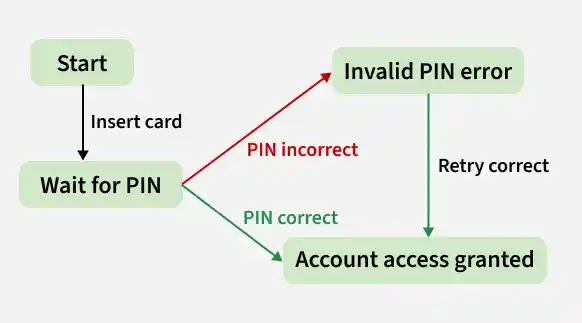
State Transition Testing
3. Experience-Based Techniques
Experience-based techniques rely on the tester's knowledge of the application, its domain, and common failure patterns. They work best as a complement to structured techniques, not as a replacement.
- **Error Guessing: Testers predict likely defect areas based on experience and common error patterns.
- **Exploratory Testing: Test design, learning, and execution occur simultaneously without predefined test cases. It is widely used in agile development environments.
Functional and Non-Functional Testing Techniques
Functional Testing
Functional testing verifies whether the software functions according to specified requirements.
- **Unit testing: Tests individual units or components of the software to ensure they are functioning as intended.
- **Integration testing: Tests the integration of different components of the software to ensure they work together as a system.
- **System testing: Tests the complete software system to ensure it meets the specified requirements.
- **Acceptance testing: Tests the software to ensure it meets the customer's or end-user's expectations.
- **Regression testing: Tests the software after changes or modifications have been made to ensure the changes have not introduced new defects.
Non-Functional Testing
Non-functional testing evaluates qualities beyond functionality, such as performance, security, usability, and accessibility.
- **Performance and Load Testing: Verifies system speed, stability, and response time under expected user load. Common tools include Apache JMeter, k6, and Locust.
- **Stress Testing: Tests the system beyond normal capacity to identify breaking points and failure behaviour.
- **Soak (Endurance) Testing: Runs the system under continuous load for a long duration to detect memory leaks and performance degradation.
- **Security and Penetration Testing: Identifies vulnerabilities such as SQL injection, cross-site scripting, and authentication flaws by simulating attacks.
- **Usability Testing: Observes real users performing tasks to identify confusion, errors, and user experience issues.
- **Accessibility Testing: Ensures the application follows standards like World Wide Web Consortium WCAG so users with disabilities can effectively use the system.
Manual, Automated, and Hybrid Testing Approaches
These testing approaches define how testing is performed, whether manually by testers, automatically using tools, or through a combination of both methods.
- **Manual Testing****:** Testing is performed manually by testers without using automation tools. Testers execute test cases step by step to verify software behavior.
- **Automated Testing****:** Testing is performed using automation tools and scripts to execute test cases quickly, accurately, and repeatedly.
- **Hybrid Testing: Combines both manual and automated testing approaches to achieve better test coverage, flexibility, and efficiency.
Black-Box, White-Box, and Grey-Box Testing
These testing types are classified based on the tester’s knowledge of the internal code and system structure.
- **Black-Box Testing****:** Testing is performed without knowledge of the internal code structure, focusing only on inputs and expected outputs.
- **White-Box Testing****:** Testing is performed by examining the internal code, logic, and structure of the software.
- **Grey-Box Testing****:** Testing combines both black-box and white-box approaches, where the tester has partial knowledge of the internal system.
Choosing the Right Technique
No single technique covers all defect types. The table below maps common situations to the most appropriate approaches.
| Situation | Recommended Technique(s) |
|---|---|
| New feature with well-defined input ranges | Equivalence Partitioning + Boundary Value Analysis |
| Complex business rules with multiple conditions | Decision Table Testing |
| Workflow or session-based interactions | State Transition Testing or Use Case-Based Testing |
| Code coverage gaps identified by a coverage tool | Statement Coverage or Decision Coverage (White-Box Testing) |
| High-traffic or consumer-facing application | Load Testing and Stress Testing |
| End-of-sprint validation in an agile team | Exploratory Testing |
| Post-release defect cluster in a known area | Error Guessing + Regression Testing |
| Financial, healthcare, or regulated software | Penetration Testing + Accessibility Testing |
| Refactoring an existing codebase | Regression Testing |
Application of Software Testing Techniques
- Software testing techniques improve software quality and reliability by identifying defects early.
- They enhance user experience by detecting usability issues and improving interaction.
- They build confidence by ensuring the software meets requirements and works correctly.
- They support maintenance and reduce costs by fixing defects early.
- They help manage complex systems and enable efficient testing, including automation.