AWS Fargate: Definition, Features, Pricing (original) (raw)
Last Updated : 6 Aug, 2025
AWS Fargate is a serverless compute engine that lets you **run containers without the need to manage servers. It is part of **Amazon Web Services (AWS), designed to simplify containerized application deployment and eliminate the need for manual infrastructure management. With AWS Fargate, you can focus on your application code while AWS takes care of **provisioning, managing, and scaling the underlying infrastructure automatically.
In this article, we will explore what AWS Fargate is, **how it works, its key features, and its benefits, along with some potential drawbacks. We will also compare it with other AWS services like **EC2, ECS, and Lambda to give you a clear understanding of how Fargate fits into the AWS ecosystem.
Table of Content
- What is AWS Fargate?
- What is Serverless and Why is it Game-Changing?
- How AWS Fargate Works?
- AWS Fargate Features
- Components of AWS Fargate
- How AWS Fargate Works?
- AWS Fargate Use Cases
- Benefits of AWS Fargate
- AWS Fargate Drawbacks
- AWS Fargate Pricing
- AWS Fargate vs AWS EC2 Instance
- AWS Fargate vs AWS Lambda
What is AWS Fargate?
AWS Fargate is a fully managed AWS service that enables you to run containerized applications on AWS without having to manage the underlying servers or clusters. Whether you are using AWS Elastic Container Service (ECS) or Elastic Kubernetes Service (EKS), Fargate abstracts away the infrastructure management and lets you focus on developing and deploying your applications.
With Fargate, you only **pay for the resources your containers use (CPU and memory), and AWS automatically provisions the appropriate infrastructure for you. This makes AWS Fargate a cost-effective and efficient solution for developers and businesses looking to simplify container management.
What is Serverless and Why is it Game-Changing?
Serverless computing is a cloud computing model that allows developers to run code or applications without provisioning or managing the underlying servers. Serverless computing abstracts away the infrastructure so developers can focus on **writing code and building applications, instead of worrying about managing servers.
AWS Fargate represents the serverless concept for containers. Unlike traditional container services where you must manage EC2 instances and clusters, Fargate automatically allocates the compute resources required for your containers to run. It allows you to define your application’s resource needs (e.g., CPU, memory), and then it handles the rest.
The game-changing aspect of **AWS Fargate is that it completely removes the need for managing infrastructure. Developers can now focus on building scalable applications without the complexity of server management, which significantly reduces both operational overhead and costs.
AWS Fargate Features
AWS Fargate comes with several powerful features that make it a top choice for containerized application management:
- **Serverless Container Management: No need to manage servers. AWS Fargate takes care of provisioning and scaling the infrastructure automatically.
- **Pay-as-You-Go Pricing: You only pay for the compute and memory resources used by your containers. This allows for more cost-efficient operations.
- **Seamless Integration with ECS and EKS: Fargate works seamlessly with Amazon ECS and EKS, allowing you to use familiar AWS services for container orchestration.
- **Automatic Scaling: Fargate automatically adjusts your resources based on your application’s needs, scaling up or down depending on traffic or demand.
- **Security and Compliance: AWS Fargate integrates with AWS security services like IAM and VPC to ensure your applications are secure, and your data is protected.
Components of AWS Fargate
- **Clusters: Clusters are logical groups where tasks and services in Fargate are organized.
- **Task Definitions: Task definitions are configuration files where users define containers and their settings for the application. They act as blueprints for the Fargate application, specifying various parameters for the containers.
- **Tasks: A task is the running instance of a task definition. Users can create multiple tasks from the same task definition in a cluster, either running a single task or multiple tasks at the same time.
- **Services: Services in Fargate manage and run tasks. They can run multiple tasks simultaneously and replace tasks if they fail or stop, according to the task definition
How AWS Fargate Works?
AWS Fargate is a serverless compute engine that allows you to run containerized applications without worrying about the underlying infrastructure. With Fargate, you only need to configure your application’s requirements (like CPU, memory, and storage), and Fargate handles the provisioning of the infrastructure.
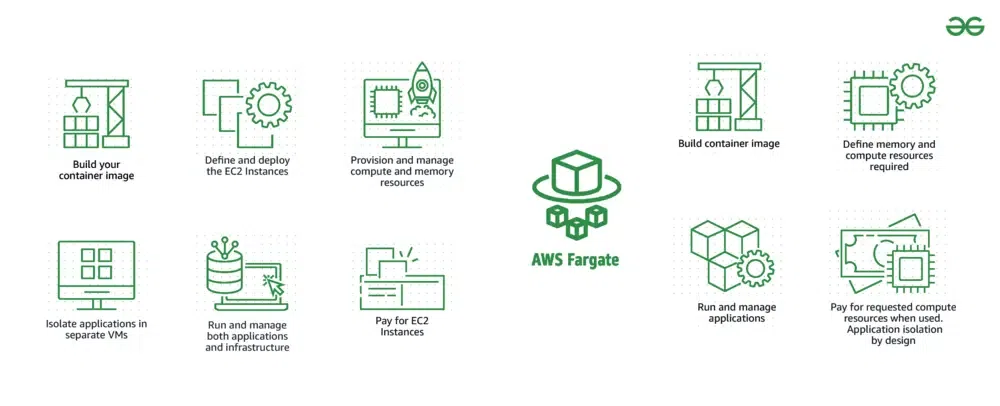
To use Fargate, you first package your application’s dependencies into a Docker image. After configuring the necessary settings, Fargate takes care of deploying the application on virtual machines, and you only pay for the resources your application uses.
AWS Fargate Use Cases
- **Large Workloads with Minimal Effort: Fargate is ideal for managing large workloads with minimal manual intervention, handling infrastructure, scaling, and monitoring automatically.
- **Microservice Applications: It’s perfect for deploying microservices, APIs, and web applications, as well as containerized AI and ML models, allowing for seamless scaling and deployment.
- **Small Workloads with Occasional Spikes: Fargate saves costs by efficiently scaling resources for applications that experience small workloads and occasional bursts in memory or CPU.
- **Batch Jobs: Best for workloads that require batch processing, Fargate automates the starting and stopping of containers for batch tasks, eliminating the need for manual management.
Benefits of AWS Fargate
Here are some of the key benefits of using AWS Fargate for running containerized applications:
1. **Cost Efficiency
Fargate’s pay-as-you-go model means you only pay for the resources consumed by your containers. This reduces overhead costs, especially for applications with fluctuating workloads, as you don't have to maintain idle servers.
2. **No Infrastructure Management
Fargate eliminates the need to manage EC2 instances and clusters. You don’t need to worry about provisioning, scaling, or patching the infrastructure. AWS handles it all, saving time and effort for developers.
3. **Seamless Scaling
With Fargate, scaling is automatic. AWS adjusts the infrastructure to accommodate the needs of your containerized applications, ensuring they can handle traffic spikes or dips without any manual intervention.
4. **Simplified Operations
AWS Fargate is integrated with ECS and EKS, making it easy for developers to deploy, manage, and monitor containerized applications. The service allows you to focus on coding and application performance rather than worrying about the underlying infrastructure.
5. **Enhanced Security
Fargate integrates with AWS Identity and Access Management (IAM) for fine-grained access control and with Amazon VPC to ensure your containers are running in a secure, isolated network.
AWS Fargate Drawbacks
While AWS Fargate offers many benefits, there are a few limitations that you should consider:
1. **Cost for Long-Running Tasks
For long-running tasks, AWS Fargate can be more expensive compared to using traditional EC2 instances. If your workload is constantly running, EC2 might be a more cost-effective option.
2. **Less Control Over Infrastructure
Fargate abstracts away much of the infrastructure management, which may not be ideal for users who need fine-grained control over the server settings, configurations, or performance.
3. **Limited Availability in Some Regions
AWS Fargate might not be available in all AWS regions. You will need to check if it’s available in the region where you plan to deploy your application.
AWS Fargate Pricing
The AWS Fargate Pricing is dependent on the resource that your application is going to use while it was running.
- The pricing is purely based on the resources consumption per second like no.of CPUs, Memory, Storage, and also a region that you are going to use the AWS Fargate.
- If you are going to deploy your application in the Asia Pacific (Mumbai) the prices will be as follows.
- **vCPU per hour: $0.04256.
- **Memory per GB per hour: $0.004655.
Additionally, **AWS Fargate Spot offers up to 70% lower prices for running containers with unused capacity, making it an attractive option for cost-conscious users.
AWS Fargate vs AWS EC2 Instance
| AWS Fargate | AWS EC2 Instance |
|---|---|
| AWS Fargate is an serverless compute engine for the an applications which need to be run in the containerization form without worrying about the underlying infrastructure. | AWS EC2 instance is most preferable for the virtualization application but manual provisions of the underlying infrastructure is required. |
| Containers will be isolated from each other where no data breach will be happen. | You have complete control so the isolation is also depends in you hands more careful configuration is required. |
| AWS Fargate scales automatically the applications by depending on the incoming traffic. | AWS EC2 will not be scaled automatically it should be integrated with other AWS service for autoscaling of the instances. |
| AWS Fargate is for short-running tasks. | EC2 consists of long-running containers. |
AWS Fargate vs Lambda
Although both **AWS Fargate and **AWS Lambda are serverless services, they differ greatly in several key aspects.
| **Feature | **AWS Fargate | **AWS Lambda |
|---|---|---|
| **Use Case | Ideal for running containerized applications and managing stateful workloads. | Ideal for running short, stateless functions triggered by events. |
| **Type | Container-as-a-Service (CaaS) | Function-as-a-Service (FaaS) |
| **How They Run | Runs containers on EC2 instances managed by AWS. | Runs individual code functions without server management. |
| **Event Triggers | No built-in event trigger. Runs continuously based on container configuration. | Event-driven; responds to triggers like S3 object uploads. |
| **Best For | Stateful applications, microservices, batch jobs, large workloads. | Short, event-driven applications (e.g., API backend, real-time processing). |
| **Pricing Model | Pay-as-you-go model based on resources consumed (CPU, memory). | Pay-as-you-go model based on execution time (time and memory used). |
| **Scaling | Automatically scales containers based on demand. | Automatically scales based on the frequency of the events. |
| **Resource Management | Manages resources like CPU and memory based on container configuration. | Managed automatically for short-term code execution. |
AWS Fargate vs ECS
| **AWS Fargate | Amazon ECS |
|---|---|
| AWS Fargate used to run the application in the form of containers. | AWS ECS used to run the application in the form of containers. |
| No server management is required. | You should take care of managing and configuring the EC2 instance. |
| It can be done manually or can be integrate with other services for scaling the servers. | Automatic scaling based o the incoming traffic. |
AWS ECS and AWS Fargate are both two services which are offered by AWS(Amazon Web Services) to run applications in the form of containers. When you started using the AWS Fargate with the AWS ECS you are no longer responsible for the servers to provision and scale the application and underlying the infrastructure it all be taken care of by the AWS.
Before launching the application, specify all the prerequisites that it needs, such as CPU and memory requirements, networking requirements, and IAM( Identity and Access Management) policies, in the form of a package. By setting the requiresCompatibilities task definition parameter to FARGATE, you can configure your task definitions for Fargate. Go to Launch Types for additional details. AWS Fargate will pick the suitable instance for the application deployment and also there are several EC2-Instance types.
Conclusion
Fargate is a really powerful and helpful service provided by AWS for container services. It helps users to save a lot of time, effort, and cost while using Container services. If a user is new to AWS and the concept of containers in AWS, then this is the go-to tool as it helps in focusing on just building the application rather than managing it.